CUI Marking and Handling in AI-Generated Documents
AI summaries of controlled material stay CUI until reviewed.
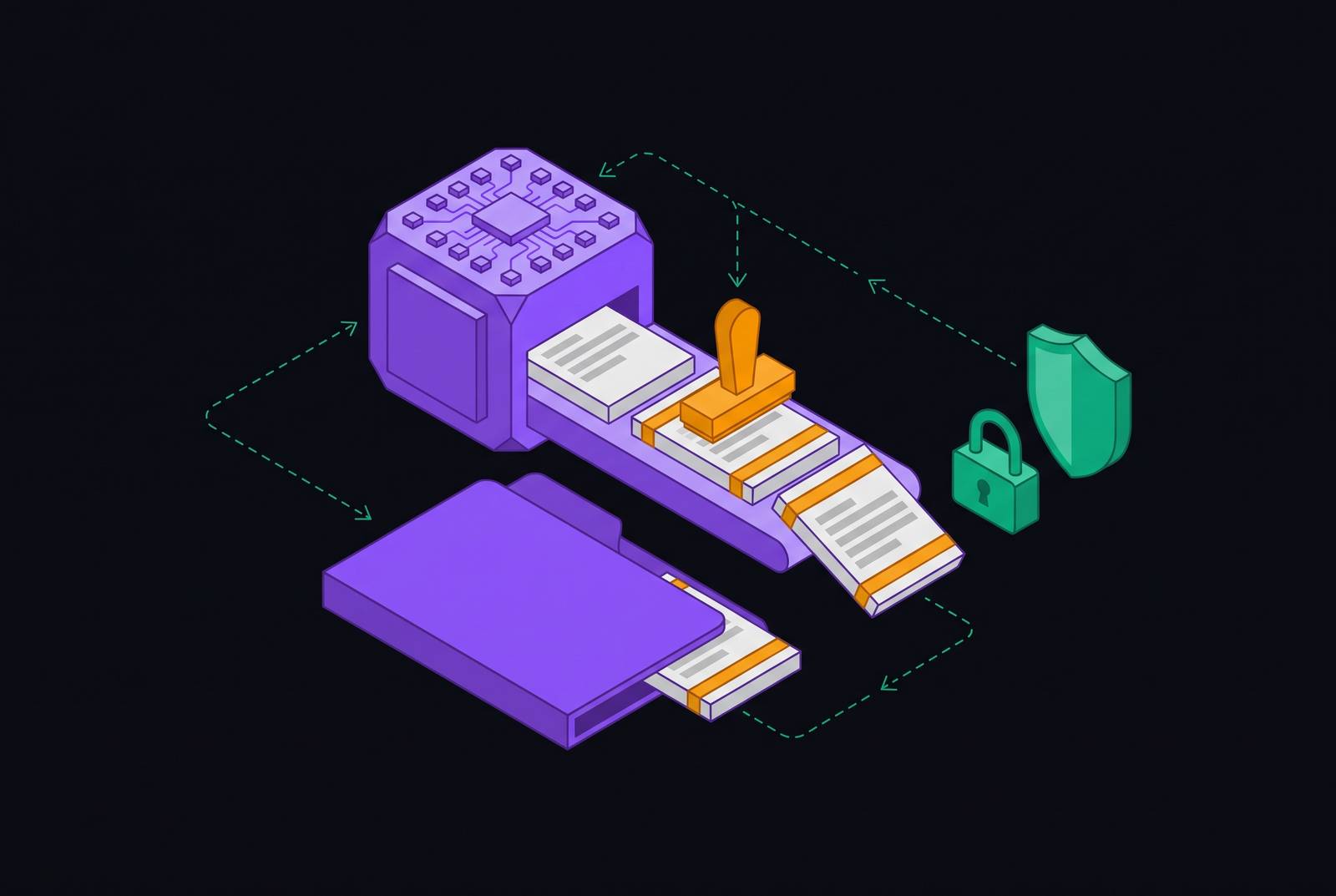
AI-generated documents do not lose their CUI obligations because an assistant leaves off the markings. When AI turns controlled source material into a summary, table, or analysis, the information can still be controlled even if it looks like everyday working notes. Organizations must treat that output as CUI until qualified review determines otherwise, and build the controls that make that rule work.
How CUI marking normally works and why AI disrupts the chain
Controlled information usually comes with instructions people can see, but AI-generated output can come without any. Technical data packages have banners, controlled documents are kept in protected repositories, and files come with handling instructions. Those signals tell people what they are holding. A marked document prompts a marked response, and a labeled folder prompts protected handling. The chain depends on people recognizing the information’s status at each step.
AI disrupts that chain at the output stage. An engineer can put a marked technical specification into an approved AI assistant and ask for a plain-language summary. The result may have no banner, no portion marking, and no cover sheet. It looks like personal notes rather than controlled technical material, even though its substance comes from the protected source.
Approving the assistant does not by itself decide how the document it creates must be marked, stored, or shared. Shorter and more readable does not mean less controlled.
What derived CUI actually looks like in practice
A summary is the most straightforward example of this gap. A forty-page statement of work becomes one readable page, with the sensitive information still present. Cutting out the explanation around that information can even pack it more tightly together. The summary is easier to read and circulate. How polished it looks says nothing about whether the information in it still needs protection.
An extraction creates a different kind of portability. Deliverable dates, milestones, and part numbers put into a table can look like everyday planning data. Yet the table may hold the very controlled details someone wants from the original document. How the information must be handled depends on what remains in it, whether it is in rows or paragraphs.
In an analysis, the assistant explains what controlled material means instead of shortening the source or picking out fields. That explanation can still hold information that needs protection, even when it looks unlike the source document. A new presentation is not a release decision. Across all three forms, the absence of a CUI marking does not remove the obligation to protect controlled contents.
Where the regulatory framework currently stands — and where it has not yet arrived
NARA AC 11.2026, issued August 21, 2026, uses a technology-neutral rule to apply the Federal Records Act to how AI is used. Whether an output becomes a federal record depends on its creation, maintenance, and use. AI use alone does not make something a record. Material is likely a record when it supports official business, informs decisions, circulates, enters agency systems, or is needed to meet legal obligations.
That records framework addresses one part of the problem, while CUI guidance addresses another. ISOO Notice 2026-07, issued September 2, 2026, gives Executive Agent Guidance for Implementation of the Controlled Unclassified Information Program. Notice 2026-08, issued the same day, revises requirements for CUI Program waivers. Both arrived after the pressure from the technology became visible. They sit within a framework that is developing around AI uses organizations are already putting into practice.
The remaining gap is narrower than an absence of rules. There is still no detailed DoD rulebook that tells contractors exactly how to mark and handle every AI-generated derivative. NARA’s guidance addresses federal records. These authorities therefore cannot be treated as interchangeable answers. The missing detail concerns how to apply existing protection obligations to new outputs.
Why CMMC assessment boundaries now include AI tools, and what that costs organizations that miss it
Any AI tool that processes, stores, or transmits CUI or Security Protection Data falls inside the assessment boundary, whether or not the organization has listed it in its System Security Plan. Omission does not put the tool outside the boundary. An SSP that documents human access but leaves out AI doing the same work gives an incomplete account of how controlled information is handled.
CMMC program rule 32 CFR 170.19 requires external service providers to be documented in the SSP. A cloud AI service that stores, processes, or transmits CUI is therefore within the contractor’s assessment scope. An undocumented tool can leave requirements marked NOT MET in a self-assessment. The legal risk follows from the reporting. An inaccurate SPRS score or affirmation creates False Claims Act exposure, though a scoping gap does not by itself establish that a contractor committed fraud.
Shadow AI is the highest-risk route into this problem. Proposal drafting is the most common vector, with incumbency data, past performance narratives, and technical approaches pasted into consumer LLM interfaces without review of processing or storage. CMMC Phase II C3PAO audits are suspended as of July 13, 2026. NIST 800-171 and DFARS obligations remain fully in force for AI tools touching CUI, regardless of the suspension of third-party audits.
What organizations must actually do when AI generates a document from CUI source material
The operational response starts with a default decision. Organizations should treat AI-generated output made from CUI as CUI until a qualified human reviews it and decides otherwise. This default keeps an unmarked output subject to protection until someone has assessed its contents.
That default needs a review step built into the workflow. The engineer who requests a summary should not decide unilaterally that the result is clean merely because it reads like ordinary notes. Review cannot depend on individual discretion alone. Someone must make the handling decision before the output moves into an email, a Teams chat, a Word document, or a slide deck.
To make that workflow cover the actual work, organizations must inventory AI tools that touch CUI and document them in the SSP. Proposal drafting tools, research assistants, and capture pipeline platforms built into commercial CRMs qualify when they ingest CUI.
NARA’s framework means outputs used in official business, relied on for decisions, or circulated within or across agencies are likely federal records and must be managed accordingly. That question runs in parallel with the CUI determination. Building both decisions into the workflow prepares contractors for further formal requirements through DFARS and CMMC without waiting for a derivative-specific rulebook.
How AI governance infrastructure closes the gap that marking policy alone cannot
Organizations cannot document AI systems they cannot see, restrict access they cannot trace, or review outputs for which they have no record. The SSP scoping gap is therefore also a visibility gap. As AI operates across an enterprise at greater speed and volume, a process that relies entirely on people noticing each use becomes unreliable.
Real-time observability connects the policy to the work. Visibility into what an AI agent accessed and what it generated gives the organization a basis for enforcing the rule that outputs remain controlled until reviewed. A log read after an incident serves a different purpose. It may explain what happened, but a postmortem is not a control over the handling decision that should have come first.
Access controls address the other side of enforcement. Once an organization decides which AI tools may touch which categories of CUI, role-based controls for AI agents must enforce that decision at the access layer. Training alone cannot provide that restriction. Governance infrastructure with a gateway, access controls, and observability over MCP servers and AI agents can put those decisions into practice where AI touches enterprise data.
An approved route also reduces the appeal of shadow AI. Employees with a governed way to draft proposals are less likely to paste controlled material into consumer platforms than employees offered restrictions alone. That is the practical role of governance tooling.
How the EU AI Act's marking requirements interact with CUI obligations for organizations operating across jurisdictions
The EU AI Act adds a parallel marking obligation. Article 50’s transparency requirements took full effect August 2, 2026, and include machine-readable marking for AI-generated content. Those marks address whether content can be recognized as AI-generated. They do not establish its contents’ controlled status or authorized recipients.
The European Commission’s final Code of Practice, published June 10, 2026, sets out practical steps for providers and deployers to meet the transparency obligations. The Code is voluntary and supplements the Act. Its approach calls for providers to mark audio, image, video, and text outputs with at least two machine-readable techniques, such as digitally signed tamper-evident metadata and imperceptible watermarking. It also calls for prohibiting users from stripping metadata. Very short text outputs fall below the threshold that triggers the watermarking requirement.
For organizations operating across jurisdictions, these requirements create two distinct handling questions. An output may need detectable evidence of AI origin while also requiring restrictions on access, storage, and transmission because it contains CUI. Neither marking answers the other question. A machine-readable AI-origin mark does not establish that a document has received a CUI handling determination, and a CUI banner does not establish compliance with AI transparency requirements.
The distinction also applies to short outputs. Text below a watermarking threshold can still contain controlled information, with both frameworks applying to the same document for distinct purposes. Compliance with either one leaves the other obligation to be addressed.
Why getting ahead of derivative CUI marking is a strategic decision, not just a compliance one
A contractor that can document its tools, enforce access decisions, and resolve output handling has a basis for approving AI-assisted work that an unprepared contractor lacks. Controlled environments need a way to use AI without making every generated document an unresolved handling question.
The SSP scoping gap, False Claims Act exposure, and ISOO guidance already create pressure to act before Section 1513’s DFARS implementation arrives. Waiting does not keep AI out of the organization. Where employees lack an approved path, shadow adoption can create the marking gap, assessment gap, and legal exposure together, without the benefits of a sanctioned deployment.
Machine-readable marking infrastructure addresses AI-origin transparency, while CUI governance addresses the protection of the information itself. Organizations working across jurisdictions need both layers. Treating governance as infrastructure rather than an audit response positions them to adopt agentic AI at production scale in controlled environments.
Guidance will continue to develop, but the underlying obligation is already present. The strategic opportunity is to make that obligation compatible with useful AI work now, rather than let missing markings dictate where adoption stops.