Controlled Unclassified InformationLong read
CMMC Level 2 Requirements for Organizations Deploying AI Agents
AI agents touching CUI fall under CMMC scope today.
· 18 min read
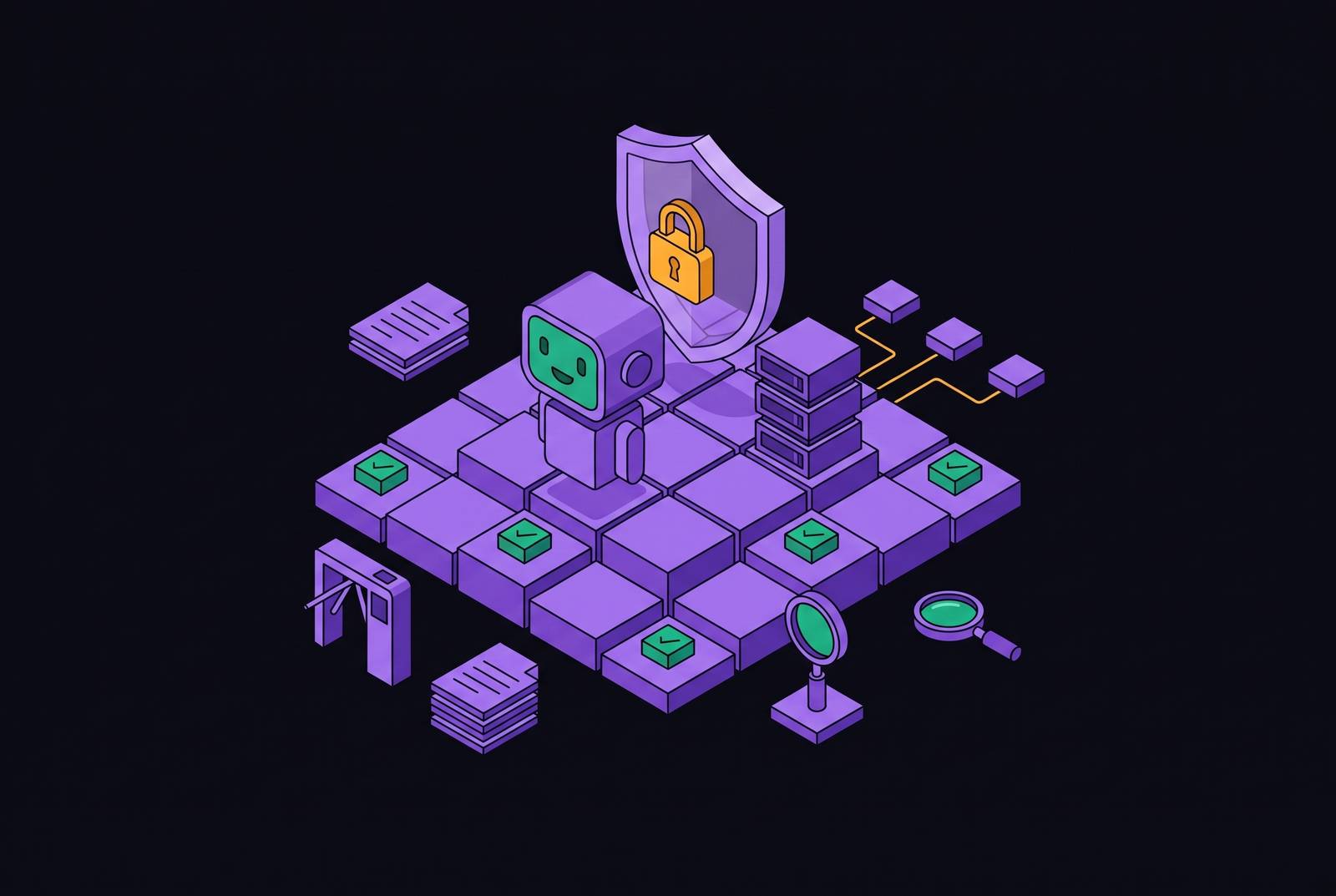
Why CMMC Level 2 already governs every AI agent that touches CUI
- Role: Opens the argument by establishing the foundational legal and regulatory reality — no AI exemption exists — so every section that follows can build on this premise rather than restate it.
- The governing mechanism is scope, not intent: Coalfire Federal's C3PAO guidance confirms that the relevant assessment question is not which AI product an organization chose but whether that product interacts with CUI — if it does, it enters the asset inventory, the network diagram, and the System Security Plan exactly like any other component.
- The cloud-service rule closes the obvious workaround: the CMMC regulation requires FedRAMP Moderate-authorized or FedRAMP Moderate-equivalent cloud services for CUI, so an AI SaaS is treated as a cloud service provider and must meet that baseline — most consumer-grade tools do not, making CUI input to them a direct DFARS violation, not a gray area.
- DFARS 252.204-7012 already requires adequate security for covered defense information and incident reporting, and its cloud-service rules apply directly to AI hosting — this obligation predates CMMC and never lapses regardless of certification phase.
- The FY2026 NDAA (Section 1513) directs DoD to develop an AI/ML security framework and incorporate it into DFARS and the CMMC program; the 110-control baseline is therefore a floor that is likely to rise, not a ceiling.
- Note: Keep this section tight — its job is to establish that there is no exemption and that scope is the operative concept. Do not preview the four control domains here; that comes next. Close on the implication: organizations deploying AI agents are already inside CMMC scope whether or not they have documented it.
The current enforcement posture and what the Phase II suspension actually changed
- Role: Picks up the "already in scope" premise and addresses the obvious objection — "enforcement is paused, so we have time" — by separating the certification timeline from the underlying legal obligation, which is necessary before the article can argue that compliance work is urgent.
- The July 2026 suspension of CMMC Phase II requirements paused mandatory third-party certification for most contracts but left the underlying NIST SP 800-171 obligation fully intact.
- On July 13, 2026, DoW announced the immediate suspension of Phase II requirements (originally scheduled for November 10, 2026) and established a reform task force; during this period, DoW enforces cybersecurity compliance through self-assessments and select government-led assessments.
- Phase 1 self-assessment remains active; voluntary C3PAO Level 2 certification assessments remain available; DFARS 252.204-7012 security obligations continue unchanged.
- The practical risk of confusing "paused certification" with "paused obligation": organizations submitting CMMC self-attestations while employees route CUI through non-FedRAMP AI tools are asserting compliance they do not have — exposure under the DOJ Civil Cyber-Fraud Initiative and the False Claims Act.
- The reform period is, paradoxically, an opportunity: the task force window is the most available time to build the AI governance infrastructure that assessors will examine when Phase II requirements resume.
- Note: Treat the suspension factually and without alarm — its purpose is to clarify the stakes, not to sensationalize enforcement risk. One sentence on False Claims Act is enough; do not dwell on legal jeopardy. Transition out by noting that the underlying controls are what actually govern day-to-day AI agent operations, leading into the control-family analysis.
How assessors actually evaluate AI tools: the data path, not the model
- Role: Shifts from regulatory framing to assessment mechanics — establishes the evaluator's perspective before the article breaks down individual control domains, so readers understand what "passing" or "failing" concretely means.
- A C3PAO evaluates controls at the data access layer, not the model layer — assessors will not ask which model an agent uses or how system prompts are configured; they will ask which CUI the agent accessed, under what authorization, with what encryption, and whether a documented audit trail exists linking the access to a human authorizer.
- Coalfire Federal identifies the assessment questions that typically determine the outcome:
- Is the AI tool documented in the SSP as a component that processes CUI, with its boundary clearly defined?
- Does the asset inventory classify it correctly, consistent with the network diagram and data flow?
- Are controls — sensitivity labels, data loss prevention policies, conditional access — configured and operating, not merely licensed?
- Can the organization show where prompts and outputs travel, and that access is restricted and logged?
- Is there an AI use policy, and can the organization demonstrate it is enforced through training and monitoring?
- A licensed platform is a starting point, not a conclusion: enabling an AI feature without these elements documented commonly produces assessment findings even when the underlying platform holds a FedRAMP authorization.
- Unsanctioned AI use — an employee entering CUI into a personal ChatGPT account — is a spillage event regardless of device ownership; Coalfire Federal notes this typically surfaces through interviews and undocumented workflows, not technical architecture reviews, which means policy and monitoring gaps are independently assessable.
- The data-flow diagram is the artifact assessors use to trace where a prompt goes, what the model can reach, and where its output is stored — every CUI-touching AI agent must appear in it.
- Note: This section sets up the control-domain breakdown by establishing what assessors are looking for at a conceptual level. Keep it practical and grounded in the assessor's actual process. Avoid generic cybersecurity language; stay close to the assessment evidence — SSP, asset inventory, data flow, policy.
Access Control is the highest-exposure domain for AI agents
- Role: Begins the control-by-control argument with the largest and most directly implicated domain, establishing the pattern — each domain imposes a specific, non-trivial burden on AI agent deployments — that the following sections will develop for Audit, IA, and SC.
- Access Control is the largest CMMC control family and creates the sharpest compliance exposure for AI agents because the language of AC.1.001 and AC.2.006 explicitly covers "processes acting on behalf of authorized users" — AI agents are not a gap in the standard, they are named in it.
- AC.L2-3.1.2 requires that access be limited to the types of transactions and functions authorized users are permitted to execute; for AI agents this means minimum necessary access must be enforced at the operation level:
- An agent authorized to read a contract folder is not automatically authorized to download all files, move records, or delete content.
- Each distinct operation requires a separate policy evaluation — a single permissive service account credential fails this requirement structurally.
- Kiteworks identifies CUI segregation in AI-managed folder structures as a direct AC finding: when AI agents create, move, or restructure folder hierarchies containing CUI, those structures must inherit the same RBAC/ABAC controls as manually provisioned ones — AI-generated folders with no inherited policy applied are a segregation gap the moment a document lands in them.
- Runtime guardrails and system prompts do not substitute for data-layer access controls: network sandboxing and AI safety filters operate at the model or execution layer and do not satisfy CMMC's requirement for authorized access at the data layer.
- The practical implication for AI agent architecture: attribute-based access control must be enforced at the resource level in real time — traditional systems check permissions when a user opens a file, but AI platforms must check permissions on every document that feeds a model's response, individually, at inference time.
- Note: Anchor the argument in the specific control numbers (AC.1.001, AC.2.006) so the writer can carry them precisely. The folder-structure point is a concrete, assessable finding — use it as the section's closing illustration before transitioning to Audit.
Audit and Accountability requirements and why AI agent logs almost never satisfy them out of the box
- Role: Builds on Access Control by showing that even correctly scoped access is inadequate without a complete audit record — the two domains work together, and a gap in either produces independent findings.
- AU.2.042 requires that system audit logs and records be created and retained to the extent needed to enable the monitoring, analysis, investigation, and reporting of unlawful or unauthorized system activity, and most AI platforms produce logs that do not satisfy this standard as written.
- A compliant audit record for an AI agent CUI interaction must capture:
- The agent's authenticated identity (not a shared service account)
- The specific human who authorized the workflow (the delegation chain)
- The specific CUI accessed, identified at the resource level
- The operation performed
- The timestamp
- Kiteworks identifies the delegation chain as the central audit failure: without a record linking the agent's identity to the specific human who delegated the workflow — not merely to a service account — the audit trail is incomplete by definition, and this cannot be remediated retroactively because the delegation record must exist at the time of access.
- Requirements 3.3.1 and 3.3.2 applied to AI workflows: system audit logs must be created and retained to enable monitoring and investigation of unauthorized activity, and all actions must be uniquely traceable to individual users, interpretive guidance and frameworks such as the CSA AICM extend this to logging the prompt received, documents retrieved, and output returned — platform-generated conversation logs that omit retrieved sources or attribution to a human authorizer are insufficient.
- The operational implication: audit logs must be exportable to the organization's SIEM or audit review process — logs held only inside an AI vendor's proprietary console are not available for the periodic review AU.2.042 requires and may not be accessible after an incident.
- Note: The delegation chain point is the argumentative core of this section — it is where the audit and access control domains intersect, and it is the gap most likely to produce findings. Spend the most time here. The CSA reference is useful for showing assessors a recognized mapping framework exists; keep it brief.
Identification and Authentication requirements that shared API keys and service accounts cannot satisfy
- Role: Continues the control-domain argument by addressing the identity layer — the mechanism that makes the audit trail and access control decisions possible — showing that the most common AI deployment pattern (shared credentials) fails at the foundation.
- CMMC's IA practices require that every user and every process be uniquely identified and authenticated before accessing CUI, and AI agents operating through shared service accounts or pooled API keys fail this requirement at the architectural level.
- Each AI agent must carry a unique identity credential tied to the specific workflow it executes and the human authorizer who delegated it — a single API key used by multiple agent instances creates an identity that cannot be distinguished in an audit record.
- The practical consequence: when an assessor asks "which agent accessed this CUI record, and who authorized it," a shared credential produces an unanswerable question — the audit trail collapses at the identity layer before reaching the access control or logging analysis.
- Agent-to-agent infrastructure compounds the problem: where AI systems communicate with other AI systems through connections such as Model Context Protocol servers, each hop in the chain must maintain an authenticated identity traceable to a human authorizer — an agent calling a downstream agent through an ungoverned connection inserts an unidentifiable principal into the access chain.
- Kiteworks notes that CMMC assessors evaluate controls at the data layer — not the model layer — meaning identity must be established at the point of data access, not merely at the point of model invocation.
- Note: Keep this section relatively concise — the identity argument is structurally simple even if operationally complex. The MCP/agent-to-agent point connects naturally to the company's positioning on ungoverned agent identities without requiring explicit promotion. Close on the transition: unique identity is the prerequisite for both compliant access control and a complete audit trail, which makes it the foundational gap to close first.
Encryption requirements under SC.3.177 and where AI data paths fail FIPS validation
- Role: Completes the four-domain analysis by addressing the channel-level control — establishing that even correctly identified, authorized, and logged access produces a finding if the data path itself uses unvalidated cryptography.
- SC.3.177 requires CUI to be encrypted using FIPS-validated cryptography when transmitted or stored outside the organization's protected environment (e.g., over wireless/remote access connections, removable media, or cloud storage), and standard TLS or AES implementations without confirmed FIPS 140-3 validation do not satisfy this requirement regardless of their technical strength.
- For AI agents, every segment of the data path the agent touches is a potential SC.3.177 finding:
- API calls from the agent to CUI repositories
- Model inference pipelines receiving CUI-bearing prompts or retrieved documents
- Temporary file caches created during retrieval-augmented generation
- Output delivery channels returning generated content derived from CUI
- The FedRAMP Moderate baseline — which DFARS sets as the minimum for cloud services handling CUI — requires FIPS-validated cryptographic modules; selecting a FedRAMP Moderate-authorized platform addresses the infrastructure layer, but organizations must verify that their specific configuration and data paths inherit that validation rather than bypassing it through non-validated endpoints or local processing steps.
- Coalfire Federal distinguishes FedRAMP Moderate from FedRAMP High as the default baseline for CUI: the December 2023 DoD CIO memo requires full implementation of Moderate controls, assessment by a FedRAMP-recognized third-party assessor, and a contractor-accessible body of evidence — a SOC 2 report alone does not satisfy this.
- ITAR and export-controlled CUI typically require GCC High, Azure Government, AWS GovCloud, or another FedRAMP High-authorized (or FedRAMP Moderate with end-to-end encryption) environment with US-person access controls — a distinction from the general CUI baseline that matters for contractors handling technical data packages.
- Note: The list of data-path segments is the concrete, assessable illustration this section needs. Do not overload with cryptographic technical detail — the point is that every segment must be validated, and most AI deployments have not mapped every segment. Close on the implication that SC.3.177 is the easiest finding to miss because infrastructure-level FedRAMP authorization is mistaken for end-to-end validated encryption.
Which AI hosting environments are authorized for CUI and what their actual feature constraints are
- Role: Shifts from control-domain analysis to deployment decision — having established what compliance requires in each domain, the article now addresses where organizations can realistically deploy AI agents while meeting those requirements, giving the argument practical grounding.
- The choice of hosting environment determines which CMMC controls are inherited versus which the organization must implement entirely on its own — and most environments that pass the FedRAMP Moderate threshold do so with a narrower AI feature set than their commercial equivalents.
- Government cloud AI options confirmed available as of sources used:
- Microsoft 365 Copilot: became generally available in GCC High in December 2025, with a smaller feature set than the commercial version; suitable for CUI when configured with sensitivity labels, data loss prevention, and conditional access operating — not merely licensed.
- Azure OpenAI in Azure Government: available with FedRAMP High authorization for custom applications built by contractors inside their own Azure Government tenant.
- Amazon Bedrock in AWS GovCloud: available with FedRAMP High authorization for model inference inside the contractor's GovCloud environment.
- OpenAI's government offering: announced FedRAMP Moderate authorization covering ChatGPT Enterprise and API Platform, available through OpenAI directly or via authorized resellers — this authorization applies to ChatGPT Enterprise and the OpenAI API Platform, not to consumer ChatGPT (free, Plus, or Team) accounts.
- On-premises or air-gapped deployment of open-weight models inside an existing CMMC boundary: simplifies control inheritance because the system lives where other controls already apply; requires documented update procedures and software bill of materials; suitable for the most sensitive programs.
- VSO Inc.'s 2026 contractor guide identifies the three pre-deployment questions that determine which environment an AI use case requires: whether the tool will touch CUI even indirectly (including connected mailboxes and drives); where it processes and stores data including prompt retention and vendor access; and whether the organization can demonstrate NIST SP 800-171 controls for it in the SSP.
- A government cloud authorization is a starting point, not a conclusion: an assessment evaluates how the tool is configured and operated, not which license was purchased.
- A provision in the FY2026 NDAA prohibits defense contractors from using AI developed by DeepSeek, High Flyer, or companies subject to foreign ownership from China, Russia, North Korea, or Iran in performance of a DoD contract — this constraint applies regardless of which hosting environment is selected.
- Note: Present the hosting options as a factual comparison, not a product ranking. The point is that each option involves real trade-offs between feature availability and control inheritance — contractors must evaluate both. Keep the feature-limitation point for each environment; readers making deployment decisions need to know what they are giving up.
The System Security Plan as the document where AI governance lives or fails
- Role: Connects the hosting decision to the documentation obligation — establishing that selecting a compliant environment is only half the work, and that the SSP is the artifact assessors will examine to confirm that the access, audit, identity, and encryption requirements are actually implemented for each AI agent.
- Every AI agent that touches CUI must appear in the System Security Plan with its boundary defined, its data flows documented, and the specific controls applicable to it described — an AI tool enabled without this documentation is ungoverned from an assessment perspective regardless of its underlying technical controls.
- The SSP must document for each AI agent:
- The asset classification and its placement in the network diagram
- The data flow showing where prompts originate, what CUI repositories the agent can reach, where outputs are stored, and which encryption is applied at each path segment
- The identity credential structure — unique per agent and per workflow, linked to a human authorizer
- The access control policy — which operations are permitted, enforced at the resource level in real time
- The audit log configuration — what is captured, where it is stored, how it is reviewed, and whether it is exportable to the SIEM
- The FedRAMP authorization evidence for the hosting environment, including the body of evidence available to the organization
- CSA's AI Model Risk Management Framework introduces model cards, data sheets, risk cards, and scenario planning as its four core documentation and risk management tools that support CMMC traceability requirements — model cards provide evidence of model provenance and intended use, while risk cards document known vulnerabilities; both can be incorporated into the SSP as evidence artifacts.
- Configuration management applies to AI agents as it does to any system: model versions and inference settings must be pinned and version-controlled, prompt templates and tool permissions treated as configuration items under change control, and deviations documented — an agent running an uncontrolled model version is a configuration management finding.
- An AI Acceptable Use Policy must accompany the SSP: it should prohibit entering CUI or FCI into unauthorized AI systems, require that only approved AI solutions be used for company data, and state that AI usage may be monitored and logged — and it must be demonstrably enforced through training and technical controls, not only written.
- Note: This section is where the argument becomes operational — it tells readers what they actually need to produce. Structure it around the SSP components so the writer can present it as a documentation checklist without making it feel like a listicle. The configuration management point is often overlooked for AI systems; give it a sentence.
What a governed AI agent deployment looks like in practice, and where ungoverned deployments accumulate findings
- Role: Makes the argument concrete by contrasting a compliant deployment pattern against the failure modes that produce assessment findings — giving readers a mental model for evaluating their own environments before transitioning to the closing governance framework.
- The gap between a technically capable AI deployment and a CMMC-compliant one is almost entirely a governance gap: access policy, identity management, audit trail completeness, and documentation — not model capability or hosting cost.
- Three recurring failure patterns that produce material findings:
- The delegation chain failure: an AI agent accesses a CUI document through a shared service account without a record linking the access to the human who authorized the workflow — the access event has no accountable authorizer, producing findings against AC.1.001 and AU.2.042 simultaneously; Kiteworks confirms this cannot be remediated retroactively because the delegation record must exist at the time of access.
- AI-created folder structures without inherited controls: AI agents building proposal document hierarchies, program deliverable folders, or technical data packages create folder structures with no RBAC or ABAC policy applied unless a human provisions them afterward — every document placed in an ungoverned AI-created folder is a CUI segregation finding at the moment of placement.
- Shadow AI use that surfaces in interviews: Coalfire Federal notes that unsanctioned AI use — employees routing CUI through personal AI accounts outside the managed boundary — typically surfaces during assessor interviews, unapproved accounts, and undocumented workflows, not technical scans; it constitutes a spillage event regardless of device ownership and is a finding the technical architecture cannot prevent on its own.
- A compliant deployment pattern, by contrast, has these properties: CUI stays inside the assessed boundary; every agent carries a unique identity credential tied to a specific workflow and human authorizer; access is enforced at the resource level for each operation; every prompt, retrieved source, and output is logged with attribution; FIPS 140-3 validated encryption is confirmed on every data path segment; and the entire configuration is documented in the SSP with exportable audit logs feeding the SIEM.
- Supply chain and agent-to-agent risk: AI vendors frequently rely on nested models and third-party APIs; where AI agents communicate with downstream AI systems through infrastructure such as MCP servers, each connection extends the supply chain and must be inventoried, authorized, and logged — an ungoverned downstream connection is an unidentifiable principal in the access chain and an unexamined data path in the boundary.
- Note: Lead with the governance-gap framing rather than the technical details — the point is that most failures are organizational, not architectural. The three failure patterns should be brief and concrete; each one maps back to the control domain already analyzed. The supply chain point is worth one paragraph; do not expand it into a separate taxonomy.
Building an AI governance framework that satisfies CMMC Level 2 controls before an assessor arrives
- Role: Closes the argument by converting the control-domain analysis into a forward-looking governance structure — the practical answer to the question the entire piece has been building toward: what does satisfying these requirements actually look like as an organizational program, and how should teams sequence the work?
- The organizations that close AI governance gaps before assessment are faster AI adopters, not slower ones — a governed path to AI tooling reduces shadow AI use more effectively than prohibition, and the guardrails are what allow teams to say yes to production deployments of agentic AI against CUI.
- Sequencing the work: the four control domains map to a logical build order:
- First, inventory: identify every AI tool in use, sanctioned or not, by asking teams and checking network and expense records; classify each by whether it could touch CUI; this establishes the scope before any other work is meaningful.
- Second, identity infrastructure: assign unique credentials to each agent workflow tied to a human authorizer — this is the prerequisite for compliant access control and for any audit trail that can survive assessor scrutiny.
- Third, access policy: implement operation-level ABAC that evaluates permissions at the individual resource level for each agent action, including inherited controls on AI-generated folder structures.
- Fourth, audit pipeline: configure logs to capture the full record (prompt, retrieved sources, output, agent identity, human authorizer, timestamp) and route them to the SIEM for periodic review — confirm log exportability before finalizing the configuration.
- Fifth, documentation: update the SSP, asset inventory, network diagram, and data flow diagrams to reflect every AI agent; write and enforce an AI Acceptable Use Policy with training and technical controls.
- Visibility into what an AI agent touched is only actionable if it is real-time and attributable — an audit log reviewed after an incident is a postmortem, not a control; the governance infrastructure must be in place before the agent accesses CUI, not after it already has.
- Organizations that treat AI governance as infrastructure rather than compliance overhead — building identity management, access control, and audit logging into agent deployment from the start — are the ones positioned to expand agentic AI use as the FY2026 NDAA framework develops, because they already hold the evidence package an assessor or regulator will require.
- The reform period created by the Phase II suspension is the available window to build this infrastructure before mandatory third-party assessment resumes — contractors that use it to close governance gaps will enter Phase II with evidence packages already assembled; those that do not will face retroactive remediation under assessment pressure.
Sources
Filed underControlled Unclassified Information
More in Controlled Unclassified Information
CUI Categories and Subcategories Relevant to AI Systems
Marcus Delacroix-Ng
NIST SP 800-171 Controls for AI Agent Access to CUI
Priya Subramaniam
CUI Marking and Handling in AI-Generated Documents
Tobias Wrenfield