MCP Server vs API for Enterprise Tool Integration
MCP discovers tools at runtime; REST handles predictable workflows both need governance.
MCP servers and REST APIs solve different enterprise integration problems. REST fits predictable workflows written by developers. MCP fits AI agents that discover and choose tools at runtime. The right architecture usually uses both, with a separate governance layer controlling what agents can touch. Choosing a protocol does not settle who gets access, which actions are allowed, or how those actions are tracked.
Why enterprises are asking "MCP or API" right now
An AI agent entering an enterprise stack must work out which tools exist before deciding which one to use. In a traditional integration, those choices have already been made. A developer reads the documentation, selects an endpoint, and writes code that controls the parameters. The API does not need to explain itself to the caller.
Agents change that assumption. REST has supported reliable enterprise integration for decades, with stateless requests, horizontal scaling, and established tooling. But an agent choosing its next action at runtime needs a way to discover capabilities that a hardcoded integration does not. That is an architectural problem before it is a buying decision.
The N×M integration problem that MCP was built to solve
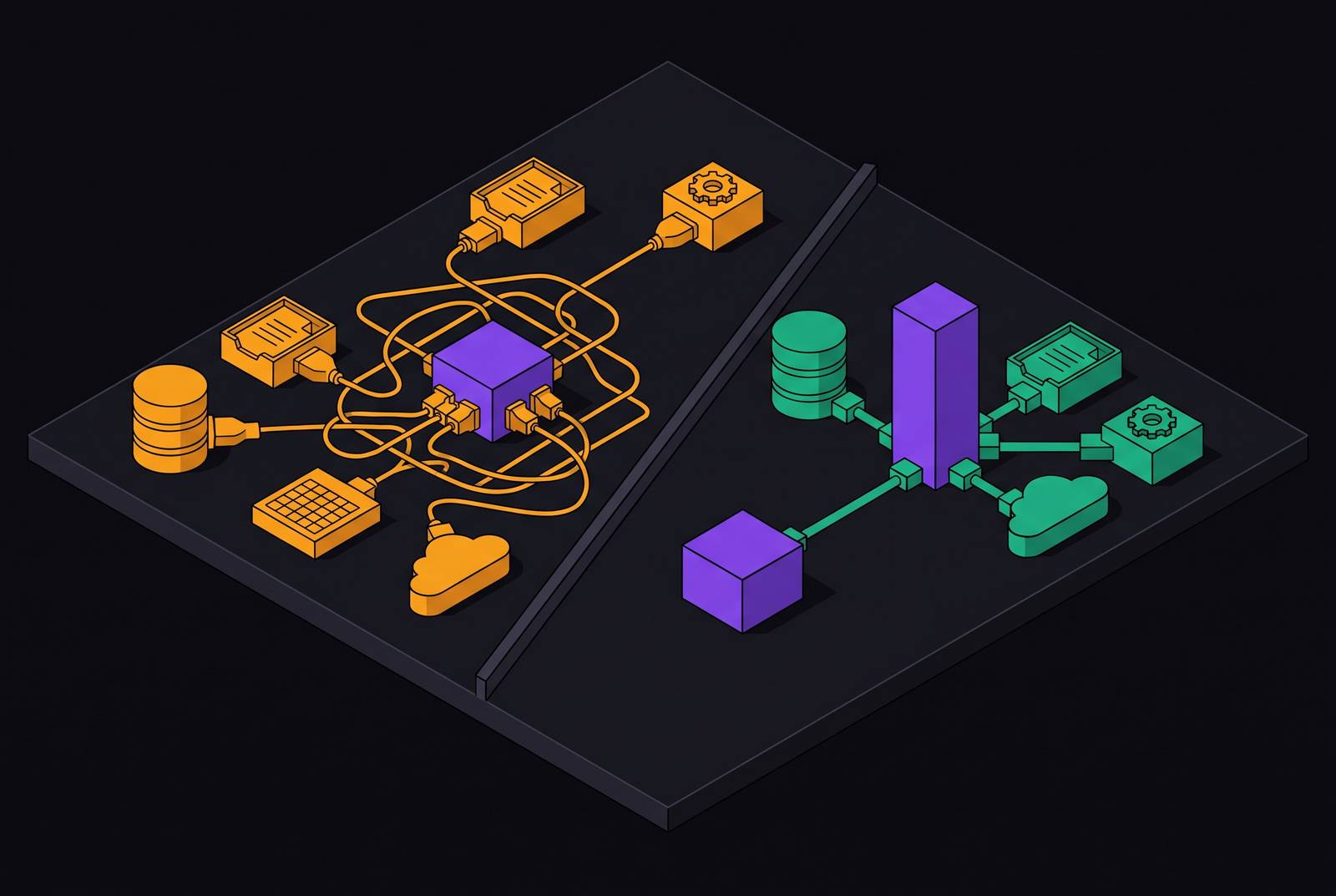
When every AI application needs its own custom connector to every tool, the work of connecting them grows as N×M. Adding an application means connecting it to the tools it needs. Adding a tool means updating the applications that need it. Each connection brings authentication logic, error handling, schema management, and maintenance. The cost grows on both sides at once.
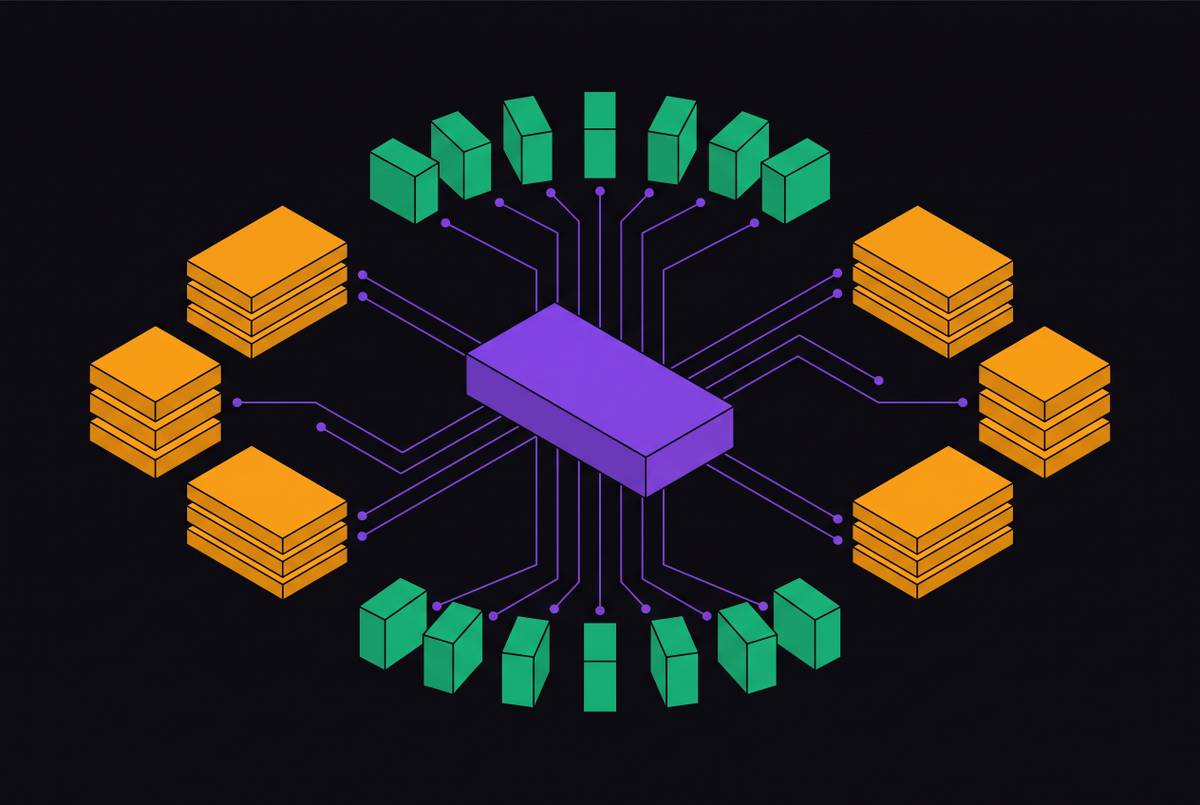
MCP replaces that pattern with a shared protocol, reducing the integration model to N+M. Each application speaks the standard, and each tool publishes through it. A data team using Claude for metadata search, a custom pipeline monitor, and a code-generation agent can give those systems a common route to shared tools.
The shared interface also makes capabilities discoverable at runtime. MCP exposes resources for read-only data, tools for actions that modify state, and prompts for reusable instruction templates. Together, these form a machine-readable catalog that agents can inspect. When a server adds a tool, agents can discover it without each consumer receiving a code update. This is an engineering economics argument.
How MCP and REST APIs actually differ architecturally
Discovery is the first architectural difference to examine. With REST, a developer usually reads the documentation and writes stable calls. MCP exposes capabilities, accepted inputs, and output shapes so an agent can select a tool while working. Its intended consumer is an LLM application, which pays a token cost for the definitions it reasons over. Machine-readable schemas reduce the overhead of explaining those capabilities.
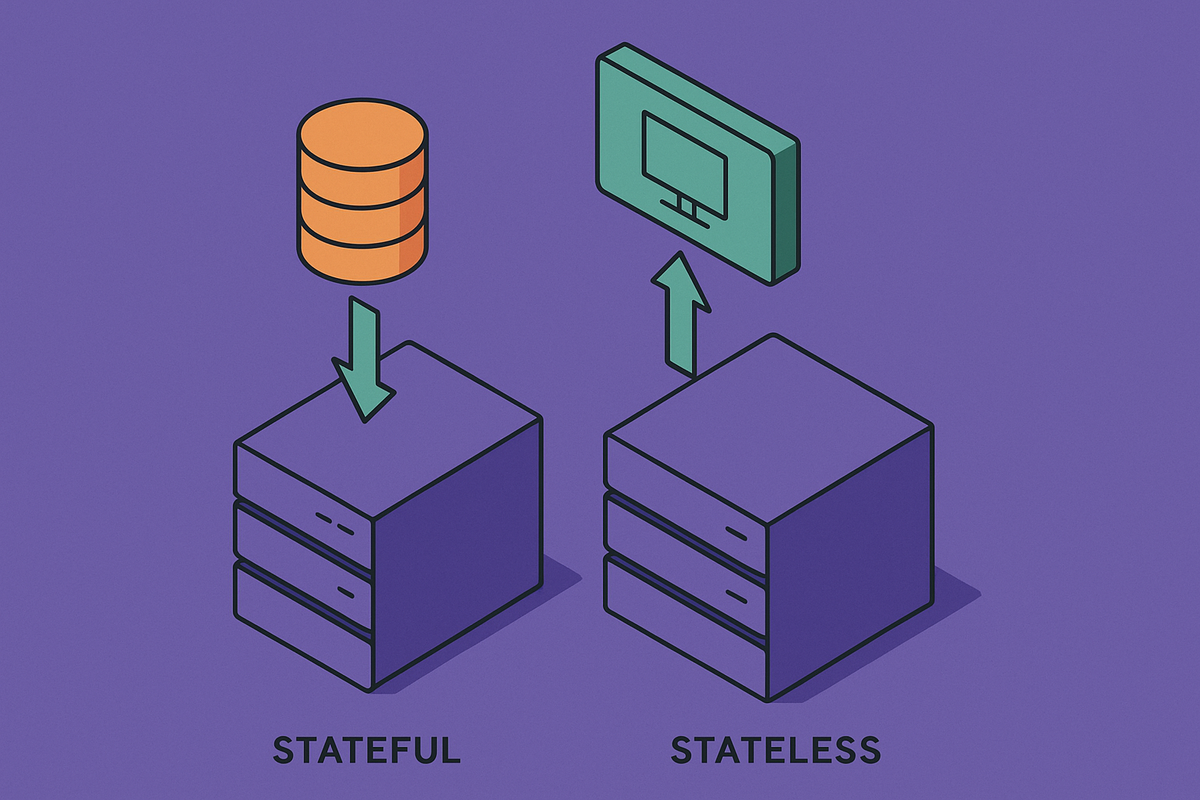
Session state is no longer the dividing line. REST is stateless by design, with each request supplying what the server needs. MCP used to have stateful bidirectional sessions, but since its July 2026 update it uses self-describing requests that can reach any server instance behind a round-robin load balancer. MCP uses JSON-RPC 2.0 over stdio or Streamable HTTP, with the latter supporting real-time bidirectional tool interaction. Those transport details do not change the central distinction between predetermined calls and runtime discovery.
Authentication creates another difference in how integrations are arranged. Traditional API callers manage tokens or API keys per request, which can leave credentials exposed to an agent. MCP centralizes authentication at the server, with OAuth 2.1 and credentials kept outside the model’s context. That separation helps protect secrets. It does not, by itself, decide which user may perform which action.
Where REST APIs remain the stronger choice
Predictable work does not benefit from an agent deciding how to perform it. Financial transaction processing, regulatory reporting, and audit submissions often need a code path that stays fixed and can be audited. A direct REST call gives developers control over the endpoint, parameters, and sequence. Agent reasoning adds a choice that these workflows may have no need for or may forbid. Here, determinism is the feature.
The performance difference can be substantial as well. A direct API call can retrieve data in roughly 100ms. The same query routed through an MCP-connected agent requires reading a tool description, choosing the tool, constructing parameters, making the call, and processing the response. That sequence can take seconds and thousands of tokens. The extra cost comes from the agent-driven workflow.
REST also preserves infrastructure that already works. HTTP caching, CDNs, load balancers, API gateways, OpenAPI specs, and Postman need not be replaced to support stable integrations. A Python script calling one well-understood endpoint gains little from a discovery layer. With fewer than three AI-connected integrations, the connector burden may not justify MCP’s overhead either.
Where MCP earns its place in an enterprise stack
MCP becomes useful when several integrations, runtime decisions, and frequent tool changes converge. With a third or fourth AI-connected tool, it gets harder to justify handling authentication, error handling, and schema maintenance for each tool on its own. If tools also change faster than developers can update consumers, live discovery becomes a practical advantage. Agents can find new capabilities through the catalog.
Exploratory workflows make the distinction especially clear. An agent examining a revenue dashboard might pull quarterly totals, notice an anomaly, and then request monthly breakdowns. The next call depends on the previous result. MCP suits that kind of multi-step work, including cases where the needed tool was unknown at design time. Multiple agents sharing the same tools strengthen the case further.
Institutional support makes this more than an isolated integration experiment. The Agentic AI Foundation, a directed fund under the Linux Foundation, governs MCP, with new code and specifications under Apache-2.0 licensing. Anthropic, Block, and OpenAI co-founded the foundation. OpenAI’s migration from the Assistants API to the Responses API adds native MCP support, with the Conversations API providing persistent state. With vendor-neutral governance, there is less risk of lock-in, though an enterprise still needs its own access controls.
Why MCP adoption is outpacing MCP governance — and what breaks as a result
MCP is a protocol. Most default implementations prioritize connecting developers to tools. A service account or API key may give the agent access to everything that credential can reach. If all requests use that same account, different users can effectively inherit the same access. The server is connected, but the user’s actual permissions are missing from the decision.
That is a structural failure. Session-level authorization checks whether an agent is allowed to connect. Per-operation authorization asks whether this user may take this action on this data. Only the second check enforces least privilege throughout the work. Trusting everything once an agent is in leaves an implicit-trust window that zero-trust architecture rules out.
MCP servers can aggregate context, orchestrate calls, and merge information from several sources. Under GDPR Articles 5 and 6, that processing needs a lawful basis and a defined purpose. An ungoverned server therefore opens both an access problem and a data-processing problem. Neither begins only after an incident exposes it.
The compliance obligations that ungoverned MCP creates across GDPR, HIPAA, and U.S. state law
GDPR requires an organization to demonstrate what personal data was processed, when, and by whom. An MCP deployment needs structured audit logging to show what happened. More context is not automatically a lawful justification. Article 5’s data minimization principle says to process only what is needed for the purpose, while an AI workflow may seek more context to give a better answer. Governance must settle how much context is allowed before the data reaches the model.
The EU AI Act adds an inventory obligation for in-scope systems. The Digital Omnibus on AI deferred the high-risk obligations for stand-alone high-risk systems from August 2, 2026 to December 2, 2027. MCP gateways operating on regulated data must be considered within the organization’s risk-based AI inventory. HIPAA sets different rules for protected health information. An MCP server that creates, receives, maintains, or transmits PHI on behalf of a covered entity is a Business Associate, making the absence of a BAA an immediate exposure.
Handling opt-in consent does not establish that a platform correctly handles opt-out signals under CCPA/CPRA and other U.S. state privacy laws. Those paths need distinct implementations. A consent management platform may record withdrawal and stop an analytics tag while personal data remains in a training set or live agent query. Under GDPR Article 17, withdrawal can trigger deletion obligations extending into AI training data, so consent handling cannot stop at the website.
What enterprise MCP governance actually requires at the protocol layer
The enforcement point belongs between the model and the data. At that boundary, six minimum controls turn access policy into checks on actual calls. OAuth 2.0 authentication keeps credentials outside the AI context. Per-operation role-based and attribute-based access control, or RBAC and ABAC, check each action against the requesting user’s permissions. Attribution-level audit logging records who acted, which data was touched, and what happened.
The remaining controls constrain reach and operating behavior. Path and scope controls limit which parts of a connected system an agent may access. Rate limiting keeps runaway behavior from overloading that system. Sensitivity label evaluation blocks access to data whose classification is above the level the agent is allowed to use.
Enterprise-Managed Authorization, or EMA, stable as of July 2026, governs who can enter a connected system. It explicitly does not authorize individual actions at runtime. An organization that uses EMA still needs per-operation checks once the agent is in. An agent’s permissions should be a deliberate organizational decision.
Why governance belongs above both MCP and REST, not bolted onto one of them
A direct REST call can bypass user-level controls just as easily as an MCP call. Authentication mechanisms may help establish identity, but effective access control and auditability depend on how the surrounding architecture enforces policy. Protocol choice is not a safety net.
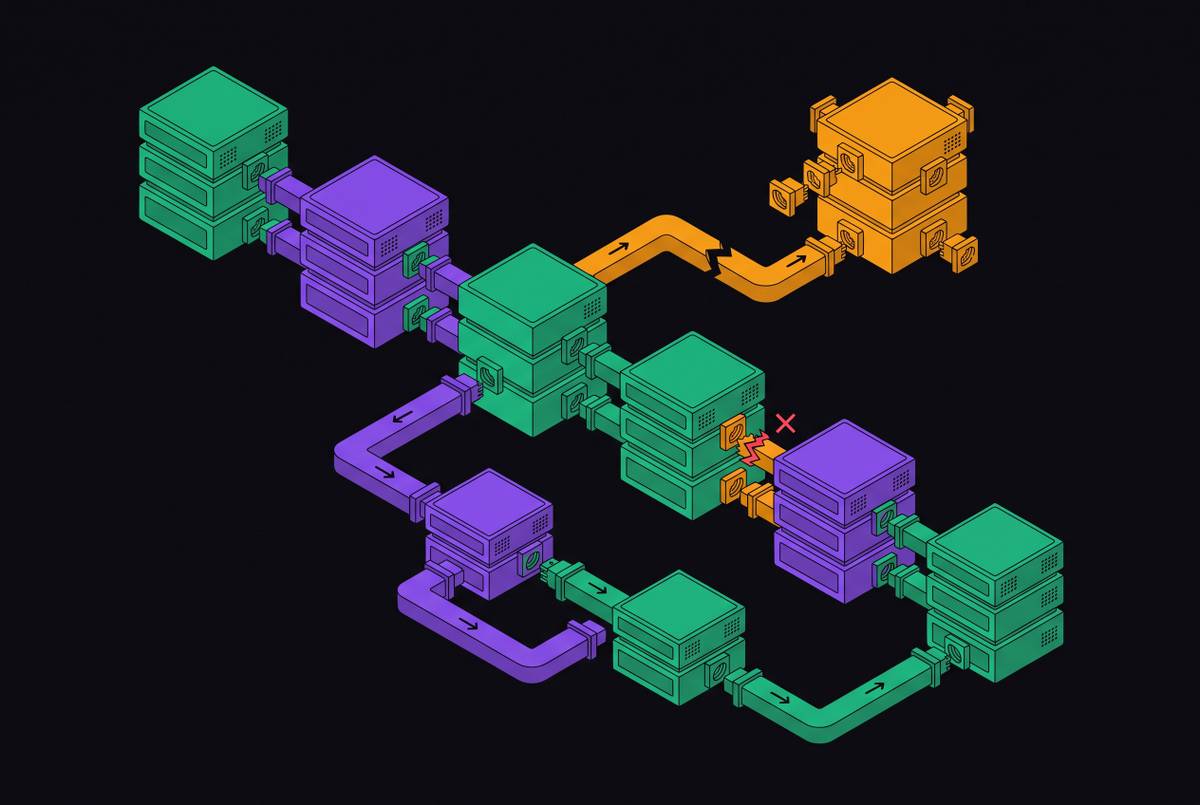
The architecture therefore needs three distinct layers. The AI model chooses or performs work, the governance layer applies policy, and the integration protocol connects to the system. The governance layer includes the gateway, registry, audit log, and access rules. It must operate independently of whether the connection below it uses MCP or REST. Otherwise, the same action can receive different treatment simply because the agent took another route.
A central registry makes it possible to hold deployed MCP servers to account. Real-time visibility then makes their activity actionable. These are production infrastructure. Blocking MCP to avoid that work can lead employees to use it out of sight instead. A governed route to the tools employees want gives the organization a stronger basis for approval than blanket restrictions do.
A decision framework for choosing between MCP, REST API, and a governed combination of both
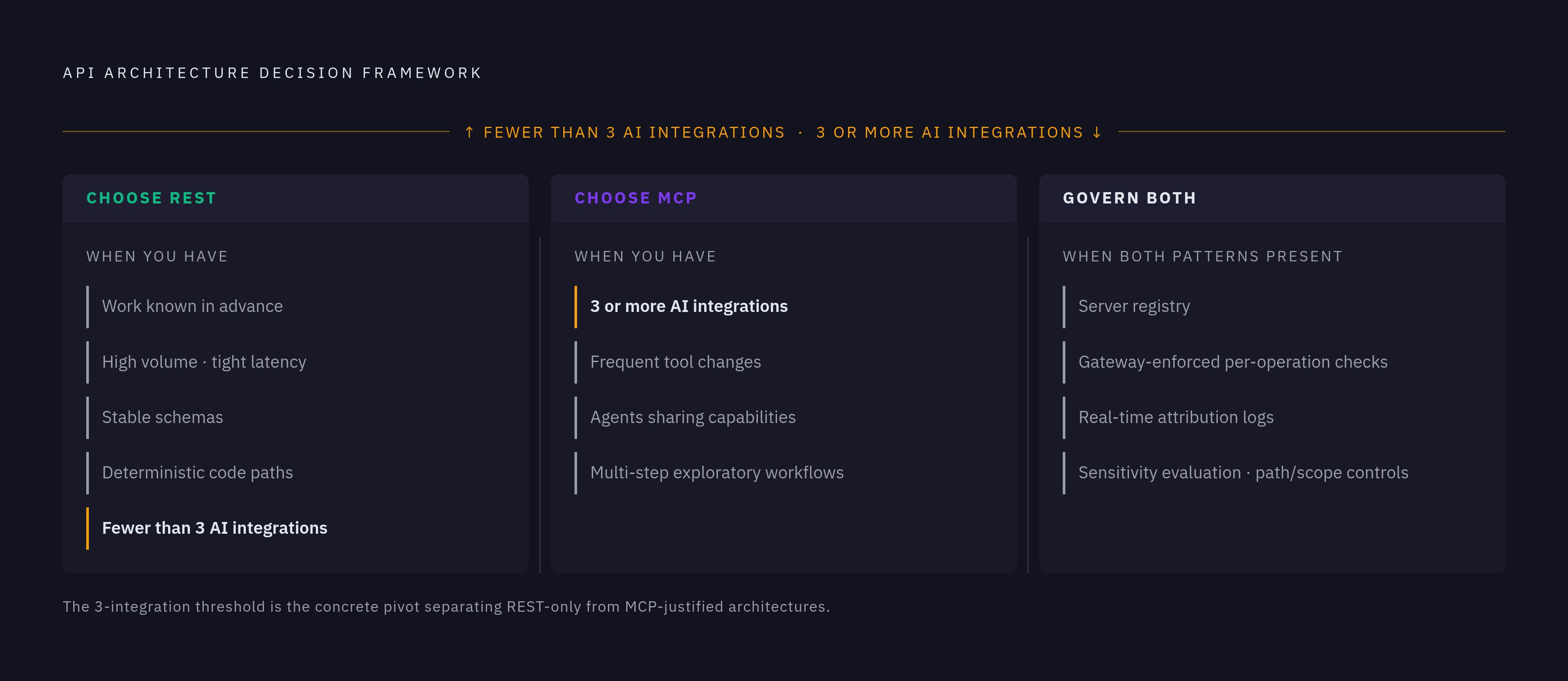
Choose REST when the work is known in advance. High volume, tight latency requirements, stable schemas, and mandatory deterministic code paths all favor direct calls. Fewer than three AI-connected integrations also weaken the economic case for MCP. In this category, hardcoded endpoints are an advantage because the workflow does not need to discover alternatives.
Choose MCP when the caller must find its way. Three or more AI integrations, frequent tool changes, and multiple agents sharing capabilities make a common discovery protocol useful. Multi-step exploration strengthens that choice when each result determines the next action.
Choose a governed combination when the work follows both patterns. Keep deterministic paths direct, make dynamic capabilities available through MCP, and use one access policy for all agent connections. That requires a server registry, gateway-enforced per-operation checks, real-time attribution logs, sensitivity evaluation, and path and scope controls. EMA can govern initial access, while data lineage and consent propagation connect withdrawal signals to the AI pipelines that received the data. Governance then becomes the means of approving production use.