GDPR Compliance When AI Agents Access Personal Data via MCP
Fast-growing MCP servers expose a compliance gap between AI capability and GDPR enforcement.

Anthropic released MCP in November 2024. Within a year it had become close to the default way of wiring AI models into outside tools, databases, and services. By December 2025 it had been handed off to a Linux Foundation body, a clear sign of how fast it moved from someone's side project to shared infrastructure. Adoption at that speed rarely leaves time for governance to catch up, and MCP is proving that out in the worst way possible.
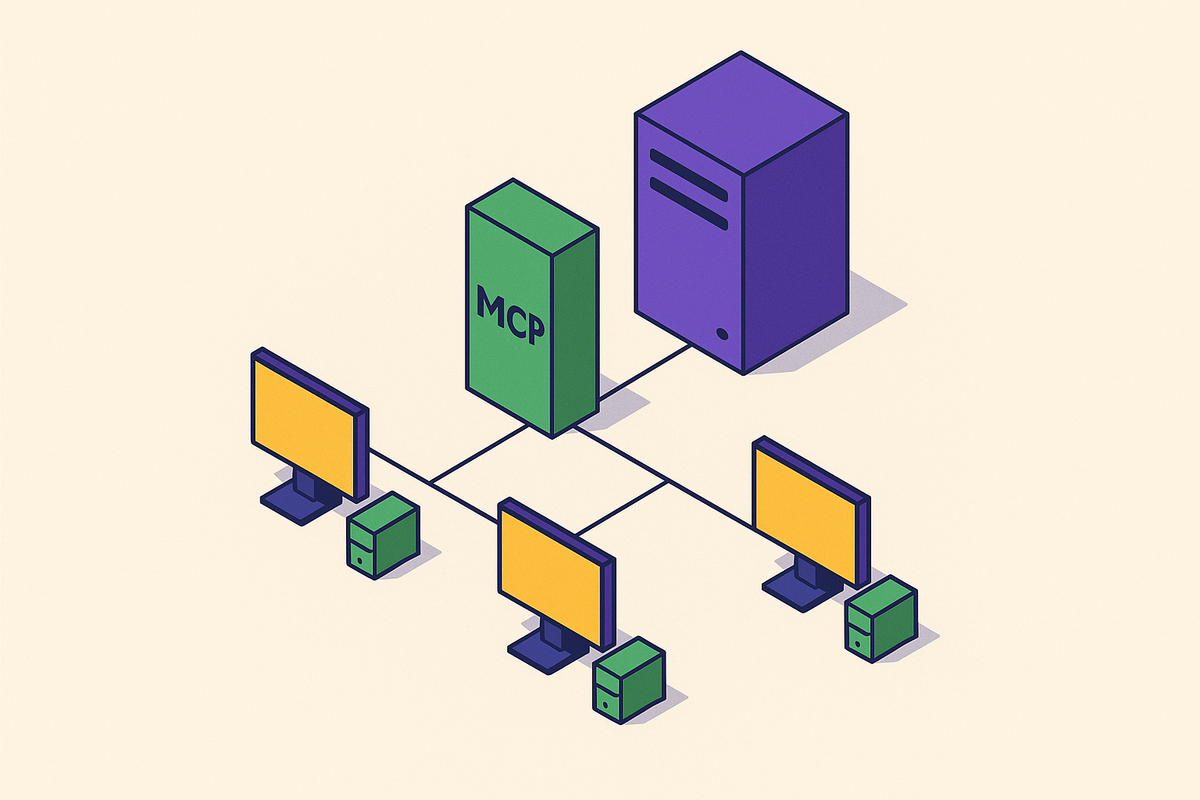
The architecture has three parts. A host is the AI application a person actually talks to. A client is the protocol piece living inside that host. A server exposes the tools, files, or data the agent can reach. Picture an EU-based sales rep asking an agent to summarize open deals in the CRM: the agent fetches contact records, routes them through an MCP server, then forwards them to the language model for summarizing. Every one of those hops moves personal data, and under GDPR, every one of those hops needs its own lawful basis. Not just the first.
Knostic's researchers found 1,862 MCP servers sitting exposed on the public internet by mid-2025. In a sample of 119 of them, every single one accepted requests with no authentication at all. That's not just a security hole. Per IAPP's reporting, it's a privacy failure too, since an unauthenticated server can't enforce access limits, log who touched what, or confirm any lawful basis existed before the data moved.
Clutch Security's numbers tell the same story from a different angle. 86% of MCP deployments run locally, with full system privileges and direct filesystem access baked in from the start. 38% of deployed servers come from unofficial sources with authors nobody can identify. Meanwhile, a PwC survey found 88% of executives planning to increase AI-related budgets over the next year, specifically because of agentic AI. Adoption is accelerating right as the governance gap widens, not the other way around, and that order of operations is the entire problem in one sentence.
Each GDPR obligation below has to get satisfied inside a system built for capability first and compliance second. If it was built for compliance at all.
Lawful basis under Article 6, why "the agent is authorized" is not a legal ground
Article 6 requires a documented lawful basis before personal data gets processed. Not once a quarter. Not during the next audit. Before.
Enterprises keep confusing system authorization with legal justification, and that mistake is where most of this breaks down. An agent being allowed to query a database answers a permissions question. Whether a lawful basis exists for that specific query touching that specific data is a separate question entirely, and MCP's access model never asks it. It just checks whether the door is unlocked.
Legitimate interests is often the most workable basis for enterprise AI processing, but the EDPB's Opinion 28/2024 is clear that it demands a genuine necessity test and a balancing assessment done per use case, not a blanket justification stapled onto every task an agent runs. Once special category data enters the picture under Article 9, health information, for instance, a lawful basis under Article 6 alone stops being enough. A separate condition under Article 9(2) also has to be met, and explicit consent is just one of several possible conditions.
Two examples make the line clear. An agent reading support emails to classify tickets by urgency: contract performance or legitimate interests likely covers that fine. Now take that same agent and have it cross-reference ticket history against marketing data to score churn risk. The purpose just shifted, and the original basis doesn't follow it automatically. A fresh lawful basis is needed. Push it further: an agent profiling users to personalize marketing content almost certainly needs consent, and a generic "we use AI" checkbox buried in a privacy policy doesn't meet the specificity GDPR demands.
This can never be a one-time, system-level box ticked at deployment. Basis has to get rechecked every time an agent gets retasked or chained into a new pipeline, because the purpose of the processing changes even when the underlying system doesn't. Per a 2025 AI enforcement review, 43% of companies using AI in customer-facing workflows had no valid data processing agreement covering their AI providers at all. That's nearly half of deployments missing a document that's supposed to exist before the first API call.
Data minimization under Articles 5 and 25, enforcing limits at context assembly, not at the source database
Article 5(1)(c) says personal data has to be adequate, relevant, and limited to what's necessary. For a human analyst, that limit usually gets enforced at the database, through row-level permissions or field masking. For an agent, the limit has to live somewhere else entirely: inside the context window, at the moment the agent assembles what it's about to reason over.
Most enterprise GDPR programs were built around the database as the control point, and that assumption falls apart the moment an agent enters the picture. Agents pull from multiple systems at inference time, stitching together CRM records, support tickets, and internal docs into one context blob. That assembly happens later in the pipeline than where minimization controls traditionally sit, so by the time the data reaches the model, the old controls have already been left behind.
MCP servers make this worse by default, because broad permission scopes are easier to build and more flexible to use. Granting broad access instead of the narrowest scope the task requires is a recurring pattern, and it directly conflicts with Article 5(1)(c), which asks for the opposite: the narrowest scope that still gets the job done.
The fix that's emerging is a task-scoped context boundary: defining, for a given agent task, exactly which data sources, which fields, and which retention windows apply, so the agent only ever receives the slice of data its task actually needs rather than standing access to an entire record. Article 25's design-by-default requirement backs this up by asking enterprises to weigh factors such as the state of the art, implementation costs, and the risk to the people whose data it is.
Multi-agent pipelines add a failure mode nobody's fully solved. When one agent hands data to another through a context handoff, there's typically no additional access check or logged event at that transfer point. A person's data can move through an entire chain of agents without a single downstream agent triggering its own audit record. Nobody's watching that handoff, and that's exactly where purpose limitation quietly drifts. It's also where the next obligation, the right to erasure, starts colliding with how agents remember things.
The right to erasure under Article 17, why deleting the source record is not enough
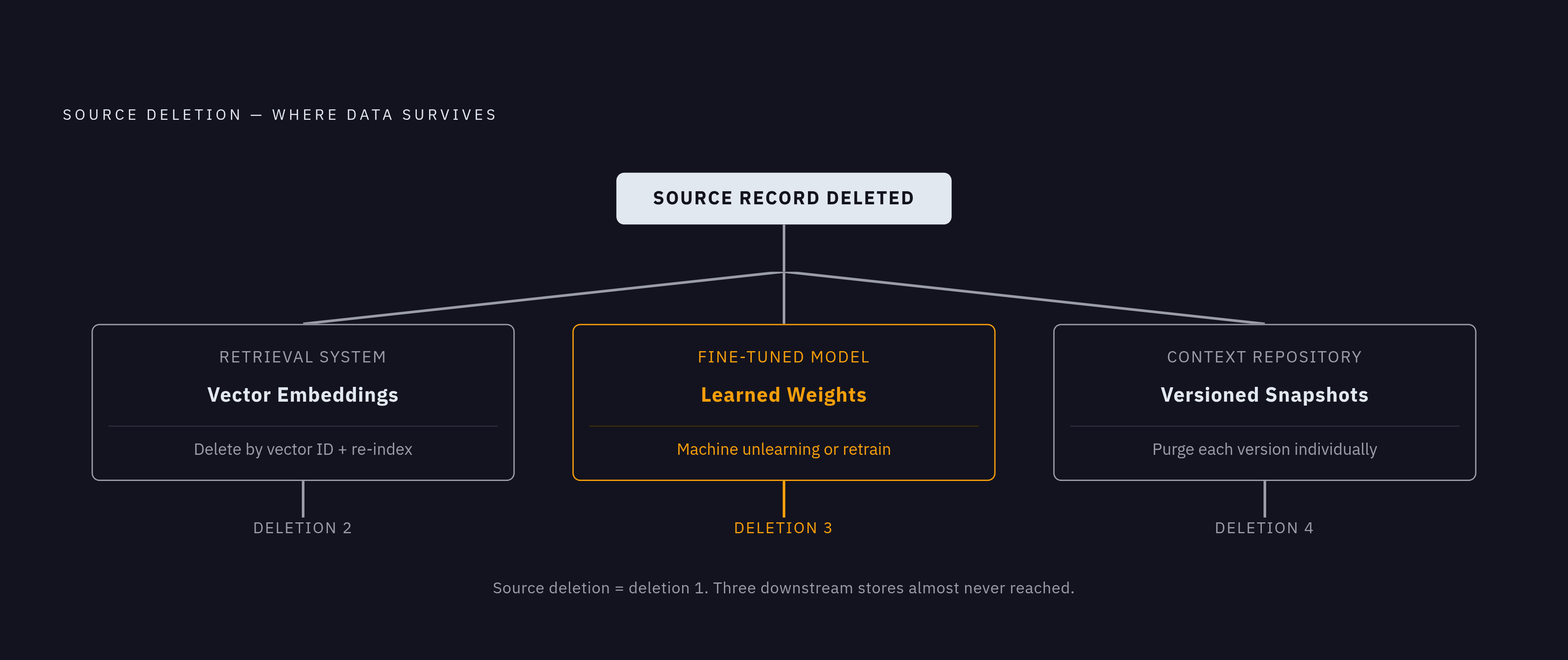
Article 17 requires erasure without undue delay once a valid ground applies, including where the data is no longer necessary for the purpose it was collected. The instinct in most enterprises is to delete the row in the source database and call the request closed. That instinct is wrong, and it's wrong in a way that actually matters.
An agent's memory can hold the personal data it processed along with inferences and derived attributes that never existed in the source system at all, things the agent concluded on its own, never written down anywhere a standard deletion request would reach. Deleting the source row does nothing to those.
That data persists in at least three different formats, and each one needs its own deletion mechanism:
- Vector embeddings sitting inside a retrieval system
- Learned patterns baked into a fine-tuned model
- Versioned copies inside an enterprise context repository
Most teams haven't even mapped which of these formats their agents actually use. Deletion isn't the hard part here. Nobody knows where the data went in the first place, and that's the real failure.
What's actually required is a provenance map, something that traces every source record forward to every downstream memory store that ever touched it. Without that map, there's no way to confirm an erasure request was fulfilled, because there's no way to know what still exists somewhere else. That same map answers Article 15 access requests and Article 16 rectification requests too. The erasure problem, at bottom, is a visibility problem, just showing up in its most urgent form, and that visibility is exactly what's needed to explain, and defend, any automated decision the agent goes on to make.
Article 22 safeguards and DPIAs, what automated decision-making means when the decision-maker is an agent pipeline
Article 22 gives people the right not to be subject to decisions made solely by automated processing when those decisions carry legal or similarly significant effects. Loan approvals. Candidate screening. Insurance pricing. Access to a service. Enterprise agents are moving into exactly this territory, often without anyone stopping to ask whether Article 22 now applies to them.
"Solely automated" is a much harder line to draw with agents than it ever was with a rules engine. A pipeline might involve several tool calls, a memory retrieval, and a sub-agent delegating part of the task to another agent, and at no point in that chain does a human actually look at the decision before it gets made.
Where Article 22 applies, three safeguards are required, namely the right to get a human to step in, the right to say something about the decision, and the right to contest it. All three depend on the enterprise being able to produce a decision trace, a record of how the outcome was actually reached, not just what the outcome was.
Article 35's DPIA requirement kicks in before deployment whenever processing is likely to create high risk, and that includes systematic profiling with legal effects and large-scale processing of special category data. Regulatory guidance increasingly treats agentic deployments touching personal data as warranting that scrutiny, and it raises two questions a standard DPIA template was never built to answer: what happens when an agent pulls in more context than the task actually called for, and what happens when a hallucinated fact spreads across tool calls and ends up shaping a downstream decision. Regulators have begun naming that second risk directly, which says something about how seriously they are starting to take it.
Skipping a DPIA that was required counts as a violation on its own, regardless of whether any actual harm follows. Article 30's records of processing have to cover agent-driven workflows too: the purpose of the processing, the categories of data and data subjects involved, who receives the data, any transfers outside the EU, retention periods, and the security measures in place, updated every time an agent is retasked or chained into a new workflow. A record written at deployment and never touched again has stopped functioning as a record. It's a fossil.
The MCP attack surface that puts all five obligations at risk before they can be satisfied
Tool poisoning is the clearest example, and the one that should worry security teams most, because nothing about it looks wrong from the user's side. Malicious instructions get embedded in a tool's own metadata, the description the model reads to decide how to use it, and those instructions can hijack the model's behavior before the user has done anything at all. The precondition is simple: nobody validated the tool's description before it entered the model's context.
Invariant Labs laid this attack class out formally in April 2025, with a working proof of concept against the Cursor IDE. Exfiltration instructions were hidden inside the description of a basic calculator tool. When the developer called a simple add function, the model quietly read the developer's SSH private key and MCP configuration file and smuggled both out, disguised as a parameter of the tool call itself. What the developer actually saw on screen was a correct arithmetic answer. No warning, no error, nothing that looked wrong. That's what separates tool poisoning from older prompt injection attacks: the victim has no reason to suspect anything happened.
A WhatsApp MCP vulnerability surfaced the same month. A malicious MCP server had poisoned its tool descriptions with hidden instructions, so when a user made an ordinary request, the agent carried out the visible task and the hidden one at the same time, quietly rerouting data to a destination the attacker controlled.
Indirect prompt injection attacks hidden inside content that agents retrieve have also been demonstrated as a class, letting attackers redirect agent behavior without touching the user's interface. CVE-2025-6514 documented an OS command injection flaw in mcp-remote, a widely used MCP proxy, that allowed remote code execution just by connecting to a malicious server.
There's a slower-moving version of this risk too, sometimes called the rug pull. MCP has no cryptographic content-addressing and no version pinning for tool descriptions, so a server that passed review last month can behave completely differently today with nobody noticing the change. Call it a supply chain attack that moved up to the semantic layer instead of the code layer.
None of this is theoretical at scale. Uber's ADR system ran for over ten months, reaching more than 7,200 unique hosts and processing over 10,000 agent sessions a day, and it turned up hundreds of credential exposures spread across 26 categories. That's what production-scale agentic exposure looks like once someone actually goes looking for it.
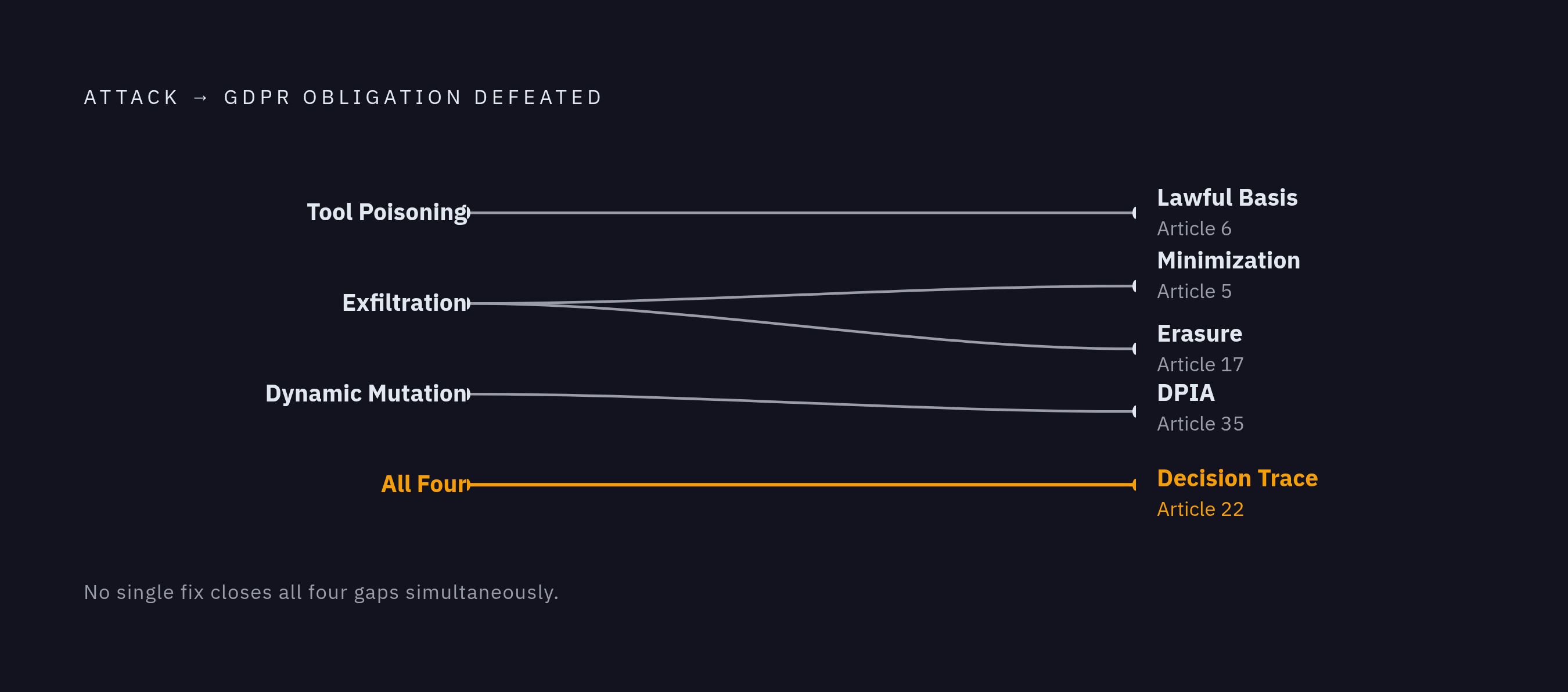
Each of these attacks lands on a different GDPR obligation, and that mapping matters more than any individual vulnerability report. Tool poisoning defeats lawful basis, since data gets redirected with no legal ground behind the redirection at all. Exfiltration defeats both erasure and minimization, because data leaves the boundary the enterprise thought it had drawn. Dynamic mutation, the rug pull, defeats the DPIA, because the system that got assessed isn't the system actually running anymore. And all of them defeat Article 22, because there's no clean decision trace left standing to contest.
What protocol-layer controls actually look like for each GDPR obligation
None of the obligations above get satisfied by policy documents sitting in a compliance folder somewhere. Policy documents don't stop an agent from calling a tool. They get satisfied, or they don't, at the protocol layer, where the agent actually touches data.
Start with a trusted MCP registry, an authoritative allowlist of approved servers. Each one is tied to a name, a version, a source, and an accountable owner. Version pinning stops silent updates from slipping through unreviewed, and the host itself refuses to talk to anything not on the list. That single control is what stops shadow MCPs, servers nobody vetted, from reaching production in the first place.
For lawful basis, the mapping has to happen per task and per data category before the agent acts, and a gateway enforcing task-scoped access is what makes that real rather than aspirational. If a task doesn't map to an approved basis, the retrieval simply doesn't happen. The system refuses by default instead of asking forgiveness later.
For minimization, enforcement moves to context construction instead of the source database. The Bounded Context Space pattern scopes exactly which sources, fields, and retention windows apply to a given task, and runtime policy enforcement through OAuth scoping and tool access restrictions replaces the broad, all-or-nothing permissions MCP servers default to.
For erasure, a provenance map linking source records to every downstream memory store, vector databases, context repositories, fine-tuned weights, turns an Article 17 request from a guess into a fact. Deletion has to reach all three formats, not just the one that's easiest to query.
For Article 22 and DPIAs, what's needed is a complete audit trail of every tool call, every reasoning step, every data retrieval, not just the final output but the causal chain that produced it. That trail has to get captured in real time, because a log pulled together after an incident is a postmortem, not a control. Third-party servers need continuous re-validation too: version tracking, security advisory monitoring, file hash checks, and a re-approval step before any upgrade goes live. That's the direct answer to the rug-pull risk that quietly invalidates a DPIA after the fact.
Controller and processor accountability rounds it out. Data processing agreements have to name AI providers explicitly, something enforcement reviews have found missing across a significant share of deployments, and Article 30 records have to get updated every time an agent is retasked or chained differently than before.
MCP Manager, now part of Usercentrics, is designed around exactly this layer: a gateway providing access controls, guardrails, and real-time observability across MCP server interactions, folding the registry, the runtime policy enforcement, and the audit trail into one governed control plane. For enterprises trying to move agentic AI into production, that's the difference between moving fast and moving blind.