Real-Time Agent Activity Monitoring vs Post-Incident Audit Logs
Real-time monitoring catches agent threats mid-execution, audit logs prove what happened after.
Real-time monitoring didn't start in cybersecurity. It came out of contact center operations, where supervisors needed a live picture of agent status, queue depth, wait times, abandonment rates. A lag of even a few minutes made intervention pointless. The queue had already collapsed. The customer was already gone. The logic was blunt: if you can't see it while it's happening, you can't do anything about it while it's happening.
That same logic applies to AI agent environments, and the stakes are considerably higher.
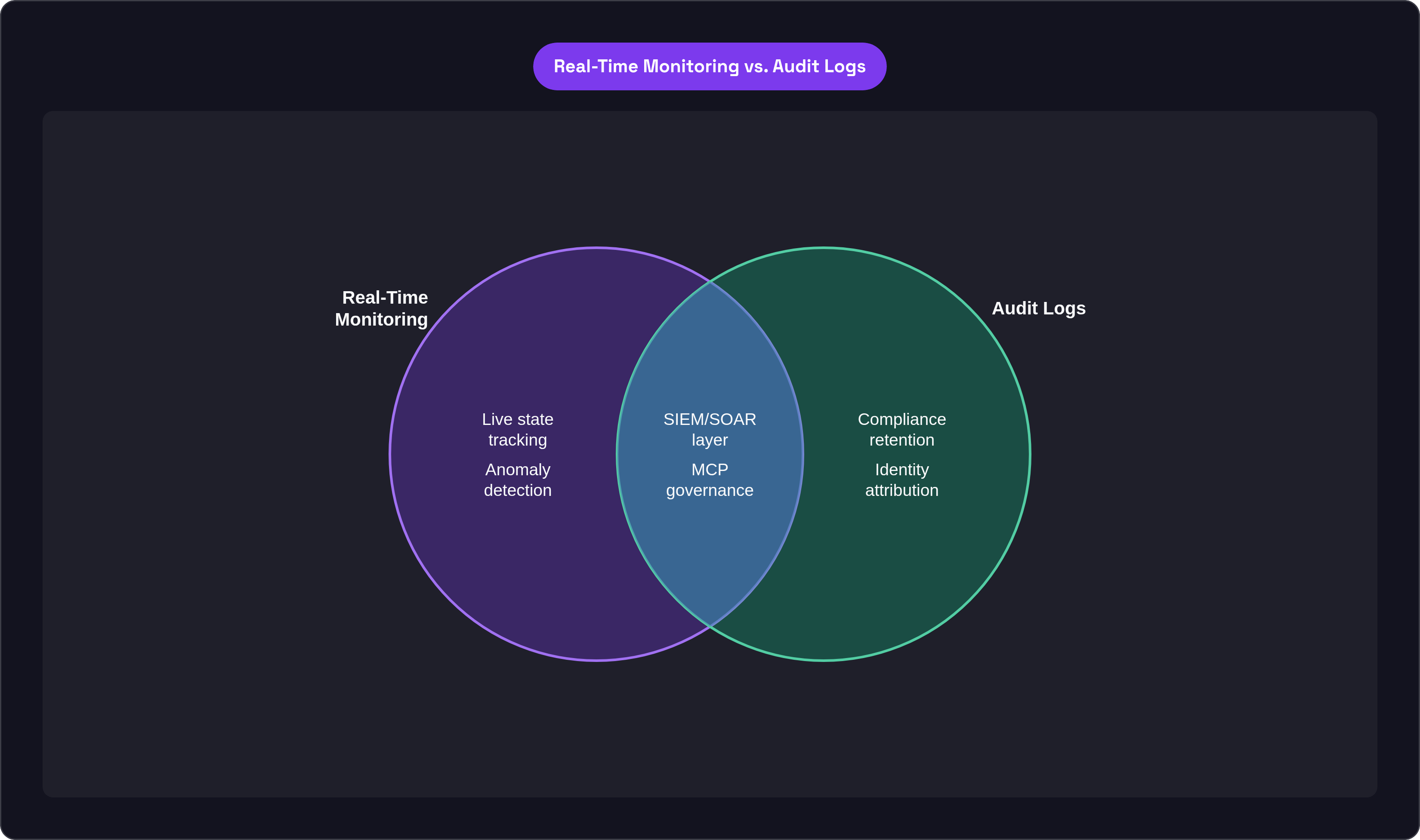
Three capabilities define what real-time monitoring actually does in practice: live state tracking, behavioral anomaly detection, and intervention mechanisms. Live state tracking tells you which agents are running, which are idle, and which are mid-execution. Behavioral anomaly detection works at the data-event level, catching an agent that normally reads a bounded number of records and suddenly reads an order of magnitude more. The intervention mechanism is the operational payoff of the whole thing: the ability to halt, reroute, or quarantine an agent mid-execution rather than after it has finished and done whatever damage it was going to do.
Generative AI has changed what monitoring can practically mean. Earlier observability tools flagged keywords or measured latency. Current systems can synthesize narrative summaries of agent behavior across many interactions, giving supervisors interpretable context rather than raw signal streams. That matters because the volume and velocity of agent actions far exceed what any human can parse from raw data in real time. The technology caught up to the operational need, which is genuinely useful.
Why traditional APM misses the actual threat surface
Application performance monitoring was built to answer infrastructure questions: is the service up, is latency acceptable, are errors spiking? Those remain valid questions. They're just not sufficient for AI agents.
An agent can return HTTP 200, technically successful, while producing a hallucinated response, calling an unauthorized tool, or exfiltrating data. Latency metrics stay flat throughout. A prompt-injection payload, a compromised token, a new tool added without governance review: any of these can flip a well-behaved agent into a misbehaving one without triggering a single traditional alert. Policy drift, gradual deviation from a governance baseline, can accumulate over weeks without registering anywhere a developer is looking.
The McDonald's AI drive-through pilot illustrates the structural gap without ambiguity. The company pulled it in July 2024 after a series of viral mis-orders, one of which involved accepting an order for 260 Chicken McNuggets. There was no reasonability constraint, no enforcement mechanism, no way for operators to intervene in the moment. Every incident was visible only after it had already happened, documented externally by customers with phones. The log existed. The window to intervene did not.
Real-time monitoring shifts operational posture from reactive reporting to proactive intervention. Its value is not the record it produces. It's the window it opens.
What audit logs are genuinely built for — and what they do well
A SOC analyst reconstructing an incident at T+72 hours needs something specific: millisecond-level timestamps, stable identity attribution, and a queryable graph of events. They need to walk from a triggering input through every tool call, every data access, every model invocation, to wherever the output ended up. That forensic function is what audit logs are genuinely and uniquely suited for. No real-time monitoring system replaces it.
The structural difference in AI agent audit logs
A traditional application log records what the system did. An audit log records who acted, under what authorization, and how long that authorization was valid. These often live together but serve entirely different consumers: the developer, the auditor, and the incident responder each need a different cut of the same event stream, and designing for one often means the others get a degraded version.
For AI agents, the requirement goes further. A traditional change log records what changed and who authorized it. An agent action log must also record why the agent decided to change it, the reasoning or policy context that produced the action. That "why" column is new, and it's not a nice-to-have. It's the difference between a log that satisfies an auditor and one that supports an actual investigation of autonomous decision-making. Without it, scoping an AI-agent incident is guesswork, and guesswork is what turns a contained event into a disclosable one.
A structural weakness worth naming
Instrumentation that depends on the agent process to emit its own telemetry has an inherent limitation most documentation glosses over. OpenTelemetry propagates trace context reliably; it does not provide kernel-level ground truth. A compromised agent or a poisoned dependency has no particular incentive to report its own activity accurately. For threat models that include a compromised agent, self-reported telemetry is a structural gap, not a solved problem. It's worth being honest about that.
Audit logs are the evidence layer compliance frameworks require. They answer whether a record exists, which real-time monitoring alone cannot answer. What logs cannot do is answer that question in time.
How long attackers stay undetected — and what that time costs
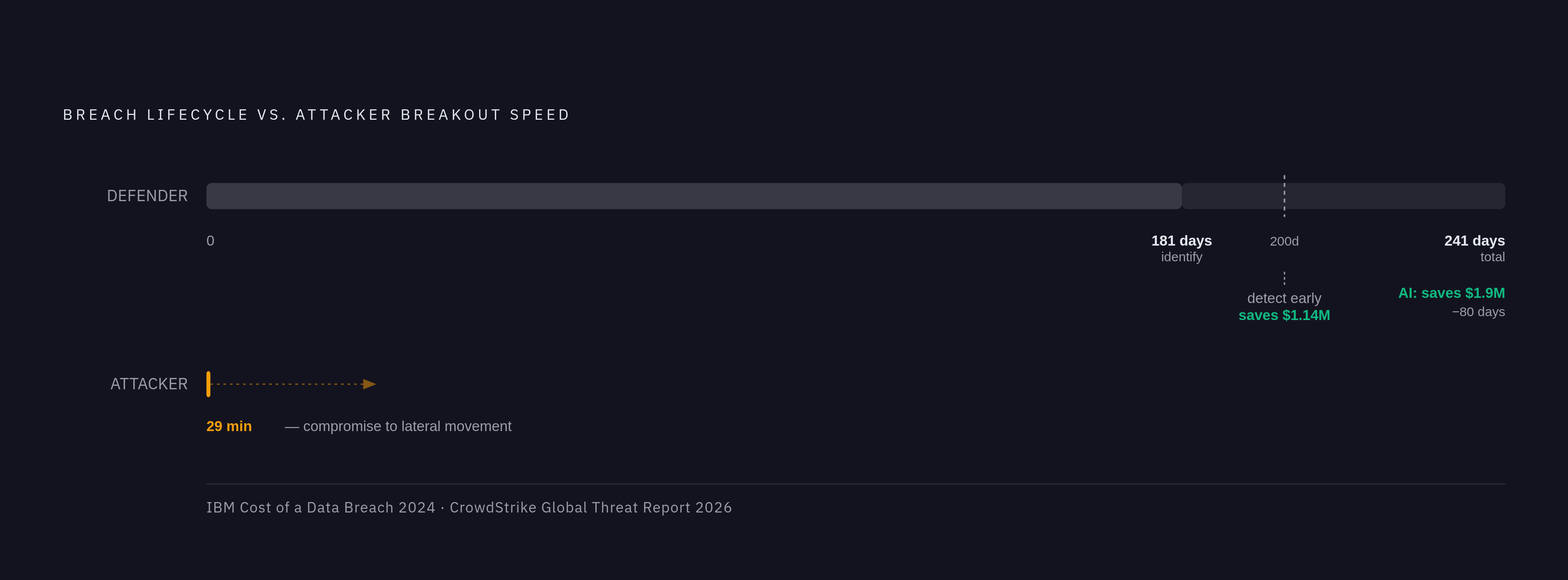
The IBM Cost of a Data Breach Report 2025 puts the mean time to identify a breach at 181 days. Add roughly 60 days to contain it and the total breach lifecycle reaches 241 days, about eight months from intrusion to containment. That number is the baseline against which every architectural decision about monitoring and logging should be evaluated, because everything else is relative to it.
The acceleration problem makes the picture worse. Per CrowdStrike's 2026 Global Threat Report, the interval between initial compromise and lateral movement has fallen to 29 minutes. Attackers are operating faster than any retrospective review cycle can interrupt.
What detection speed is actually worth
Organizations that detect breaches in under 200 days save an average of $1.14 million compared to longer detection cycles. Organizations using security AI and automation extensively saved $1.9 million per breach and reduced breach identification and containment time by 80 days, per IBM 2025. Those aren't marginal efficiency gains; they're the difference between a bad quarter and a genuinely damaging event.
Malicious insider threats, the category most structurally analogous to a compromised or misbehaving agent operating with legitimate credentials, carry an average breach cost of $4.92 million and require 260 days to fully resolve. That combination of high cost and long duration reflects what happens when an entity with authorized access operates undetected inside a system that was built to trust it.
Mandiant's M-Trends 2026 data adds an important wrinkle: global median dwell time has fallen overall, but for cyber espionage incidents specifically, median dwell time reaches 122 days. The aggregate average obscures the categories where exposure is far longer and far more damaging. Architectures designed for the average case are under-defended for the expensive case.
What this means for audit-log-only postures
A log reviewed after an incident closes the forensic record. It does not recover the months during which the activity was occurring undetected. If the log is only read after an incident has been externally reported, its value for containment is functionally zero. The architecture that produces excellent logs but routes them nowhere actionable in real time is not a security posture. It's documentation of damage, organized neatly after the fact.
Where audit logs alone break down in agentic AI specifically
An AI agent is not a user making a request. It's an autonomous system making a sequence of decisions, calling multiple tools, potentially delegating to sub-agents, acting on behalf of a user whose original intent may be several steps removed from the action ultimately taken.
In a standard microservices architecture, execution paths are largely deterministic. Logs reconstruct reliably because the event sequence follows a bounded set of patterns. In an agentic system, the execution path is dynamic. Reconstructing a timeline after a prompt-injection attack or an unintended logic loop is genuinely difficult without real-time trace capture. The log may exist; the causal chain it represents can still be opaque. I've seen incident responders spend days trying to attribute a decision to a specific model invocation when the trace context was incomplete. It's a time-consuming problem that grows with system complexity.
The shadow-user problem
An ungoverned AI agent effectively operates with high-level access privileges and limited accountability. It can read, summarize, and act on thousands of records in a single prompt execution, in the time it takes a human to read one email. The traditional assumption that anomalous access patterns will reveal themselves gradually, across hours or days, doesn't hold at machine speed. The machine is already done by the time a pattern is visible.
Cascade failures in multi-agent systems
The risk compounds in multi-agent architectures. Galileo AI research from December 2025 found that in simulated multi-agent systems, a single compromised agent poisoned the downstream decision-making of the broader system substantially within four hours, faster than traditional incident response could contain the spread. Individual agent governance is necessary but insufficient in densely connected systems. System-level circuit breakers and quarantine mechanisms aren't optional architectural features; they're the difference between a contained incident and a cascade.
An audit log of a cascade failure is useful for the postmortem. It cannot stop the cascade while it's running, and that distinction matters enormously.
Per the Gravitee State of AI Agent Security Report 2026, roughly half of organizations have experienced or suspected an AI agent security or data privacy incident in the past twelve months. Agents are already operating in production. Governance infrastructure is still catching up in most places.
The practical failure mode is not abstract. A clinical chatbot giving incorrect medication guidance, a diagnostic AI misclassifying imaging results: in both cases, the damage completes before any retrospective review surfaces it. And when investigators ask what data the agent accessed, "we think it only touched support tickets" is not an answer that satisfies a regulator, a customer, or an incident commander. It's the answer you get when real-time monitoring wasn't there.
What regulators now require from both approaches
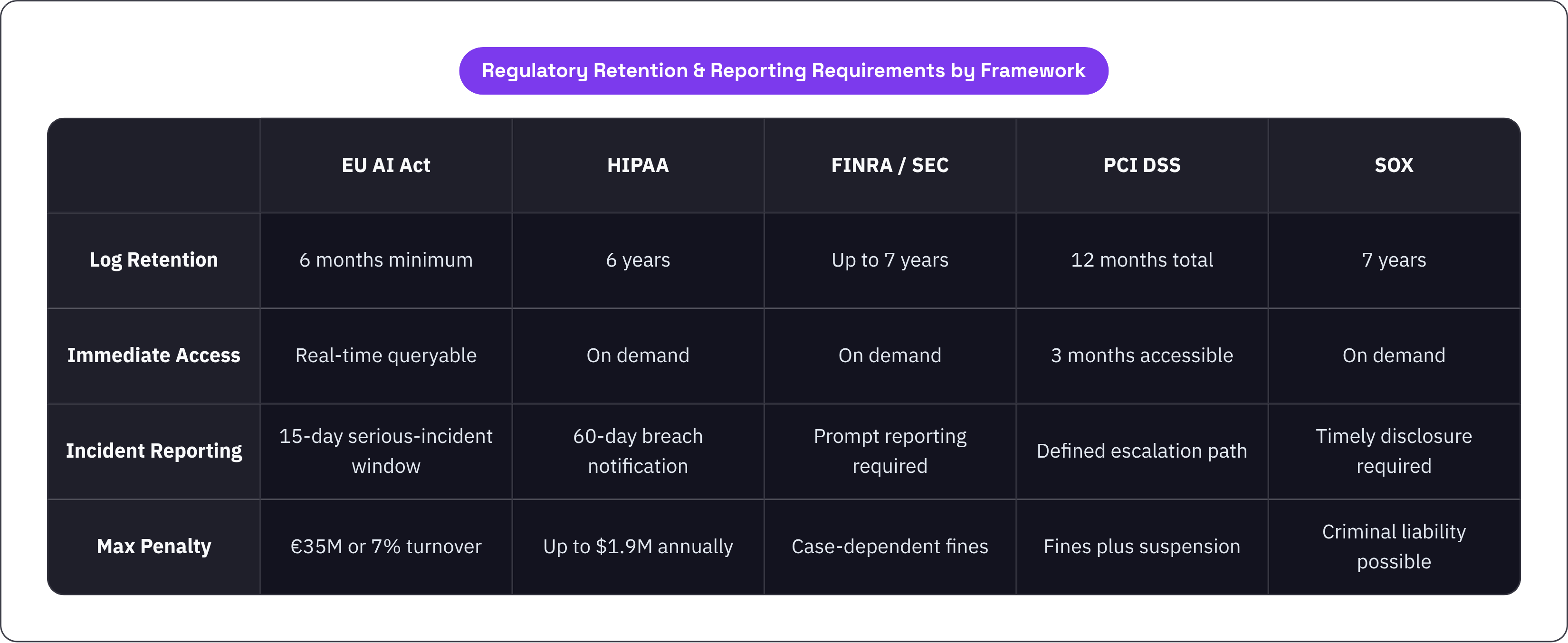
The EU AI Act sets the most urgent deadline. High-risk AI system obligations, including Article 73's 15-day serious-incident reporting requirement, become fully applicable on August 2, 2026. Article 19 mandates six-month automatic log retention for high-risk systems. Penalties for the most serious violations reach €35 million or 7% of global annual turnover; high-risk AI non-compliance carries up to €15 million or 3% of global annual turnover, whichever is higher.
Financial institutions using high-risk AI must achieve compliance by August 2026, requiring risk assessments, governance implementation, bias testing, documentation, and monitoring systems simultaneously. That is not a long runway for organizations that haven't yet separated their logging infrastructure from their monitoring infrastructure. Several I'm aware of are treating those as the same thing. They are not.
Sector-specific mandates that exceed the EU baseline
FINRA and SEC require up to seven years of audit trail retention for trading and advice-related activity. HIPAA requires six years for healthcare audit logs. PCI DSS requires twelve months total retention with three months immediately accessible. SOX requires seven years for financial systems logs. These mandates don't become optional because an AI agent generated the activity rather than a human user. The agent is acting on behalf of the organization; the organization owns the obligation.
NIST's acknowledgment of the governance gap
In February 2026, NIST launched an AI Agent Standards Initiative through CAISI, a direct response to governance gaps exposed by autonomous agents operating at scale. An AI Agent Interoperability Profile is planned for Q4 2026. NIST SP 800-61 Rev. 3, published in April 2025, aligns incident response to the NIST Cybersecurity Framework 2.0's six core functions, including Detect and Respond. Both require real-time capability. Retention alone doesn't satisfy either.
The convergence across frameworks is consistent. SOC 2, HIPAA, the EU AI Act, ISO 42001, and the NIST AI RMF all require demonstrable audit trails and anomaly detection or monitoring controls. They don't treat the two paradigms as interchangeable. Organizations that built logging infrastructure for human-user compliance are not automatically compliant for AI agent activity. The agent's autonomous decision-making introduces attribution and causality requirements that standard logs don't capture. OWASP's continued classification of "Security Logging and Monitoring Failures" as a critical category exists precisely because the failure to combine logging with active monitoring has been a persistent, exploited vulnerability. It made that list because organizations kept getting breached through it.
How a combined architecture actually works — and where MCP governance fits
A compliant AI agent audit trail must be operation-level, attribution-complete, tamper-evident, and real-time-queryable. These four properties together distinguish governance infrastructure from a log store. Each is necessary; none is sufficient on its own.
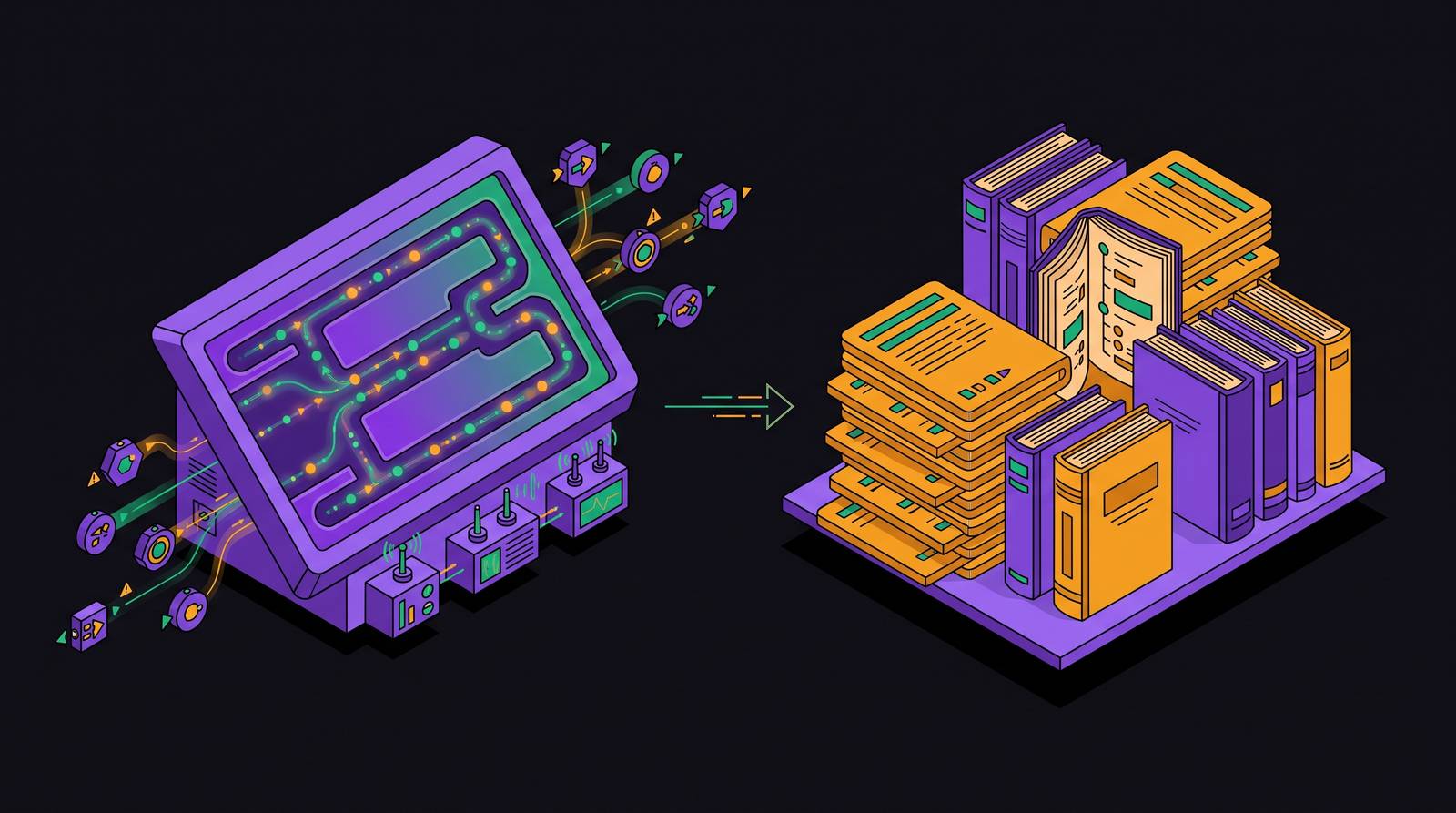
The architecture has two distinct layers with a defined relationship between them. The audit log is the source of record: what happened, who acted, under what authorization, what data was touched. The SIEM/SOAR layer is the operational layer: it ingests the log in real time, applies detection rules, and triggers response actions before the breach lifecycle extends. Without the log, SIEM has nothing to analyze. Without active SIEM forwarding, the log is read only after the fact. These layers aren't redundant; they're interdependent. Organizations that treat them as duplicative end up with neither working properly.
What a minimum viable audit trail for AI agents must capture
Per action, a defensible audit trail requires: which agent acted, identified by a stable identity rather than a session token; what tool or data source was accessed; what data was read, written, or transmitted; the authorization context under which the action occurred; and, for AI agents specifically, the policy or reasoning context that produced the decision. That last element is what separates a log that satisfies an auditor from one that supports a real investigation into autonomous decision-making.
Where MCP governance fits into this architecture
The Model Context Protocol has become a dominant standard for how AI agents connect to tools and data sources, and its adoption is accelerating. That means it's also where governance gaps are concentrating right now. An MCP gateway that enforces access decisions at the protocol layer, in real time, with structured audit emission per action, is where the two paradigms converge into a single control point. MCPManager, a Usercentrics product that provides a centralized governance layer for auditing and controlling how AI systems access business data via MCP, addresses exactly this junction between enforcement and record-keeping. Enforcing and recording simultaneously, at the point where agents actually interact with tools and data, is what makes the combined approach coherent rather than just additive.
Tools operating at this layer enforce access decisions and produce structured audit records at the point where agents interact with tools and data, meaning a policy violation can be halted mid-execution rather than discovered in a subsequent review. For organizations standing up MCP-based agent infrastructure under regulatory deadlines, that combination represents a practical implementation of the architecture described here.
Any architecture that treats monitoring and logging as alternatives is accepting a gap. The question isn't which paradigm to choose. It's whether the infrastructure connecting them can act fast enough to matter, and whether anyone has honestly assessed what happens in the space between an event occurring and a log being read.