Governance Frameworks for Autonomous AI Agents
How to build identity, access control, and observability before agents go live.
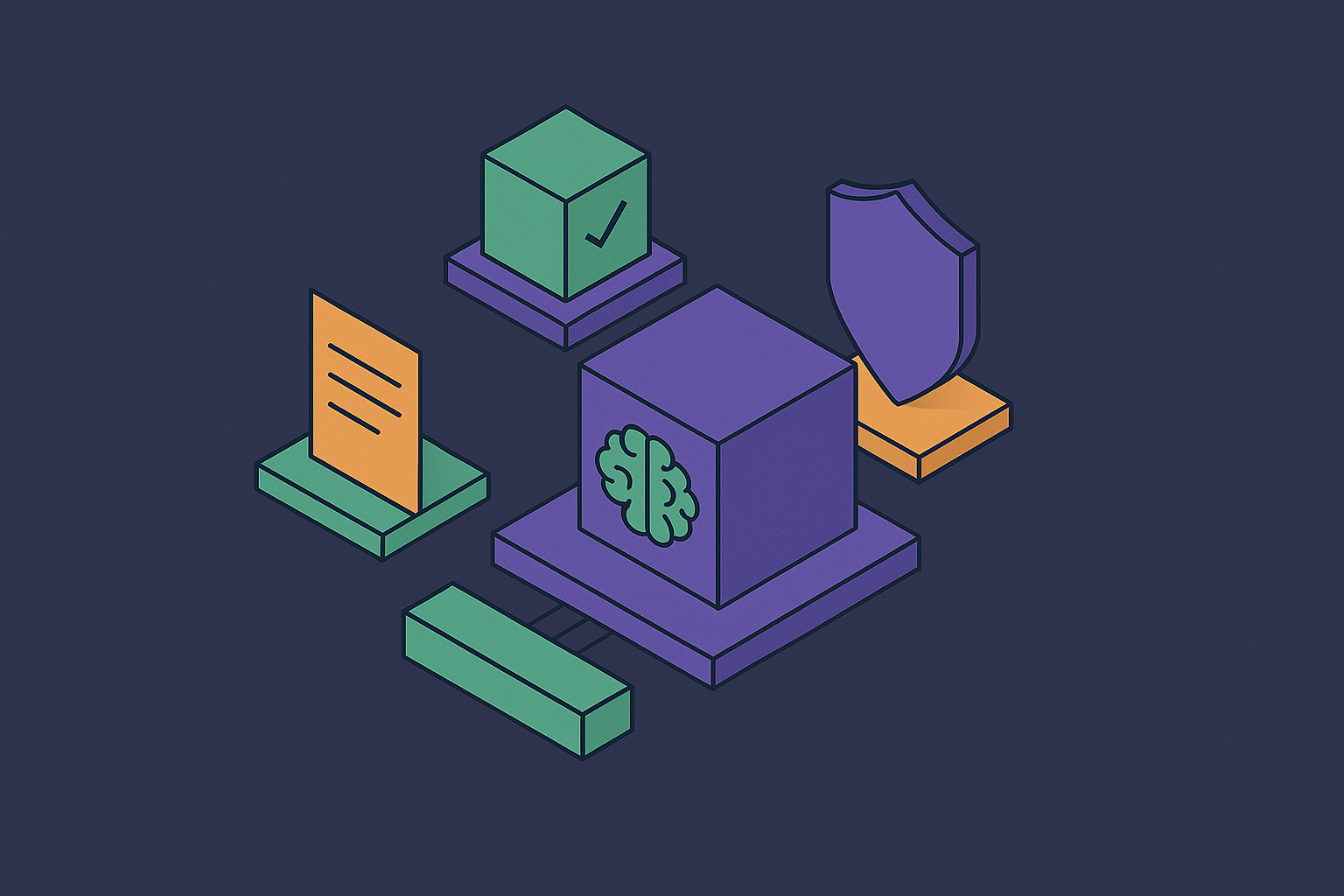
Governing autonomous AI agents comes down to four things you build before an agent ever touches production: identity, access control, observability, and accountability. Skip one and you're hoping the deployment goes fine rather than governing it. I've spent enough time inside these deployments to notice which one teams skip first (it's usually observability), and the pattern in what that costs them later is consistent enough to be worth naming.
How existing frameworks fall short of what agentic deployments actually require
NIST's AI Risk Management Framework assumes two things: that you can characterize a system's behavior at deployment time, and that a human sits in front of every decision it makes. Sit with those assumptions for a minute and they start to look shaky even for simple agents, let alone complex ones. Agents plan, pick tools, chain actions together, and change course mid-task, usually with nobody watching the individual steps go by.
ISO/IEC 42001 does better on paper. It's the first certifiable AI management standard, and it hands you 38 controls organized around plan-do-check-act. But it was written for managing AI systems broadly, and it struggles to enforce policy while an agent is three tool calls deep into something it decided to do on its own. The EU AI Act at least admits autonomy exists; it covers systems that "operate with varying levels of autonomy." What it doesn't settle is how much autonomy actually triggers high-risk classification. That question stays open, with full effect landing August 2, 2026.
None of these frameworks touch multi-agent coordination. None of them say what happens when an orchestrator delegates to five sub-agents and something breaks three hops down the chain.
Here's what the gap looks like on the ground. Agents get treated like generic service accounts: no dedicated identity, no real authorization boundary, no trail showing who did what. Okta surveyed 260 executives in 2025 and found only 10% of organizations have an actual strategy for managing autonomous systems, even as non-human and agentic identities are projected to top 45 billion by the end of 2026. Working through those two numbers side by side is what makes the shape of the problem clear: the frameworks exist on paper, but almost nobody has operationalized them, and that gap between written down and actually running is where most of the risk lives.
What the regulatory landscape now demands from deploying organizations
Singapore moved first. On January 22, 2026, at the World Economic Forum, it released the first governance framework built specifically for agentic AI, structured around four pillars: bounding risk upfront, human accountability, technical controls, and end-user responsibility. Every agent needs a verifiable digital identity and an audit trail showing which agent acted under whose authorization. You meet that bar or you don't; there's no partial credit.
Compliance with Singapore's framework is voluntary, but liability for what your agents do isn't. Doesn't matter whether you trained the model in-house or licensed it from a vendor, if your agent causes harm, you're on the hook.
The EU AI Act backs this through Articles 14 and 15, requiring human oversight scaled to risk, autonomy, and context. The Council of Europe's Framework Convention, adopted May 17, 2024, goes further: it's the first binding international AI treaty, spanning the full AI lifecycle across 26 articles, and its signatories include non-EU countries like the US, UK, Canada, Japan, and Australia.
American states are moving too, just clumsier about it. California's AB 316, effective January 1, 2026, kills "the agent acted autonomously" as a legal defense outright. Colorado's AI Act, effective June 2026, requires annual impact assessments from high-risk AI deployers, and NIST, having realized its existing playbook doesn't translate, launched an AI Agent Standards Initiative in February 2026, aiming for an interoperability profile by Q4.
Line these up and the direction is consistent even though the mechanisms differ: liability follows deployment, not intent. The governance structure has to exist before the agent acts, rather than get bolted on after something breaks.
Agent identity as the foundation every other control depends on
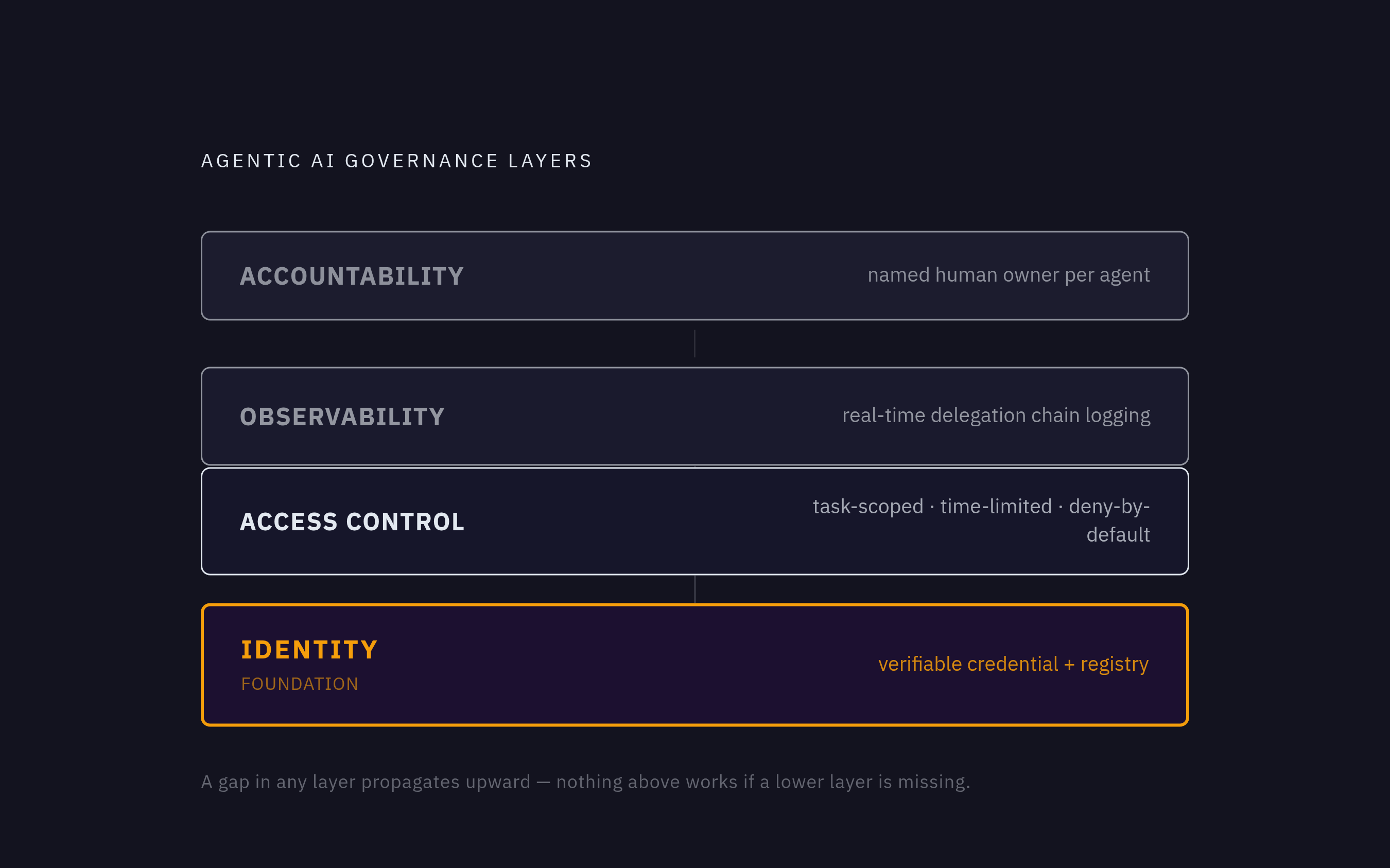
Nothing else on this list works without identity first. An agent with no verified identity looks exactly like any other background process on your network. You can't credential it, audit it, or hold it to a policy, because your systems don't see a "who." They see traffic, and traffic doesn't answer to anyone.
The tools we've leaned on for identity, OAuth, SAML, federated identity, were built for humans logging in or services that sit still in one place. Agents don't sit still. They run continuously, kick off downstream actions, and hit multiple systems back to back within a single task. NIST's own concept paper flags this mismatch directly, and it's worth reading if you want it spelled out plainly.
What agent identity actually needs: a credential scoped to the agent's specific role rather than a shared account three teams are quietly piggybacking on. Full attribution through delegation chains, so you can trace which agent authorized which action when an orchestrator hands off work. And lifecycle management, meaning credentials get issued, rotated, and revoked on a schedule, because a decommissioned agent with a live credential is a door nobody remembered to lock.
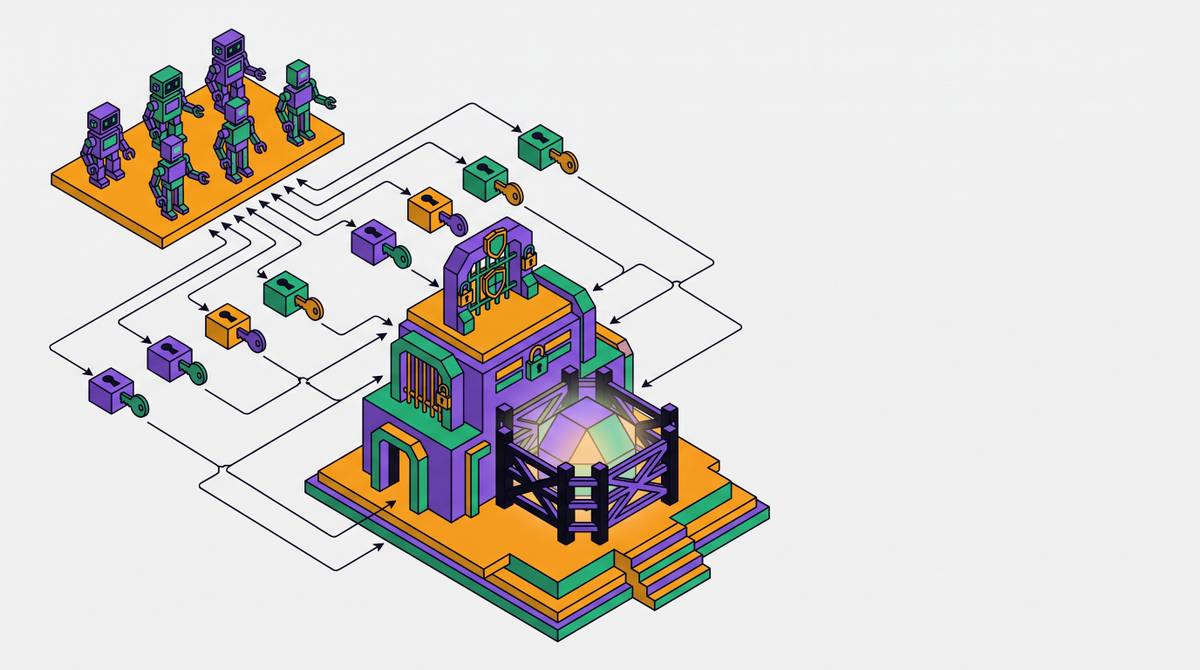
Singapore's framework makes this concrete: a verifiable digital identity and an authorization trail for every agent. Identity starts with a registry, and an agent that was never registered is an agent your organization can't account for. Unaccounted-for identities are exactly the ones that get exploited first. Model Context Protocol (MCP) has become the standard way agents connect to data sources, and a governed MCP registry gives you one place to see every agent that exists and everything it's allowed to touch.
Access control designed for agents that act across multiple systems in sequence
Human role-based access control assigns permissions to a person and mostly leaves them sitting there for months, sometimes years. Agent access control has to work differently: scoping permissions to a task, a window of time, and a set of resources, then taking that access back the moment the task ends.
Least privilege, done right for agents, means the agent gets exactly what its current task needs and nothing wider. Access narrows or expires as the task moves along, instead of sitting open at the broadest scope it was ever handed. In multi-agent setups, a sub-agent should never automatically inherit its orchestrator's full permission set just because it happens to sit downstream in the chain.
This is where MCP's attack surface problem shows up in practice. Every MCP server connected without an access policy is an open door the moment it connects, not the moment someone walks through it. A working framework spells out specifics: which agent can call which tool and under what condition, whether an action is read, write, or delete and scoped to which store, what an agent can't do without a human confirming first, and a deny-by-default rule so anything not explicitly granted gets blocked automatically.
Observability built for real-time detection, not post-incident review
A log you read after something breaks is a postmortem. Observability that actually functions catches the agent stepping outside its lane while it's happening, not two weeks later when someone finally pulls the logs because a customer complained.
Traditional logging tells you a system call happened. Agentic observability has to tell you more: which agent took the action and in what context, the full delegation chain showing which orchestrator triggered which sub-agent and what that sub-agent touched, every external API or data store or code execution environment the agent called along with its inputs and outputs, and the decision points where the agent chose between options.
Most organizations right now have no record of what their agents actually accessed, and that's the whole risk picture in one sentence. The danger in agentic AI usually isn't the model making a bad call; more often, it's the enterprise never finding out that it did.
Regulators already treat this as a baseline requirement. Singapore demands an audit trail tying every action to an authorizing agent, and the EU AI Act's Article 14 requires oversight to be possible, which means you can't oversee what you can't see. In multi-agent systems, visibility has to travel the entire chain; a sub-agent that isn't logged is a blind spot sitting underneath every control you built above it. Centralized logging across MCP connections gives you one consistent view across every server and agent. Without it, observability splinters by tool, by team, by whichever vendor happened to build that particular piece.
Accountability structures that work when no human approved each individual step
Accountability isn't only about assigning blame after something's gone wrong. It's the structure that lets you say, before anything happens, exactly who answers for what an agent does.
Three layers make this real. Organizational accountability names which team owns which agent and who has the authority to shut it down. Process accountability defines what approval an agent needed before reaching production and how often it gets reviewed while running. Technical accountability is the record, tied to a specific identity, a specific permission grant, a specific timestamp, that gives the other two layers something to point to when someone asks.
California's AB 316 makes this concrete in about the worst way possible. It strips away "the agent acted on its own" as a legal shield, so deployers answer for agent behavior no matter how the decision got made. Both the EU AI Act and Singapore's framework go further, requiring a named human, not a job title, not a department, to be responsible for oversight.
Shadow AI is what accountability looks like when it fails. An employee spins up an agent outside any governed path, and from that point on nobody is answerable for it, because nobody official even knows it exists. Banning the practice doesn't fix this; it just pushes it underground where you can't see it at all. Organizations that give teams a governed, sanctioned way to get the agent access they actually want end up with less shadow AI than the ones that try to ban it outright. Accountability doesn't stop at agents you built yourself, either. Singapore's framework covers third-party agents too: you're accountable for the behavior regardless of who trained the model.
How the framework components interact in multi-agent operations
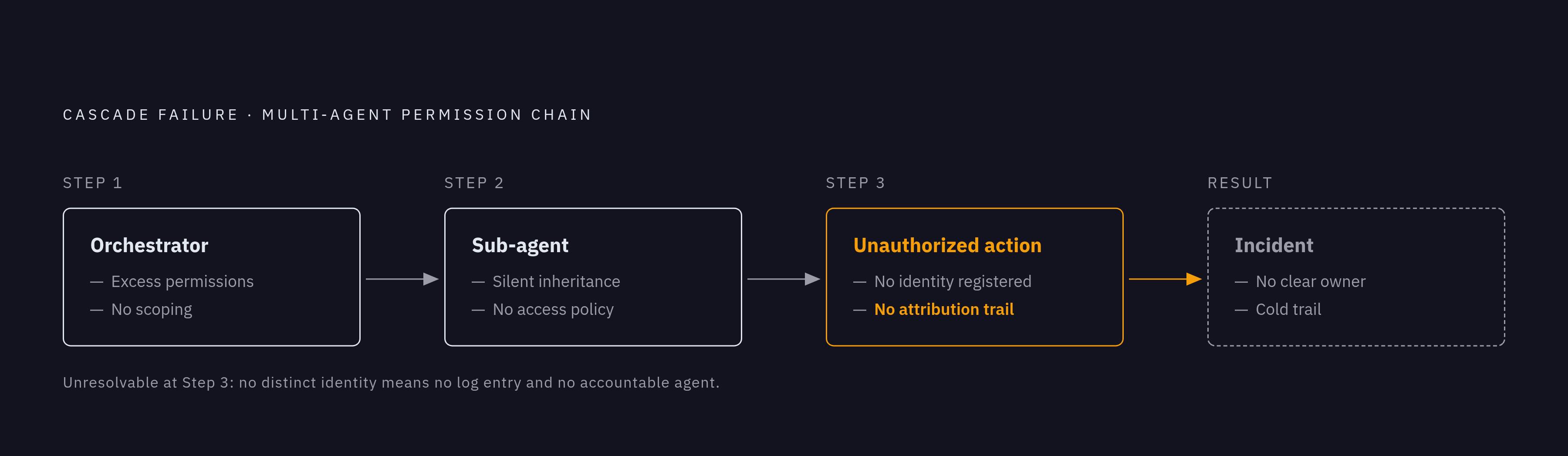
A single agent with a flaw is a contained problem. A multi-agent system with the same flaw is a chain reaction, and a gap in one layer doesn't stay in that layer; it travels.
I've traced this failure mode more than once, and it rhymes every time. An orchestrator holds broader permissions than it should, then delegates to a sub-agent that has no access policy of its own. That sub-agent quietly inherits access nobody explicitly gave it, takes an action nobody explicitly authorized, and leaves no attribution trail because it was never registered as a distinct identity to begin with. Three small failures stack into one incident with no clear owner and no clear cause, and by the time anyone's looking, the trail's already cold.
None of the major frameworks in use today specifically address this cascading failure, which is exactly why a framework built for agents has to. Cross-layer coherence needs a few things working together: a sub-agent's credential distinct from its orchestrator's, traveling with every action it takes; permissions scoped to the delegated task rather than cloned wholesale from the orchestrator; logging that spans the full chain with delegation context preserved at every hop; and a central registry naming a human responsible for the orchestrator and recording ownership of every sub-agent underneath it.
What actually makes this operational is a centralized gateway, a single point where policy gets enforced right when agents connect to tools and data. Without that enforcement point, every layer gets built in isolation, team by team, and the seams between them are exactly where incidents happen. MCP Manager is built around that model: a gateway that enforces access controls, logs every tool invocation, and keeps a live registry of agent identities across every MCP connection. Solve the cross-layer problem once at the infrastructure level, and you stop rebuilding it, imperfectly, every time a new team ships an agent.
Deploying a governance framework without making it the reason agentic AI moves slowly
The usual objection goes: governance slows things down, so secure it once it's live. Trace that choice through and it produces one of two outcomes, delayed production or ungoverned production, and neither is actually fast, no matter how it feels in the moment.
"Secure it later" misreads how the risk works. An ungoverned MCP server is an open attack surface the instant it connects, not the instant something exploits it. Putting off governance doesn't put off the exposure; it just puts off finding out about it, usually at the worst possible time, in front of the worst possible audience.
The teams shipping agentic AI fastest right now built access policy and identity management before their first production deployment. Guardrails set up in advance are what let them say yes quickly, instead of re-justifying every new deployment from scratch to whoever's asking that week.
If you're starting from roughly where most organizations sit today, that 10% baseline, sequencing matters more than ambition. Start with the registry: you can't govern what you haven't counted, so every MCP server and every agent gets an entry before it touches production. Get identity and access policy in place before launch, rather than after your first incident forces a conversation nobody wanted to have. Wire observability to real-time alerts instead of archives nobody opens until something's already on fire, then name a human accountable for each agent before it goes live, not after someone asks who was supposed to be watching it.
None of this is exotic. It's the same rigor we've applied for years to every other system that touches customer data or production infrastructure. Agents just move faster than what we're used to governing, so the discipline has to show up earlier. That's the whole adjustment.