Shadow AI and Ungoverned MCP Adoption in Enterprises
Most enterprises can't see the AI tools their workers use, let alone control them.
Unauthorized AI tool use isn't fringe behavior confined to a careless minority. Studies put the majority of enterprise workers using unapproved AI tools, and security leaders themselves are not exempt. When organizations deploy automated monitoring, the real number of AI tools in active use turns out to be several times larger than leadership estimated, sometimes by a factor of three. That isn't a rounding error. It's a different reality entirely.
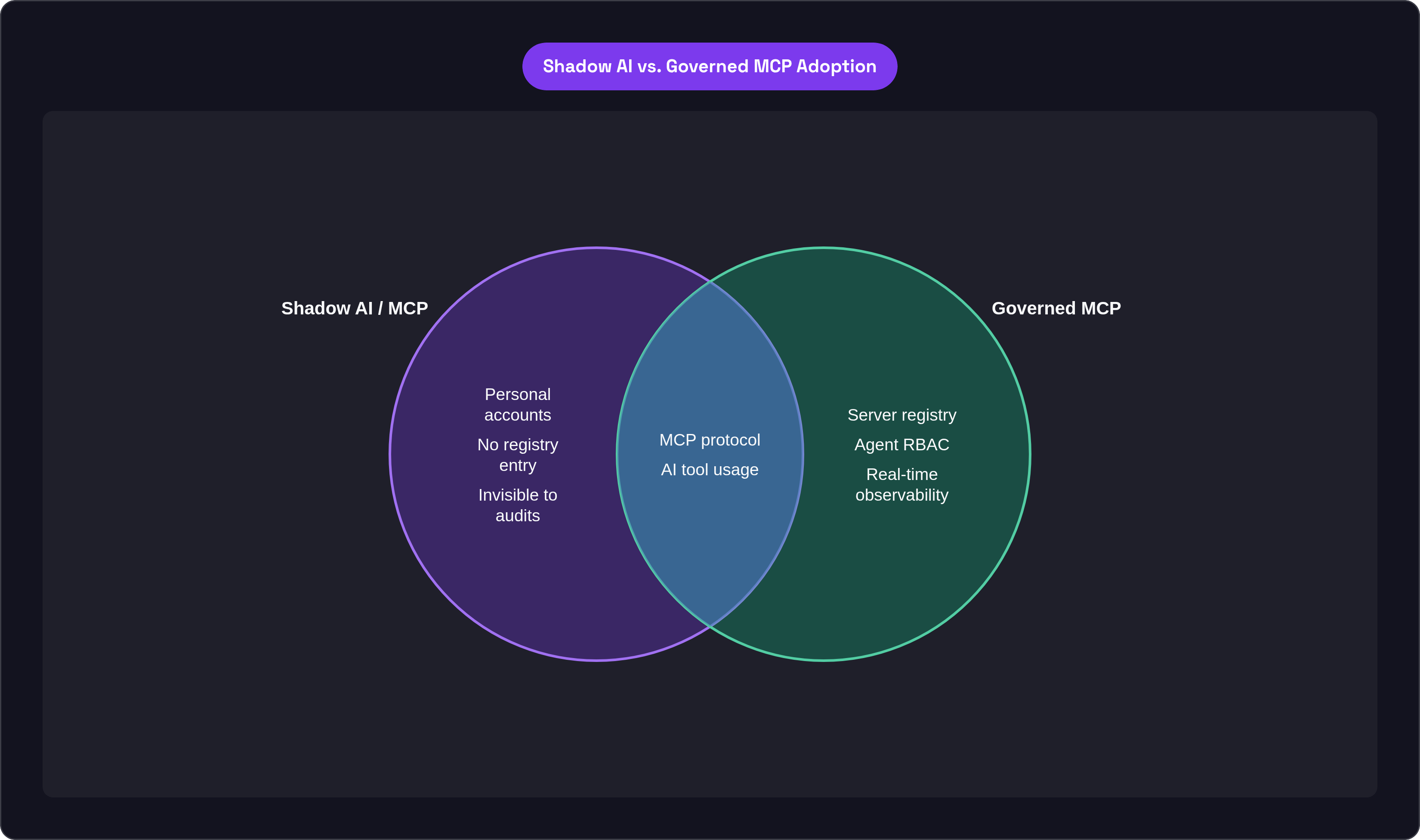
What keeps this persistent is that the access vectors are, often inadvertently, designed to be invisible. A large share of enterprise generative AI usage flows through personal, unmanaged accounts, which means data entering those tools bypasses corporate controls entirely. Some shadow AI tools accumulate hundreds of days of active use before IT learns they exist, at which point the tool is load-bearing: someone has built workflows around it, and removing it creates real disruption. The organization has made a dependency without ever deciding to.
Fewer than half of organizations have policies that would even detect shadow AI usage, let alone manage it. That's the baseline before MCP existed. Every dimension of it compounds when you add an autonomous agent layer that can act on live systems without a human approving each step.
These claims require citation of specific studies and reports to be verifiable. The figures cited — majority of workers using unapproved tools, the factor-of-three gap, the share using personal accounts, the hundreds of days of undetected use, and the fewer-than-half figure on policy coverage — should each be attributed to a named source.
What MCP's explosive adoption curve looks like when most of it happens outside security review
The Model Context Protocol, introduced by Anthropic in late 2024, is a standardized way for AI systems to connect to external tools and data sources. What it did practically was collapse the integration effort. Developer teams that previously needed weeks of custom API work to connect an agent to a CRM or internal database can now do it in hours. That isn't a marginal improvement; it's a category change in who can build these connections and how fast, and speed changes behavior.
MCP went from niche protocol to mainstream enterprise integration standard within months, with downloads scaling from negligible to millions in under half a year. Major enterprises across financial services, technology, and e-commerce are running it in production. But legitimate adoption and governed adoption aren't the same thing, and conflating them is where organizations get into trouble.
A significant share of organizations experimenting with MCP servers haven't reached production yet, and pre-production deployments have almost never passed through formal security review. Authorization wrappers and access controls get added opportunistically, after the fact, when teams notice they're missing. MCP's open-source ecosystem now includes thousands of servers and hundreds of clients, most built without security as a first-order design concern, and the developer experience actively accelerates this pattern.
The result is structurally identical to the shadow IT dynamic enterprise security teams spent the last decade managing, except the consequence when it goes wrong is materially different. An ungoverned MCP server doesn't just leak data a user typed into a chat window. It can act on live systems autonomously, at machine speed, persisting across sessions and accumulating access in ways a browser tab never could. That qualitative shift is the part that actually matters, and most organizations haven't internalized it yet.
Specific claims in this section — the download figures, the share of organizations not yet in production, the number of servers and clients in the ecosystem — require citation of named sources.
The security vulnerabilities that ungoverned MCP servers introduce that conventional controls don't catch
MCP reverses a familiar interaction pattern. Instead of clients requesting data from servers in a predictable, auditable sequence, servers in the MCP model often query and execute actions on behalf of clients. That inversion creates attack paths that existing network and application controls were never designed to intercept.
Authentication is optional in the base protocol, not required. That means production MCP servers exist right now, reachable from agent runtimes, with no credential check on who is asking. Role-based access control is absent from the MCP protocol entirely; any access boundaries have to be built and enforced by the implementing organization, which ungoverned deployments don't do because nobody in the organization knows the deployment exists.
The credential aggregation risk is worth sitting with for a moment. MCP servers frequently hold OAuth tokens for multiple connected services simultaneously, so compromising one server can grant access to everything linked to it, and those tokens can persist even after a password change.
Security researchers have documented specific incidents in published advisories. A malicious MCP package operated undetected for weeks while exfiltrating email data. An official, widely-used MCP server package was backdoored by its own maintainer to silently copy outbound emails to an attacker-controlled address across multiple published versions, meaning the supply chain itself was the attack vector. A platform compromise exposed API keys, database credentials, and OAuth secrets across thousands of deployed MCP applications through a path-traversal flaw. A late-2025 attack used malicious MCP packages to steal developer credentials from local tooling, then automatically republished infected packages at scale. Each of these incidents should be attributed to the specific advisory or researcher report in which it was documented.
NSA guidance stating that MCP adoption has outpaced the development of appropriate security safeguards, and the claim that researchers from multiple security firms maintain dedicated vulnerability trackers with a significant share rated critical, should each be cited to the specific NSA publication and the named firm reports.
Tool poisoning deserves its own mention. Server-side metadata that an agent uses to discover what it can do has been maliciously authored in documented incidents, causing the agent to read a poisoned capability description and execute actions its operator never intended. Prompt injection in an MCP ecosystem isn't the same as prompt injection in a chatbot; it can trigger automated actions on live systems, not merely produce a bad text response. The blast radius is different.
These vectors are only possible because ungoverned servers lack the registry entries, access controls, and monitoring that would make them detectable and containable. This isn't a protocol flaw a patch will fix. It's a governance absence, and only governance addresses it.
Why banning MCP or restricting access to AI tools makes the exposure worse, not better
The Samsung case has become a widely cited illustration of why blanket prohibitions backfire. After data exfiltration incidents prompted a ban on generative AI tools, the ban didn't reduce AI use. It reduced visible AI use. Employees kept using personal accounts and unofficial tools, now entirely outside the scope of enterprise monitoring. This account of the Samsung case should be cited to a specific, named source.
Research on shadow AI confirms this dynamic broadly. A large share of employees continue using personal or unofficial AI accounts even after an organizational ban, bypassing enterprise controls entirely. This claim requires citation of the specific research. Blocking pushes adoption underground rather than eliminating it. Underground adoption is adoption without any of the guardrails, registry entries, or monitoring that would make it manageable. Compliance training hasn't closed this gap either; in some cases it creates overconfidence, because employees who've received training feel they understand the risk well enough to manage it themselves. The claim about training creating overconfidence should likewise be attributed to a named source.
For MCP specifically, the structural problem is identical. Developer teams that can't get official server access through governed channels will build or pull unofficial ones: identical function, zero visibility.
A policy of restriction doesn't eliminate the MCP attack surface. It ensures the organization has no record of where that surface is. The organization isn't safer; it's simply less informed about its own exposure.
The alternative isn't permissiveness. It's a governed path that makes sanctioned adoption easier than unsanctioned adoption, so developers default to it because it's the path of least resistance, not because someone persuaded them to care about security. That's a meaningful distinction. You're not trying to change culture; you're changing the incentive structure.
What an organization needs to have in place before it can govern MCP adoption
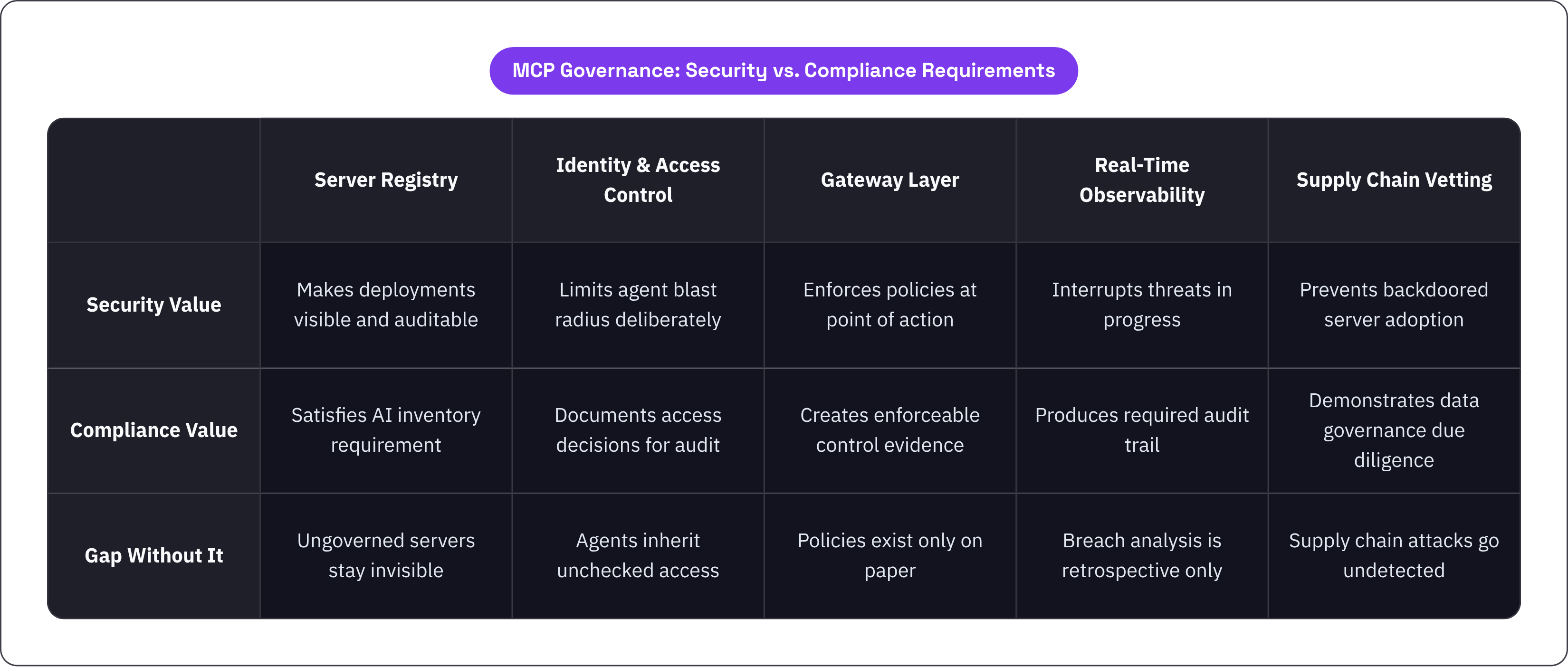
Start with visibility, because you cannot govern what you cannot see. Most organizations right now cannot produce a complete inventory of their AI systems, and that inventory is also a foundational requirement under major regulatory frameworks. The compliance problem and the security problem share the same root cause.
A server registry is the starting point. Every MCP server that agents are allowed to connect to needs an entry capturing who deployed it, what it accesses, and under what authorization. Ungoverned servers are invisible identities, and invisible identities become exploitable identities because no one is watching them.
Identity and access control must extend to agents, not just humans. Applying role-based access control to AI agents means the organization has made a deliberate decision about what each agent is permitted to touch, rather than discovering after an incident that the agent had access to everything it could reach. The principle is exactly what organizations have applied to human principals for years, now extended to a new class of actor.
A gateway layer is the enforcement surface. Routing agent-to-server communication through a centralized control point creates both the mechanism for applying access policies and the collection point for audit data. Without it, policies exist on paper but have no operational reality. They can describe, after the fact, what shouldn't have happened. They can't interrupt anything.
Real-time observability matters more here than retrospective logging. An audit log reviewed after a breach is a postmortem tool. Governance that functions as a safety net needs to be capable of interrupting an action in progress, not documenting it afterward.
Supply chain hygiene for MCP servers means vetting provenance and integrity before servers are registered, not after deployment. Given documented incidents of maintainer-side backdoors, this isn't an abundance of caution. It's operational practice consistent with what the threat landscape has already demonstrated.
None of this infrastructure is primarily about restriction. It's about creating a governed path that is faster and easier than the ungoverned alternative, so developer teams default to it because it's the sensible choice, not the imposed one.
How governed MCP adoption accelerates production deployment rather than slowing it down
Engineering teams push back on governance for an obvious reason: it delays deployment, and fast-moving teams can't afford security review on every MCP server connection. That concern is legitimate. The conclusion they draw from it usually isn't.
The actual bottleneck in most organizations isn't governance overhead. It's the absence of a clear, repeatable path from experimentation to production approval. Teams stall at the threshold of production not because security is too rigorous, but because nobody has built the machinery that would let security say yes with confidence. The review process is slow because it's being invented from scratch each time, under pressure, without established criteria. That's not governance slowing things down; that's the absence of governance creating a vacuum that everyone works around inefficiently.
Teams that centralize and enforce MCP access policies proactively move to production faster, because the guardrails are already in place rather than being constructed after the fact under incident pressure. The gap between MCP experimentation and production deployment visible across the industry isn't primarily a technical barrier. It's a trust barrier: organizations lack the visibility to confidently approve production use, so deployments sit in pre-production limbo that satisfies no one. These empirical claims about team behavior and deployment timelines should be supported by cited evidence.
A governed path closes that gap by making the registry, access controls, and observability standard infrastructure rather than a project triggered by an incident. Organizations treating AI governance as a competitive advantage rather than a compliance checkbox are building the audit trails and access records that regulators and enterprise customers will increasingly require. They're not waiting to be asked.
Usercentrics built MCP Manager as a gateway and control layer for agentic AI deployments, providing observability, guardrails, and access controls for organizations working through exactly these challenges.
The regulatory floor that makes ungoverned MCP adoption a compliance liability, not just a security one
The EU AI Act is enforcing now. Prohibited AI practices have been in scope since early 2025, GPAI model obligations since mid-2025, and high-risk system requirements along with full transparency and documentation obligations are active as of mid-2026. These dates and scope descriptions should be cited to the official EU AI Act text or a named authoritative source.
Among those requirements: risk management, data governance, technical documentation, and cybersecurity, all of which assume an organization knows what AI systems it's running and what those systems access. An organization that cannot produce that inventory isn't in a preliminary state of compliance. It's non-compliant on the foundational predicate for everything else.
Fines under the EU AI Act scale to a percentage of global annual turnover. For a large enterprise, non-compliance with high-risk system requirements is a material financial exposure, not a theoretical one. The specific penalty tiers should be cited to the relevant articles of the EU AI Act.
The NIST AI Risk Management Framework and ISO 42001 share the same foundational requirement: an AI inventory. Ungoverned MCP servers are invisible to any inventory process by definition. If a server has no registry entry, it cannot appear in a compliance audit. The organization is simultaneously exposed to security incidents and unable to demonstrate compliance, regardless of how mature the rest of its security program is.
This is the part that removes ambiguity about whether MCP governance is optional for enterprises operating under these frameworks: it isn't. The registry, access controls, and observability layer that closes the security gap is also what makes AI inventory production possible. These are not separate projects with separate budgets and separate timelines. They are the same project, and the organizations that recognize that earliest will spend considerably less money solving it than the ones who discover it under regulatory scrutiny.