Agentic AI Incident Response Playbooks
Governance frameworks that let agentic AI respond faster without losing audit trails.
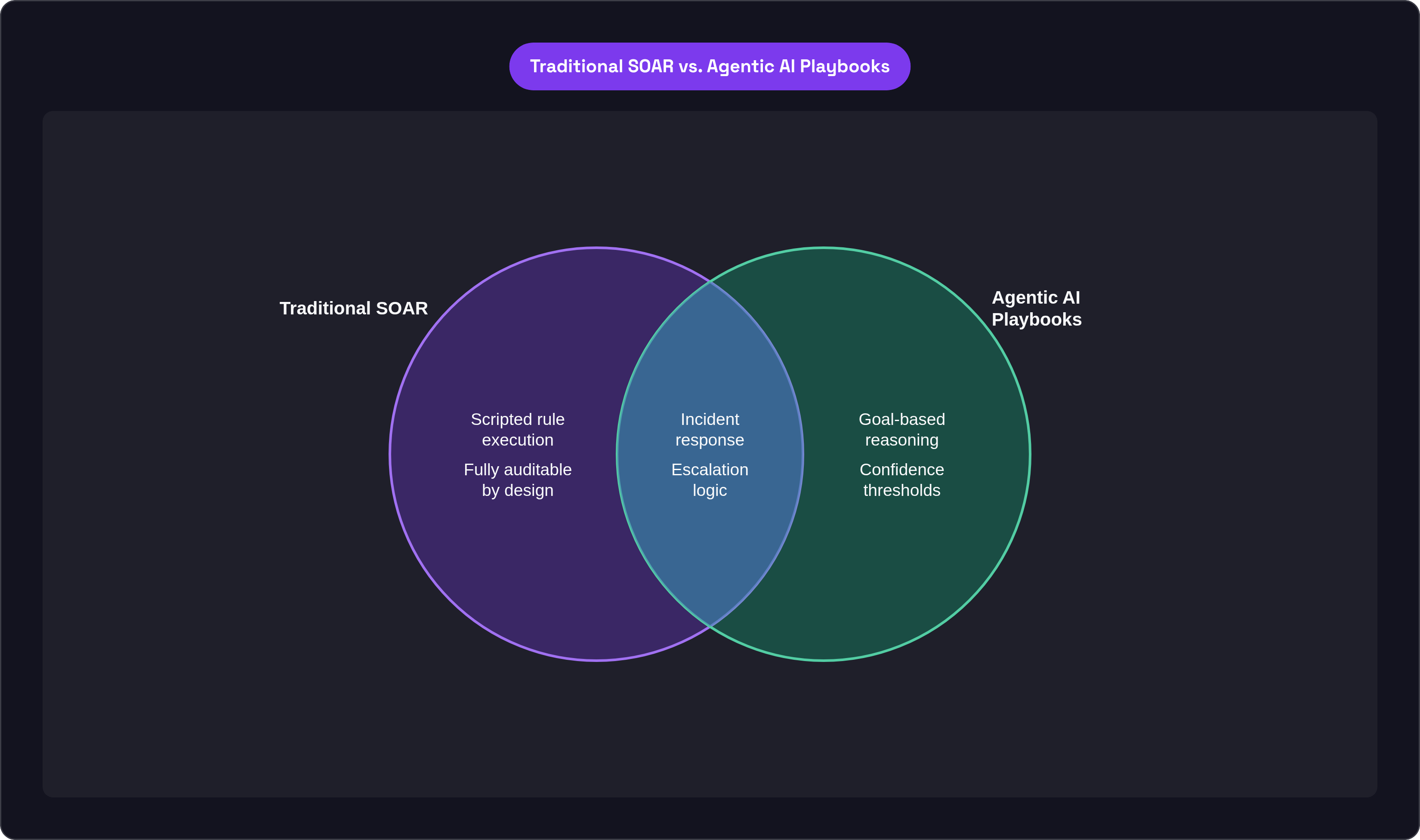
SOAR runs scripts: give it condition X, it fires step Y, every time, same order. Agentic AI doesn't work that way. It reasons about goals, picks its own tools, and acts across multiple steps without anyone hovering over each decision, and most SOC teams are still writing playbooks built for the scripted world, which is the gap I want to walk through here.
The old playbook was fully auditable precisely because it was dumb. It only ever did what you told it, so tracing why it fired was trivial; you just read the rule. An agentic system reasons and adapts mid-execution, which means SOAR automates tasks while agentic AI acts on judgment. That distinction sounds small until you're the one explaining to an auditor why an agent revoked a credential nobody flagged.
Gartner retired the SOAR Magic Quadrant in 2025, and that alone tells you where the industry thinks this is heading. But adoption is still early: Gartner's 2025 Hype Cycle for Security Operations puts AI SOC agents at 1 to 5% market penetration. So most of us are figuring out what belongs in one of these playbooks as we go, not pulling from some settled template that already exists.
Here's the shift, in one line: a traditional playbook is a script the machine follows, while an agentic playbook is a governance contract the agent operates inside, one that defines the edges of its authority, the moments it has to stop and ask, and the record of what it decided and why. Getting an agent to act was never the hard part. Building something that lets your organization trust and verify what it did, that part's still unfinished, and it's the part I care about most.
The operational pressure that makes agentic playbooks necessary right now
Start with the raw number. SOCs handle around 960 alerts a day on average, and large enterprises blow past 3,000 without much trouble. About 40% of those never get investigated at all, simply because there aren't enough hands on the keyboard, and that gap doesn't close on its own.
Attackers got faster than most of us expected. ReliaQuest's 2026 Annual Threat Report clocked the fastest lateral movement of 2025 at 4 minutes, up 85% year over year, with average breakout time dropping to 34 minutes. Unit 42 found AI-assisted attacks cutting simulated time-to-exfiltration to 25 minutes; in real-world incidents, the fastest quartile hit exfiltration in 1.2 hours, down from 4.8 hours the year before. Defenders didn't get 85% faster, but attackers did, and that asymmetry is the reason this conversation is urgent now instead of five years from now.
Traditional SOAR closes something like 30 to 40% of Tier-1 alerts on its own. Agentic SOC approaches, in the case studies I've seen documented, reach around 90%. Teams are moving toward agentic response whether or not the governance is ready for it, because a coverage gap that size is too expensive to leave sitting there.
There's a human cost buried in this too. Senior analysts spend more than 60% of their time writing up what already happened instead of hunting for what's happening right now, and mean investigation times still run around 45 minutes even with automation bolted on. Every recurring alert type technically deserves its own documented playbook, but the engineering hours needed to build and maintain hundreds of them run past what almost any SOC team actually has, and the backlog just grows.
None of this argues for turning agents loose without a leash, though. Hand an agent speed without boundaries and you've just handed that same speed to whoever compromises it first. A fast agent with no limits doesn't cover more ground than a slow analyst who's at least watching the right things; it just makes the same mistakes faster.
The six components a traditional incident response playbook is missing
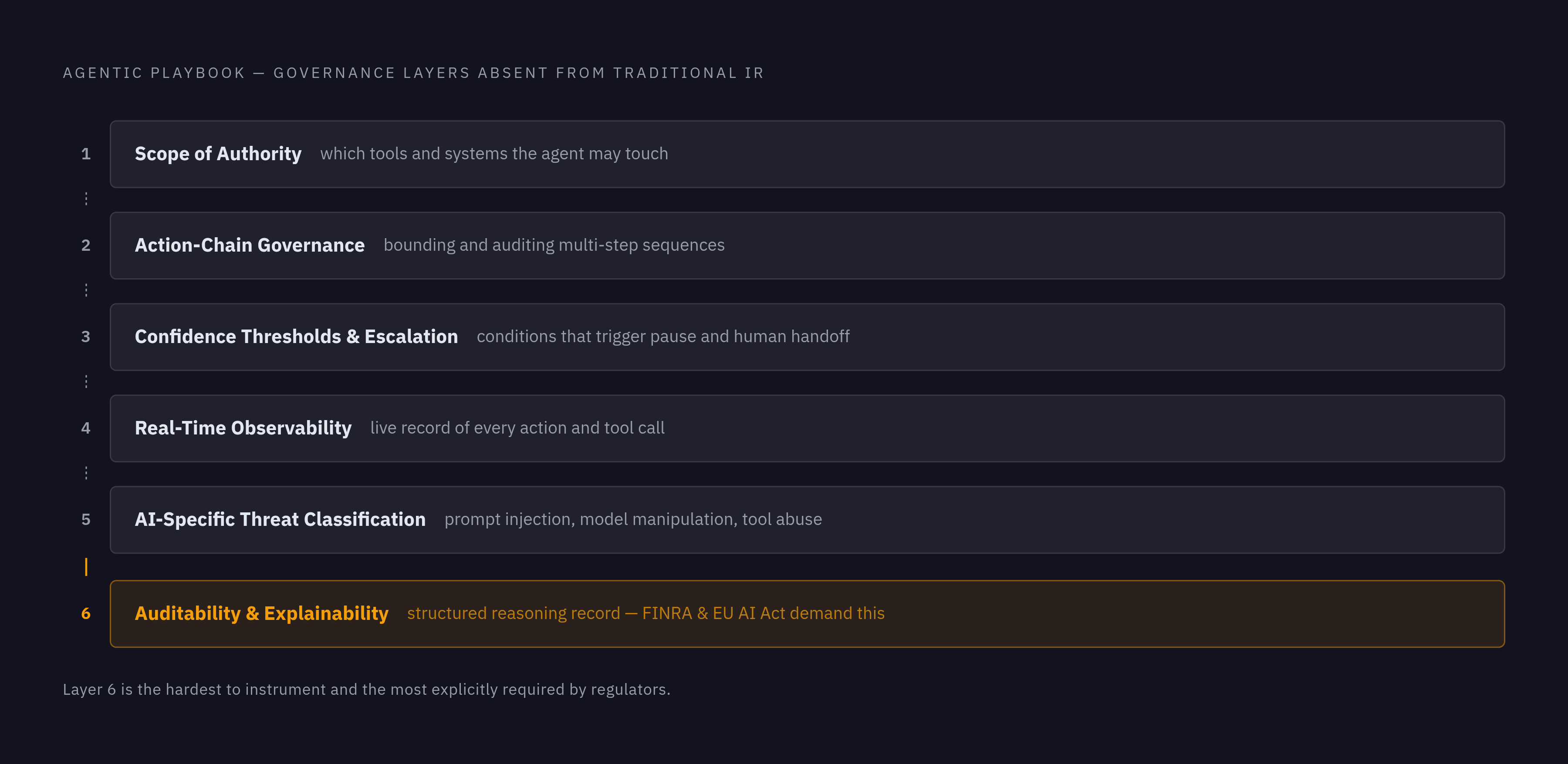
Old-school IR playbooks assume a human reads each step and decides whether to move forward. Hand execution to an agent and that assumption collapses. Every one of those judgment calls has to become an explicit rule the agent enforces on itself, and that's a bigger rewrite than most teams expect going in.
Scope of authority comes first: what tools, systems, and data the agent can touch, and what's flatly off the table. Then action-chain governance, which is really about bounding multi-step sequences so a permitted action can't quietly chain into one that wasn't. Confidence thresholds and escalation triggers come next: the exact conditions under which the agent stops and hands off instead of pushing forward on its own.
Real-time observability matters just as much. You need a live record of every action and every tool call, not a log you read the morning after. AI-specific threat classification belongs in here too, since the agent is a target now, not just an investigator; prompt injection and model manipulation deserve a place in the actual playbook rather than some separate document nobody opens. Last, auditability and explainability: a structured record of the reasoning behind a decision, not just the outcome, detailed enough to survive regulatory review.
CoSAI published the first framework that tackles these systematically. Their AI Incident Response Framework V1.0, released in November 2025, defines detection methods, triage criteria, containment steps, and recovery procedures specific to AI systems. FINRA's 2026 Regulatory Oversight Report names three of these gaps outright: autonomy (agents acting without human validation), scope creep (agents exceeding their intended authority), and auditability (multi-step reasoning that's genuinely hard to trace after the fact).
Defining the agent's scope of authority before the playbook runs
What an agent is allowed to do should be a decision your organization made on purpose. Too many deployments skip that step and just inherit whatever the vendor's defaults happen to be, which is a strange place to leave a decision this consequential.
Split it into two pieces. Tool access covers which APIs, data sources, and systems the agent can query or touch at all. Action authority covers which of those it can execute on its own (containment, ticket creation) versus what needs a human signature, like revoking credentials or sending a public-facing message.
Role-based access control applied to the agent's own identity, not just the human operator's, is what turns this into something enforced at runtime instead of a policy written down and ignored. MCP server environments raise the stakes further: every MCP server an agent can reach extends its action surface, whether anyone meant for it to or not. An ungoverned MCP connection is an undeclared grant of authority.
This is where a tool like MCP Manager earns its keep. It gives you a registry and gateway layer that makes each MCP server's access permissions explicit and enforceable, translating the playbook's authority decisions into constraints the agent physically can't cross. Without something doing that job, scope of authority stays a paragraph in a document rather than an actual limit.
I keep running into the same mistake. Teams scope authority carefully at launch, then six months later bolt on new MCP servers or integrations without ever touching the authority model again. Every new server is a new identity to account for, and skip that update enough times, and the playbook stops describing what the agent can actually do; it just describes what it used to be able to do.
Map permitted tools and actions per agent role before you write a single playbook step. Make the authority definition the first artifact you produce, not the appendix you tack on at the end.
Structuring action chains so that permitted steps cannot cascade into unpermitted ones
Say an agent can query IAM, isolate a host, and open a ticket. Each of those is fine on its own. Chain them together, though, in sequence or with something unexpected slotted in between, and those three permitted actions can add up to an outcome nobody designed for. That's subtler than the scope problem, because every individual step still looks clean on paper.
A real playbook needs sequencing constraints: which actions have to happen before others, and which ones can't follow a given action without a human confirming first. It needs state checkpoints too, points where the agent checks what's actually happening against what it expected before it keeps moving, rather than one trigger check at the start and a free run to the end. And it needs blast radius limits, hard caps like "agent may isolate up to five hosts on its own; past that, it escalates."
Exaforce's Exabot architecture shows this holding up in the field. Agents pull data across GuardDuty, CloudTrail, IAM, Okta and Entra ID, plus EDR tools like CrowdStrike and SentinelOne, but every pull and every action runs through defined sequencing logic instead of being left to the agent's judgment in the moment. AWS Security Incident Response's agentic investigation agent, updated in November 2025, builds in its own checkpoint: it identifies missing information and asks the case submitter clarifying questions before it proceeds. That pause was designed in from the start, not patched on later.
A playbook that lists permitted tools but doesn't constrain how they can be strung together hasn't actually bounded the agent. It just looks like it has.
For each incident type, write the expected action chain as a directed graph, not a flat list. Find every branch point in that graph and decide, ahead of time, whether the agent proceeds on its own there or stops.
Setting the confidence thresholds and human escalation triggers that govern autonomous action
Agentic IR systems don't just spit out a verdict. They attach a confidence level to it, and the playbook has to say, in plain terms, what confidence clears the bar for each category of action the agent might take on its own.
Think tiers. High confidence, low blast radius: the agent acts and logs it, blocking an IP or opening a ticket without asking. High confidence, high blast radius: it still acts, but it notifies immediately and needs acknowledgment inside a set window. Low confidence, regardless of blast radius: it queues for human review with a full evidence package and waits there. A genuinely novel threat with nothing matching in the playbook library escalates right away, lays out what it found, and waits.
That 34-minute average breakout time from ReliaQuest's report is exactly why the escalation window matters so much. Route too many decisions to human review and you've just rebuilt the latency problem you set out to fix.
The escalation package itself needs the evidence chain, the confidence score and what produced it, the action the agent would have taken on its own, and the alternatives it weighed and rejected. IBM's architecture is a decent example: the agent analyzes a DLP server log failure, proposes root causes drawing on its product knowledge, then triggers a remediation playbook, with the handoff between reasoning and action fully explicit and logged the entire way.
Define escalation triggers by action type, not by incident type. The same incident might warrant autonomous containment on one front and demand human sign-off for credential revocation on another. Treating the whole incident as one unit flattens a distinction that actually matters.
Building real-time observability into the playbook, not the postmortem
Most teams have no live record of what their agents touched while an incident was actually unfolding. An audit log you read afterward is a postmortem, and by the time you're reading it, whatever was going to happen already has.
Real-time observability means logging every tool call the instant it's made, not batching it once the run finishes. It means recording every data source the agent touched, down to which records, not just which system. It means capturing every action alongside the reasoning state that produced it, and every escalation alongside how fast a human actually responded.
MCP Manager's observability layer handles this in MCP-connected environments: a live feed of every tool the agent called, every data object it reached, and the identity it used to reach it. That sits as a control plane between what the agent intends and what it actually touches. Skip a gateway that intercepts and logs that traffic, and the only record you have is whatever the agent chooses to tell you about itself, which amounts to a self-report rather than an audit.
Write the observability spec before you connect anything to production, not after. Once that visibility exists, feed it back into the playbook: how often the agent escalates, how accurate its calls turn out to be over time. NIST SP 800-61r3 leans hard into this framing, treating incident response as continuous learning rather than a document you write once and shelve.
Classifying the threats the agent itself faces, not just the threats it investigates
Old IR playbooks treat the response tooling as trusted infrastructure by default. That assumption is dead now, and an agentic playbook has to treat the agent as a potential target, because it is one, full stop.
MITRE ATLAS v5.1.0, published in November 2025, catalogs 16 tactics, 84 techniques, and 56 sub-techniques aimed specifically at AI and ML systems. Prompt injection sits at the top: adversary-controlled input that redirects the agent's reasoning or its actions. Model manipulation follows, poisoned training or fine-tuning data that biases decisions at scale. Model supply chain compromise covers malicious components slipped in through the model or its tool dependencies. Tool abuse means manipulating the agent's tool-calling behavior so it exceeds its intended authority or leaks something it shouldn't.
MITRE added 14 new attack techniques targeting AI agents and generative AI systems in October 2025 alone. This taxonomy is expanding about as fast as the deployments it's trying to describe, which should tell you something about how young this whole field still is.
CoSAI's framework covers five distinct AI architecture patterns, from basic LLM applications up through complex agentic RAG systems, and each needs its own detection logic. They aren't interchangeable, and treating them as one thing is how gaps open up. GenAI-IRF, published in the Journal of Cybersecurity and Privacy in January 2026, formalizes six recurring AI incident archetypes and stitches together NIST SP 800-61r3, NIST AI 600-1, MITRE ATLAS, and the OWASP LLM Top-10 into one structure. If you're building from scratch, keep it open on a second monitor.
For every agent in your playbook, work out which adversarial techniques it's actually exposed to given its tool access and data sources, then spell out the indicators that would flag a compromised agent. That deserves a section of its own, carrying the same weight as any other core component, not a footnote at the bottom.
What regulatory frameworks now require from agentic playbooks
NIST SP 800-61r3, finalized in April 2025, does the most work here. It explicitly endorses automating alerts, triage, and information sharing, lining up with CSF 2.0's Respond and Recover functions, and it frames incident response as continuous practice woven into risk management, something you're doing before any alarm ever goes off, not after.
The EU AI Act adds hard deadlines on top of that. Full applicability lands in August 2026, and for high-risk agentic systems, the requirements get specific fast. Article 9 requires continuous risk management, and Article 12 requires tamper-evident log retention for at least six months. Article 14 requires human oversight built into deployment from day one, not added after the fact. Article 15 sets cybersecurity resilience requirements, and incident reporting has to happen within 72 hours, no exceptions.
Put these together and they're converging on one demand, said a few different ways: show your work. What the agent did, but also why, under what authority, with what oversight, and with a record that holds up when someone outside your team asks to see it. That's the actual bar now, and it sits higher than what most SOC playbooks clear today, which is the compliance gap MCPManager, a Usercentrics product that centrally controls, monitors, and audits how AI systems access business data via MCP, was built to address.