Change Management for Enterprise AI Governance Programs
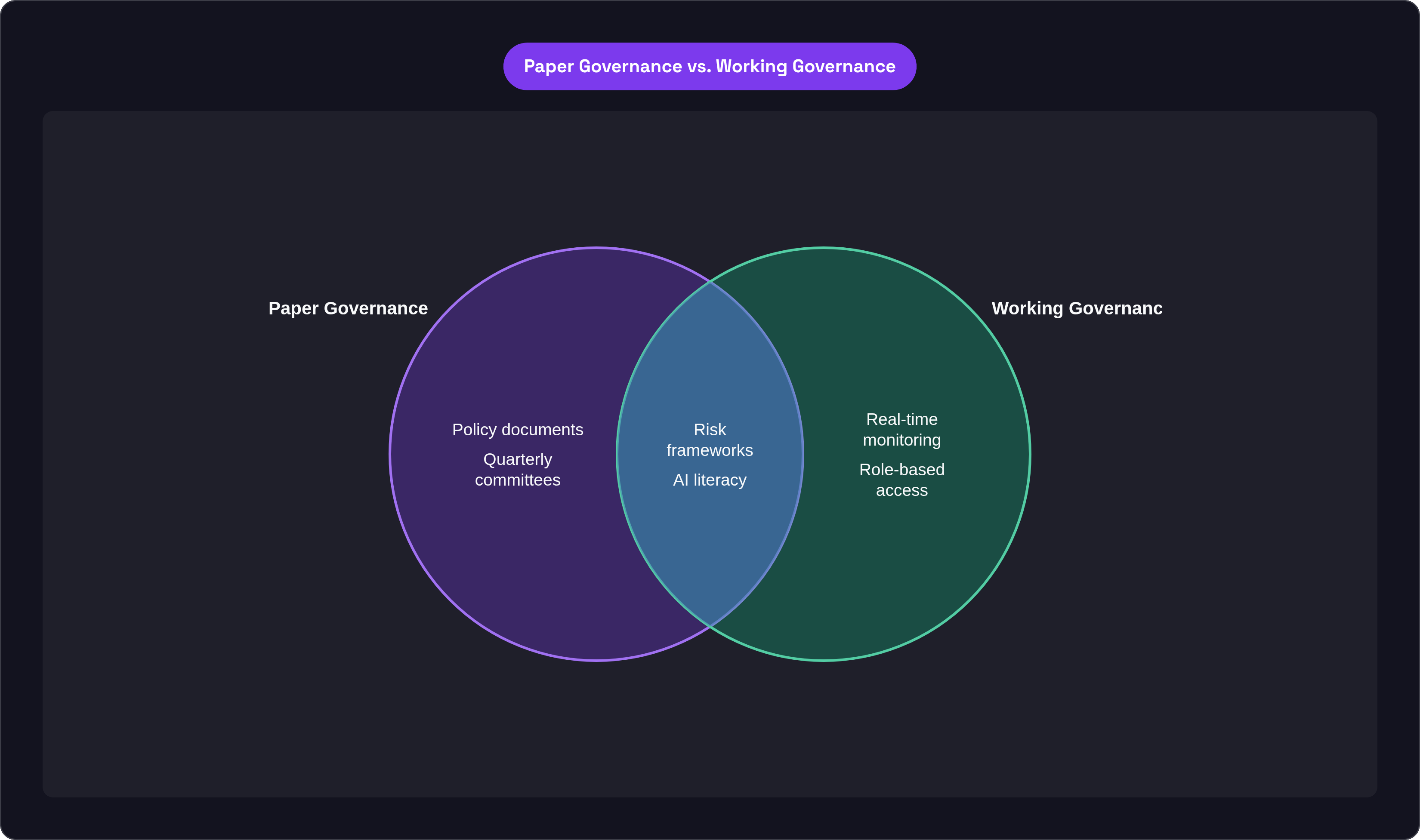
Most companies have AI governance policies on paper but fail to actually operate them day to day.

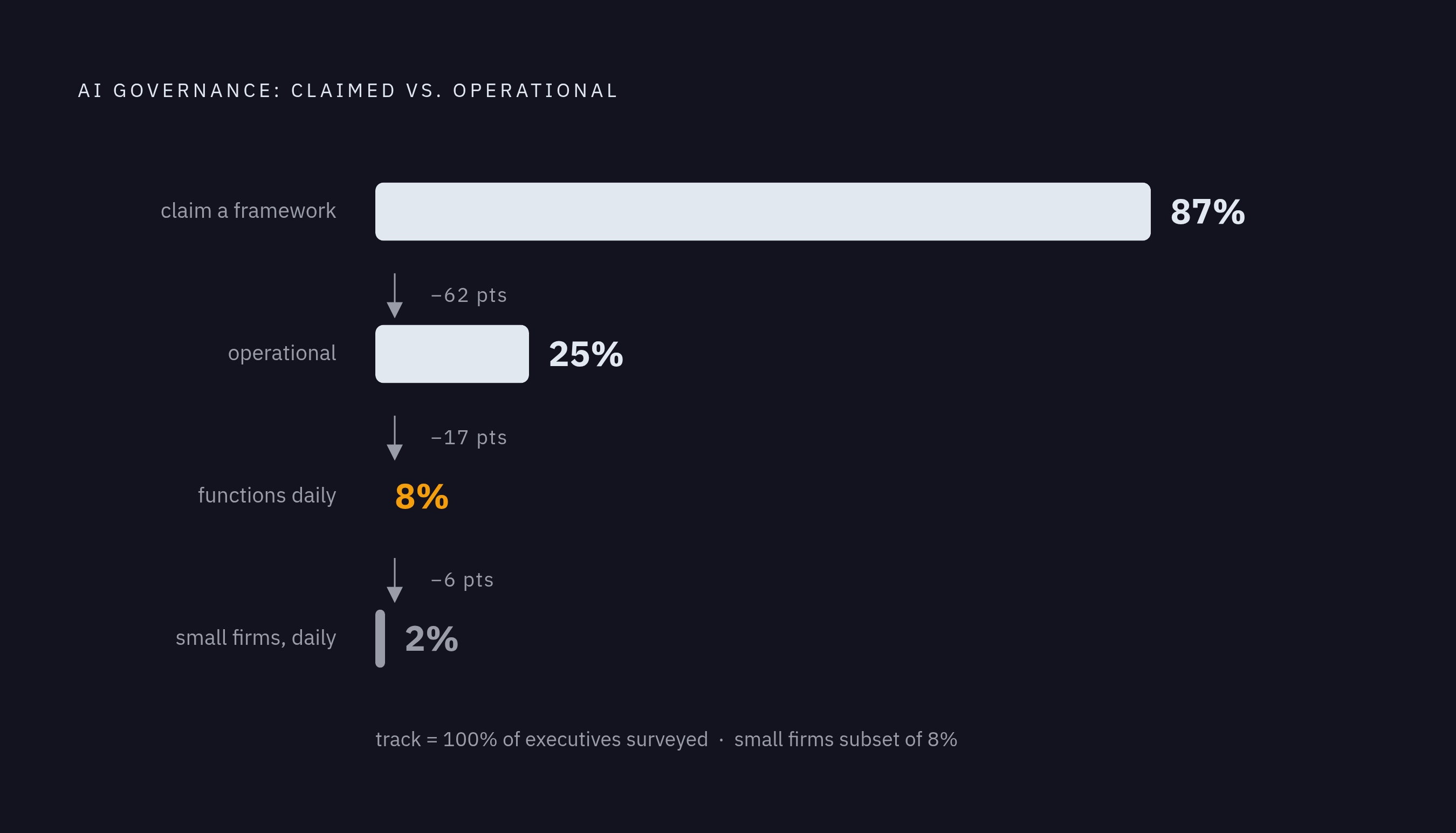
I've sat through enough of these AI governance rollouts to tell you the honest version: companies write the policy, file it in SharePoint somewhere, and never touch it again. Aon found 88% of organizations used AI in at least one business function in 2025. Economist Impact found only 8% of those same organizations have a governance framework that actually functions day to day, and that number craters to 2% among small firms. That gap between having a policy and running one isn't a technology problem. It's a change management problem, and almost nobody treats it that way.
87% of executives say they have a governance framework, but fewer than 25% have put it into operation. I've seen what passes for "governance" at plenty of large companies, and it's usually a document written by legal, a set of principles nobody's trained to apply, and a committee that meets once a quarter to nod at slides. Meanwhile 77% of organizations say they're actively building or refining AI governance right now, which sounds encouraging until you remember that building something and running it are different jobs. IBM's June 2025 study projected an 8x jump in AI-enabled workflows by year end, with 64% of AI budgets already locked into core business functions. Governance is chasing that wave, and the gap keeps widening, not closing.
What the failure data actually shows about where governance breaks down
Start with the number that should worry every CFO in the room: more than 80% of AI projects fail to deliver the business value they were funded to deliver, according to RAND Corporation's 2024 research. That's roughly double the failure rate of ordinary IT projects that never touch AI at all. MIT's Project NANDA looked at generative AI specifically in 2025 and found 95% of organizations see no measurable return to the income statement from their GenAI pilots. Modest returns would be one thing to explain away, but this is close to nothing.
ISG's 2025 research found only 31% of AI use cases studied made it to full production, which means 69% never got there. BCG's January 2025 report, "From Potential to Profit with GenAI," measured the same failure a different way: 74% of companies struggle to get value from AI once they try to scale past a pilot.
Two root causes keep showing up, and neither is an engineering problem. Leaders and the technical teams building the thing rarely agree on what problem it's supposed to solve, so nobody's on the hook for hitting a target nobody agreed on in the first place. Then, halfway through, organizations discover their data isn't ready for any of this. 62% name data governance as the single biggest barrier to AI adoption, and they usually find this out after the budget and the headcount are already spent. I've watched this exact sequence play out at three different companies, in three different industries, with three different vendors, and the ending is always the same: the data discovery is what kills momentum, not the model.
Organizations without a formal AI strategy report a 37% success rate on AI adoption, while organizations with one report 80%. Strategy and governance are load-bearing work here, not a formality you can skip to save a quarter. Skipping that layer doesn't save time; it just pushes the cost downstream, where it's more expensive to fix.
How ungoverned AI creates a security and incident surface that grows with adoption
Incident numbers move in lockstep with adoption, which is what happens when nobody's holding the line. 362 AI-related incidents got recorded in 2025, up from 233 the year before: a 55% jump in twelve months. Risk climbs right alongside adoption, and most security teams I talk to are still budgeting like that's not true.
IBM's 2025 Cost of a Data Breach Report found 97% of organizations hit by an AI-related breach had no real access controls on their AI systems. Ponemon's research for IBM found 63% of surveyed organizations had no AI governance policy at all, which means nothing was in place to catch shadow AI before it spread through the org chart.
Everyone calls shadow AI a security failure. Fair enough, but underneath the label, it's a change management failure too. Employees don't reach for ungoverned tools because they're careless. They reach for them because the sanctioned path is slow, confusing, or doesn't exist yet. Ban the tool without a real alternative and the behavior doesn't stop; it just goes underground, where nobody can see it. The organization already changed, and people are already using these tools every day. Governance just hasn't caught up to something that's been true for a while now.
Gartner surveyed 360 IT application leaders between May and June 2025 and found only 13% strongly agreed they had the right structures in place to manage AI agents, while 74% believed AI agents represent a genuinely new kind of attack surface. Agentic AI and MCP infrastructure make this worse, not better. An MCP server nobody's tracking is an identity nobody's tracking: one touching data, taking actions, generating output, with no record behind any of it. Real-time visibility into what these agents are doing is the honest test of whether a governance program is real or just written down somewhere nice. Treat access controls as a box you check during an annual audit, instead of a guardrail running live every hour of every day, and you'll keep finding out about your own incidents after the damage is already done.
Why regulatory timelines are now forcing the change management question
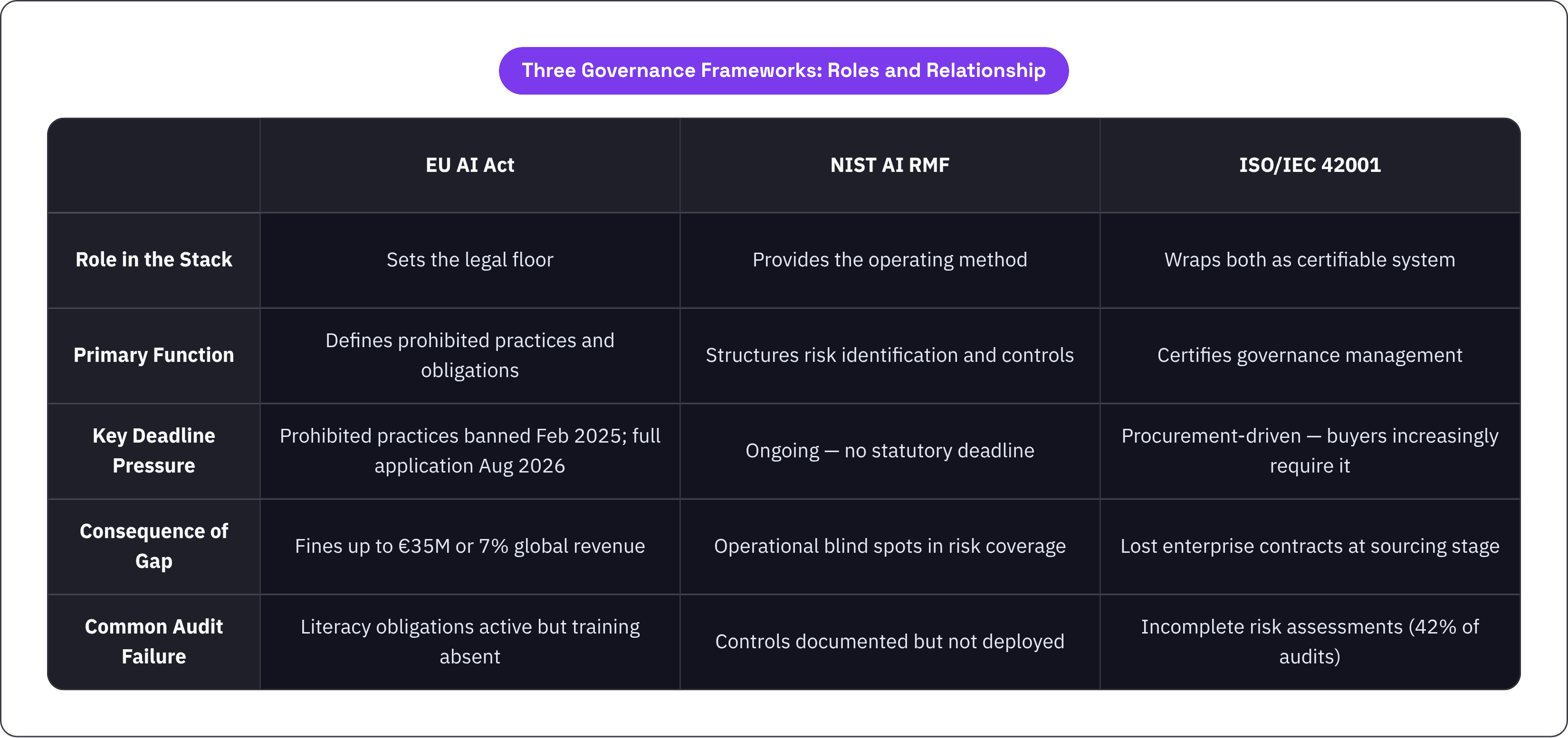
The EU AI Act took effect in August 2024, and its rollout schedule makes this a right-now problem, not a someday one. Prohibited practices have been banned since February 2025, and AI literacy obligations are already live, meaning companies are supposed to be training people now, not eventually. August 2026 brings general application and transparency rules into force. Violations tied to prohibited practices carry fines up to €35 million or 7% of global annual revenue, whichever is higher, and that "whichever is higher" clause is doing quiet, heavy work in board meetings right now.
Most enterprise governance teams I've watched run NIST's AI Risk Management Framework, ISO/IEC 42001, and EU AI Act compliance as three separate tracks: each with its own owner, its own calendar, its own documentation library nobody outside the team ever opens. That produces something like substantial duplicated effort, three risk cycles reviewing the same controls under three different labels. It's wasted motion. A better setup treats these as layers, not parallel lanes. The EU AI Act sets the legal floor, NIST AI RMF gives you the operating method, and ISO 42001 wraps around both as the thing you can actually get certified against.
That certification is starting to matter for reasons that have nothing to do with compliance departments feeling good about themselves. ISO 42001 is turning into a procurement requirement; enterprise buyers increasingly want to see it before they'll sign anything at all. Governance becomes a condition of doing business, not an internal nice-to-have. The audit data from 2025 shows exactly where this breaks down in practice: incomplete risk assessments showed up in 42% of ISO 42001 audits, missing impact assessments in 35%. Those gaps exist because nobody built the assessment process into daily operations. It got written down instead of built in, and those are not the same thing.
So the regulatory calendar forces a question every governance lead has to answer out loud, in a room full of people who'll remember the answer: what has to work by what date, and whose job is it to build it?
The organizational structures that separate paper governance from working governance
Boards are paying attention, sort of. 62% now hold regular discussions about AI, but only 27% have formally written AI governance into their committee charters. Most of what happens at board level is education, not oversight with any teeth behind it. Deloitte's research found companies where senior leadership actively shapes AI governance get meaningfully more business value out of AI than companies that hand the whole thing to technical teams and walk away.
The Chief AI Officer role grew fast because somebody has to sit at the intersection of strategy and daily operations, and it turned out nobody else was doing it. IBM's Institute for Business Value found a notable share of the organizations surveyed in 2025 had appointed a CAIO, up from a much smaller share in 2023. IBM's CEO study, running 2,000 CEOs across 33 countries in May 2026, found that number had jumped dramatically. That's an absurd amount of movement for one year. IBM's research also found organizations with a CAIO get meaningfully higher return on their AI spend than those without one. Job postings for the role have climbed just as fast, faster than anyone's actually agreed on what the job is. I still meet CAIOs who describe their own role differently depending on who's asking, and I don't think that's a coincidence.
The real job of the seat is coordination. Somebody has to sit across the CIO, the CISO, data teams, procurement, and finance, because those are exactly the functions governance has to reach if it's ever going to be more than a PDF. Skip that coordination seat and governance gets written by one team, then quietly ignored by everyone else who'd actually have to carry it out. The CAIO carries a technical mandate on paper, but the work itself runs closer to change management than to technology leadership.
Below that seat, the working governance team usually pulls from five places. Legal and compliance read the regulations, while engineering and ML build the actual controls. HR and learning teams train people and assign accountability by role. Procurement catches shadow AI before it's even purchased, and business unit leads enforce any of this in the actual flow of daily work. The failure I see most often: one of these groups, usually legal or IT, owns governance alone, and everyone else treats it as somebody else's homework to grade.
What structured governance adoption looks like in practice, phase by phase
Enterprise AI governance runs on the same phases as any big transformation: figure out where you stand, design where you want to be, build the capability, bake it into daily operations, keep it alive through feedback. None of that's unique to AI. What's different is the content inside each phase, and that's where most programs quietly fall apart.
Inventory has to come first, before a single policy gets drafted. Catalog every AI system already running, including the ones a business unit bought without telling IT, pilots that never got formally signed off, and AI quietly baked into third-party software you're already paying for. For agentic AI and MCP environments specifically, this means a registry of every MCP server in the building. An identity you haven't written down is an identity you can't govern, and it's also the one most likely to get exploited, precisely because nobody's watching it. Skip this step and the risk assessment ISO 42001 requires, the one that's incomplete in 42% of audits, simply can't be done with any accuracy.
Accountability comes next, assigned by name, never by committee. A policy that doesn't name an owner isn't operational; it's a suggestion, and suggestions don't survive contact with a deadline. Role-based access control for AI agents is the technical version of the same idea: deciding what an agent can touch only means something if a person deliberately decided who authorized that access, and why. Run two tracks in parallel here, one for framework compliance moving from NIST to ISO 42001 to the EU AI Act where it applies, and a separate one for actual control deployment: access rules, monitoring, incident response.
Then literacy, and it has to change behavior, not just check a box on a compliance tracker somewhere. The EU AI Act's literacy requirements are already active, but a training session people sit through once and forget by Friday doesn't close any real gap. Executives need to understand risk and where accountability lands. Engineers need to know how to build the controls, not just read about them in a slide deck. Business users need practical guardrails for the decisions they make every day, in the moment, without a lawyer on the phone. Literacy is what turns policy language into judgment people can actually use.
This next part is the one most companies get backwards, and I mean almost all of them. Banning a tool without a sanctioned alternative doesn't kill shadow AI; it just moves it somewhere you can't see it anymore. The design challenge is making the approved path faster than the workaround, so people choose it because it's genuinely easier, not because someone's watching over their shoulder. A gateway architecture for AI agents solves this structurally: teams get a controlled space to build and test, instead of choosing between waiting months for approval or just using the thing anyway, ungoverned, and hoping nobody asks.
Last comes ongoing monitoring, and it's what separates a governance program that's alive from one that just produces quarterly reports nobody reads closely. Real-time visibility into what agents are accessing is the difference between catching a problem while it's small and writing a postmortem after it's already cost you something real. That monitoring data has to feed back into risk assessments, policies, training, all of it, on a loop. A governance program that skips this step is a photograph of a moment that's already passed, not a system that keeps working while you sleep.
Where most change programs stall, and what separates the ones that don't
The most common stall point is almost embarrassingly simple. Companies treat governance like a project with a finish line: they announce "we have a framework," and the actual change work stops the day after the press release goes out.
The multi-framework trap eats capacity fast. Running NIST, ISO 42001, and the EU AI Act as three separate efforts burns time on duplicated paperwork instead of real operational depth. The organizations moving fastest have folded these into one architecture, rather than satisfying each one in isolation, one meeting at a time, forever.
Budget is a quieter killer, but a killer all the same. Only 38% of executives believe their AI budgets are actually enough to hit their strategic goals, and a governance program without its own line item is the first thing cut the moment something else needs the money.
Measurement is where it gets uncomfortable, honestly. Governance programs that can't point to results lose executive backing fast, and that's fair, since nobody owes a compliance program the benefit of the doubt forever. The programs that survive can show a drop in shadow AI usage, faster time-to-production for projects going through the governed path, quicker incident detection, and audit findings that actually close instead of getting carried forward every quarter like an unpaid bill. Frame governance as the reason you can say yes to a new AI use case faster, because the guardrails are already built, and it earns its keep. Framed purely as a cost center, it gets cut the first time budgets tighten, which they always do eventually.
Procurement deserves its own mention, because it's the gap that survives almost every policy rewrite I've seen. A responsible-AI policy written by one team gets routinely bypassed the moment a business unit signs its own vendor contract for a tool with AI built in somewhere nobody checked. If governance doesn't reach the sourcing decision, it's always playing catch-up to tools that are already live in production, quietly, without anyone's blessing.
What the companies actually closing this gap have in common isn't complicated: a senior sponsor with real decision authority, a coordination role like a CAIO spanning every function governance touches, an inventory-first approach to knowing what AI is even running, and a governed path that beats the workaround on speed, not just on paper in a binder somewhere nobody opens.
How MCP Manager fits into a governance change program
MCP Manager exists for the exact gap this piece has been describing: the space between a governance policy and an MCP server actually running in production right now, whether anyone's tracking it or not. It's built around the registry-first idea from the inventory phase, a live record of every MCP server in your environment, so you're not writing an access policy for identities you don't even know exist yet.
From there, it covers the operational layer governance teams usually can't build fast enough on their own. Role-based access control for AI agents means permissions map back to a real decision someone made and can defend later, if it ever comes to that. Real-time visibility into what agents are touching replaces a log you review three weeks after something's already gone sideways. A gateway gives teams a controlled space to build and test agents, so the sanctioned path is the fast path, not the slow one everybody routes around anyway.
None of that replaces the harder organizational work: naming a CAIO or equivalent, training people by role, getting procurement to catch shadow AI before it's purchased instead of after the fact. That work needs a technical backbone to run on, though. MCP Manager is built to be that backbone for agentic AI specifically. A governance program that stays a document never closes the gap this piece opened with. One backed by a working system, showing you in real time what's running and who authorized it, has a real shot.