AI Agent Governance Maturity Models for Enterprises
Most enterprises lack the controls to govern AI agents safely in production right now.

I've spent the last two years watching enterprises build AI agents faster than they can answer basic questions about them. Who owns this agent? What can it touch? Can we shut it off if it goes sideways? Autonomous agents plan, reason, chain tool calls, and run multi-step workflows, often with zero human checkpoint between steps. That's a different animal entirely from the chatbots and classifiers governance teams spent the last five years learning to manage, and most organizations haven't caught up.
The numbers back this up, and not in a comforting way. Cloud Security Alliance and Google Cloud ran a joint study in 2025 and found that hardly any organizations have a real agent identity strategy. Hand most of them a compliance audit focused on agent behavior or access controls, and they'd fail it on the spot. Gartner found something similar: fewer than half of large organizations claiming active AI governance can actually show measurable maturity when you ask them to prove it. Claiming governance and having it are two different postures, and I've sat in enough rooms to watch that gap play out in real time.
What happens in between is agent sprawl. Redundant agents, agents that conflict with each other, agents nobody remembers deploying, all running across business functions with no registry and no map of what any of them can touch. Cyberhaven's 2025 AI Adoption and Risk Report found that the share of corporate data employees feed into AI tools that counts as sensitive has more than tripled in two years. That's not a risk sitting on some future roadmap. That's happening right now, in companies that think they've got this handled because someone wrote a policy document back in 2024 and filed it away.
Here's what should actually worry you: most enterprises can't see what their agents are doing while it's happening. They find out afterward, when someone pulls the audit log because something already broke. A log you read after an incident isn't a safety net, it's a postmortem. The maturity model I'm walking through here isn't about satisfying an auditor or checking a box on a form. It's the actual plumbing that lets you move from pilot to production without crossing your fingers the whole way there.
Why traditional AI governance models don't transfer cleanly to agents
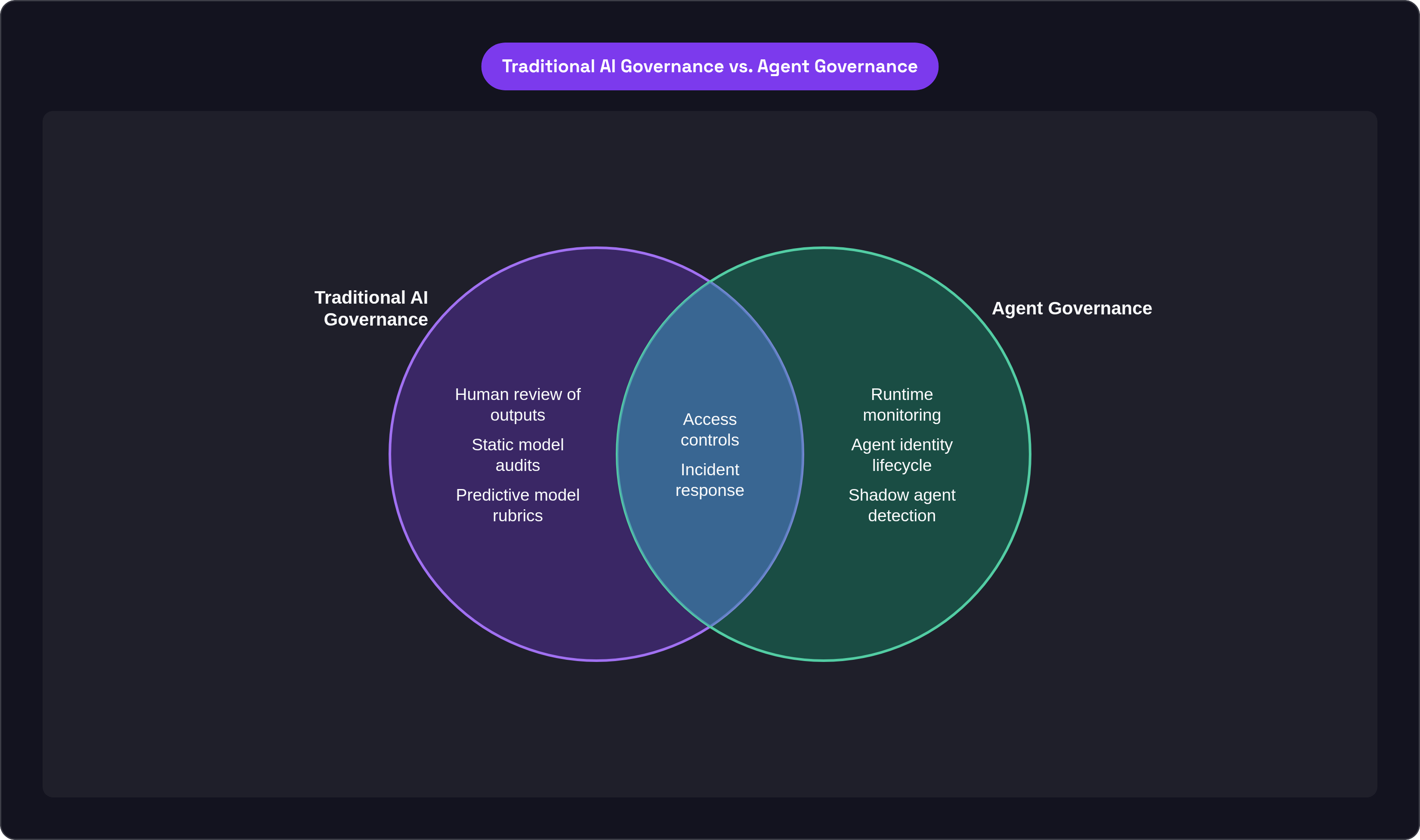
Old AI governance ran on one assumption: a human looks at the model's output before anything happens. Someone reviews the recommendation, approves the loan, signs off on the content, and only then does the action take place. Agents break that assumption at the root. They call tools, chain decisions, spin up sub-agents, and grab new capabilities mid-task, often with nobody checking each step as it happens.
Think about what an agent actually does that a predictive model never did. It runs multi-step tool calls with no per-step review. It hands work off to other agents, forming chains that nobody's watching in real time. It can extend its own reach by grabbing new tool access on the fly. And it drifts from its original goal in ways a one-time audit of a static model would never catch, because the model isn't static anymore, it's making a new decision every few seconds.
McKinsey noticed this and added agentic governance as its own separate category in 2026, because the old scoring system simply couldn't grade agent behavior in any way that meant anything. Researchers picked up on the same gap. An arXiv paper on agent governance maturity from April 2026 laid out failure patterns that don't show up anywhere in traditional model governance: duplicate agents doing the same job, shadow agents, orphaned agents nobody's tending, permission creep, delegation chains nobody's watching. None of that registers in a framework built to review model outputs.
The stuff agent deployment actually needs, identity lifecycle management, runtime monitoring tuned to catch an agent drifting off-goal, dynamic tool access governance, override mechanisms that work when you actually need them, is mostly missing from the frameworks built for the last generation of AI. So before you ask where your organization sits on the maturity curve, ask which curve you're even measuring against. Grade your agent governance on a predictive-model rubric and it'll tell you you're further along than you are. I've seen that mistake cost people six months of false confidence.
Where most enterprises actually sit on the maturity curve today
Several independent studies landed in almost the same spot, and that kind of agreement should make you pay attention. McKinsey's 2026 AI Trust Maturity Survey, covering roughly 500 organizations, found an average maturity score of 2.3 out of 4. Only about a third reached level three or higher across strategy, governance, and agentic AI oversight combined.
The COMPEL Framework Benchmark, run across 420 organizations, found an average of 2.1 out of 5. Governance structure came in as the weakest area across the board, and incident rates at the bottom level ran far higher than at the top. ServiceNow's 2025 Enterprise AI Maturity Index told an even bleaker story: global scores actually dropped year over year, and fewer than one percent of organizations scored above the midpoint on its 100-point scale.
I keep seeing the same pattern in self-assessments, too. Organizations that wrote policy documents in 2024 and 2025 tend to score themselves fine on foundational controls, then fall apart the moment you ask about runtime inspection, agent identity, or agent-to-agent controls. Those happen to be exactly the dimensions that matter once agents start acting on their own. The gap between claimed governance and demonstrated governance isn't a rounding error. It's structural. Most organizations have paperwork, not controls that actually run.
Deployment isn't waiting around for anyone to catch up, either. Deloitte's 2026 survey found roughly three-quarters of enterprises plan to deploy agentic AI within two years, and only a fraction of them have a governance model that could support that in production without something breaking. One thing that does track with higher scores: organizations that named one specific person or team as owner of AI governance outscore the ones where accountability gets spread across five committees and owned, in practice, by none of them. Naming an owner isn't just an org chart footnote. It's a maturity signal in itself.
The five stages of AI agent governance maturity and what each one looks like in practice
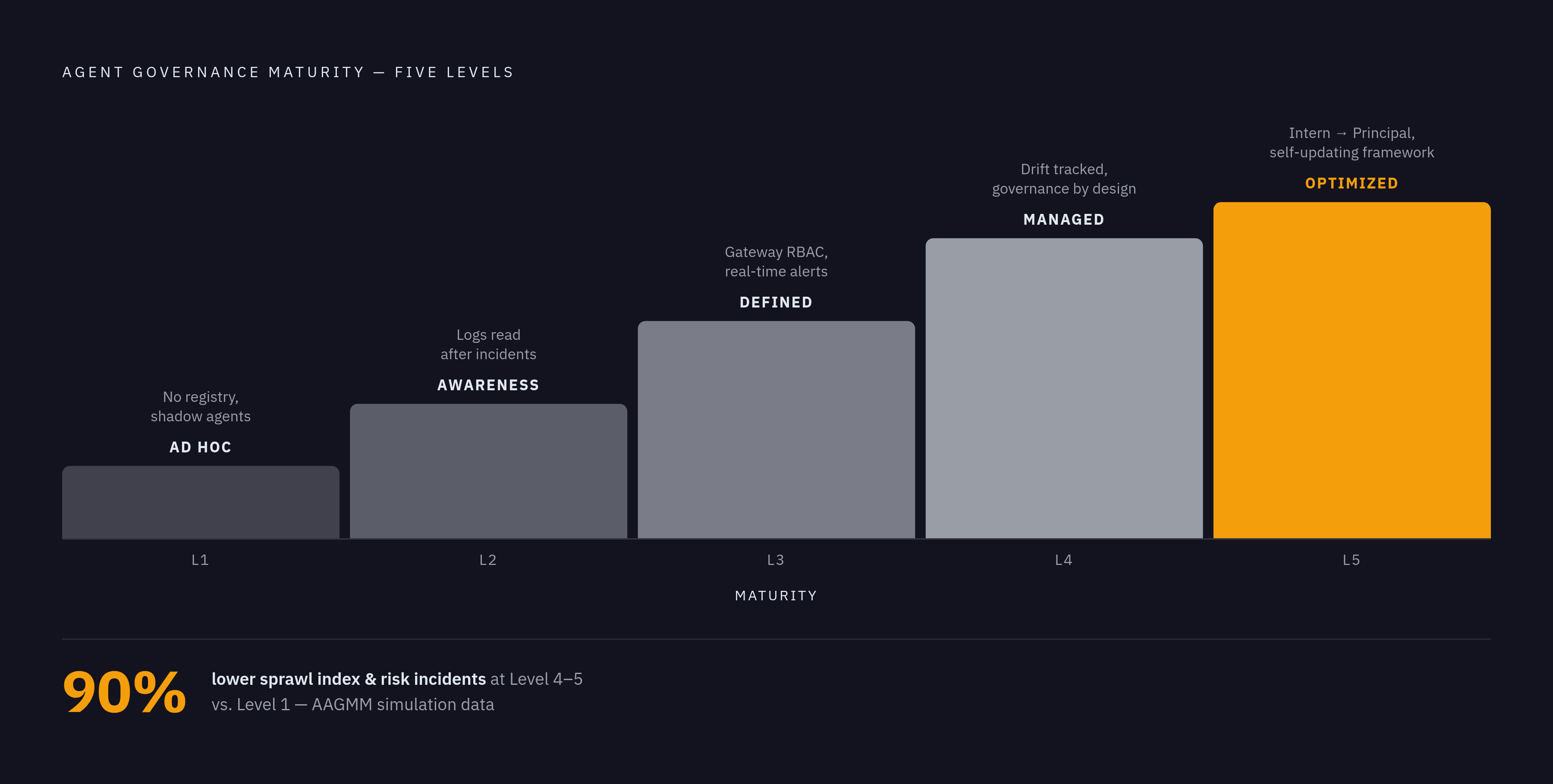
Several frameworks, AAGMM, Databricks, OWASP, and CSA's AGMM among them, all land on roughly the same five-stage progression. They use different names for the stages, but what each level actually demands operationally lines up closely enough that it's worth walking through as one model.
Level 1, Ad Hoc. Individual teams or vendors deploy agents with no central registry and no visibility from leadership. There's no identity strategy, no inventory of what any given agent can touch. Governance exists as a PDF somewhere, not as anything enforced. Shadow agents multiply right alongside the sanctioned ones, permission creep goes completely undetected, and the attack surface is whatever hasn't been found yet, which at this stage is most of it.
Level 2, Awareness. The organization has started cataloging agents and mapping their access, at least for the ones it knows about. Access controls get applied to the highest-risk systems, but inconsistently; it's more triage than strategy. Incident response exists on paper, and detection is slow, full of holes. Governance is still reactive: someone reads the audit log after something's already gone sideways. Shadow agents still exist here mostly because there's no approved path yet for a team that just wants to try a new tool without waiting six months for sign-off.
Level 3, Defined. This is where it starts to feel real. Formal identity lifecycle management is in place: provisioning, scoping, decommissioning, the whole cycle. Role-based access controls get applied to agents on purpose, not inherited by accident from a vendor default setting. A central registry covers known agents, and policy gets enforced through a gateway instead of relying on someone remembering to check. Real-time behavioral monitoring covers at least the highest-risk agents, and escalation paths to a human are defined and actually tested, meaning a team can pull the plug on a rogue agent and knows exactly how to do it. Production deployment stops being a gamble at this stage.
Level 4, Managed. Governance outcomes get measured now, not just implemented. Incident rates, access violations, behavioral drift: all tracked and trended over time instead of noticed after the fact. Agent-to-agent authorization is controlled directly, and delegation chains are governed rather than trusted by default. Continuous compliance monitoring replaces the old once-a-year audit, and governance becomes part of how new agents get designed from day one instead of a review step tacked on at the end. AAGMM's validation work ran 750 simulations across five enterprise scenarios and found real, measurable gaps between every level. Organizations at Level 4 or 5 showed sprawl indices over 90% lower and risk incidents cut by roughly the same margin compared to organizations stuck at Level 1. That's not an incremental gain. That's a different category of risk exposure entirely.
Level 5, Optimized. The governance framework updates itself as new agent capabilities and new threats show up, instead of waiting for the next planning cycle. Agent autonomy gets earned step by step based on demonstrated trustworthiness. CSA's Agentic Trust Framework calls this the "Intern through Principal" model, and at Level 5 it's actually running in production, not sitting in a slide deck somewhere. Cross-organizational trust becomes real too: external agents get authenticated and authorized through established protocols instead of blind faith. At this level, governance stops being a cost center and turns into something regulators and enterprise customers can audit on demand, which is a genuine edge over competitors still stuck reading logs after the fact.
The governance dimensions that determine your actual level, regardless of your policy documents
Here's the trap I see over and over: an organization built a policy framework in 2024, feels good about it, scores itself a Level 3 on a self-assessment, and is actually sitting at Level 1 on every dimension that matters for agentic AI specifically. Policy documents measure intent. They don't measure whether that intent gets enforced anywhere.
So what actually separates the levels? A handful of dimensions do nearly all the work.
Agent identity comes first. Is every agent sitting in a registry with a defined scope, and can you answer "what can this agent access" for every agent running in production, not just the ones someone happens to remember? Runtime visibility comes next: is behavioral monitoring live and continuous, or does it only exist as a log you read after something's already broken? Access control enforcement matters too, and the real question is whether RBAC policies get enforced by a gateway or something equivalent, or whether they're just documented expectations everyone hopes people follow.
Human override capability is where a lot of organizations get an uncomfortable surprise. Can a specific agent be isolated or shut down right now, immediately, and has anyone actually tested that it works? Then there's agent-to-agent authorization: when Agent A hands work off to Agent B, is that delegation logged and governed, or just implicitly trusted because nobody thought to check? Last, shadow agent detection: does the organization even know about agents deployed outside central IT, and is there an approved path that gives teams a reason not to route around the rules in the first place?
Gravitee's State of AI Agent Security 2026 Report found that only a small share of organizations report their AI agents go live with full security approval. Which means most production agents are sitting at Level 1 on the access control dimension, even inside organizations whose broader program looks mature on paper. CSA's AI Controls Matrix version 1.0 lays out 243 control objectives across 18 domains, and it's worth pulling up just to see the gap between that catalog and what's actually implemented anywhere. That gap is the honest distance between where you think you sit and where you actually stand.
Worth remembering: your governance maturity is the minimum of your scores across these dimensions, not the average. A strong identity program won't save you if nobody's ever tested whether the override switch works.
The major frameworks available for structuring a maturity assessment
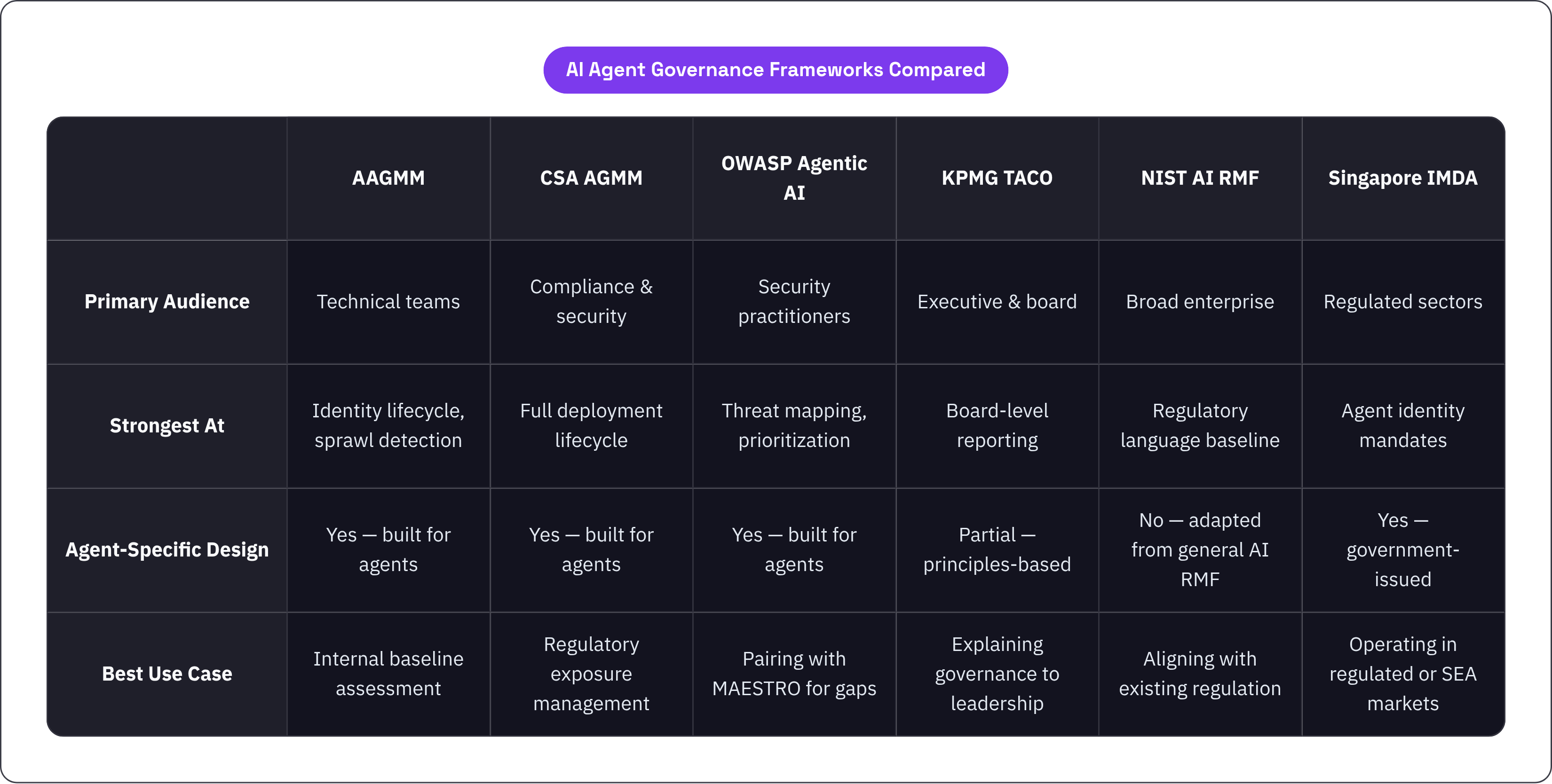
No single framework has won out yet, and that's fine, honestly, because they're built for different jobs. Pick based on whether you need a threat model, a control catalog, an assurance path, or a way to think about how agents earn more autonomy over time.
AAGMM, published on arXiv in April 2026, is a five-level, 12-domain framework grounded in NIST's AI Risk Management Framework and ISO/IEC 42001. It's strongest on the parts unique to agents: identity lifecycle, sprawl detection, delegation chains. It's been tested through simulation across real enterprise scenarios, which makes it a solid pick if you want a rigorous internal baseline before you go telling anyone else how mature you are.
CSA's Agentic Governance Maturity Model, from May 2026, is probably the most complete toolkit if you're carrying regulatory exposure. It's really five instruments working together: MAESTRO handles threat modeling, the AI Controls Matrix is the control catalog, STAR for AI is an assurance certification, AARM covers runtime enforcement, and the Agentic Trust Framework governs how autonomy gets earned over time. Each piece covers a different layer of the deployment lifecycle. The Trust Framework's "Intern through Principal" model, in particular, is the most concrete tool I've come across for deciding how much independence an agent should get at each stage, and it's directly useful when you're designing RBAC.
OWASP's Agentic AI Maturity Model, version 2.01 from June 2026, comes out of the security practitioner community, with more than 600 contributors across 18 countries. It pairs well with MAESTRO: MAESTRO tells you which architectural layer is under-governed, and OWASP's adoption tiers help you map out what to fix first.
KPMG's TACO Framework from 2025, standing for Transparency, Accountability, Control, and Oversight, is built for a different audience: enterprise leadership and board-level reporting. Less technical depth, more focus on explaining governance structure to people who don't want to read a control catalog cover to cover.
NIST's AI RMF, organized around Govern, Map, Measure, and Manage, is the baseline most other frameworks reference somewhere. Its implementation tiers, running from Partial to Adaptive, give you language regulators already recognize, though it wasn't built with agent-specific risks in mind, so it shouldn't be your only reference if agents are the thing you're actually trying to govern.
Singapore's IMDA Framework, released in January 2026, is the first full government-issued framework built specifically for autonomous agents. It requires a verifiable digital identity for every agent and a complete audit trail of agent-to-agent authorization. It's the closest thing to a regulatory mandate in structure right now, worth a look if you operate in a regulated sector or have any footprint in Southeast Asia.
If you're moving from Level 1 to Level 3, start with a control catalog and a threat model: CSA's AICM paired with MAESTRO, or AAGMM on its own. Once you're at Level 3 and pushing toward Level 4, the assurance and autonomy-progression pieces, STAR for AI and the Agentic Trust Framework, do most of the heavy lifting.
What advancing from one stage to the next actually requires operationally
Level 1 to Level 2 is about visibility before controls. Start by inventorying every agent running in production, including the ones business units spun up without telling central IT, because those exist and you already know it. Map out access: what data, systems, and tools can each agent actually reach? Build a minimum identity record for every agent: owner, purpose, access scope, date last reviewed. The registry-building exercise itself is usually where you find the shadow agents and orphaned agents nobody remembered deploying. That discovery tends to be uncomfortable, and honestly, it should be.
Level 2 to Level 3 means swapping reactive detection for enforced policy. Put a gateway or equivalent enforcement layer in place, so access control gets enforced at the infrastructure level rather than reviewed after the fact. Apply RBAC to agents as a deliberate decision, not something inherited from a vendor's out-of-the-box settings. Stand up real-time behavioral monitoring for any agent touching sensitive systems. Build an approved path for teams that want new tools, because giving people a legitimate route cuts the incentive to route around you entirely. And test human override for real: try to isolate or shut down a specific agent right now. If you're not sure it'll work, that's the highest-priority gap on your list, full stop.
Level 3 to Level 4 is about turning controls into numbers you can actually track. The shift is from "we have controls" to "our controls produce data we watch over time," incident rates, access violations, behavioral drift, all trending in a dashboard someone actually opens. Extend governance to cover agent-to-agent delegation directly, so when one agent hands a task to another, that handoff gets logged and authorized instead of assumed safe. And build governance into how new agents get designed from the start, instead of running it as a review step bolted on right before launch. That's the gap between governance as a checkpoint and governance as infrastructure, and it's the gap that shows up in the incident numbers every single time.