MCP Server Authentication Methods Compared
Most MCP teams chose the easiest method, not the safest one.
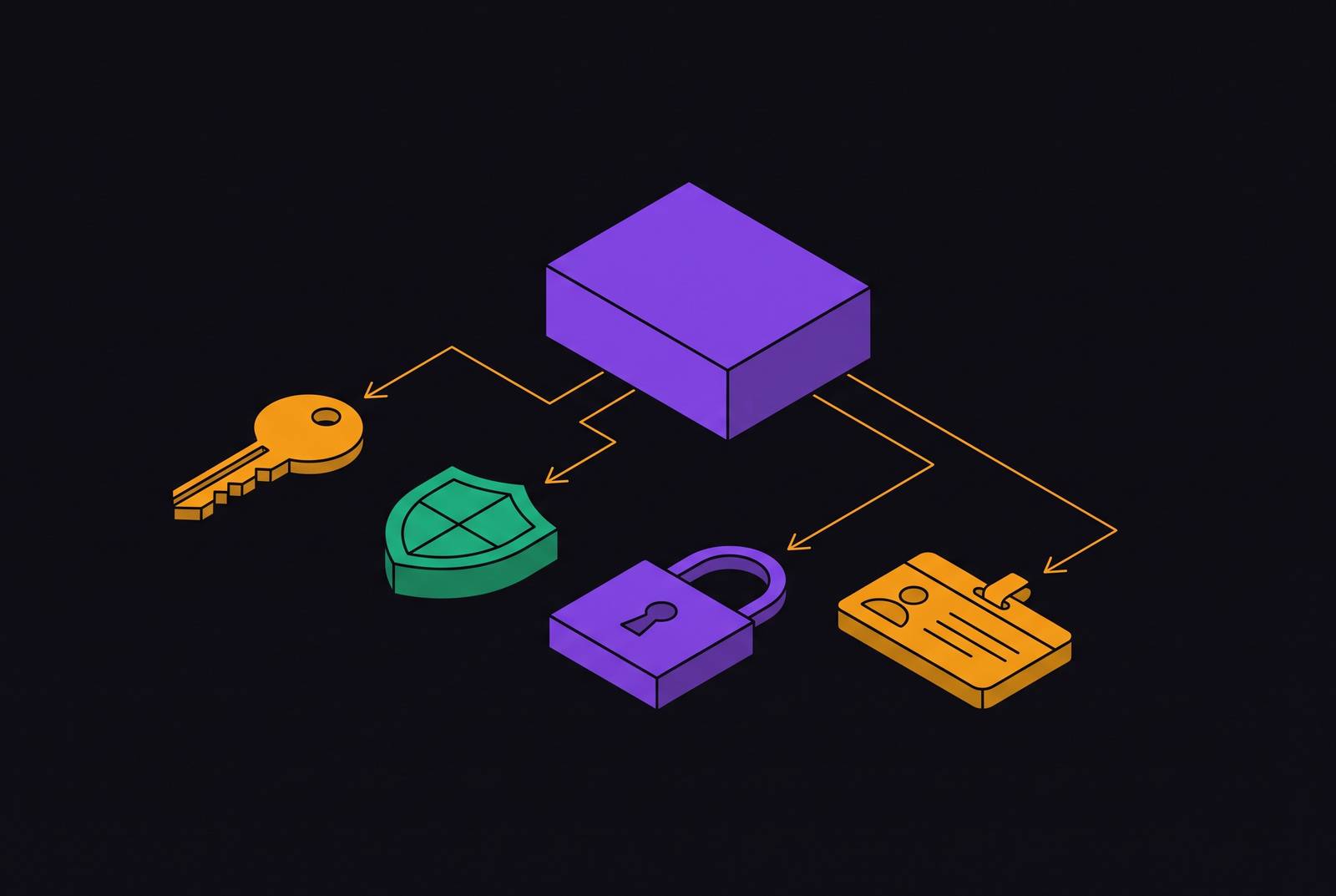
Four authentication methods exist for MCP servers: static API keys, OAuth 2.1, mutual TLS, and gateway-based controls. Here's the position worth stating up front: most teams are using the wrong one. The easy option and the right option point in opposite directions almost every time; static keys dominate because they're fast to wire up, and that's exactly the problem. The gap between what the spec recommends and what people actually ship is where this piece lives.
MCP itself is barely a year and a half old. Anthropic put it out in November 2024 as an open standard for connecting LLMs to outside tools and data. Adoption since then has moved fast: by May 2026 the official MCP Registry counted 9,652 latest server records, and GitHub had more than 15,000 repositories tagged mcp-server. Stacklok's 2026 software report found that 41% of surveyed software organizations were already in limited or broad production with MCP servers.
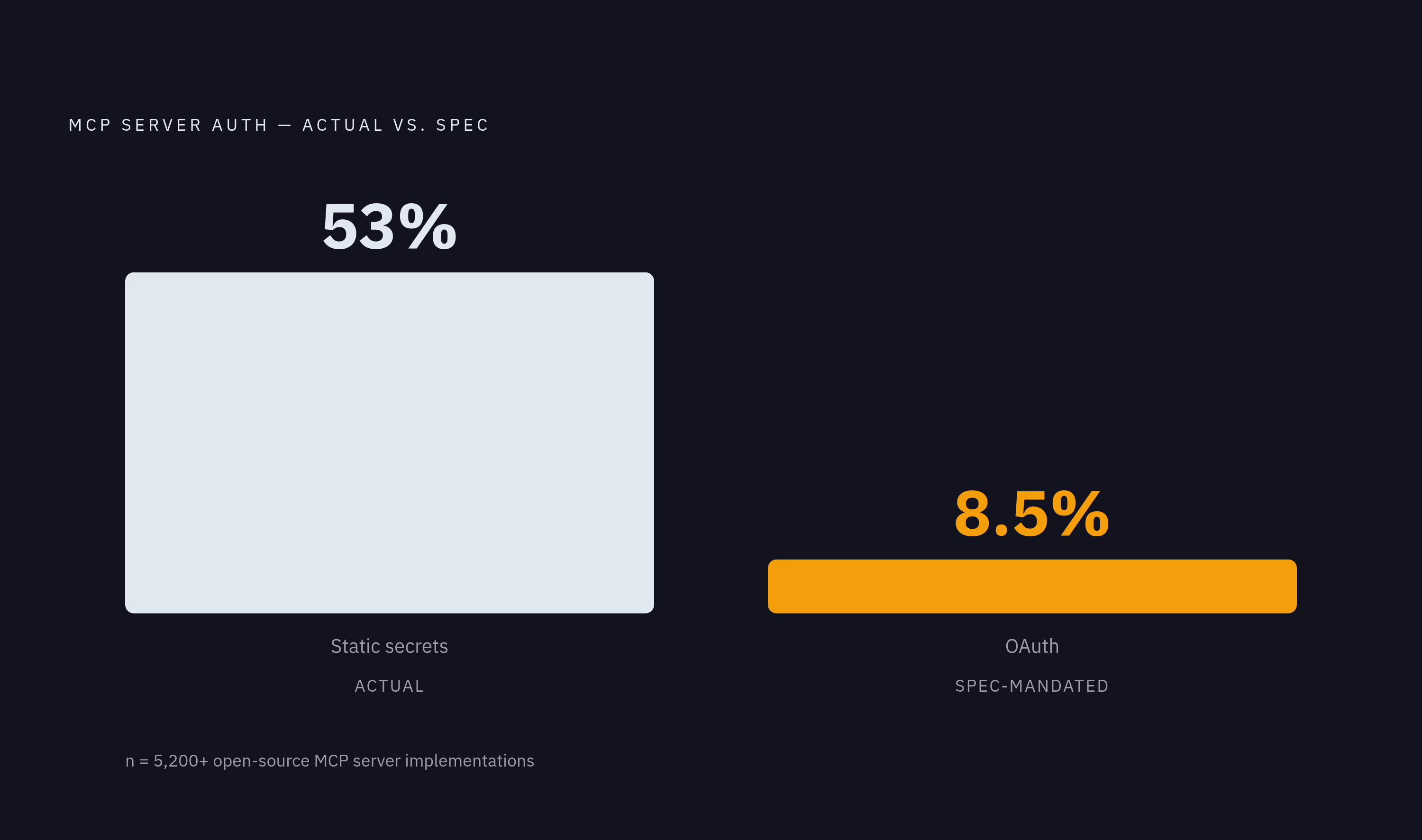
Security researchers who looked at more than 5,200 open-source MCP server implementations in 2025 found that 53% rely on hard-coded static secrets, while only 8.5% use OAuth, the method the spec actually recommends. That six-to-one gap isn't a rounding error. It's most of the ecosystem betting that convenience won't cost them later.
How the transport layer determines which authentication options are even available
MCP has three moving parts: the host, which is the user-facing AI app; the MCP client, an intermediary sitting inside the host; and the MCP server, the process that actually exposes tools and data. Before anyone picks an authentication method, the transport already narrows the field, and this is the part teams skip past too fast.
STDIO is the local option. The server runs as a subprocess of the host, inside the same trust boundary, and no network authentication happens between client and server at all. Configuration usually runs through environment variables, with no handshake and no token exchange. Whatever security exists here lives entirely in the question of who can launch the process, not in any credential the server checks.
Streamable HTTP is the remote option, formalized in the June 2025 spec revision. A server on this transport carries the full authentication and transport-security load of an ordinary web app, whether it sits on localhost, a private URL, or a public endpoint. "Remote" in MCP terms is a statement about trust, not about network distance, and treating it as a distance problem is how people end up under-securing servers that only look local.
Picking STDIO to dodge authentication complexity doesn't remove risk. It just moves the risk into the host trust boundary and the environment-variable setup, and that boundary has its own failure modes, which is where the next section goes.
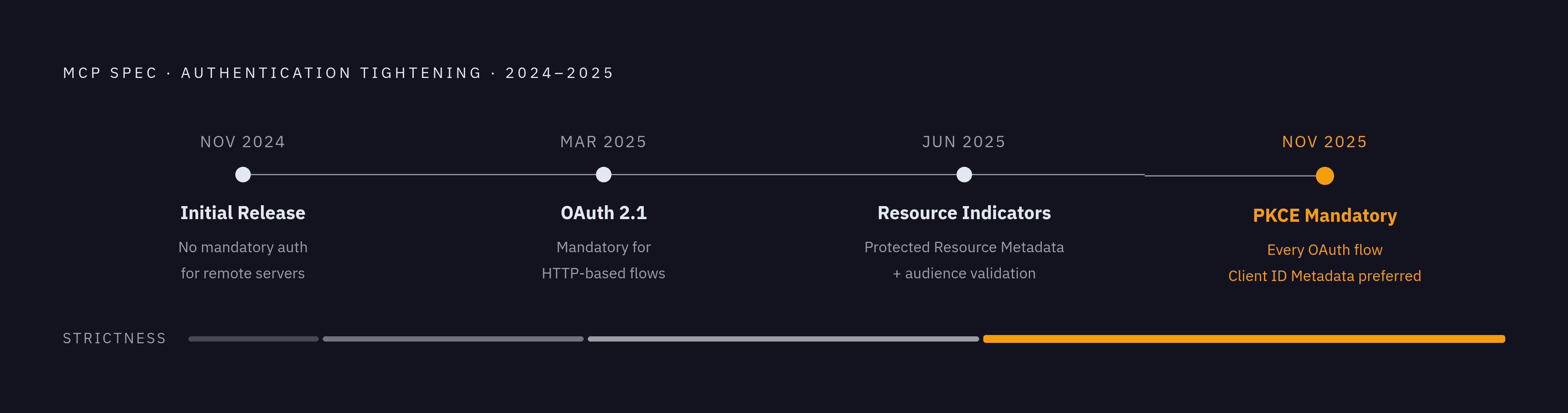
Here's how the spec's authentication requirements built up over time:
- November 2024: initial release, no mandatory authentication for remote servers.
- March 2025: OAuth 2.1 becomes the mandatory framework for HTTP-based flows.
- June 2025: Protected Resource Metadata, Resource Indicators, and audience validation get added.
- November 2025: PKCE becomes mandatory for every OAuth flow, and Client ID Metadata Documents become the preferred way to register clients.
STDIO and environment-variable credentials: the risks inside the local trust boundary
STDIO's whole pitch is simplicity, with no credential setup and no ceremony. It just works the moment a developer runs it on their own machine.
The catch is environment-variable inheritance, and it's a bigger catch than most people give it credit for. Variables like AWS_SECRET_ACCESS_KEY, GITHUB_TOKEN, and OPENAI_API_KEY sitting in the parent process flow straight into the child MCP server process unless someone explicitly turns that inheritance off. A third-party MCP server, launched over STDIO without much scrutiny, can end up reading credentials it was never supposed to touch. No network request fires, nothing gets logged, and no alert goes anywhere.
There's already a real CVE that shows what this looks like in practice: a malicious workspace configuration passed dangerous process-startup variables (NODE_OPTIONS, LD_PRELOAD, BASH_ENV) to a spawned MCP server. The result was attacker-controlled code loading the moment someone started a normal session.
The deeper issue is visibility, or the total lack of it. A large share of MCP activity in developer environments runs over STDIO, and STDIO generates no network traffic at all. Security tools built to watch the wire simply can't see which tools a server is advertising, which tool calls got made, or what data moved between the agent and the server. That blind spot hits discovery, monitoring, and enforcement all at once, since none of them work on data nobody captured in the first place.
STDIO is fast for one developer in a controlled setup, and there's nothing wrong with that. The moment untrusted servers or shared environments enter the picture, that same simplicity turns into exposure nobody's watching.
Static API keys and bearer tokens: where most MCP servers actually are today
The mechanism is about as plain as authentication gets: a pre-shared key, sent with every request, usually in an Authorization header or a query string.
That 53% figure is worth sitting with, especially next to the 8.5% using OAuth, the method the spec actually calls for. That gap reflects how much more setup work OAuth demands to get right; a rational reaction to that setup burden still doesn't make the outcome safe.
Keys earn their popularity honestly, to be fair. They're stateless and dead simple on both ends, with no redirect flow, no browser step, and no token-exchange infrastructure to stand up. For internal tooling and machine-to-machine calls, where both sides are known and the key sits in a real secrets manager, an API key does the job, and rotation is fast when someone's actually managing it.
But here's where it falls apart at scale. A static key carries no scope: it grants full access to everything the server exposes, not just the slice a given client actually needs. Keys have a long, well-documented habit of ending up in plaintext inside mcp.json files and then in version control, where they sit until someone stumbles on them. If a key leaks, full access stays live until a human manually revokes it; nothing expires on its own. And a key identifies a service, not a person, so there's no way to trace which user triggered a given tool call. Tracing anything across multiple agents or clients gets hard fast without a disciplined per-client key scheme, and few teams build one.
API keys make sense in specific spots: internal developer tools, proof-of-concept builds, machine-to-machine setups backed by a real secrets manager. Past that, they're a poor fit, and that 53% number shows the ecosystem leaning on them well beyond that narrow lane.
OAuth 2.1 with PKCE: what the spec mandates and why it was designed for this problem
OAuth 2.1 is the mandatory authentication framework in the MCP spec for HTTP transport. As of November 2025, PKCE (Proof Key for Code Exchange) is required on every OAuth flow, with S256 as the required code-challenge method. This closes a gap that static keys simply can't close.
MCP servers often serve multiple clients acting on behalf of different users. An API key can't tell those users apart, and mTLS certificates are a pain to hand out to desktop apps. OAuth 2.1 was built for exactly this multi-client, multi-user situation, so it fits without an awkward retrofit.
The flow runs like this: the client registers with an authorization server, either through Dynamic Client Registration or a Client ID Metadata Document. A user logs in through a browser and consents, and the client gets back an authorization code. That code trades for a short-lived, scope-limited access token, which rides along on every MCP request afterward. The server's only job is to check that token, never to issue one itself.
The short lifespan matters more than it looks like it should. If a token leaks, the damage is bounded in time and in scope. That's a real structural difference from a static key that stays valid until someone remembers to kill it.
Client registration has two paths now. Dynamic Client Registration, defined in RFC 7591, lets a client post its metadata to a registration endpoint and get a client_id on the spot; it solved the bootstrap problem at ecosystem scale and stays in the November 2025 spec mostly as a backward-compatibility option. Client ID Metadata Documents, the preferred approach since that same update, work differently: the client self-registers through a static document URL it controls, and the authorization server fetches that URL to check it at runtime. That's more auditable, and it leans less on separate registration infrastructure.
Two additions from the June 2025 revision close real security gaps. Resource Indicators, from RFC 8707, fix a problem called token passthrough, where early MCP servers forwarded a user's OAuth token unchanged to downstream APIs. That broke audience restriction entirely: a compromised server could replay a stolen token against services it was never meant to reach. RFC 8707 ties each token to one specific resource, so a token issued for Server A simply doesn't work against Server B. Protected Resource Metadata, from RFC 9728, standardizes how a server publishes its trusted authorization servers, supported scopes, and key material, so clients and gateways can figure out what's required without side-channel configuration.
One point of confusion worth flagging directly: when there's no user in the loop at all, the right flow is Client Credentials rather than the browser-redirect flow above. Machine-to-machine calls don't need a browser, and forcing one in just adds friction for nothing.
OAuth 2.1 gives the strongest user-identity binding of any network-layer method here, and it's the one the spec is actually built around for multi-client production use. The implementation cost is real: it needs authorization server infrastructure, token lifecycle handling, correct audience checks. But that cost is well understood and bounded, which is more than can be said for a hard-coded key sitting in a config file, waiting to be found.
Mutual TLS: cryptographic identity at the transport layer and the operational cost that comes with it
Mutual TLS works differently from either method above. Both the agent and the MCP server present X.509 certificates, and cryptographic proof of identity gets established at the transport layer before any application data moves at all.
That gives mTLS something neither API keys nor OAuth tokens offer: identity tied to a private key that never leaves the agent. There's no credential to steal, replay, or accidentally dump into a log file, because the thing that proves identity never travels over the wire in the first place. Authentication happens at the connection level, not the request level, so compromising the application doesn't automatically hand over identity too. The MCP spec lists mTLS as an enterprise-grade option alongside OAuth for environments needing that level of cryptographic assurance.
The cost shows up in certificate lifecycle management, and it's a real cost, not a footnote. Every agent needs its own certificate, every certificate expires on a schedule, and every revocation has to spread fast enough to matter. Ephemeral workloads, containers, serverless functions, agents scaling up and down on their own, all need automated issuance and renewal, because no human keeps up with that by hand. SPIFFE/SPIRE is the infrastructure most often used to solve this at scale: it issues standardized identity documents (SVIDs) to workloads automatically, and those can serve as the basis for mTLS without a person in the loop.
In gateway setups, mTLS often pairs with DPoP (Proof of Possession): agents use mTLS for first-party access to the gateway itself, and DPoP for anything beyond it. That creates a double-bound credential, which limits the damage if a token gets intercepted downstream.
mTLS fits backend service-to-service traffic inside tightly controlled infrastructure, regulated environments that need cryptographic non-repudiation, and enterprise zero-trust setups where workload identity is already solved. It's a poor match for third-party client ecosystems, where handing out certificates to every client is impractical, and for consumer- or developer-facing MCP servers, or anywhere lacking the PKI and automation to manage certificate lifecycles without constant hand-holding. The cryptographic assurance beats every other method here; the operational load beats every other method too, and it scales badly without workload-identity infrastructure already built.
Gateway-based authentication: centralizing control when individual server auth isn't enough
Every method above answers how one server authenticates one caller. None of them answers a different question: across an organization running dozens of MCP servers, who can actually say which agent accessed which server, with what credential, at what time? Per-server authentication, even done well, leaves that question sitting there unanswered.
A gateway sits between clients and MCP servers and enforces one consistent auth policy, no matter which method any individual server uses underneath. Clients present a single credential to the gateway, and the gateway handles server-specific authentication downstream, translating as needed. Role-based access control lives at the gateway layer too: which agents can reach which servers, which tools they're allowed to call, under what conditions, decided on purpose by the organization instead of inherited by accident from whatever defaults each server shipped with. Every request passing through gets logged the same way, no matter the transport or the server's own setup, and rate limiting and policy checks happen at one enforcement point instead of scattered across dozens of configs.
This solves a specific failure mode. Picture a fleet of 40 MCP servers, each configured by a different team on a different sprint: some behind OAuth, a few still running bare API keys, one or two on STDIO with inherited environment secrets nobody audited. Left alone, that fleet drifts, because every server owner makes a locally reasonable call that adds up to an incoherent whole. A gateway makes policy uniform without needing every single server implementation hardened on its own.
There's a registry problem underneath all of this too. Every MCP server added to an environment without a matching registry entry is an identity nobody's accounting for, and unaccounted-for identities are exactly the ones that get exploited. A gateway paired with a server registry closes that gap by requiring a server to be known before any of its traffic reaches production.
A handful of vendors are building this layer already. Red Hat's MCP gateway work uses Keycloak-based RBAC. Google's Agent Gateway supports mTLS and DPoP for agent identity. MCP Manager, built by Usercentrics on its existing data governance infrastructure, offers a centralized control layer with access controls, guardrails, and real-time observability across MCP deployments.
That observability question matters most in exactly the place this piece started: STDIO. Local servers generate no network traffic, so tools that only watch the wire miss them entirely. A tool like MCPManager, which gives teams centralized visibility into how AI systems actually reach data across MCP deployments, can show what local servers are touching, filling in the blind spot that STDIO's silence on the network otherwise leaves wide open.
No single method here is a universal answer, but they're not all equally reasonable either. STDIO fits one trusted developer and nothing past that. API keys fit narrow, controlled machine-to-machine work and get misused constantly outside that lane. OAuth 2.1 fits multi-user production traffic over HTTP, and it's underused relative to how often that's the actual shape of the problem. mTLS fits regulated, tightly managed infrastructure with the PKI to support it, and nowhere else. Gateways fit the moment an organization has enough servers that per-server judgment calls stop being good enough. The job is matching the method to where the server runs and who's actually calling it, and being honest when the easy choice and the right choice aren't the same thing.