Agentic AI Use Cases in Financial Services
Banks are deploying AI agents to automate fraud detection and lending workflows.
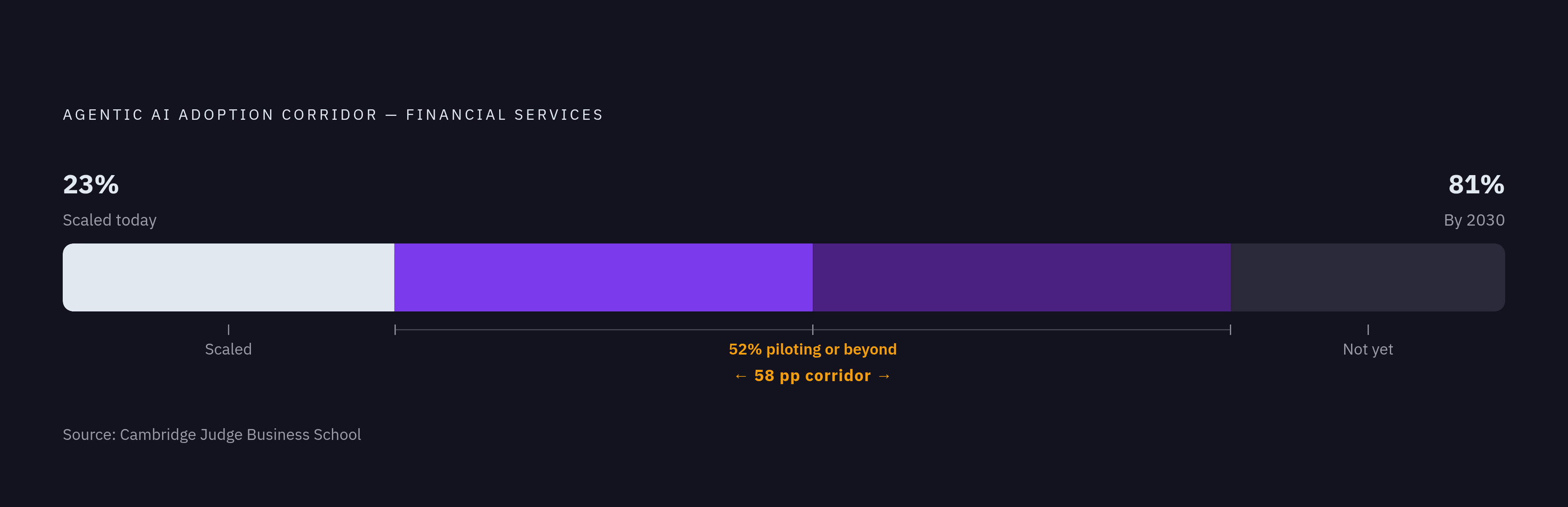
As of early 2026, 52% of financial services institutions were piloting agentic AI or had reached more advanced deployment stages, per Cambridge Judge Business School, with 23% already at scaling or transforming phases. The capital commitments make the direction unmistakable.
JPMorgan Chase and Bank of America each committed roughly $4 billion to AI in 2025. Ninety-two percent of global banks reported active AI deployment in at least one core banking function that same year. Fifty of the world's largest banks announced more than 160 use cases in 2025 alone, per McKinsey. Goldman Sachs crossed 90% internal AI adoption. Morgan Stanley's AI assistant reached 98% adoption among its financial advisor teams. Those institutions are now wrestling with the harder questions: governance, access control, scale.
Market size projections vary considerably. Mordor Intelligence estimates the agentic AI in financial services market at $7.78 billion in 2026, growing at a 41% compound annual rate through 2031. Grand View Research puts the 2025 base at $691.3 million scaling to $6.7 billion by 2033. Those numbers do not reconcile with each other, and honestly, neither methodology is airtight. The directional consensus holds regardless: rapid expansion, consistent trajectory, genuine uncertainty about magnitude.
The gap worth watching sits between 23% and 81% — the distance between institutions that have passed the scaling threshold today and those that expect meaningful agentic deployment by 2030, per Cambridge Judge Business School. Think of it as a race where most runners are still lacing their shoes while the starting gun has already fired. Most institutions are somewhere in that middle corridor right now, which is an uncomfortable place to occupy when the capability curve moves this fast. Organizations that are treating governance infrastructure, specifically access controls and observability layers, as foundational work today will be able to say yes to new use cases quickly when they surface. Everyone else will be catching up to their own approved pilots.
How Agentic AI Is Reshaping Fraud Detection and AML Investigations
U.S. consumers and businesses lost many billions of dollars to fraud in 2024, a sharp year-over-year increase, per FTC data. Combined global fraud and money laundering losses reached hundreds of billions. Before agentic AI, the systems deployed against that scale of problem were structurally mismatched to it.
More than 70% of financial institutions were still relying on manual operations for at least half of AML activities as of the 2025 to 2026 survey period, per SymphonyAI's FinCrime Frontier research. Fifty-four percent of compliance teams reported that fewer than 5% of alerts escalated to a case or SAR filing. The vast majority of analyst hours were producing no investigative output. That is a remarkable allocation of skilled labor, and it was not a people problem. It was an architecture problem — like using a fine-tooth comb to bail out a flooding ship.
Agentic AI addresses this at the architecture level. Instead of surfacing alerts for human review, an agentic system monitors in real time across channels, cross-references transaction patterns, applies dynamic typology models, and takes action: assembling case files, flagging escalations, drafting SAR narratives, without an analyst processing each alert first. The human still makes the consequential judgment call. The agent handles everything leading up to it, which is precisely where the hours were disappearing.
Results from early deployments are specific enough to be credible. JPMorgan Chase recorded a dramatic drop in false fraud alerts after moving to agentic AI, freeing analysts from low-value triage. A large Dutch financial institution deploying agentic AI in AML investigations cut investigation time roughly in half. Seventy-three percent of payment firms already report cost savings from AI in AML operations. Fraud detection and AML currently represent the largest single application segment of the agentic AI in financial services market, per Mordor Intelligence. That is where the pain was sharpest and the workflow was clearest: high volume, rules-grounded, slow enough that acceleration had immediate operational impact.
There is a governance tension embedded here that does not resolve cleanly. Agents taking action on fraud alerts are also agents touching sensitive financial records continuously. What they accessed, when, and on whose authority must be answerable in real time, not reconstructed after a regulator asks. Oracle Financial Services entered this space explicitly, introducing AI agents in its Investigation Hub Cloud Service in March 2025 to automate financial crime investigation workflows globally. The product category is moving. The compliance architecture has to keep pace.
What Agentic AI Actually Does Inside Lending, From Application Intake to Credit Memo
The lending workflow is unusually well-suited to agentic AI, and the reasons compound. It is multi-step, data-intensive, largely rule-governed at each stage, and slow enough that acceleration has direct revenue implications. In a rate-sensitive market where borrowers compare term sheets in parallel, speed to commitment is a genuine competitive differentiator, sometimes the only one that matters.
At application intake, document collection, verification, and identity checks that humans previously handled sequentially get compressed into near-simultaneous execution. At the credit risk assessment stage, an agent pulls bureau data, financial statements, and covenant history; synthesizes a structured memo; and flags exceptions before any human analyst touches the file. At decisioning support, the agent presents structured recommendations with supporting evidence rather than raw data, directing the underwriter's attention to what actually requires judgment. Post-decision, agents handle loan onboarding, covenant monitoring, and renewal triggers. The whole lifecycle moves faster with existing headcount.
The productivity evidence from actual deployments is concrete. A U.S. bank cited by McKinsey that deployed AI agents for credit risk memos saw a 20% to 60% increase in productivity and a 30% improvement in credit turnaround time. JPMorgan's COiN platform reviews thousands of commercial credit agreements annually, work that previously required hundreds of thousands of lawyer hours, while improving accuracy and generating estimated annual savings in the tens of millions.
This is not primarily a headcount reduction story. It is a throughput story: the ability to process more applications with existing staff, to compete for business that would have previously taken too long to underwrite, to move faster than competitors in markets where the decision window closes quickly. The underwriting agent is not making the credit decision. It is restructuring where human judgment gets applied, shifting time away from data assembly and formatting toward actual risk assessment.
How Agentic AI Operates in Capital Markets, From Execution to Risk Management to Research
Capital markets is where the speed advantage of agentic AI is most literal. Decisions that improve with faster execution simply cannot be made by humans at the required frequency. Market conditions move in milliseconds. Human cognition does not.
Multi-agent trading architectures have been documented in recent academic research, including work published by Springer Nature in 2026, describing how these systems decompose the portfolio problem into specialist agents covering stock selection, trend prediction, risk management, trade execution, and portfolio rebalancing. Each agent operates within its defined lane and coordinates continuously with the others. No single agent is responsible for the full portfolio decision, and the architecture is designed so that each component is independently auditable, which matters most when something goes wrong.
Goldman Sachs is the most prominent institutional reference point in this domain. Agentic trading algorithms now execute a substantial share of the firm's equity trades, with decision latency in the low milliseconds. Risk management agents run continuous value-at-risk checks and update portfolio allocations in response to market movements, operating without shift changes, without fatigue, without the communication latency that comes with human handoffs. Research synthesis agents work in an adjacent lane: ingesting earnings transcripts, macro data, and regulatory filings to produce analyst-ready briefings, freeing human analysts for interpretive work that requires contextual judgment and genuine relationship knowledge.
The operational risk embedded in this use case deserves proportional weight. Agents operating at millisecond latency and touching market infrastructure at scale are exactly the agents whose permissions and access logs require the most rigorous governance. A misrouted instruction at that speed has consequences that play out before any human can intervene. The institutions that have thought carefully about this built their governance layers before the first incident, not in response to one.
What Wealth Management Looks Like When Portfolio Work and Client Communication Are Automated
A human advisor can meaningfully serve a finite number of clients. That is not a failing; it is arithmetic. The promise of agentic systems in wealth management is extending an advisor's reach without degrading the relationship, which is the core value proposition in this business and historically the hardest thing to scale.
The tasks agents take on in this context are not the relationship tasks. They are the operational and monitoring tasks that consume advisor time without requiring advisor judgment. Portfolio rebalancing: monitoring drift against targets, executing rebalancing trades, optimizing for tax lots, continuously rather than at quarterly review. Client reporting: generating personalized performance reports tailored to each client's portfolio and stated goals, on demand. Proactive communication: flagging events the client should know about — a benchmark breach, a significant market move, an upcoming required minimum distribution — before the client asks. Onboarding and compliance: KYC documentation, suitability questionnaires, account setup workflows. None of this required an advisor's judgment in the first place. It required their time, which turns out to be the more constrained resource.
KPMG estimated in 2025 that automation of portfolio management processes can reduce operational costs by 40% to 50% by eliminating manual interventions, and that stronger proactive client communication can improve retention and grow the client base by 10% to 20%. Morgan Stanley's AI assistant reached 98% uptake among financial advisor teams, saving roughly 30 minutes per client meeting across roughly 1 million annual calls. Orion launched AI assistants in September 2025 with a product roadmap expanding into account opening, billing, and reconciliation through early 2026, signaling that the vendor ecosystem is building toward a more comprehensive automation layer, not stopping at meeting prep.
The personalization question this use case surfaces is fundamentally a governance question. Agents that communicate proactively with clients on behalf of advisors have access to full client financial profiles. The trust and permission architecture around that access is a fiduciary obligation, and it needs to be embedded in the deployment architecture from the start, not retrofitted after advisors have already built workflows around it.
The Operational and Regulatory Demands That Serious Agentic Deployment Actually Creates
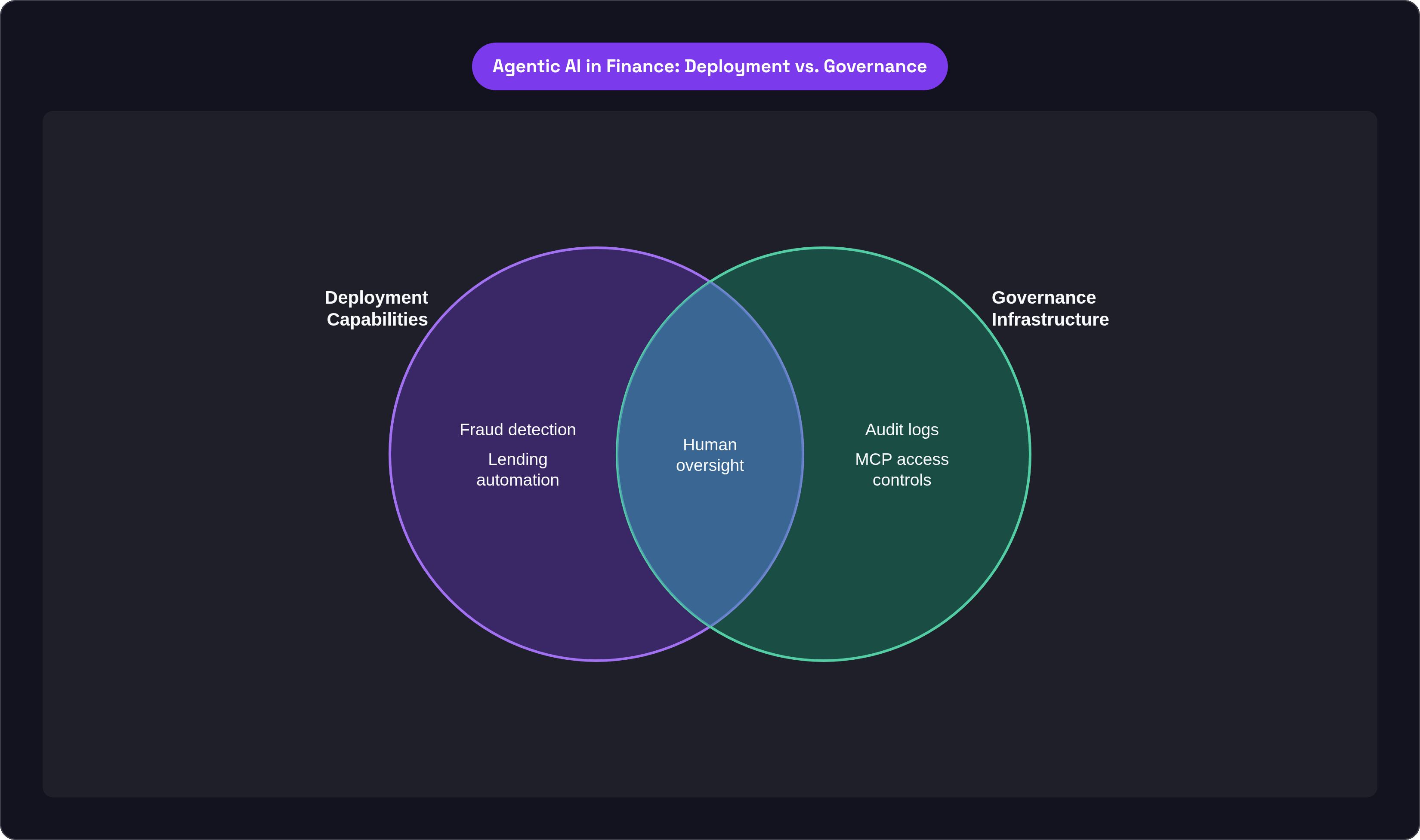
The gap between piloting and scaling is not a model problem. Institutions stuck at the piloting stage are stuck because they cannot demonstrate, to their own risk and compliance functions, that what the agent is doing is fully visible and fully governed. That is an infrastructure gap, not a capability gap.
Regulators in this space are watching for three things. Explainability: can the institution show why a credit decision was made, which data sources the agent drew on, and in what sequence? Auditability: is there a complete record of what each agent accessed and when, available before an incident, not assembled in response to one? Human oversight: is there a documented, meaningful point at which a human can review, override, or correct the agent's output? These are not novel demands. They are the same demands regulators make of human-operated processes, applied to a faster and more autonomous system. Institutions that have been through serious regulatory scrutiny tend to take them seriously earlier in the deployment cycle, which is not a coincidence.
The Model Context Protocol has emerged as meaningful infrastructure in this context. As agents connect to more data sources and external systems, MCP defines how that connectivity is structured. Ungoverned MCP connections are ungoverned access to critical systems. The protocol is not itself a governance solution; it is the standard that governance solutions are built on top of. The institutions moving fastest are the ones that centralized access policies and deployed a governed gateway early, because the guardrails are already in place when a new use case comes up for approval.
Shadow AI is the real alternative to governed deployment, and it operates whether or not institutions acknowledge it. Teams that cannot get approved tools find unapproved ones. A banned MCP server is not a missing capability from the institution's perspective; it is an undiscovered one operating outside the perimeter. The practical choice is not between agentic AI and no agentic AI. It is between governed agentic AI and ungoverned agentic AI, and most institutions have more of the latter than their risk functions currently realize.
Real-time observability is what separates institutions that can scale from those that cannot. An audit log reviewed after an incident is a postmortem, not a control. Centralized governance layers built on MCP address this directly, giving enterprises the controls, monitoring, and audit capability that allow agentic AI to move from piloted to production without moving from governed to ungoverned.
Where Financial Institutions Actually Stand in the Agentic AI Transition, and What Comes Next
Fifty-two percent of institutions are piloting or beyond. Only 23% have passed the scaling threshold. The majority are in the corridor between proof of concept and reliable production, and they are not the only ones aware of how wide that corridor has become.
The institutions that achieved the most clearly documented results in this piece — JPMorgan, Goldman Sachs, Morgan Stanley, the Dutch AML case — share something that does not show up in the headline numbers. They invested in the infrastructure that made agents accountable before they scaled them. Access controls, observability layers, governance architecture first; then speed, because the conditions for trust were already in place. Other institutions built the agent and then tried to retrofit the accountability, which is a slower and more expensive path than it looks. You might say they built the plane and tried to design the runway on the way down.
Some industry reporting as of mid-2025 described capability improvement rates measured in months rather than years. That pace does not wait for governance catch-up. Institutions that cannot keep their compliance architecture current with their deployment pace are accumulating unaccounted-for access across their own systems quietly, and that exposure tends to surface at the worst possible moment, usually in the middle of something else.
The ROI evidence across fraud detection, lending, capital markets, and wealth management is directional and consistent. Institutions that deployed thoughtfully are reporting returns that justify the investment and the organizational disruption that accompanied it. The question is not whether the return is real. The question is whether a given institution has built the conditions to realize it sustainably, at scale, under regulatory scrutiny, without losing track of what its agents are doing on any given Tuesday afternoon when nobody is paying especially close attention.
Eighty-one percent of industry respondents expect meaningful agentic deployment by 2030. The decisions being made right now — about governance infrastructure, about access controls, about observability — are not preparatory work. They are the competitive work. Everything else follows from whether those foundations are already in place or still being poured.