What an AI Governance Framework Actually Needs to Cover
Enforcement is tightening fast, and most organizations are unprepared for what it actually demands.

The global regulatory picture is fragmented but converging, and faster than most legal teams anticipated. The OECD AI Policy Observatory now tracks well over a thousand AI policy initiatives across dozens of countries. That number alone tells you something about the direction of travel: the era of voluntary AI ethics principles is ending, and enforceable obligations are replacing them.
The EU AI Act is the most consequential single regulation to emerge from that wave. It is a risk-tiered framework classifying AI systems from prohibited to minimal risk, with mandatory conformity assessments, registration requirements, and human oversight obligations for high-risk systems. What makes it operationally significant is the specificity of those high-risk categories. Hiring systems, credit scoring tools, critical infrastructure management, border control: enterprises are already running these things today. The Act's penalties for violations rank among the largest in any regulatory regime anywhere, and enforcement applies to any organization whose AI touches EU citizens regardless of where that company is headquartered.
The United States has not enacted a comprehensive federal AI law, but that does not make the domestic environment permissive. Sector regulators including the CFPB, FDA, SEC, FTC, and EEOC are increasingly referencing NIST AI RMF principles in their enforcement expectations. State-level activity has accelerated sharply in parallel. South Korea enacted dedicated AI legislation in early 2025. China has issued AI content-labeling requirements and a second version of its AI Safety Governance Framework.
Here is the part that catches companies off guard. Even organizations not directly subject to the EU AI Act are finding that auditors, insurers, and enterprise customers evaluate their risk management practices against its logic anyway. Compliance with the Act's letter is one obligation. Demonstrating that your governance practices are commensurate with its underlying logic is a separate and broader one, reaching further than most legal teams initially mapped. I've seen this happen to organizations that thought the Act simply didn't apply to them — like a swimmer who thinks they're safe because they're standing at the edge of the pool, only to find the tide came in — and the conversation with their enterprise customers was uncomfortable.
The regulatory pressure is not an argument for compliance theater. It is an argument for building the operational infrastructure that compliance actually requires.
How the NIST AI RMF structures the work most frameworks leave undefined
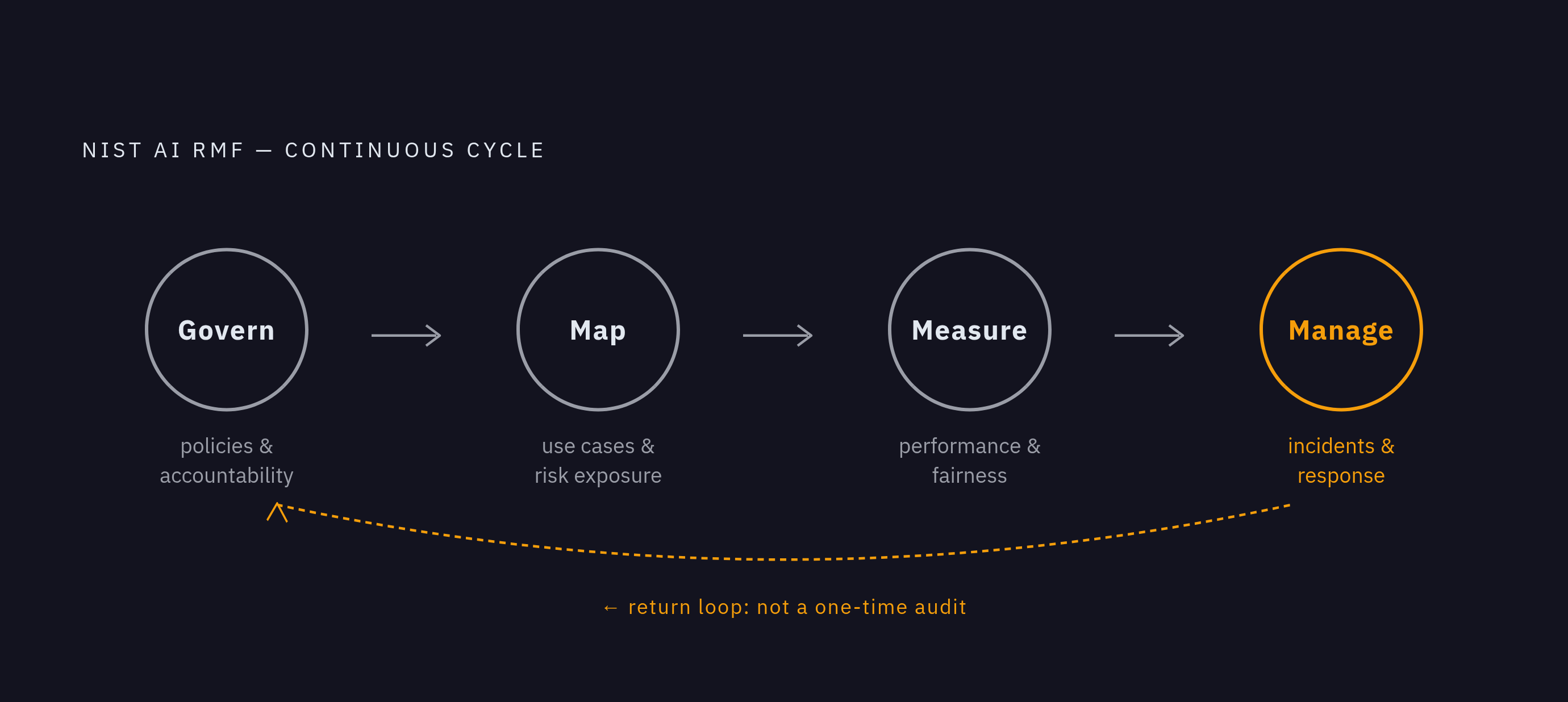
The NIST AI Risk Management Framework, published in 2023 and updated significantly since, has become the de facto international reference point for organizations designing or auditing AI governance programs. Its structural value is genuine: it turns a vague aspiration toward "responsible AI" into discrete, accountable functions that teams can actually divide and own.
The four functions, Govern, Map, Measure, and Manage, create a continuous loop rather than a one-time compliance exercise. Govern establishes policies, accountability structures, and organizational culture. Map documents use cases, data sources, third-party dependencies, and risk exposure. Measure evaluates model performance, fairness, and the effectiveness of controls already operating in the field. Manage monitors incidents, tracks ongoing compliance, and handles response when something breaks. The loop matters because AI systems change after deployment in ways that a static point-in-time review cannot catch.
The 2025 and 2026 updates expand the framework's scope explicitly to cover generative AI risks, supply chain vulnerabilities, and new attack vectors. Organizations treating this as a static reference document are already working with an outdated read of it, which matters more than it sounds given how quickly the threat surface is shifting.
NIST also released a Generative AI Profile, designated NIST-AI-600-1, cataloging risks specific to generative systems: hallucination, prompt injection, data poisoning, over-reliance, and others that the base framework predates. If your organization is running large language models in production and your governance program doesn't address at least some of these vectors explicitly, you have a gap. A documented one, now.
What the RMF does well is create shared language across functions that otherwise argue past each other. Legal, engineering, risk, and compliance can orient to the same four-function structure without spending the first three meetings arguing about what "governance" even means in an AI context. What the RMF does not provide is the technical enforcement layer. It describes what to govern; building the infrastructure that actually governs it in real time is left entirely to you.
The components a framework must cover before a model reaches production
Risk classification and inventory
Every downstream governance decision depends on knowing what AI systems the organization is running, what data they touch, and what decisions they influence. Without that inventory, there is no framework. There is a policy document, and there is hope.
Inventory scope has to be comprehensive: models, datasets, APIs, third-party vendors, and use cases. Not just the flagship systems that received board-level attention, but the smaller deployments that accumulate quietly across business units over time. Those quieter deployments are frequently where exposure concentrates, because they were launched without scrutiny and nobody named an owner. Nobody reviewed them at all.
Risk classification then assigns proportional controls. A low-stakes internal summarization tool and a hiring algorithm carry different obligations and different audit requirements. Treating them identically wastes resources on one and under-governs the other. This sounds obvious and yet organizations routinely get it backwards, piling process onto the visible systems while the obscure ones operate without oversight for years.
Accountability structures
Cross-functional governance bodies that bring together technical, legal, ethics, and business perspectives are necessary because no single function sees the complete risk picture. Pull any one of those chairs from the table and the blind spots multiply fast. And each function genuinely sees something different. What the model is technically capable of, what the organization is legally permitted to do, what it should do, and what it is financially incentivized to do are four distinct questions, and the answers frequently conflict.
Board-level accountability remains weak across the industry. A substantial share of boards now hold regular AI discussions, but formal charter-level accountability is far less common, and CEO or C-suite ownership of AI governance as a named responsibility is still a minority practice. Dedicated Chief AI Officer roles are one structural response, though adoption remains partial and inconsistent.
What cuts through all the structural discussion: a governance program with no accountable individual attached to each system is a policy document, not a control. Named ownership matters because accountability requires a specific person who can be called when something goes wrong at 11 p.m. on a Tuesday, and "the committee" does not answer phones.
Model approval workflow
Documented criteria and formal sign-off before deployment, not after. This sounds obvious. In practice it is frequently bypassed under schedule pressure, and the bypass is exactly where organizational exposure begins to accumulate. The urgency of a launch deadline is a poor defense in a regulatory proceeding, and yet the conversation about skipping approval happens constantly at companies that otherwise consider themselves well-governed.
Fairness and bias testing
Bias is the most frequently litigated AI failure mode, and it compounds quietly. Models trained on historically skewed data automate inequality at scale in hiring, credit, and healthcare contexts. The automation does not introduce bias so much as amplify and launder existing bias through an apparently neutral system, which makes it harder to contest and easier to miss. Regulators understand this mechanism now, and the "the model decided" defense has been consistently rejected.
Pre-deployment bias detection should include statistical parity tests, equalized odds analysis, and subgroup performance evaluation. Demographic drift after deployment can surface bias that clean pre-launch data did not predict. The testing regime has to extend into production, not stop at the deployment gate.
Explainability requirements
Explainability integrated at every stage of the machine learning lifecycle is qualitatively different from explainability retrofitted after deployment. Organizations that bolt on an explanation layer after the fact frequently discover it cannot account for training data attribution or influence scoring in a way that satisfies a regulator or holds up in court. The retrofit problem is partly technical and partly organizational: by the time someone asks for an explanation, the people who made the original modeling decisions are no longer on the team.
Enterprise-grade explainability requires training data attribution, influence scoring, complete audit trails, and support for contestability. In high-stakes domains, hallucination rates in large language models remain a material concern even for frontier models. Structured detection and human verification belong in the governance framework, not the product roadmap.
The operational controls that turn policy into enforcement once a system is live
The five concurrent mechanisms
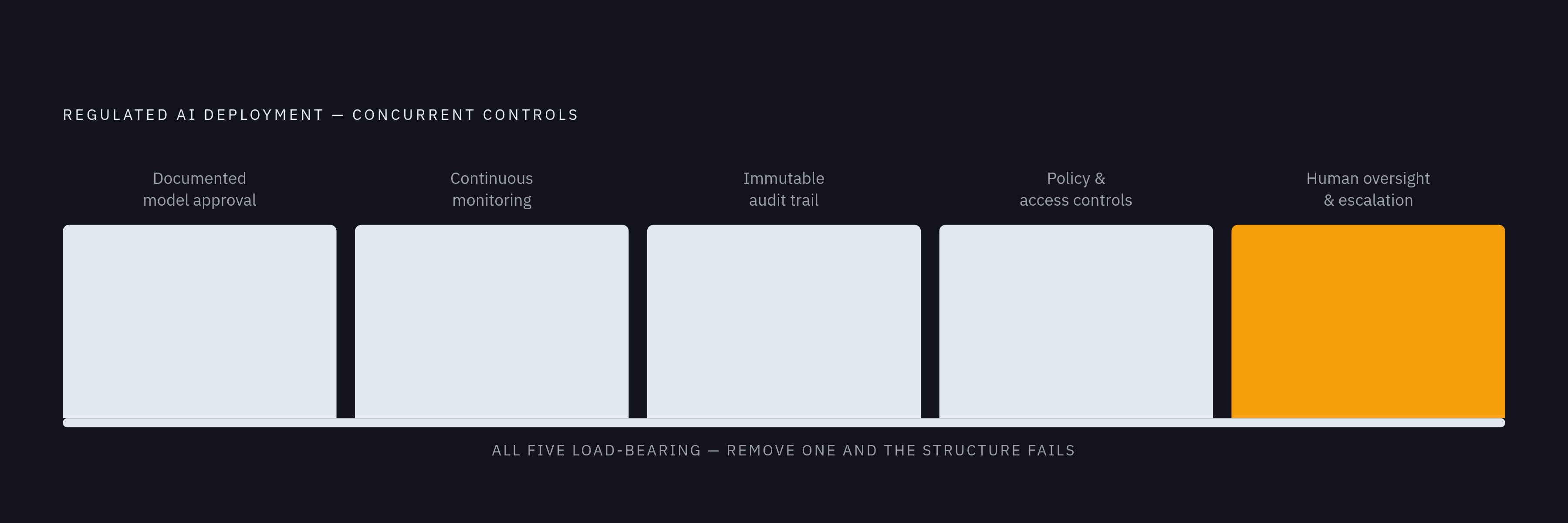
A regulated deployment requires five things operating simultaneously, not sequentially. First, the documented model approval workflow already covered above. Second, continuous model monitoring that detects drift, fairness degradation, and performance decay in production on an ongoing basis, not on a quarterly review calendar. Third, an immutable audit trail: a record of every consequential decision the system made, when it made it, and what it touched, captured in real time rather than reconstructed after an incident from fragments. Fourth, policy controls enforcing output and access boundaries at the infrastructure level, not left to model-level instructions that can be circumvented. Fifth, human oversight with meaningful escalation paths built into the system's operation, not appended as a review step after consequences have already propagated.
Each of those five is load-bearing. Remove one and the others cannot compensate.
Access controls as the enforcement layer most policy documents skip
Data governance and AI governance are inseparable in practice, even when organizations maintain them as separate workstreams. The question of what an AI system can touch is a governance question, not merely a security configuration. Per IBM's 2025 Cost of a Data Breach Report, the overwhelming majority of organizations that experienced breaches of AI models or applications lacked proper AI access controls.
Role-based access control applied to AI systems ensures that what a system can access reflects a deliberate organizational decision, not the default permissions inherited from initial setup. Access controls without visibility are still incomplete, though. Knowing what a system is allowed to touch matters less than knowing what it actually touched, when, and why. Those are different questions and most organizations have only answered the first one.
Real-time visibility versus retrospective audit logs
An audit log reviewed after an incident is a postmortem. It tells you what happened. Governance infrastructure that surfaces anomalies in real time — unexpected data access, out-of-scope actions, permission escalations — allows intervention before consequences compound into something harder to contain or explain. Think of it as the difference between a smoke detector and a fire investigator: one stops the damage, the other documents it.
Fewer than a fifth of organizations in heavily regulated industries have dedicated AI incident reporting tools in place. That monitoring gap is pervasive across the industry, including at organizations that would describe their governance programs as mature. The gap is invisible until it isn't.
GDPR and AI Act compliance programs that run as separate workstreams create both compound obligations and compound blind spots. Coordinated governance across both is structurally necessary, and the organizations that haven't reconciled those two frameworks yet are accumulating more overlap debt every quarter.
Why agentic AI breaks the assumptions most current frameworks were built on
Most AI governance frameworks were designed around a model that sits in one place, receives a prompt, and returns a response. That model of AI behavior is already outdated for a growing share of enterprise deployments. Agentic AI systems execute multi-step autonomous actions across internal systems, external APIs, and organizational data, frequently without a human in the loop at each step. The governance assumptions built for the first category fail structurally when applied to the second.
Enterprise adoption of task-specific AI agents is projected to grow sharply over the next few years. The governance problem is arriving faster than most frameworks are evolving to meet it.
What existing frameworks were not designed for
A static model inventory assumes identifiable, bounded systems. Agents spawn dynamically, connect to new tools, and change scope in ways that a point-in-time inventory cannot capture. Human oversight mechanisms designed for individual decisions do not scale to chains of autonomous actions completing in seconds. Access controls scoped to a single model miss the lateral movement an agent can perform across connected systems once it has initial access.
These are not edge cases. They are the default behavior of agentic systems doing their job correctly. The failure mode isn't the agent misbehaving; it's the organization discovering after the fact that they had no record of what it did.
The MCP layer as a specific governance surface
The Model Context Protocol defines how agents connect to data sources, APIs, and tools. Each MCP server in an enterprise environment is an integration point, and each one is a potential access vector the governance framework either accounts for or does not. An MCP server added without registry entry, access policy, or monitoring is an identity the organization cannot account for. I've watched this play out at organizations that considered themselves well-governed, and the discovery conversation is never pleasant. Unaccounted identities are where exploitation happens, and the gap between "we have a governance program" and "we know what our agents can actually touch" is larger than most security teams realize.
Shadow AI compounds the agentic risk in a specific way. Teams that cannot access governed paths to agentic tools will find ungoverned ones. Blocking without providing alternatives does not eliminate adoption; it pushes adoption underground, producing the same exposure without any of the visibility. You end up with the risk and none of the information, which is worse than either outcome individually.
Frameworks that treat agentic systems as a subcategory of "advanced AI" rather than a structurally different governance problem will find their controls inadequate the first time an agent does something unexpected in production. And they will find out the hard way, meaning after something has already happened.
How third-party and supply chain dependencies extend the governance perimeter
Enterprise AI systems are rarely built from scratch. They combine foundation models, third-party APIs, vendor platforms, and pre-trained components whose behavior the deploying organization did not design and does not fully understand. The governance framework has to extend to every dependency in that supply chain because the attack surface does, regardless of what the contracts say.
Third-party risk is now a primary governance concern. What that requires in practice is vendor assessment processes that evaluate AI-specific risks rather than applying standard software security questionnaires that were not written with model behavior in mind. Contractual obligations need to cover data handling, model updates that change behavior post-integration, and incident disclosure timelines. Third-party components need to be mapped into the organization's risk classification system, not siloed outside the framework's scope as if the risk boundary stops at the organization's own code.
Cross-framework deduplication is a practical efficiency worth prioritizing. Governance platforms that map a single risk control to requirements across the EU AI Act, ISO/IEC 42001, and NIST AI RMF simultaneously mean evidence collected once satisfies multiple obligations. This matters because the overhead of maintaining parallel compliance workstreams is a primary reason governance programs get treated as a burden rather than infrastructure, and when governance gets treated as a burden, teams start looking for corners to cut.
The visibility gap here is structural. Organizations have stronger controls over systems they built than over systems they bought or integrated. A governance framework that treats those categories differently has a blind spot precisely where supply chain risk concentrates. The vendor relationship does not transfer the accountability, and that asymmetry will surface in a regulatory proceeding long before it surfaces in a vendor conversation.
What a complete framework looks like when the operational and policy layers are actually aligned
The integrated picture
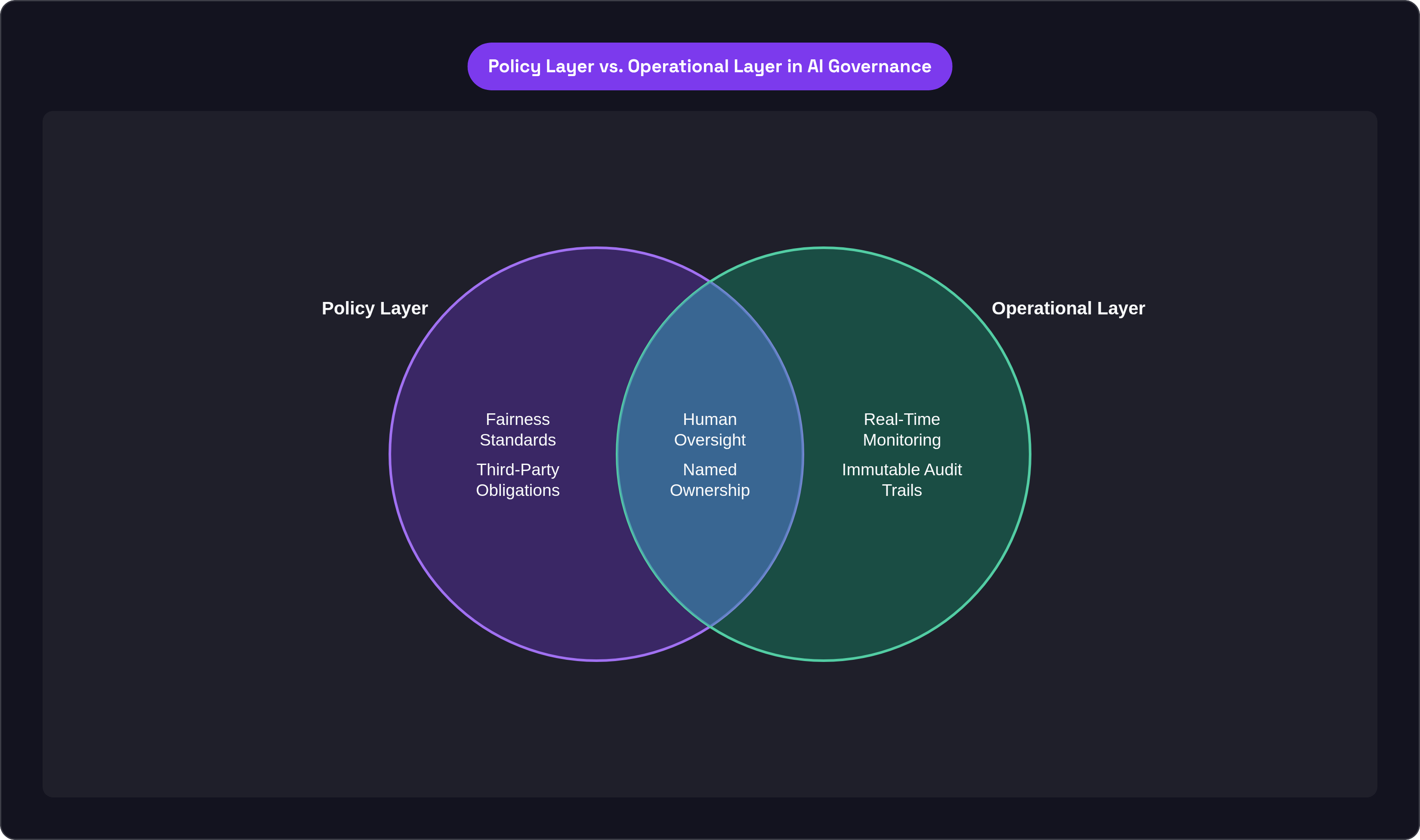
A complete framework has two layers and, critically, a real connection between them. The policy layer covers risk classification, accountability structures, fairness standards, transparency requirements, and third-party obligations. The operational layer covers access controls, real-time monitoring, immutable audit trails, human oversight mechanisms, and incident response procedures.
Those two layers only constitute a governance framework when they are actually connected. A policy that describes an access control that doesn't exist in the technical layer is documentation of intent. A named owner attached to a system with no monitoring infrastructure is an organizational chart entry. Neither is governance.
What closing the execution gap looks like in practice
Every AI system in the inventory has a named owner, a risk classification, and controls calibrated to that classification. Access is governed by explicit policy, not default permissions. What an AI agent can touch is a decision the organization made deliberately, not a configuration it inherited from initial setup and never revisited. Monitoring is continuous and surfaces anomalies before they become incidents. Audit trails are real-time records, not reconstructed logs assembled in the aftermath of something going wrong. Human oversight is embedded in the system's operation from the beginning, not bolted on after a regulator asks where it is.
The velocity argument
Here is the argument that often lands better with leadership than the compliance case: organizations that embed governance into the technical layer can approve production deployments that organizations without that infrastructure have to refuse or delay indefinitely. The governance controls are what enable velocity because they provide the assurance that accelerates decisions.
Treating governance as friction misunderstands the mechanism entirely. The organizations moving fastest on AI deployment are not doing so in spite of their governance programs. The programs are the reason they can move at all.
The competitive and regulatory reality
Organizations that treat AI governance as operational infrastructure rather than a compliance obligation are building the audit trails, access records, and accountability structures that regulators, insurers, and enterprise customers will increasingly require as a condition of doing business. This is already happening. It is not a forecast.
A governance framework that lives only in documents describes what the organization intends to do. The framework that lives in the technical layer is what the organization actually does. The distance between those two things is not an abstraction. It is the risk, and it is measurable.