HashiCorp Vault Integration With MCP Tool Calls
How Vault's short-lived secrets and policies limit what a hijacked agent can reach.
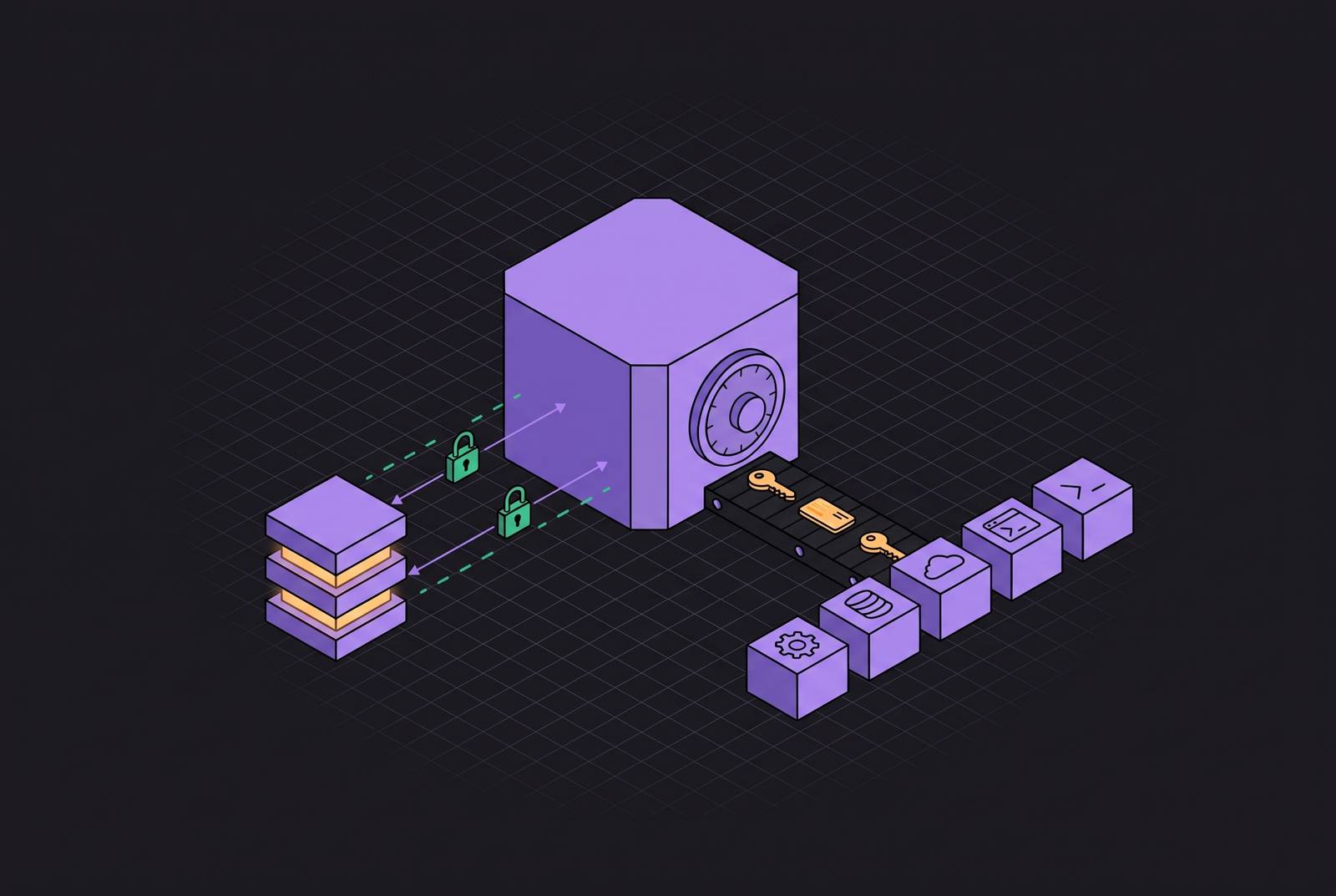
Integrating HashiCorp Vault with MCP tool calls replaces hardcoded credentials with secrets issued on demand, limited by policy, and revoked when their work is done. That gives agent workflows a stronger security boundary without a person having to approve each new request. But short-lived secrets are only part of the answer. The agent identity, tool permissions, and audit records must stay linked at every step of the workflow.
Why AI agents cannot safely use static credentials
The “Deadbugz” campaign in August 2026 showed how ordinary tool use could conceal credential theft. A malicious MCP server spread through public GitHub pull requests, executed three ordinary tool calls, then pivoted to harvesting SSH keys, AWS credentials, shell history, and Kubernetes configuration. It hid that activity from the user.
The structural problem starts when an agent receives a long-lived API key in its conversation context. That key can persist throughout the session. A prompt injection that gains access to the context can therefore expose credentials beyond those needed for the current task. A developer’s key in a secrets manager and an agent’s key in a prompt have different exposure paths, even when both unlock the same service.
Static keys also spread through configuration files, environment variables, and development, staging, and production systems. Copies outlast the tasks that required them. Without an inventory that links each credential to its agent, rotation is hard and access can stay open with no end date. A compromised agent can then reach every system its key permits, extending its access beyond the resource needed for one task. The alternative is to issue dynamic, short-lived secrets when they are needed.
What HashiCorp Vault's dynamic secrets engine actually does
Vault’s dynamic secrets engine generates a credential when requested, attaches a lease, and revokes it when that lease expires. The lease sets the access window. For databases such as Postgres, MySQL, and MongoDB, the engine creates a temporary user scoped to a named role. When the lease expires, that user is deleted.
Not every Vault engine works this way. KV v2 stores versioned static application secrets and uses check-and-set, or CAS, to prevent concurrent requests from overwriting changes. Transit encrypts and decrypts data without handing the encryption key to the agent. PKI issues X.509 certificates when they are needed for mutual TLS between an agent and a service. These engines serve different purposes, so putting a static API key in KV v2 does not turn it into a dynamic credential.
AppRole, Kubernetes service account tokens, JWT/OIDC, and cloud IAM methods let workloads authenticate without a person approving each request. Dynamic credentials have a time to live, while token renewal through auth/token/renew-self avoids repeated authentication during a task. Token renewal and a database credential’s lease are distinct controls. HashiCorp’s NORD/LB case study reports that key management now takes less than five minutes, illustrating the operational benefit without changing those underlying mechanics.
How the official Vault MCP server and FastMCP wrappers expose these capabilities to agents
The Vault MCP server translates an agent’s request into an authenticated Vault API call. The agent requests an action through a tool. The server determines how to make that request, while Vault decides whether its policy permits it. This separates the model’s expressed intent from the authority needed to act on it.
HashiCorp’s official server is a public beta under the MPL-2.0 license, with stdio and streamable HTTP transports. It exposes capabilities for secrets storage, rotation, machine identity, audit, self-hosting, and agent identity. Activepieces surfaces Read Secret, Write Secret, Delete Secret, List Secrets, and Custom API Call through its integration. Tool annotations also identify dangerous operations. For example, delete_mount includes the warning “Use with extreme caution”, though a warning is not an access control.
FastMCP wrappers in TypeScript or Python can expose narrower tools. A get_database_credentials tool returns a temporary username and password, expiry timestamp, and lease ID, while revoke_credential requests early revocation through sys/leases/revoke. An encrypt_data tool proxies Transit without exposing its key. A get_api_token tool can retrieve a KV v2 value and discard the server’s copy after returning it, but that does not erase the returned value from the recipient.
The intended boundary keeps Vault credentials away from the agent. The agent holds a scoped MCP server token, the server holds a Vault token limited to one mount, and Vault stores or generates the secrets.
Why a Vault-backed MCP design limits credential theft from prompt injection
Vault removes the need to leave long-lived credentials available throughout an agent’s work and limits the lifetime of newly issued access. That changes what an attacker can obtain and how long it remains useful. It does not make a password safe merely because it arrived through a tool response.
This distinction is essential to the design. If a tool returns a database password into the agent’s context, the agent still has its copy after the server discards its own. The next request for a credential can trigger another Vault policy check, but that check cannot take back a secret already disclosed. Transit provides a stronger boundary for encryption because the key never reaches the agent at all. The security claim therefore depends on which tool is used and what it returns.
The August 2026 Grafana MCP flaw, CVE-2026-19516, illustrates the danger of weak server identity isolation, with a shared session enabling use of the server’s service account and a caller-controlled header redirecting requests toward cloud metadata. The fix shipped in mcp-grafana 1.1.0. The MCP Python SDK’s September 2026 OAuth flaw likewise allowed a malicious server to obtain a client secret and was fixed in versions 1.30.0 and 2.2.0. Patched dependencies remain necessary. Vault’s lease-and-revoke model bounds a compromised run in time and scope; the decisive question is how much an injection attempt can accomplish before access ends.
How Vault policy, auth methods, and audit logs enforce least-privilege across agent tool calls
Least-privilege begins with the identity attached to each request. The MCP server maps that identity to Vault policy before it asks for access. A read grant on secret/data/agents/* permits only reading that path. An agent allowed to request database/creds/agent-ephemeral-role gains no access to database/creds/admin-role without a separate grant. Explicit deny rules override permissive grants.
Delegation needs its own upper bound. Vault Enterprise 2.1.0 made agentic IAM generally available, including ceiling policies that limit delegated token permissions according to the Agent Registry. An agent acting for a user remains within the limit set for its agent class, keeping delegated access within that boundary.
Authentication determines how firmly those policies attach to a workload. AppRole suits serverless and pipeline agents, using a configured role ID and a secret ID rotated on a schedule. Kubernetes authentication binds access to the pod’s service account token. Enterprise JWT/OIDC support with OAuth Rich Authorization Requests can replace reliance on a standing Vault token with request-scoped authorization.
Audit records connect these decisions to evidence. Every Vault edition supports audit logging, and calls that reach Vault, whether allowed or denied, produce structured records covering the timestamp, authentication method, policy, path, and operation. Willow routes Vault MCP calls through SSO and runtime RBAC, with audit output to Splunk and Loki. Snowflake’s Tools by Cortex AI Gateway, announced at Black Hat 2026, applies centralized request and permission recording at the data layer.
That data layer remains a separate boundary. Vault can control access to a warehouse credential, but a subsequent query can still retrieve unnecessary PII. A broad service account can make an authorized tool call expose unauthorized data. A live SIEM integration shows patterns in how credentials are accessed as work happens, while query-level controls govern what happens once access is granted.
What compliance frameworks require from agent credential audit trails
The EU AI Act sets a minimum time to keep audit logs for high-risk deployments. Articles 19(1) and 26(6) require the relevant operation logs under Article 12 to be kept for at least six months. A 30-day rolling buffer falls short. Vault audit output therefore needs to move from ephemeral container logs to a durable, long-retention destination. Producing a record and retaining it are separate obligations.
GDPR also reaches the tool interface itself. Article 5(1)(c) requires personal data to be limited to what the specific purpose needs. A tool that transmits a full name, email address, date of birth, and account number when fewer fields would suffice creates a minimization problem before credential policy enters the picture. Even with narrow access to a secret, a parameter schema can still be too broad.
HCP Vault runs on HashiCorp-managed AWS or Azure infrastructure, while its control plane involves IBM’s global infrastructure under US jurisdiction. Selecting an EU region does not, by itself, resolve the GDPR and CLOUD Act tension. A Data Processing Agreement governs processing on the customer’s behalf but does not shield against compelled disclosure under a CLOUD Act order. Self-hosted Vault Community edition, under BUSL-1.1, on EU-jurisdiction infrastructure removes that particular managed-control-plane exposure.
Audit records themselves can contain personal data. Endpoint addresses, usernames, and records of developer access create storage, disclosure, and deletion questions, including California deletion rights where no retention exception applies. HashiCorp states that its global privacy program addresses GDPR and CCPA through data subject rights processes and third-party Data Protection Addenda. That statement is not a substitute for assessing the deployment’s own obligations.
Deployment patterns that connect agent identity, Vault policy, and MCP gateway control
A stdio MCP server using AppRole has the lowest operational complexity. The server authenticates at startup and holds a token scoped to one mount for its lifetime. This suits a single-agent, single-task pipeline because the server instance implicitly identifies the agent. Sharing that instance changes the risk. Without per-request token isolation, agents can end up with one another’s Vault context, which is what the Vault MCP server’s July 2026 fix addressed.
Kubernetes deployments can bind access to pod identity instead. ToolHive’s Kubernetes Operator documentation shows Vault Agent Injector annotations on an MCPServer resource, with a sidecar authenticating through the pod’s service account token. Secrets stay out of manifests and container image layers. The documented GitHub MCP server example retrieves a GitHub PAT from Vault at startup, with the Vault Agent handling its renewal-related rotation. This pattern avoids distributing an AppRole secret ID, though injecting a PAT is not the same mechanism as creating a temporary database user.
A centralized MCP gateway addresses shared enterprise environments. All tool calls pass through SSO, RBAC, and audit controls before reaching the Vault MCP server. Willow implements this pattern with output to Splunk and Loki. The gateway can separate low-privilege agents from tools reserved for higher-privilege agents even when both use the same Vault cluster. An approved-server registry completes that control surface because an unregistered server discovered at runtime sits outside the gateway’s accounted-for identities.
The FastMCP revoke_credential tool lets a workflow end its database lease when the task finishes, before the full TTL elapses. Automatic expiry remains the backstop.
What teams get wrong when they adopt Vault-backed MCP without centralizing governance
The secrets engine is rarely the governance gap. The gap appears when each team runs its own MCP server, policy mapping, and audit destination without an enterprise-wide view. An unregistered server becomes an identity the gateway cannot account for. Teams seeking unavailable capabilities may then build ungoverned workarounds, repeating the shadow IT pattern. A governed path addresses that pressure in a way a ban does not.
Shared authentication creates a different blind spot. If several agents use the same AppRole, the audit record can identify “mcp-agent-role” without identifying the agent instance responsible. Short-lived credentials do not repair that missing attribution. After an injection attempt, the organization still needs to connect access to a specific session and end-user identity to determine what was exposed.
A complete record stored only in a 30-day container buffer and read after an incident is a forensic artifact. A live SIEM connection can instead surface unusual credential-request frequency or requests outside an agent’s normal task type.
Finally, credential policy cannot repair excessive data retrieval. A tool that accepts user_id may still return email, date of birth, and account number if its query asks for too much data. That is a schema and query-control failure. A deployment has closed its governance gap only when the identity requesting access, the permission granted, the data returned, and the resulting audit record can be accounted for together.