AI Agent Orchestration Frameworks Compared
Choosing the right framework matters more than teams realize under deadline pressure.
AI Agent Orchestration Frameworks Compared
Why teams choose frameworks under pressure, not on merit
The major AI agent orchestration frameworks differ in architecture, multi-agent support, production readiness, and governance surface, and picking the right one means understanding those tradeoffs rather than reaching for whatever name shows up most in a search. That distinction matters because the decision is happening under real time pressure. Roughly 23% of enterprises are already scaling agentic AI systems in production, and another 39% are running active experiments, which means most enterprise AI teams have moved past the planning stage entirely In-Context Prompting Obsoletes Agent Orchestration for Procedural Tasks. The market backing that shift is large: the global agent market sat at $7.84 billion in 2025 and is on track to hit $52.62 billion by 2030, a 46.3% compound annual growth rate that raises the cost of picking wrong. Gartner's own projection adds to the squeeze, predicting that 40% of enterprise applications will carry task-specific AI agents by the end of 2026, up from under 5% in 2025.
That timeline doesn't leave much room for a leisurely bake-off between frameworks. A 2026 survey of more than 500 developers found that 80% of them struggle to choose among the available options, and the top complaint centered on LangChain's abstractions, which one respondent described as requiring "traversing seven layers of code" just to make a single change In-Context Prompting Obsoletes Agent Orchestration for Procedural Tas…. The frustration has spilled into public forums too: a 66-point Hacker News thread and a 51-upvote Reddit thread in r/AI_Agents both argued that 90% of agentic projects would be better off as simple prompt chains. That's a widely shared complaint. It's a signal that overchoice and over-engineering are real risks, not just a grumble from developers who don't want to learn something new.
The scope and limits of a framework
Strip away the marketing, and a framework is the control layer wrapped around a large language model. It decides how the agent moves through a multi-step task, when it calls a tool, how it holds onto state between turns, and how it talks to whatever system sits outside the model. The model itself does the reasoning and the generating. The framework is just the scaffolding around each call, deciding what goes in before and what happens after.
That distinction matters because it draws a hard line around what a framework can't do for you. None of them hand an agent live web data. Search and data access still run through external APIs regardless of which orchestration layer sits on top. None of them make a simple job simpler, either. If the task is a static Q&A bot or a single-step prompt, wiring in a full orchestration framework is more infrastructure than the job calls for, and teams that reach for one anyway are usually solving a problem they don't have yet.
A governance angle sits here too. A framework that obscures what's happening under the hood creates a blind spot the moment an agent touches sensitive data or a system that matters. Observability and access control aren't things to bolt on after a deployment goes live; they need to be part of the framework evaluation from the start, alongside raw orchestration capability, not an afterthought once something breaks.
The five dimensions that separate a working demo from a production agent
The framework that gets a prototype running fastest is often not the framework that survives contact with production. That gap appears across five specific dimensions.
Developer experience during prototyping is the most visible one: how fast can a team get something running, how clear is the mental model, how big is the API surface a new engineer has to learn before shipping anything. Production reliability decides whether an agent survives contact with real traffic. Durable execution, state persistence, and predictable error handling either come built in, or the team ends up bolting on external systems like Temporal or Redis just to get basic reliability, which quietly pushes that complexity back onto whoever's maintaining the thing. Observability and debugging support decide whether a failure is something the team can reproduce and trace, or something that just... happens, with no record of what the agent touched or when.
Ecosystem integrations round out the technical side: the framework may be tied to one model provider or work across all of them, connector library depth varies, and MCP support for standardized tool discovery is a further factor. And governance surface, meaning role-based access control for agents, audit logs, and access restrictions, is a prerequisite for a production deployment. It's the operational mechanism that lets a team say yes to a production deployment quickly, because the guardrails are already there instead of needing to be built from scratch.
Language ecosystem fit is a meta-criterion that cuts across all five, and a framework excellent for Python teams building document-heavy pipelines may be the wrong fit for a.NET enterprise team or a TypeScript shop. Evaluating a framework against your actual stack affects whether it fits the team's existing tooling and workflows, unlike evaluating it against a benchmark leaderboard. Vellum's 2026 developer guide states that the frameworks worth building on are modular, observable, carry governance a team can actually take to an audit, and offer deployment options that match the stack already in place.
The uncomfortable baseline: what production agent success rates look like
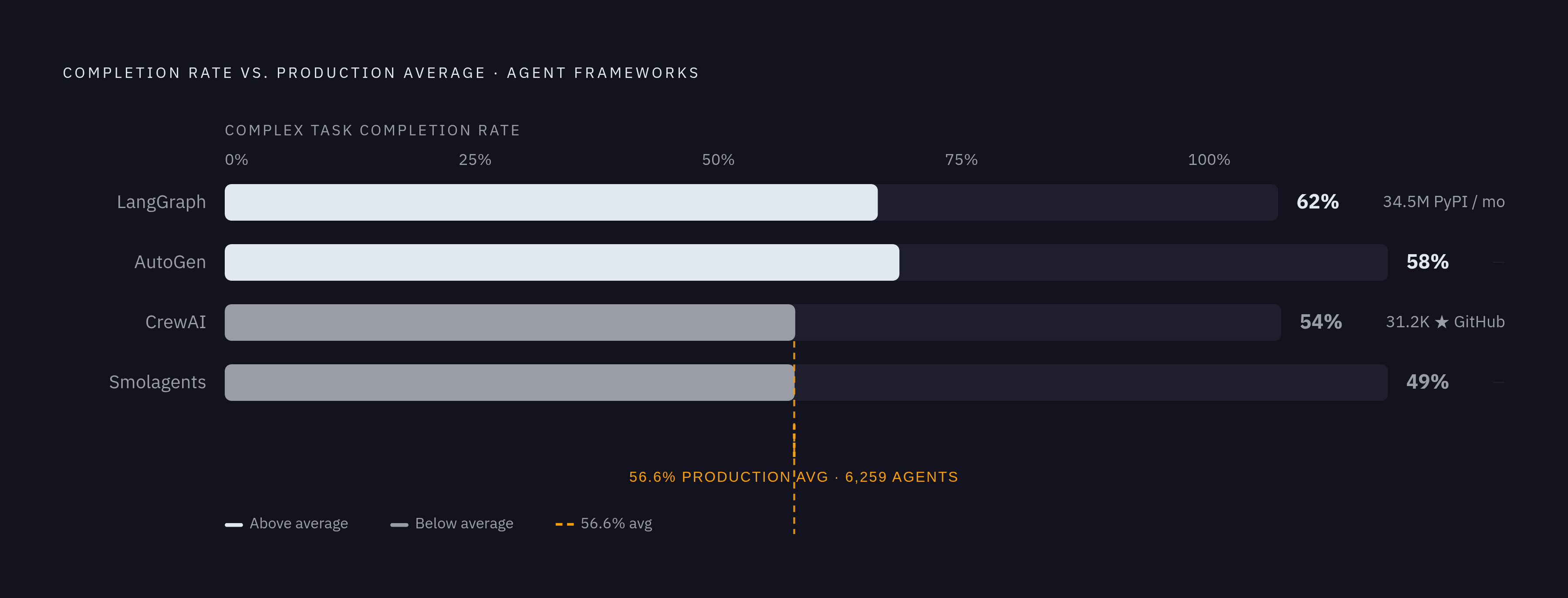
Before comparing frameworks by name, it helps to know what "working" even means in production, and the number is humbling. Foundra's 2026 production reliability analysis measured a 56.6% task success rate across 6,259 deployed agents and 4.5 million runs. Most real-world agent systems, in other words, succeed on fewer than 6 out of every 10 tasks they attempt.
Framework choice shifts that number, but not by as much as marketing decks suggest. DataCamp's comparison testing put LangGraph's completion rate on complex benchmark tasks at roughly 62%, AutoGen at roughly 58%, CrewAI at roughly 54%, and Smolagents at 49%, with code generation introducing its own failure modes at the planning stage In-Context Prompting Obsoletes Agent Orchestration for Procedural Tasks. Those gaps sound modest until they're run through actual volume. At 10,000 complex agent tasks a month, the difference between LangGraph's 62% and CrewAI's 54% works out to roughly 800 additional retries, and every one of those retries carries its own compute cost plus whatever downstream cost comes from a workflow that failed to finish.
That compounding matters because of how agent economics actually work. LLM API costs typically represent 70-85% of operational expenses excluding labor, or 15-25% of total real cost when engineering and infrastructure are included, for production agent systems. Either way, a lower completion rate doesn't just mean more frustrated users. It means the failure rate is compounding directly into the invoice.
None of this touches governance failure, either. These benchmarks measure whether a task got done, not whether the agent reached into data it had no business touching along the way. An agent that completes its task by accessing something it shouldn't have doesn't register as a failure in any of these numbers. With that baseline in view, the framework profiles that follow should be read with a specific question in mind: is this fast to prototype with, or built to hold up once it's running at scale? Those are rarely the same answer.
LangGraph: the current production standard and its operating costs
LangGraph has become the default answer for production-grade agent systems, and the download numbers back that up, with 34.5 million monthly downloads, an active 1.2.x release line, version 1.2.6 landing on June 18, 2026, and a further release on September 21, 2026 whose exact patch version hasn't been confirmed. LangChain, the parent project, carries roughly 134,000 GitHub stars The best AI agent frameworks in 2026.
The architecture explains a lot of that adoption. LangGraph treats the agent as a state machine built from a graph, not a linear prompt chain, which means it natively supports cycles, branches, and conditional routing, all backed by durable checkpointing that can resume a workflow after an interruption. Layered on top of that: more than 700 pre-built connectors reaching into databases, APIs, and enterprise tools, model-agnostic support across OpenAI, Anthropic, Google, and open-source or custom endpoints AI agent frameworks that actually work for cross-functional teams in…. Stateful patterns built into the graph also cut LLM calls by 40 to 50%, simply by reusing context instead of re-sending it.
The enterprise deployment list reads like a checklist of companies that don't take chances lightly: Klarna, Uber, LinkedIn, BlackRock, Cisco, Elastic, JPMorgan, and Replit have all shipped on it. Klarna's case is the standout. Its customer support bot, built on LangGraph, now handles two-thirds of all customer inquiries, does the work of 853 employees, and saves the company $60 million a year, making it the clearest published ROI case anywhere in the agent framework landscape.
That level of capability comes at a cost. LangGraph has the steepest learning curve of the major frameworks, and teams new to it should plan on 2 to 4 weeks of ramp-up before anyone's genuinely productive. Thinking in graphs instead of linear steps doesn't come naturally for simple tasks, and the documentation assumes a working familiarity with LangChain already, so it's not a great place to start from zero. For straightforward tool-calling agents, LangGraph is overbuilt. Its strongest fit is complex routing logic: customer support systems with escalation paths, multi-step approval chains, anything that needs durable execution running at real scale.
CrewAI: the fastest path to a working multi-agent prototype, with production limits to plan around
CrewAI's core idea is almost disarmingly simple. Each agent gets a role, a goal, and a backstory, tasks get descriptions, and the crew runs the work between them, a setup that can be sketched on a napkin in five minutes and running in 30 minutes. That speed is the entire pitch, and it's a real one.
The project's growth backs up how much that resonated: from 2,800 GitHub stars in January 2024 to 31,200 by April 2026, and CrewAI actually led LangGraph in star count through early 2026, even as LangGraph pulled ahead in production PyPI downloads, driven by enterprise teams whose graph-based architecture mapped more cleanly onto audit trails and rollback points. That split tells its own story: stars measure interest, downloads measure who's actually shipping it.
In production, the friction occurs in specific, familiar places. The abstraction that makes simple workflows fast to build starts to limit anything that doesn't fit the standard mold. Debugging a multi-agent conversation remains genuinely painful. Sequential handoffs bottleneck performance on complex chains, and memory or state management between separate crew runs stays limited.
None of that erases where CrewAI earns its keep: content pipelines that move through research, writing, editing, and publishing, lead qualification, sales automation, document-heavy work, anything that maps cleanly onto a handful of distinct roles. The honest read is this: CrewAI is the right call when speed to a working prototype is the actual priority, and it's the wrong call the moment governance, auditability, or complex state management move from nice-to-have to requirement. CrewAI achieves a ~54% complex task completion rate (DataCamp), a meaningful gap versus LangGraph's ~62% when running at scale.
Microsoft Agent Framework: what the transition to this framework from its predecessor means for enterprise teams already on the Microsoft stack
Something structurally unusual happened in the Microsoft ecosystem. AutoGen entered maintenance mode in October 2025, and Microsoft Agent Framework reached general availability at version 1.0 in April 2026, marking the first time a major open-source agent framework has been deliberately retired by the corporate sponsor that built it. That's not a small project being quietly discontinued, either. AutoGen carried 50,000 GitHub stars and 559 contributors before the sunset, a real ecosystem that had built real things on top of it.
What emerged from that transition is a three-way split. Microsoft Agent Framework is the official production successor, merging AutoGen's orchestration model with Semantic Kernel's enterprise foundations, both of which are being succeeded outright rather than just donating features. It brings graph-based workflows, session-based state management, type safety, filters, telemetry, and responsible AI guardrails wired through Azure AI Foundry, running on both Python and.NET. AutoGen's v0.7.x line remains a stable maintenance branch, still built on the async actor-model architecture introduced back in v0.4, and it's suited to research and prototyping rather than serving as a production migration target. AG2 is the community fork, originally built for backward compatibility with the legacy v0.2 "GroupChat" style, though that compatibility layer has since split off into its own ag2-classic project.
The practical gap MAF closes is specific: AutoGen v0.4 had no session state management, so multi-turn conversations needed manual persistence built by hand, and observability was limited. MAF addresses all three. For teams deciding what to do next, the path depends entirely on where they're standing. Already on Azure and want long-running, auditable workflows? MAF is the clear route. Sitting on an existing AutoGen v0.2 codebase that needs backward compatibility? AG2 is the lower-friction near-term option. Using AutoGen purely for research? The v0.7.x maintenance line still works fine. The best fit overall sits with enterprise teams already inside the Microsoft stack,.NET shops in particular, and any team that needs responsible AI guardrails built into the orchestration layer rather than added on afterward.
OpenAI Agents SDK, Google ADK, and the provider-native tradeoff
The design philosophy is deliberately minimal, treating an agent as a model, a set of tools, and a loop, with no heavy abstraction layered on top. Agents can call other agents as tools, which gives multi-agent coordination a composable shape that's easy to trace end to end. The standout features are built-in handoffs and native MCP support for standardized tool discovery, but the API doesn't expose chain-of-thought reasoning tokens in its responses. It fits tightly scoped assistants and clean multi-agent delegation well, especially for teams who see minimal abstraction as a feature rather than a gap to fill later.
Its most interesting feature is the A2A protocol, which lets an ADK agent discover and invoke an agent built on an entirely different framework, LangGraph or CrewAI included, through a standardized task interface. ADK fits GCP-native teams looking for an opinionated, batteries-included runtime with debugging tools already built in.
Both SDKs share the same tradeoff. OpenAI's native MCP support is one of the clearest signals yet that MCP is turning into real infrastructure, not just a protocol on paper, but the access layer that decides what an agent can actually reach. That makes governing that layer a production concern from day one, not something to figure out after launch. OpenAI Agents SDK:. Google ADK (Agent Development Kit):. A2A is gaining real traction: Google has integrated it across Vertex AI and Gemini Enterprise (formerly Agentspace).
Mastra, LlamaIndex, Pydantic AI, and Smolagents: where each fills a real gap
Beyond the frameworks carrying the most enterprise weight, a smaller set of tools fills gaps the bigger platforms leave open, each built by people who ran into a specific missing piece and built around it. Mastra, for one, comes from the team behind Gatsby.js, and its roots in that world are visible in a framework built with the instincts of web developers rather than the research-lab lineage most agent tools trace back to.
LlamaIndex earned its early reputation as the go-to tool for retrieval, especially for teams building agents that need to reason across large private document collections, and its orchestration layer has grown up around that same core strength rather than starting from scratch. Pydantic AI takes the opposite tack from LangGraph's graph-first design: it leans on Python's type system to make agent outputs and tool calls checkable at write time, which appeals directly to teams who'd rather catch a mismatch during development than during a production run.
Smolagents, meanwhile, is at the small, minimal end of the spectrum, built around generating and running code as the primary way an agent gets things done rather than routing everything through structured tool calls. That approach carries its own cost: the 49% completion rate on complex benchmark tasks reflects the added failure modes that come with code generation at the planning stage, a fair tradeoff for teams whose use case fits the model, and a real constraint for teams whose tasks demand the reliability that structured tool-calling frameworks are built to provide In-Context Prompting Obsoletes Agent Orchestration for Procedural Tasks. They compete on being exactly right for one specific job, and for the right team, that's worth more than breadth.
Sources
- The best AI agent frameworks in 2026
- AI agent frameworks that actually work for cross-functional teams in 2026
- The Top 11 AI Agent Frameworks For Developers In September 2026
- In-Context Prompting Obsoletes Agent Orchestration for Procedural Tasks
- From Demo to Production: Closing the AI Agent Reliability Gap | Gartner Webinars