MCP vs Function Calling vs OpenAI Assistants API Compared
Each is an architectural layer, not interchangeable tools for the same job.
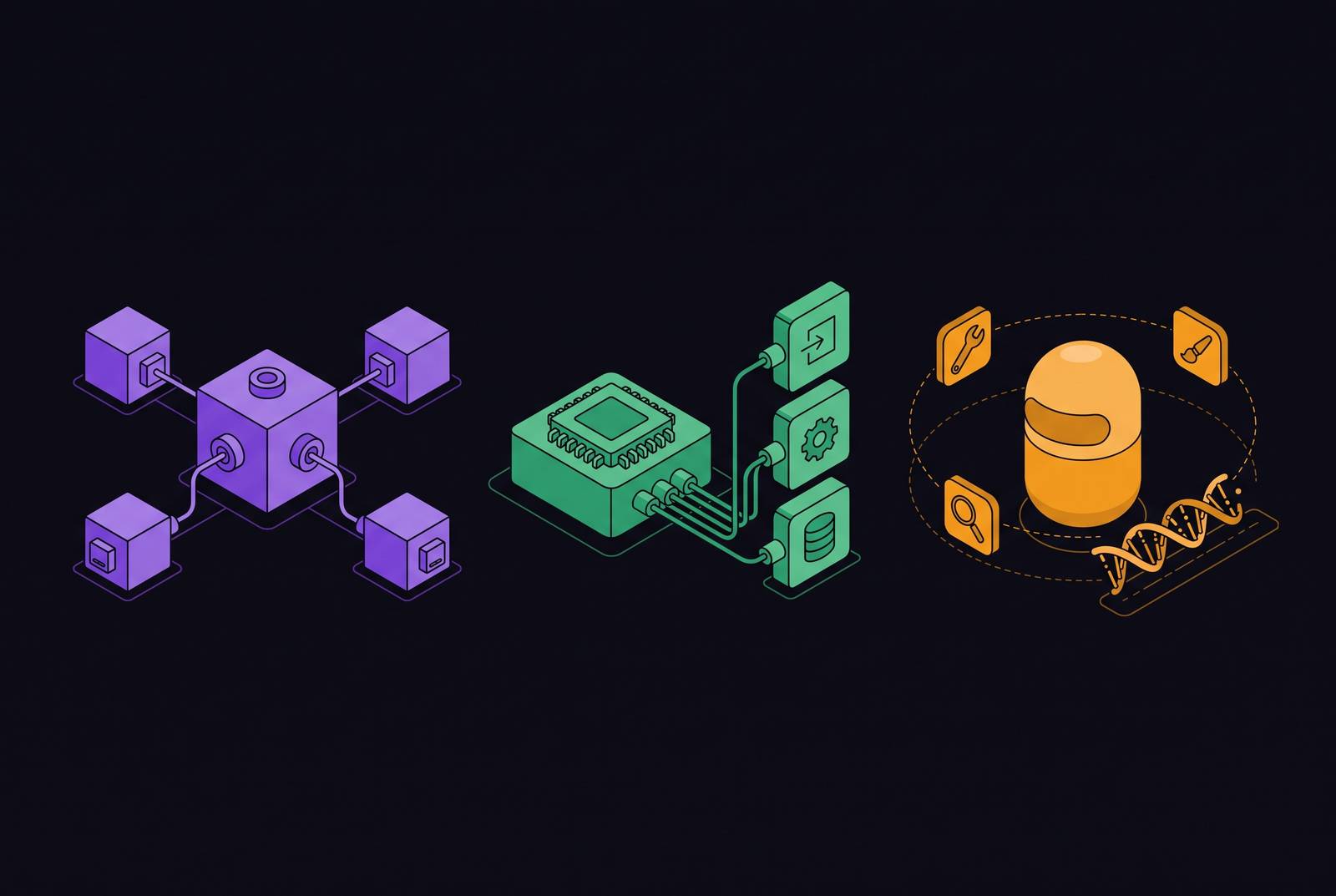
MCP, function calling, and the Assistants API operate at fundamentally different architectural layers (protocol, API feature, and managed runtime respectively), so the real comparison isn't which is better but which layer your use case requires. From a distance, they look interchangeable.
That's the trap. Developers treat these three as competitors for the same job, but MCP is a protocol, function calling is an API feature, and the Assistants API was a managed runtime: three different architectural layers, not three flavors of the same thing. Function calling is a feature bolted onto an API. MCP is a protocol, a set of rules for how systems talk to each other. The Assistants API was a managed runtime, a hosted service that ran infrastructure on your behalf. All three let an AI model reach outside itself to do real work: call an API, retrieve a file, run code.
This piece walks through each layer: what it was built to do, where it is in the architecture, and why the decision usually isn't "which one" but "which ones, stacked together". One note before diving in. The Assistants API still shows up in searches and old tutorials, so it earns a place in this comparison. But it was officially sunset on August 26, 2026 en.wikipedia.org baeseokjae.github.io. Treat it here as a closed chapter, not something to build on.
Function calling: the layer it occupies
Function calling is a feature of the Chat Completions API. A developer includes a list of tools, called a tools array, that describes what functions the model can invoke. The model returns structured arguments, the app runs the actual function, and the result gets fed back into the conversation.
The model never runs code. It generates a JSON object, a name and a set of arguments, nothing more. Your application decides whether to actually call that function, with what safeguards, and what to do with the result. That separation is the point. It's what keeps a human, or at least a human's code, between the model's intent and anything actually happening in the world.
Because of that, function calling lives inside the API request and response cycle. Not in a separate server, not in an independent process.
That placement brings real constraints. Tools are defined statically per request, so there's no discovering new tools at runtime; if you want to add one, you write code and redeploy. And the whole flow runs through the OpenAI API specifically, so you're locked to one provider. Every tool definition you send also counts as input tokens, so a long tools list adds cost on every single turn, not just the first one. Keep the active tool count under roughly 20 per turn as a practical ceiling baeseokjae.github.io.
Two levers make function calling reliable and fast enough for production. First, strict mode. Setting strict: true forces the model's output to comply with your schema through constrained decoding at the token level baeseokjae.github.io. That's a meaningfully different guarantee than prompt-based instructions, which can break under adversarial input or a long context window. OpenAI recommends turning it on, always baeseokjae.github.io. Second, parallel tool calls. A single response can return several tool_calls at once, and your app can run them all simultaneously instead of one after another apiscout.dev LLMCompiler paper en.wikipedia.org. The LLMCompiler paper measured a 3.7x latency improvement from this pattern apiscout.dev en.wikipedia.org. As of mid-2025, GPT-5 and newer models support strict mode and parallel calls together, though fine-tuned models still carry a small caveat worth checking before you rely on both at once apiscout.dev LLMCompiler paper en.wikipedia.org.
So when is function calling the whole answer, not just a piece of one? When it's a single-provider product built entirely on OpenAI, a latency-sensitive loop, a small and stable set of tools, and a team that owns the whole stack top to bottom. No multi-client reuse to worry about, no cross-provider portability.
The Assistants API: why it was replaced
The Assistants API sat on top of function calling as a managed runtime. It handled persistent conversation threads, file storage, vector search, and hosted tools, so developers didn't have to build and maintain their own state management from scratch.
The ambition was to be a full stateful backend, owning threads, files, and vector stores on the developer's behalf. But that ambition came with a cost. Being a stateful backend service managing threads, files, and vector stores created tight coupling, and that coupling limited what OpenAI could add on top of it later.
So OpenAI sunset it. August 26, 2026, officially, the Assistants API stopped being available en.wikipedia.org baeseokjae.github.io. Azure OpenAI's version of the Assistants API was deprecated the same day, with Microsoft pointing customers toward the Foundry Agents service as the migration path en.wikipedia.org baeseokjae.github.io.
The downstream effects were immediate and concrete. Zapier deprecated every ChatGPT step built on the Assistants API en.wikipedia.org baeseokjae.github.io. Its 'Create Assistant' action stopped working on that same date en.wikipedia.org baeseokjae.github.io. The legacy 'Conversation With Assistant' Zaps weren't just switched off, Zapier auto-migrated them to a new Conversation action built on the Responses API, though users still need to rebuild any customizations that didn't carry over cleanly en.wikipedia.org baeseokjae.github.io.
OpenAI said it will not build an automated tool to migrate old Threads into the new Conversations model. The recommended path is to start migrating new threads going forward and backfill history manually if you actually need it.
What replaced it is the Responses API, launched back in March 2025 apiscout.dev baeseokjae.github.io en.wikipedia.org. It's stateless by default, but you can pass a previous_response_id to carry context forward on the server side without managing a full thread object apiscout.dev baeseokjae.github.io en.wikipedia.org. OpenAI reports 40 to 80 percent better cache utilization compared to the old Assistants API, and the Responses API unlocked things the Assistants API never had: native MCP server connections, Computer Use, deep research tools apiscout.dev baeseokjae.github.io en.wikipedia.org.
The Responses API isn't a managed runtime in the heavy sense the Assistants API was en.wikipedia.org baeseokjae.github.io. It moves state management to something lighter, server-side but not infrastructure-heavy, and that lighter footprint is exactly what made room for MCP to plug in as a first-class citizen rather than a bolted-on afterthought.
MCP: the protocol layer that sits beneath model and provider
MCP is not an OpenAI product, and that's the whole point of it. Anthropic introduced it as an open standard in November 2024 Model Context Protocol - Wikipedia apiscout.dev baeseokjae.github.io. In December 2025, Anthropic handed governance over to the Agentic AI Foundation under the Linux Foundation, co-founded alongside Block and OpenAI, with AWS, Google, Microsoft, Bloomberg, and Cloudflare backing it Model Context Protocol - Wikipedia apiscout.dev baeseokjae.github.io. That's vendor neutrality baked into the org chart, not just a line in a press release.
Architecturally, MCP runs client-server over JSON-RPC 2.0. An MCP host, which could be Claude, Cursor, or some custom agent runtime a team builds in-house, spins up a dedicated MCP client for every server it connects to. Servers expose tools, resources, and prompts. Clients call a method named tools/list to find out what's actually available, usually right after the connection initializes, though nothing in the spec forces that timing. That's runtime discovery. Compare that to function calling's static, baked-in-at-deploy-time tool list; the difference is the whole story.
Practically, this means tools live on the server, not in the API call, so they're reusable across any MCP-compatible client without per-client integration code. Building one MCP server for your internal tools means Claude Desktop, Cursor, and GitHub Copilot can all use it, along with whatever new client shows up next year and adopts the protocol. Nobody has to rebuild the integration for each one.
The protocol had a major overhaul on July 28, 2026, its most substantial revision since launch en.wikipedia.org baeseokjae.github.io blog.modelcontextprotocol.io. Session tracking got stripped out in favor of a stateless core, with capability info now carried per-request in a field called _meta. Multi-round-trip requests, header-based routing, cacheable list results, tighter authorization, and a formal extensions framework all landed in that update, alongside refreshed Tier 1 SDKs en.wikipedia.org baeseokjae.github.io blog.modelcontextprotocol.io. Sampling, roots, and logging got deprecated in the same pass en.wikipedia.org baeseokjae.github.io blog.modelcontextprotocol.io. Transport-wise, it's stdio for anything local and HTTP for remote connections, with identical protocol behavior either way.
The download numbers back up how fast this spread. Both the TypeScript and Python SDKs have each crossed 1 billion total downloads, and Tier 1 SDKs combined are pulling close to half a billion downloads a month en.wikipedia.org baeseokjae.github.io blog.modelcontextprotocol.io presenc.ai.
The architectural table: what differs when you put all three side by side
Feature checklists miss the point here. What actually matters is where discovery happens, who owns portability, and where the security surface lives.
On discovery: function calling is static and per-request, a developer sets the list at build time and any addition means a code change and a redeploy. MCP does it at runtime through that tools/list call, so the catalog can shift without touching the application at all, and different tenants can even see different tool sets at the protocol level. The Responses API is stateless by default but forwards context through previous_response_id.
On provider portability, function calling works with OpenAI models, the entire flow is coupled to the OpenAI API. MCP works with any compatible client, Claude, Cursor, Copilot, whatever comes next, build the server once and it's consumed everywhere.
On where the tools actually live: function calling embeds them directly in the API payload, so they exist only for that one conversation. MCP servers run as independent processes that own the tools outright, decoupled from any single conversation or client.
Security surface is where the layers diverge hardest. Function calling pushes auth, rate limiting, and audit logging entirely into application code someone has to write and maintain. MCP, by contrast, is gateway-enforceable: policies, authentication, and audit logs can sit at the protocol layer itself, without touching the server or the client code. That's exactly where a gateway or control layer earns its keep instead of patching security in app by app.
State handling follows a similar split. Chat Completions and function calling are stateless, the developer manages the entire messages array by hand. The Responses API keeps state server-side through previous_response_id. MCP, after the July 2026 spec update, is stateless at the protocol layer too, with session info riding along per-request inside _meta en.wikipedia.org baeseokjae.github.io. And on multi-tenancy, function calling and LangChain-style frameworks handle it as an application concern, something you build yourself, while MCP has tenant-scoped tool filtering designed into the protocol from the start.
The ecosystem MCP is attracting, and the governance gap that comes with it
The numbers on MCP's growth show a rapid, non-incremental expansion. Pulled from the official MCP Registry API on May 24, 2026, the registry held 9,652 latest server records and 28,959 total server and version records, an ecosystem that formed almost overnight blog.modelcontextprotocol.io digitalapplied.com.
Production adoption is harder to pin down cleanly. The strongest survey source available, Stacklok's 2026 software report, found 41 percent of surveyed software organizations already running MCP servers in either limited or broad production, with a separate figure putting it closer to 45 percent of software companies running MCP in some production form en.wikipedia.org baeseokjae.github.io affinco.com Stacklok 2026 software report. A commonly repeated figure claiming 78 percent enterprise production adoption has no traceable sample behind it, so it doesn't belong in a serious accounting of where things actually stand.
Salesforce offers a concrete, named example instead of a survey number. Its Headless 360 platform started routing customer and agent interactions through MCP in April 2026, and by late May 2026 the company reported 4.5 million MCP calls processed since launch, a real production workload rather than a pilot en.wikipedia.org baeseokjae.github.io.
Fast growth like this has a shadow side, though. The official directory and the community-curated lists use different rules for what counts as a legitimate entry, so broken and abandoned servers pile up in the gaps. That's not a rounding error; it's a coin flip on whether a given server even works.
There's a security dimension too, and it's bigger than most teams assume. Wiz Research found MCP servers present in at least 80 percent of observed cloud environments, and 5 percent of those environments were running at least one MCP server exposed directly to the internet en.wikipedia.org baeseokjae.github.io. An attack surface found after the fact isn't a surprise, it's a governance failure. The vulnerability existed the moment that server went live without oversight, and every server added without a registry entry is effectively an identity nobody can account for.
The protocol itself was never designed to enforce governance, that was never its job. What closes the gap is a control layer sitting on top of the protocol: a gateway with access policies, audit logging, and a server registry, the thing that turns the ecosystem's sheer size from a liability into something a team can actually rely on. GitHub Search API records 15,926 repositories tagged with the mcp-server topic en.wikipedia.org digitalapplied.com. Community-curated lists now count 8,000–12,000 distinct servers, up from roughly 50 at launch in November 2024 Model Context Protocol - Wikipedia baeseokjae.github.io presenc.ai. A signal-to-noise problem persists because the official directory and community-curated lists apply different inclusion criteria, broken and abandoned servers proliferate, and users report 30–50 percent installation failure rates on community servers, per presenc.ai research.
When to use each layer or stack them
Start from the premise that these aren't rivals fighting for the same slot. They sit at different layers of the stack and, in most real deployments, end up coexisting rather than competing. The actual question is which layers a given use case needs, not which single tool wins.
Function calling is enough on its own for a single-provider product built entirely on OpenAI, with a small and stable tool set and a team that owns the whole pipeline. If latency is the main constraint, strict mode plus parallel tool calls covers most of what reliability and speed demand.
MCP becomes the right layer once tools need to work across more than one client or more than one AI provider. It's also the right call once the tool catalog gets large, changes often, or is owned by a different team than the one building the agent, and once an organization needs centralized policy, audit trails, and accountable server identity, things that stop scaling the moment they're handled as scattered application code.
The Responses API, not the sunset Assistants API, is the right managed layer for multi-turn, stateful applications built on OpenAI. It gives you server-managed context without building thread infrastructure by hand, and it opens the door to native MCP connections, Computer Use, and deep research tooling alongside ordinary tool calling.
In practice, all three let an AI model reach outside itself to do real work: call an API, retrieve a file, run code. Responses API, or a LangChain-style orchestration layer, handles the agent logic. MCP servers handle tool connectivity. And a gateway sits in front of the protocol as the control layer, enforcing access policy, keeping a server registry, and logging in real time what an agent touched and when. MCPManager is one option built for that role, and it approaches it from a data-governance background rather than starting from the protocol side. That gateway doesn't change how MCP itself works, it is in front of it and gives a team the visibility to say yes to production instead of stalling on "secure it later." Teams that put access policy in place up front tend to ship agentic AI faster than teams that try to bolt security on after the fact, because blocking MCP servers outright doesn't reduce adoption, it just pushes it underground where nobody can see it.
As a rough shorthand: one provider, one app, stable tools, reach for function calling. Multiple clients, evolving tools, cross-provider needs, that's MCP. Stateful, multi-turn, built on OpenAI, that's the Responses API. And at enterprise scale with real governance requirements, the answer is usually all three at once, with a control layer sitting over the protocol to keep the whole thing accountable.