MCP Transport Layer Comparison: Stdio vs HTTP SSE vs WebSocket
Picking the wrong MCP transport layer traps you in a six-month migration nobody budgeted for.
I've spent enough time debugging MCP deployments to say this plainly: transport choice decides where your server can live, how many people can hit it, and whether your security team has any visibility into what's happening. Get it wrong and you won't see a bug on day one, but rather a migration project six months out that nobody put in the budget. Stdio, HTTP+SSE, and Streamable HTTP each solve a different piece of that puzzle, and knowing which one you actually need beats defaulting to whatever the quickstart guide used.
Underneath all three, the cargo is identical. MCP runs on JSON-RPC 2.0, three message types, all UTF-8: requests, responses, notifications. The transport's only job is moving those bytes from one process to another. The protocol stays fixed, while what changes is delivery mechanics, and delivery mechanics are what decide your deployment topology, whether you meant them to or not.
How the transport landscape evolved from 2024 to 2026
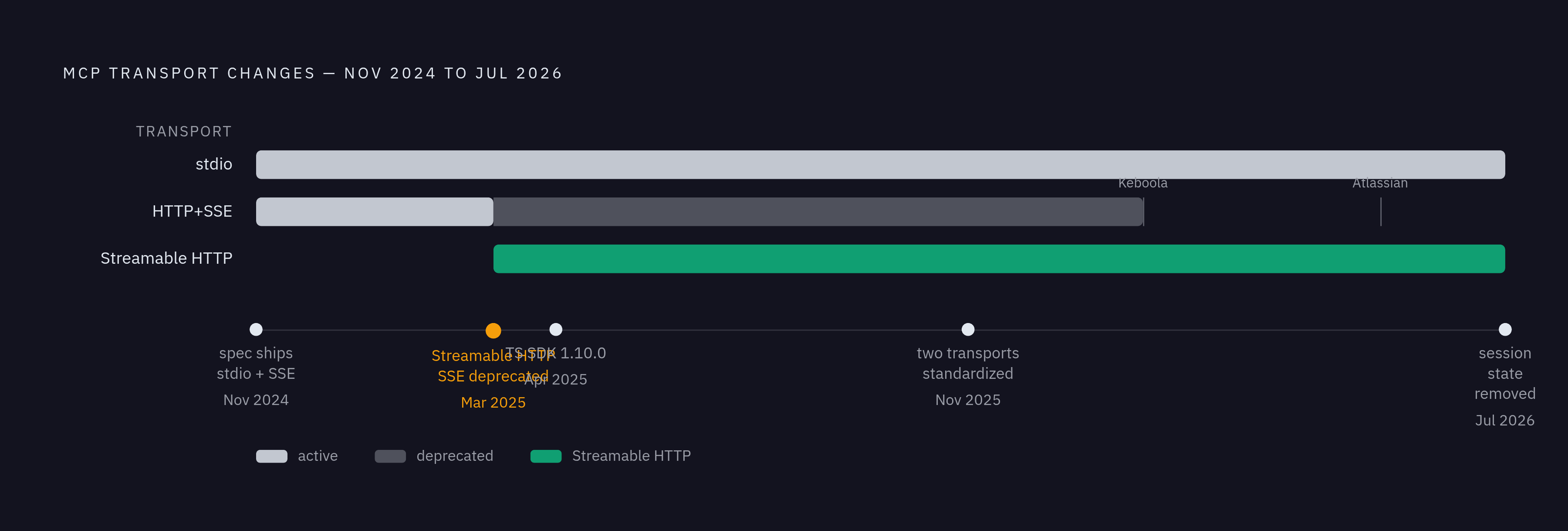
Knowing which spec generation a server was built against tells you almost everything about what it can do, so it's worth having the timeline straight.
November 2024, spec version 2024-11-05, ships with two transports: stdio and HTTP+SSE. Four months later, March 2025, Streamable HTTP arrives, and HTTP+SSE gets deprecated in that same release, which is a fast turnaround by spec standards. April 2025, the TypeScript SDK hits 1.10.0 and becomes the first SDK to support it. By November 2025, the current spec locks stdio and Streamable HTTP in as the two standard transports, with SSE hanging around for backward compatibility and nothing else. Then July 2026 brings a release candidate with an actual breaking change, since the protocol drops state at the transport layer entirely. More on that below.
None of this is trivia if you're the one inheriting a codebase. If someone on your team found a third-party MCP server on GitHub last week, the first thing I'd check is which era it was written in, because that tells you what it's capable of before you've read a line of the source. Vendors are already drawing hard lines: Keboola dropped HTTP+SSE support April 1, 2026, and Atlassian's Rovo cut it off June 30, 2026. A server that still assumes SSE is the modern choice is already a year behind.
Stdio: how it works and what it is actually good for
Stdio is the simplest transport in MCP, and that simplicity is the whole point of it.
The client launches the MCP server as a subprocess, the server reads JSON-RPC off stdin, writes responses to stdout. Messages are newline-delimited and can't contain embedded newlines, with no exceptions there. Logging goes to stderr, never stdout, because writing one stray console.log to stdout in a stdio server breaks the message stream, as the client is reading every single line of stdout as a JSON-RPC message.
No port to open, no auth to wire up, no CORS, no network stack at all. Current ecosystem documentation describes stdio as the most common and most interoperable transport available today, and that checks out: it's what every tutorial reaches for first, because it has the fewest moving parts of anything in the spec.
It's built for exactly one shape of deployment: one developer, one machine, one agent. IDE integrations, CLI assistants, local tooling that never needs to leave your laptop. A spawn npx ENOENT error trying to get a stdio server running is almost never a protocol issue, but rather a PATH problem where the subprocess can't find the binary. It's the kind of error that can cost significant debugging time before the real cause becomes clear. Redirect stdout at process start as cheap insurance, too; some dependency buried three layers deep in your stack will eventually write something that isn't JSON-RPC to the wrong stream, and you want that caught, not silently corrupting your message flow.
Where stdio breaks down at scale
Stdio was never built to serve more than one client. That's a design constraint, not an oversight someone forgot to fix, and it's local-only by construction, so no remote client can reach a stdio server, period.
The concurrency ceiling shows up fast, too. Load testing on stdio found the large majority of requests failing once you hit just 20 simultaneous connections, and it isn't a gentle slope down but a wall.
Picture what that looks like at real organizational scale: 50 developers, 8 MCP servers apiece, and you're now running something like 400 concurrent processes scattered across 50 different laptops. Any one of those laptops can probably handle its own handful just fine. The actual problem is that you've now got 400 independent processes with zero central point of control over any of them.
Auth is where it really falls apart. Stdio has no transport-layer auth mechanism at all; environment variables are the only lever you get, and they get rebuilt separately on every single host by hand. There's no gateway, no proxy, no single choke point where you can ask "who is this, and what should they be touching." Audit trails get stitched together after the fact, one machine at a time, which is a nightmare during an incident.
That's not a technical inconvenience, it's a governance hole. Every stdio instance running somewhere in your org is an identity your security team can't see from a single dashboard, and identities nobody's watching are exactly the ones that get exploited eventually. The transport decides, upfront, whether you can even observe what your agents are doing while it's happening.
HTTP+SSE: the architecture it used and why it failed under production conditions
HTTP+SSE was MCP's first stab at a remote transport, and it borrowed its shape from something that already existed: the browser's EventSource API.
Two separate endpoints did the work. A GET to /sse opened a long-lived stream for server-to-client messages, while a POST to /messages carried client-to-server requests back the other way. That split works fine for simple one-way push, notifications, live scores, that kind of thing. It was never built for bidirectional RPC under real load, and it showed.
Splitting the connection in two created problems that stack on top of each other. There's no native resumability, so a dropped stream means starting over from scratch. Load balancers don't like the pattern, serverless runtimes actively fight it, and firewalls flag long-lived connections as suspicious traffic. Proxy buffering, something most teams never think twice about, can silently swallow an entire event stream without throwing a single error anywhere in your logs.
Under sustained load, SSE-based transports measured somewhere in the 7 to 30 requests-per-second range, latency climbing into the hundreds of milliseconds. Nobody's running a production agent fleet on numbers like that, and serverless makes it worse: on Cloud Run or Lambda, SSE connections die mid-conversation the moment an auto-scaling event cycles the instance out from under you.
At this point there's exactly one legitimate reason to still implement HTTP+SSE: you've got a client that predates March 2025 and can't upgrade yet. Even then, there's no cliff edge forcing your hand, since servers can run legacy SSE endpoints alongside the new Streamable HTTP endpoint during the transition, so migration doesn't have to be a hard cutover on some deadline.
Streamable HTTP: the mechanics behind the current standard
Streamable HTTP fixes the two-endpoint mess by collapsing everything onto a single path.
The server runs as its own process and handles many client connections through one HTTP endpoint that accepts both POST and GET. The client sends JSON-RPC via POST, with an Accept header listing both application/json and text/event-stream. The server picks the response shape per request: plain JSON for a quick tool call, an SSE stream if the operation runs long or needs to report progress along the way. Same endpoint, either shape, depending on what the request actually calls for.
Worth correcting directly, because the name practically begs you to assume otherwise: Streamable HTTP does not require HTTP/2. It runs fine over HTTP/1.1 with chunked transfer encoding. "Streamable" is about progressive response streaming, which has nothing to do with HTTP/2's multiplexed streams despite the name overlap. Don't let that send you down a protocol-upgrade rabbit hole you don't need to go down.
There's a real seam here, and I'd rather name it than paper over it: HTTP/1.1 is half-duplex. When the server needs to initiate something, the client has to come back with an additional POST just to receive it. It's clunky, and I've heard developers complain about it, with good reason.
What Streamable HTTP does get right is reconnection. Exponential backoff starts at 1 second, doubles up to a 30-second ceiling, jitter added in so you don't get thundering-herd reconnects. Sessions recover through an Mcp-Session-Id header, missed events replay via Last-Event-ID. It's proven enough now that the major platforms have standardized on it: ChatGPT's MCP integration runs Streamable HTTP and requires OAuth 2.1 with Dynamic Client Registration, and Claude.ai's Custom Connectors support it natively too.
Streamable HTTP performance and what it enables for multi-user deployments
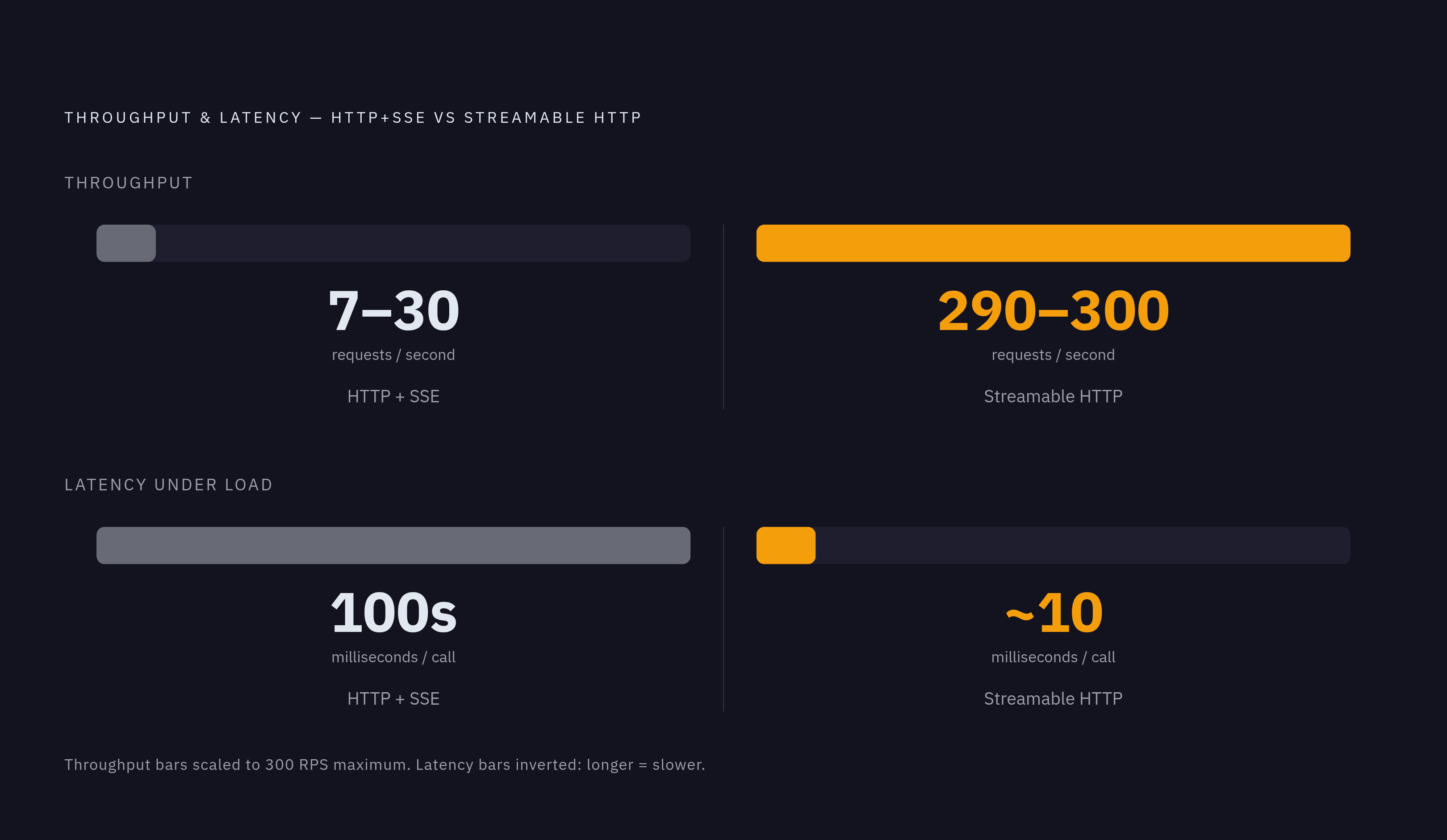
The gap between this and SSE isn't marginal. It's the difference between something you demo and something you actually run in production.
Benchmarks from gingerlabs.ai put Streamable HTTP at roughly 10 milliseconds of latency per call under load, with shared-session deployments sustaining 290 to 300 requests per second at 100% success. Stack that against SSE's 7-to-30 RPS ceiling and there's not much left to argue about.
The architectural payoff matters just as much as the raw numbers, honestly. One server process now handles every client, so there's no more per-user subprocess sprawl chewing through 400 separate processes across 50 machines. Because everything funnels through a single point, access control, audit logging, and identity checks can all live at one gateway instead of getting rebuilt piecemeal on every host.
Migration is cheaper than most teams assume going in. Stdio to Streamable HTTP is usually one argument change in the SDK you're already using, and even a third-party server that only speaks stdio can get wrapped with mcp-proxy without anyone touching its source.
This is where governance and transport choice stop being separate decisions. A centrally governed MCP gateway sitting on Streamable HTTP is what makes real-time RBAC and observability possible in the first place, and that kind of control is nearly impossible to bolt onto 400 untracked stdio processes after the fact. Teams that build this early ship agentic AI into production faster, because the guardrails are what let leadership actually say yes to the next agent. Skip them, and every new deployment turns into a fight.
The 2026 stateless breaking change and what it means for existing deployments
July 2026's release candidate is the biggest architectural shift since Streamable HTTP itself: the protocol drops state entirely.
Before this, running a remote MCP server meant sticky sessions, a shared Redis store for session state, or a gateway doing deep packet inspection just to keep one conversation coherent across multiple requests. That's real operational weight, and anyone running MCP at any scale has felt it.
The stateless model just removes it. The initialize/initialized handshake is gone, along with the Mcp-Session-Id header. Every request now describes itself completely and stands on its own. Protocol version, client info, client capabilities, all the stuff that used to get negotiated once at session start, now rides inline in a _meta field on every request.
The payoff, according to Google's developers blog on the change, is concrete: a remote MCP server can sit behind a plain round-robin load balancer now. Sticky sessions, shared session stores, packet inspection at the gateway, all of it becomes unnecessary overhead. The C# SDK 2.0 makes HTTP transport stateless by default for this exact reason, calling out horizontal scaling, serverless, and multi-instance environments as the direct winners.
Make no mistake, though: this breaks things. Any server holding state in memory tied to a session ID has to externalize that state or move to explicit handles, because implicit session scope just doesn't exist anymore. If your team runs governed MCP infrastructure today, now's the time to check whether your gateway or your observability tooling quietly leaned on session affinity somewhere. If it did, move that state model before you upgrade, not after you find out the hard way.
WebSocket transport: what the proposed spec enhancement would change
WebSocket isn't a standard MCP transport, not yet. It's a proposal, SEP-1288, authored by Larry Maccherone in 2025, aimed directly at the half-duplex seam in Streamable HTTP.
The gap is specific. When the server wants to push something under Streamable HTTP, the client has to come back with a POST to receive it. That's fine for most tool-calling patterns, but awkward for anything where the server genuinely needs to drive the conversation in real time. WebSocket swaps that for a persistent, fully duplex connection: real server-push, no POST-response dance required at all.
Where does that actually matter? Streaming agent output where the server initiates each turn, real-time collaborative tools or live monitoring dashboards, and low-latency agentic loops where every round trip's overhead compounds fast enough to notice.
Until SEP-1288 gets formally adopted, though, building on WebSocket means betting on where the spec is headed rather than shipping against something standardized. Streamable HTTP is the right call for anything you need running today. WebSocket is worth watching closely if true duplex communication is a hard requirement for your use case and your team can stomach some spec risk while it settles.
Choosing the right transport for your deployment context
Four questions cover almost every transport decision I've run into. Worth working through them in order instead of just defaulting to whatever the getting-started tutorial happened to use.
Where does the server run? Same machine, single user: stdio, no contest, since there's no network overhead and nothing to secure beyond the process itself. Remote server, multiple clients, anything resembling shared infrastructure: Streamable HTTP is the standard now, and there's no real argument against it. Stuck with a legacy client from before March 2025: HTTP+SSE, but treat it as a bridge, not a place to settle down, and put a migration date on the calendar while you're at it.
What's the actual communication pattern? Most tool-calling workloads, request in, response out, occasional streaming for long operations, fit Streamable HTTP cleanly since one endpoint covers both shapes. True bidirectional, server-initiated-in-real-time work is the edge case where Streamable HTTP's POST-response workaround starts to feel like exactly that, a workaround, and that's where WebSocket, once it's standardized, becomes the better fit.
What do you need for governance and observability? Stdio hands you zero central interception point; every audit trail gets reconstructed machine by machine, which makes it a bad primary transport anywhere visibility into agent behavior actually matters to someone. Streamable HTTP flips that completely: one gateway can enforce access controls, apply role-based permissions, and capture observability data across all agent-to-server traffic in a single place. That centralized shape is also what makes a real MCP management layer possible at all, a registry of servers, guardrails on what agents can touch, audit built into the control plane instead of duct-taped on after something's already gone wrong.
How are you future-proofing this? New project, no legacy baggage: start on Streamable HTTP, since the 2026 stateless model only makes running it at scale easier from here on out. Existing stdio deployment about to go multi-user: the migration cost is genuinely low, an SDK argument change or an mcp-proxy wrapper, so there's not much excuse to keep putting it off. Planning further ahead matters too: audit any session-scoped logic in your stack now, because "implicit session state" won't be there to catch you once you're on the new spec.
Most teams end up on stdio simply because it's what every tutorial ships first, and nobody ever came back to revisit the call once real users showed up. That's the trap, plainly stated. The transport you inherit by default is rarely the one that matches where the deployment actually ends up, and getting it right from day one costs a lot less than the governance debt you rack up telling yourself you'll deal with security later.