Human-in-the-Loop Controls for High-Stakes Agentic Workflows
Agents act faster than humans can review, so oversight needs to happen before they move.
Agentic AI doesn't just recommend anymore. It acts: moving money, editing infrastructure, sending emails, closing tickets on its own. That shift changes what oversight has to mean, because a human reviewing a bad prediction has time to think, and a human reviewing a completed wire transfer does not. Most organizations are putting their human-in-the-loop checkpoints in the wrong places, and a lot of what gets called oversight right now is a rubber stamp with better branding. This piece maps out where those checkpoints actually belong, and what it takes to build oversight that holds up under real pressure instead of just looking good in a compliance deck.
Start with the mechanics of the shift. Traditional AI produces an output, a human reads it, a human decides, and the window for that decision stays open as long as anyone needs it. Agentic AI collapses that window. The agent plans the step, decides on the step, and executes the step, often in the same breath: querying an API, triggering a downstream workflow, sending the message. The intervention window shrinks from "whenever you get to it" to a matter of seconds. Failure stops being a bad recommendation sitting in an inbox. It becomes a transaction that already happened, money that already moved, a record that already changed.
Scale is what turns this into an emergency instead of an academic worry. McKinsey found 62% of organizations were experimenting with or scaling AI agents, with 23% already scaling agents in at least one business function. A separate research brief tracked a sharp distributional shift in agent counts: from a mean of around 37 agents per organization to a point where, by April 2026, nearly 38% of organizations reported running more than 100 agents. Gartner projects 70% of enterprises will fold agentic AI into their IT infrastructure operations by 2029, up from under 5% in 2025. None of that is a future problem. It's a headcount problem happening right now, except the headcount is software, and software doesn't call in sick or ask a supervisor before it hits send.
The three-tier oversight model and what each tier is for
Oversight is a spectrum you apply, not one setting you flip on or off. Most agentic systems need all three tiers running at the same time, applied to different actions inside the same workflow, sometimes inside the same five minutes.
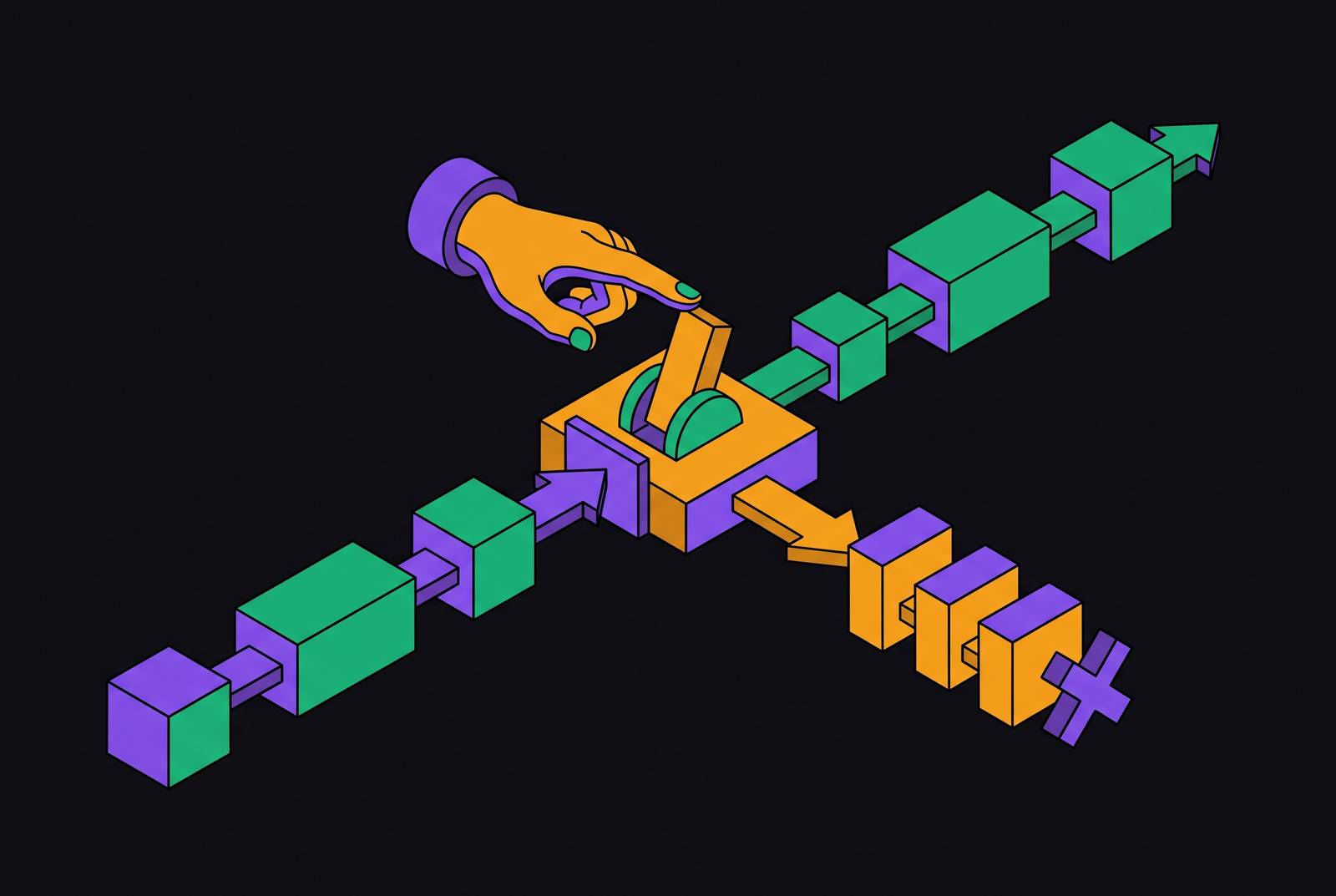
Human-in-the-Loop (HITL) stops the agent cold at a defined checkpoint. It cannot proceed without a human saying yes. That's the right setting for anything high-risk, irreversible, or regulated: financial disbursements, legal agreements, access to sensitive records. The friction is the point.
Human-on-the-Loop (HOTL) lets the agent run on its own while a human watches dashboards and alerts, stepping in only for exceptions. The system keeps moving even when nobody's staring at it in real time. That fits medium-risk work where speed actually matters and mistakes can be caught and fixed after the fact.
Human-Out-of-the-Loop (HOOTL) means the agent handles the entire process, start to finish, with no human touch. That's only appropriate where the risk is genuinely low, the action is cheap to reverse, and the decision boundary has been tested enough times to trust without a second set of eyes.
There's a fourth role that gets skipped constantly: humans "in command," setting the objectives and constraints for the whole system before any of the loops start running. Skipping that role produces beautifully designed checkpoints serving a goal nobody actually signed off on. A perfectly tuned HITL gate on a bad objective just approves the wrong thing more carefully.
How to identify the moments that warrant a HITL checkpoint
One question matters more than any other: can this action be undone at reasonable cost and speed if it turns out to be wrong? If the answer is no, that's a HITL candidate, full stop, regardless of how confident the model claims to be.
Three situations call for a human checkpoint every time. High-stakes, irreversible decisions top the list. An agent recommending approval on a large contract might have flawless analysis behind it, but final sign-off needs a human name attached, because accountability doesn't transfer to a model no matter how good its reasoning looks on paper.
Ambiguous calls that need judgment come next: a customer request that falls technically outside policy but makes contextual sense. The agent's job is to flag it. A human's job is to decide whether the exception is worth making, and why.
Then there are contexts the agent simply can't model: shifting market conditions, new regulatory language, a company quietly realigning its priorities behind the scenes. Agents run on learned patterns; they weren't trained on what changed last week. Humans adapt to that in a way pattern-matching never will.
In regulated industries, none of this is a design choice anyone gets to debate. Clinical recommendations, lending decisions, benefits denials: human sign-off is a legal floor, not a nice-to-have. And the sign-off has to mean something. The reviewer needs the reasoning chain, the confidence level, the sources the agent consulted, enough to form an independent judgment instead of rubber-stamping whatever the model spat out.
A practical way to sort this out: list every action the agent can take. Score each one on reversibility (can it be undone), consequence magnitude (what breaks if it's wrong), and regulatory exposure (does a rule somewhere require a human signature). Anything that scores high on even one of those three belongs in the HITL bucket. Everything else can live in HOTL or HOOTL.
What the governance data reveals about how these checkpoints are being implemented
The gap between the framework and the reality on the ground is wide, and it's a visibility problem before it's a discipline problem. You cannot enforce a human approval gate on an agent you can't see acting.
Only 38% of organizations monitor AI traffic end-to-end, meaning prompts, tool calls, and outputs all covered together. Only 17% continuously monitor agent-to-agent interactions. Those monitoring gaps mean large portions of agent activity in production are invisible to the teams nominally responsible for them. That reality should stop anyone building a HITL checkpoint dead in their tracks.
That blind spot has already produced losses you can put a number on. Among companies with revenue above $1 billion, 64% reported losses exceeding $1 million tied to AI system failures during 2025. Eighty percent documented risky agent behaviors outright, including unauthorized system access and data exposure nobody had planned for.
Shadow AI compounds it. This is really an enforcement failure wearing a technology label. Okta's 2026 AI Agents at Work survey found 52% of employees using AI tools that were never approved through any official channel. When the sanctioned path is too slow, or doesn't exist for the task at hand, people go around it, and whatever oversight checkpoint was supposed to catch a mistake disappears right along with the policy that created it.
The incident rate confirms none of this is hypothetical. Eighty-eight percent of organizations reported a confirmed or suspected AI agent security incident in the past year. In healthcare, where the stakes of a bad agent decision run about as high as they get, that number climbs to 92.7%.
The cosmetic HITL problem, when an approval step is not oversight
"Human in the loop" gets treated like one fixed thing, when in practice it covers everything from full human review of every single output down to a bare intervention right that quietly never gets exercised. Boards want to hear the phrase. Regulators require it for high-risk AI. Vendors put it on a feature list. In a lot of real deployments, satisfying the label on the box drives what gets built, and that label is what displaces the requirement it was supposed to represent.
Mandated HITL steps often function as what researchers call moral crumple zones. When something goes wrong and the organization can point to a required review step that technically happened, the human who clicked "approve" becomes the accountable party. HITL ends up working as a liability transfer with an approval button attached, rather than as an actual control.
Genuine oversight has to clear bars that most current setups miss. The reviewer needs the full payload: not just "agent proposes action X," but why the agent is proposing it, what data it touched to get there, and whether the action can be undone if it's wrong. The reviewer needs real time to sit with that information before the action fires, which runs directly against every throughput metric a company might be optimizing elsewhere. And the reviewer needs actual authority: not the theoretical ability to say no, but the practical guarantee that a refusal stops the system cold, paired with the training to know when refusing is the right call.
Regulators are catching up to this distinction fast. The EU AI Act's Article 14 and NIST's AI Risk Management Framework both demand human oversight that's trained, measurable, and provable. An auditor asking for evidence won't accept a screenshot of a checkbox as proof of anything. Most organizations are still confusing the presence of a review step with the practice of actual review, and those are not the same thing.
Automation complacency, the human-side failure that degrades checkpoints over time
Even a well-designed checkpoint decays if the human standing at it stops paying attention. That decay has a name: automation complacency. It isn't simple inattention. Automation complacency is a pattern where people start over-trusting a system, explaining away anomalies instead of flagging them, and gradually stop questioning outputs. Counterintuitively, the more reliable a system looks, the less vigilant the people watching it tend to become.
The research backing this is specific. Le and Kunz, published in the Journal of Service Management, ran six experimental studies covering 1,370 participants, including 160 service employees across a range of industries. The finding that matters most: the biggest driver of AI complacency wasn't workload, and it wasn't time pressure. It was the absence of monitoring accountability, meaning nobody was checking whether the checker was actually checking.
A second, slower failure mode compounds that one: skill atrophy. Handing enough technical judgment to an agent for long enough causes the human oversight role to hollow out from the inside. A project manager who's delegated technical design work to an AI agent for months starts evaluating proposals on timeline and budget alone, because the engineering background needed to judge scalability or security risk either faded from disuse or was never really theirs to begin with. The oversight seat stays occupied. The judgment that made it worth having quietly disappears.
Transparency design has to account for this instead of pretending it away. A static transparency setting that treats all reviewers and all tasks the same gets this wrong by design. What the evidence supports is a graduated approach: more context when the stakes climb, adjusted as the reviewer's own expertise and the task's risk profile warrant it.
Aviation's Crew Resource Management model as a blueprint for making oversight an operational discipline
Aviation solved a version of this problem decades ago, and the fix wasn't a policy memo sitting in a drawer. It was a total redesign of how people make decisions under pressure. After a series of accidents exposed deep human-factor failures, airlines built Crew Resource Management: structured briefings before every flight, standard phraseology so nothing gets lost in translation, challenge-and-response checklists, and no-blame debriefs after incidents. Human-factor accidents dropped measurably, and CRM became the global best practice for the industry.
The part of CRM that transfers directly to agentic oversight is what the checklist trains for, not the checklist itself. Flight simulators don't just teach pilots how to fly a plane. They teach pilots when to escalate a problem, when to hand control to air traffic control, and when to abort a maneuver. That judgment under time pressure gets trained deliberately, through repeated practice against realistic scenarios. Nobody assumes it's already there.
Enterprise AI oversight needs that same discipline, and most of it doesn't have it yet. A HITL process that exists only as a diagram in a slide deck is a manual sitting in a drawer, not oversight. Reviewers need to practice the decision, including the decision to refuse, before they're standing in front of a live, irreversible action with seconds to decide.
In practice, that means defining what "approve" actually requires at each specific checkpoint: what information has to be present, what criteria should trigger a rejection, where the escalation path leads if the reviewer isn't sure. It means training reviewers on the specific agent workflow in front of them. It means running tabletop exercises against failure scenarios: what does the reviewer do when the agent's reasoning looks completely plausible but the proposed action has consequences nobody can undo? And it means running no-blame debriefs after every intervention, because the same data used to improve the agent should be used to improve the reviewer standing next to it.
Designing the control type to match the intervention moment
None of this works as a blanket policy. The control type has to be set by the risk profile of the specific action.
A single agentic pipeline might touch a dozen actions in sequence: pulling customer data, drafting a response, checking a policy exception, issuing a refund, updating a record, sending a notification. Each carries a different reversibility score, a different consequence magnitude, a different regulatory footprint. Treating the whole pipeline as one oversight decision, either fully gated or fully autonomous, guarantees the wrong outcome somewhere in the chain. Either the low-risk steps get buried under approval friction nobody has time for, or the irreversible step slides through on the same autonomy granted to the harmless ones next to it.
The fix has to be granular. Map the actions, score them against reversibility, consequence, and regulatory exposure, and assign HITL, HOTL, or HOOTL at the level of the individual action, not the workflow as a whole. Pair that mapping with reviewers actually trained on the specific failure modes of what they're approving, a payload that hands them the reasoning and not just the bare request, and a no-blame process that keeps their judgment sharp instead of letting it erode over time.
Oversight built this way scales, because it puts friction exactly where the cost of being wrong runs highest and strips it away everywhere else. Oversight built as a blanket policy doesn't scale: it either collapses into rubber-stamping under the volume, or it slows the whole system down until someone quietly builds a workaround that skips it. The agents aren't slowing down to wait for better governance to catch up. The organizations getting this right are the ones that stopped treating human oversight as a checkbox and started treating it as an operational discipline, trained and rehearsed the same way a flight crew trains for the moment nobody hopes ever happens.