NIS2 Directive Implications for AI-Driven Enterprise Operations
EU regulators are enforcing AI governance rules that NIS2 never explicitly mention.
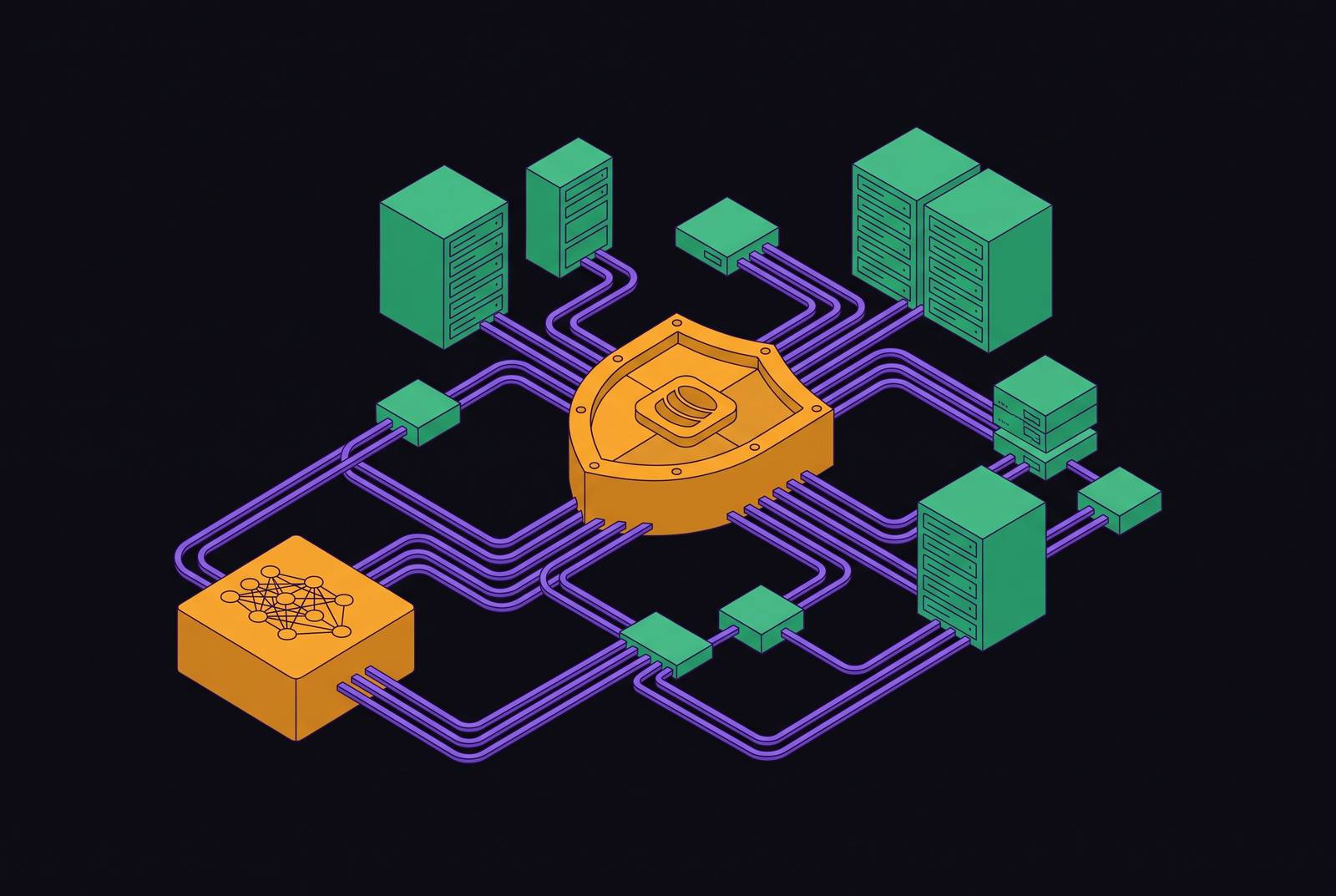
NIS2 doesn't say the word "AI" anywhere in its text, yet Article 21's risk management duties and Article 23's incident reporting clock apply to AI systems the same way they apply to a firewall or a payroll server. That's the point of this piece: Article 21's risk management duties and Article 23's incident reporting clock apply to AI systems the same way they apply to a firewall or a payroll server, whether the directive names them or not. Enterprises that treat those two articles as a design spec for AI governance, rather than a legacy IT box to check, end up moving faster with less exposure. The ones that treat NIS2 as paperwork are finding out, in real time, what a 24-hour reporting deadline does to a system that can't explain what it just did.
Where enforcement stands across EU member states as of mid-2026
Transposition across the bloc is patchy, but enforcement hasn't waited for stragglers to catch up. As of mid-2026, 23 of 27 member states have fully transposed NIS2 into national law, and the European Commission has already referred 7 member states to the Court of Justice of the EU for failing to do so.
Germany is the clearest test case. Its NIS2UmsuCG law took effect December 6, 2025, pulling roughly 29,500 companies into scope. The BSI (Germany's federal cybersecurity agency) set a registration deadline of March 6, 2026, and only around a third of covered entities actually registered in time. The BSI didn't sit on that gap: it issued 47 formal notices in the fourth quarter of 2025 alone, primarily for failure to register in the national NIS2 entity register.
Belgium moved early and is already collecting proof. Essential entities there faced an April 18, 2026 deadline to submit compliance evidence to the Centre for Cybersecurity Belgium, through a recognized compliance pathway. France's ANSSI framework is expected to bring 10,000 to 15,000 entities into scope, with full enforcement kicking in from late 2026. Spain is still catching up: its cybersecurity governance bill cleared the Council of Ministers back in January 2025 but was still sitting in parliamentary process as of June 2026, never published in the Boletín Oficial del Estado.
Fines are starting to land. Estimates aggregated from national authorities and press coverage put early penalties at €185,000 in Belgium, €450,000 in Italy, €78,000 in Hungary, and €52,000 in Lithuania. In the Netherlands, Dutch authorities ran compliance checks on 120 essential entities in digital infrastructure during the second half of 2025 and found that 38% hadn't put adequate controls in place. Some member states have gone further than the directive requires, adding additional obligations on top of the NIS2 floor.
Paper transposition and operational readiness are two different things, as those numbers side by side show. Germany registered a third of its covered companies by deadline. The Netherlands found more than a third of essential entities under-protected. Formal compliance on a government form doesn't mean the systems behind it actually hold up.
How the January 2026 amendments change the compliance picture without removing the core duties
On January 20, 2026, the European Commission put out proposals to amend NIS2, part of a wider cybersecurity package building on the Digital Omnibus Package from November 19, 2025. The headlines make it look like relief is coming. The fine print shows the core duties are untouched.
The amendments trim scope in real ways. They're designed to ease the compliance load for 28,700 companies, including 6,200 micro and small businesses. Some sectors get narrower thresholds, electricity producers, for instance, only fall in scope above 1 MW of generation capacity. A new "small midcap" category gets classified as "important" rather than "essential," which means lighter supervision. On the other side of the ledger, new categories are getting added: providers of European Digital Identity Wallets, European Business Wallets, operators of submarine data cables, and strategic dual-use infrastructure. There's also a push for more standardized data on ransomware, requiring entities to report attack vectors and what they did to contain them.
None of that touches Article 21's risk management requirements or Article 23's reporting timeline. Those stay exactly as written. In parallel, the NIS2 Cooperation Group adopted common templates for incident reporting at its 39th Plenary meeting in Cyprus on May 26, 2026, which cuts paperwork friction but also locks in, more precisely, what evidence regulators expect to see.
The amendments aren't expected to be adopted before late 2026, and 2027 is the more likely landing point. Organizations already in scope can't treat that timeline as a reason to slow down. The reform narrows who's covered and cleans up some reporting mechanics. It doesn't touch the two articles that reach into how AI systems are governed and monitored, and that matters most for anyone running AI in production today.
Article 20 places personal legal responsibility on executives for what AI systems do under their governance
Article 20(1) doesn't leave room for interpretation: management bodies of essential and important entities have to approve cybersecurity risk-management measures, oversee how they're carried out, and can be held personally liable when they fail. Article 20(2) adds a training requirement on top: board members have to go through training themselves, and the entity has to offer comparable training to staff so directors can actually recognize risk and judge whether the company's practices hold up.
Germany has turned that into a real number. Individual managers there face fines up to €500,000 for governance failures, on top of whatever penalty hits the organization. That's a compliance department's problem no longer; it's a line item a CFO has to explain to a board. That's a line item a CFO has to explain to a board.
AI enters the picture without ever being named. Every AI system running inside a company, a commercial AI assistant, an internal machine learning pipeline, an AI feature bolted onto a business app, counts as an ICT system under NIS2's definition. Same risk management rules that apply to the network and the servers apply to the model calling out to a third-party API at 2am. Yet by one late-2025 survey, 84% of in-scope organizations admit they aren't ready.
Article 20 is the mechanism that turns AI governance from a nice-to-have engineering practice into something a board member can be personally fined for ignoring. What "ready" actually looks like in practice is what Article 21 spells out next.
What Article 21's 10 minimum measures require when AI systems are part of the ICT estate
Article 21 runs on what's called an all-hazards approach: entities have to defend against cyber threats, physical threats, environmental threats, and human error. The directive lists 10 minimum measures that apply across the whole ICT estate, and AI systems are just one piece sitting inside that estate.
Four of those ten measures carry the most weight once AI enters the picture:
Access control policy (measure i) means deciding, in enforceable terms, which employees or automated agents can send which categories of data to which AI vendors, and that decision has to be enforced at the point the request actually goes out, not just written down in a policy PDF somewhere. Multi-factor authentication has to extend to AI interfaces the same way it extends to remote access tools and admin consoles. Supply chain security (measure d) means the AI vendor gets treated the same as any other supplier: their security posture, their subprocessors, their own incident reporting commitments all become part of the entity's risk picture. And incident handling (measure b) is what generates the actual evidence that makes an Article 23 report possible.
AI makes all four of these harder than they were for legacy IT, for a specific reason: AI systems read natural language, guess at intent, ingest files, call external tools, and reach out to third-party model providers, and they do all of it probabilistically rather than deterministically. That opens up risks that don't map cleanly onto old network and endpoint threat categories: prompt injection, sensitive data leaking out through a response, model manipulation, tool misuse, data poisoning, supply chain exposure, and plain incident ambiguity (was that a bug or an attack?). An AI system failing doesn't leave a clean log entry the way a server crash does. Sometimes the evidence is scattered across three different systems. Sometimes it doesn't exist anywhere the enterprise actually controls.
Agentic AI raises the stakes again. Systems that plan autonomously, call outside tools on their own, and run multi-step action chains with less human oversight expand the attack surface well past what a standard application presents. And the sectors already living with this aren't hypothetical: a bank running AI for transaction monitoring, a hospital using AI for clinical decision support, a water utility running one model for demand forecasting. All three are in scope because banking, healthcare, and water are named sectors.
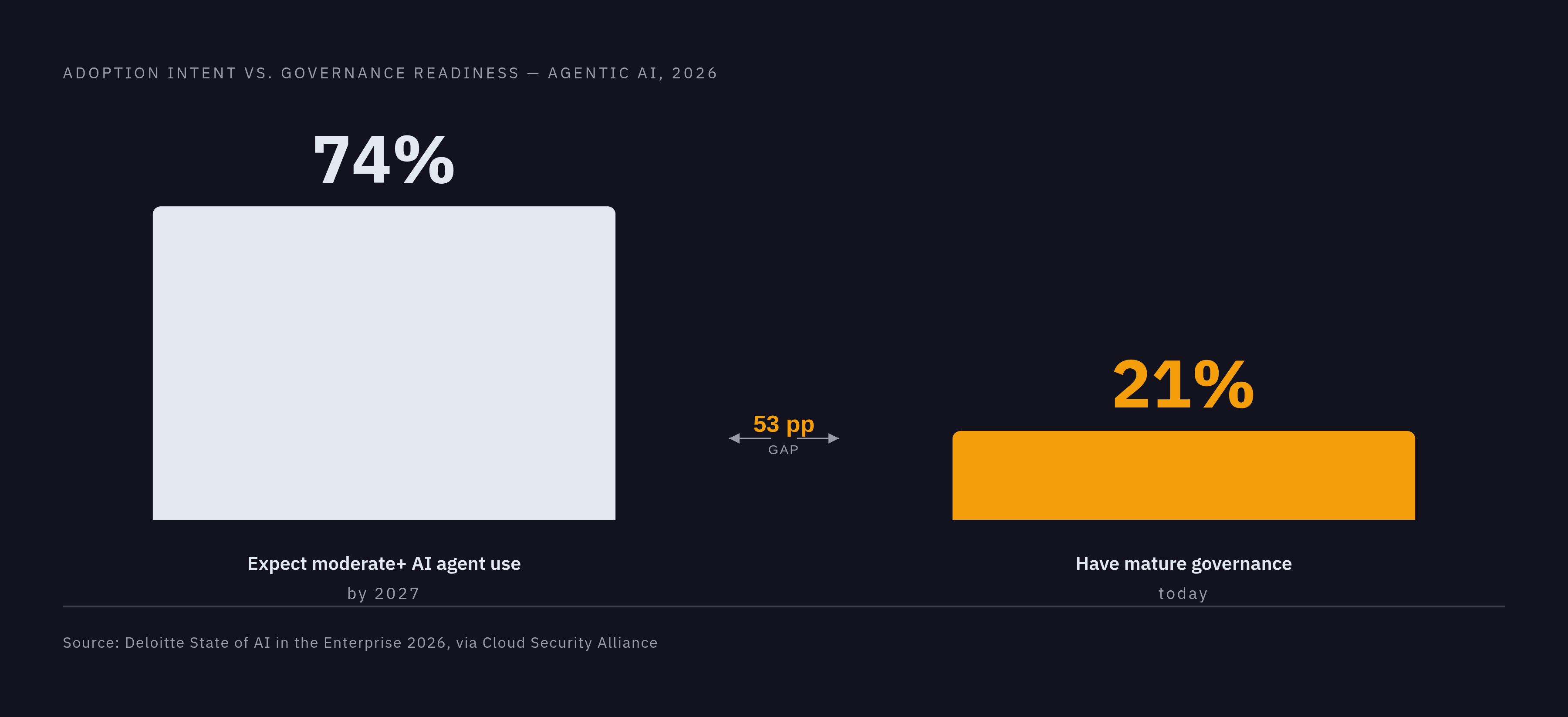
Deloitte's 2026 State of AI in the Enterprise report (cited by the Cloud Security Alliance in August 2026) found that 74% of organizations expect to use AI agents at least moderately by 2027, but only... Deloitte's 2026 State of AI in the Enterprise report, cited by the Cloud Security Alliance, found that 74% of organizations expect to use AI agents at least moderately by 2027, but only 21% say they have a mature governance model for agentic AI in place today. That gap, between adoption and governance, is exactly where Article 21 exposure lives.
What satisfies a regulator here is operational evidence. It's operational evidence: for every AI request, a record of who or what made it, what role they were authorized under, how the prompt was classified, which vendor and model handled it, what policy version applied, what happened, and when. And those records need to be queryable by identity, by time, by vendor, and by classification.
Article 21's supply chain clause and the specific threat of AI data poisoning
Article 21(2)(d) spells out supply chain security in plain terms: entities have to manage "security-related aspects concerning the relationships between each entity and its direct suppliers or service providers." Article 21(3) goes further, requiring entities to weigh "the vulnerabilities specific to each direct supplier" and the overall quality of that supplier's cybersecurity practices, including how securely they build their own products.
For AI, that supply chain is wider than most compliance teams are used to mapping. Training datasets, live context data pulled in at runtime, third-party APIs, pre-trained models licensed from somewhere else, every one of those is a link where something can go wrong.
Data poisoning is the threat that fits squarely inside this clause. Deliberately manipulating the data an AI system relies on counts as a cyber threat under NIS2's scope, and an analysis from TTMS labeled it the invisible cyber threat of the year, pointing out that tampering with an AI agent's context data can quietly change its decisions without tripping any of the alerts a traditional log would generate. AI components were leveraged in over 80% of social engineering activity observed globally in 2025, a signal that the AI supply chain is drawing sustained adversarial attention. IBM and Ponemon's 2025 Cost of a Data Breach Report shows breaches that trace back to a third-party vendor or supply chain compromise are consistently among the most expensive categories a company can suffer.
For an agentic AI system, this stops being a vendor questionnaire exercise. It requires actually knowing which model the agent called, which dataset it pulled context from, and whether anything upstream got tampered with, in enough detail to satisfy Article 23's 24-hour early warning clock. That's where an MCP gateway earns its place in the architecture: a control layer sitting between the agent and every tool, dataset, and API it touches, logging each call as it happens. That's the mechanism that turns "supply chain security" from a paragraph in a vendor contract into something an entity can actually point to as evidence.
Why Article 23's incident reporting timeline is structurally incompatible with how most AI systems currently log their activity
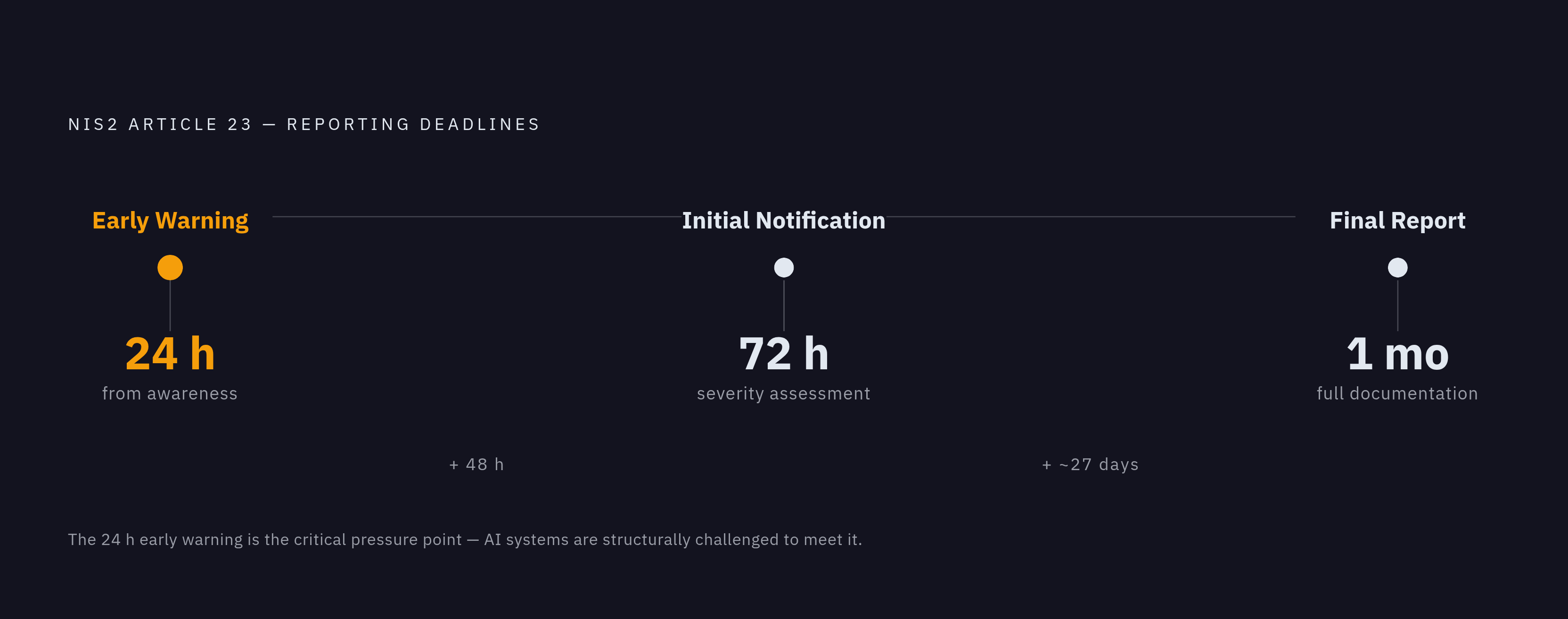
Article 23 runs on three deadlines. An early warning within 24 hours of becoming aware of a significant incident. A fuller notification, with an initial severity assessment, within 72 hours. A final report within one month.
What counts as "significant" is about impact. It's about impact on operations, finances, or other affected parties. A model hiccup and a ransomware attack get judged by the same yardstick.
The mismatch is this. When an AI system sits somewhere in the chain of an incident, most operators can't reconstruct what the model actually saw or did within that 24-hour window, because the evidence lives inside a vendor's cloud infrastructure, behind a support ticket queue that doesn't move on regulatory time. If an AI agent produces bad output because its input data was tampered with, the entity has to document, with actual evidence, which data was compromised, when, and what it affected downstream. That's a data lineage problem dressed up as a notification procedure.
Context for how strained this already is: figures from D3 Security show the average enterprise security team faces around 3,000 alerts a day, spends about 70 minutes investigating each one it actually looks at, and leaves 63% untouched. Figuring out which of those alerts crosses the "significant incident" line for NIS2 purposes is a governance problem before it's ever a reporting problem. Now add agentic AI into that mix: a single agent action chain might touch several systems, call several outside tools, and produce outputs across several business processes before anyone notices something went wrong. The 24-hour clock starts running from the moment the entity becomes aware, and awareness depends on whether the logging infrastructure can surface the event.
Article 23 compliance for AI is a real-time observability problem. It's a real-time observability problem. A log a team reads the day after an incident is a postmortem. It tells the story of what already happened. It does nothing to help someone hit a 24-hour deadline that started ticking the moment the damage occurred, whether anyone noticed yet or not.
The governance architecture that satisfies Article 21 and Article 23 for AI-driven operations
Putting Article 21 and Article 23 side by side makes the shape of what's needed obvious. Article 21 wants access control enforced at the request boundary, supply chain visibility down to the vendor and model level, and incident-handling records detailed enough to hold up under review. Article 23 wants awareness fast enough to start a 24-hour clock the moment something goes wrong.
Both of those point at the same underlying requirement: a system that watches AI activity as it happens, rather than one that reconstructs it after the fact. A quarterly audit doesn't satisfy either article. Neither does a policy document sitting in a compliance folder that nobody checks against what's actually running in production.
Organizations that treat AI as part of the full ICT risk surface, rather than as a separate concern to worry about later, are already closer to what Article 21 demands than they might realize. Tools like MCPManager, which give centralized visibility and control over how AI systems reach into business data, put that governance directly at the operational layer where the risk actually sits, turning what used to be a compliance audit into something closer to real-time observability. That's not the only way to build toward this. But whatever the mechanism, the target is the same: every AI request identifiable, every tool call logged, every vendor relationship visible, so that when the question comes (and under NIS2, it will come within 24 hours) there's an answer already sitting in the record instead of one that has to be built from scratch under deadline.