Enterprise Readiness Assessment for Agentic AI Deployment
Governance and data foundations, not technology, determine whether agentic AI actually ships.
Enterprise Readiness Assessment for Agentic AI Deployment.
Why most agentic AI pilots stall before they reach anyone who matters
An enterprise readiness assessment for agentic AI deployment is, at its core, a governance and access-control audit. Not a technology checklist, not a vendor bake-off.
The timeline pressure makes this expensive to get wrong. Gartner projects that 40% of enterprise applications will embed task-specific AI agents by the end of 2026, up from less than 5% at the start of the year Gartner. That's not gradual rollout. That's a land grab, and it means unpreparedness compounds fast rather than surfacing slowly over a few quiet quarters Gartner Gartner.
Yet the production numbers tell a very different story than the adoption numbers. It's because the infrastructure, governance, and accountability structures around the model were never built digitalapplied.com. MIT/NANDA research backs this up directly: roughly 95% of generative AI pilots stall due to flawed enterprise integration, not model quality Gartner MIT NANDA GenAI Divide. The gap is organizational, not new.
So what does the surviving 12% look like digitalapplied.com? A consistent operating profile emerges across the pilots that do reach production: named ownership, scoped success criteria, automated evaluation, and organizational readiness to ship and to roll back when something goes wrong digitalapplied.com. None of that is an AI decision. All of it is governance, decided in advance, by people with actual authority to decide it digitalapplied.com.
What "readiness" means when agents act autonomously across enterprise systems
Enterprise AI agents aren't chatbots wearing a new label, and they aren't robotic process automation with better marketing. They reason, plan, and take multi-step actions across CRM, ERP, financial, and compliance systems, often with minimal human intervention along the way. That autonomy is the entire value proposition. It's also the entire exposure.
Traditional AI governance was built for a different kind of system: static models, reviewed periodically, audited by hand. It was never designed for software that autonomously executes workflows, calls external tools, and coordinates with other agents in real time. Applying old governance to new autonomy is like applying a building inspection checklist to a moving vehicle.
And the fleet is growing faster than anyone planned for. A recent survey found the mean number of agents per organization jumping sharply, with nearly 38% of organizations reporting more than 100 agents deployed by April 2026, up from a mean of roughly 37 agents just months earlier in December 2025 EY/AIUC-1 Consortium survey. Agent sprawl is already the present condition inside a lot of enterprises, not a future risk.
Much of that sprawl is invisible to the people responsible for securing it. That's not a rounding error. That's the overwhelming majority operating with a blind spot at the center of their risk picture.
Readiness concerns whether the organization has the identity controls, the data foundations, the governance structures, and the human oversight mechanisms to let an agent act on its behalf at scale. Gartner's own forecast reflects how seriously this is starting to bite: over 40% of agentic AI projects will be canceled by the end of 2027, and the driver is escalating costs, unclear business value, or inadequate risk controls, not a failure of the underlying capability Gartner. Cancellation, in other words, is usually a governance verdict, not a technology one Gartner Gartner. 82% of enterprises already have AI agents or workflows their security teams did not know existed, a defined category now known as "shadow agents," per 2026 research.
Dimension 1: Data and integration readiness, the foundation agents break when it is missing
Start with how few organizations actually believe they're ready. A Harvard Business Review survey found only 15% of companies believe their data and systems are fully ready for agentic AI Gartner. That's a startlingly honest number, coming from the people closest to the problem.
The specifics explain why. Only 47% of organizations report broadly trusted, enterprise-authoritative structured data, and only 27% have a governed, enterprise-wide semantic layer that machines can actually consume S&P Global Market Intelligence and McKinsey precisely.com. That second figure matters more than it sounds. A semantic layer is what lets different systems agree on what a term means, what a field represents, what "customer" or "active account" actually refers to across departments. Without it, agents operating across the enterprise don't share a consistent understanding of the data they're touching. The outputs still look plausible. They just reflect inconsistencies baked into the underlying data, replicated now at scale and at machine speed rather than caught by a human doing a manual reconciliation once a quarter.
Integration timelines get underestimated as a matter of routine. Pilots almost never plan around this, because the pilot ran on clean, curated data, hand-picked for the demo. Production runs on decades of accumulated ERP configurations, inconsistent APIs, and data siloed across departments that never had a reason to reconcile it before. What happens when an agent hits an API that behaves differently in production than it did in the test environment? Usually nothing good, and usually nobody had planned for the answer.
Skipping this step doesn't make the cost disappear. IDC FutureScape projects that companies without AI-ready data foundations will suffer a 15% productivity loss by 2027 Gartner Harvard Business Review. The cost of skipping data readiness is deferred, with interest Gartner Harvard Business Review.
A readiness audit on this dimension has to answer some blunt questions. Is the data broadly trusted across the organization, or only trusted within individual silos that don't talk to each other? Does a governed semantic layer exist that agents can actually consume consistently, or is "semantic layer" still aspirational language in a slide deck? Have integration timelines been benchmarked against the messy production environment, rather than the sanitized pilot one? None of these questions are exotic. They're just rarely asked before the deployment decision gets made. Build approaches require 6 to 12 months to achieve production readiness neontri.com.
Dimension 2: Security and identity readiness, the structural gap that enterprises are not measuring
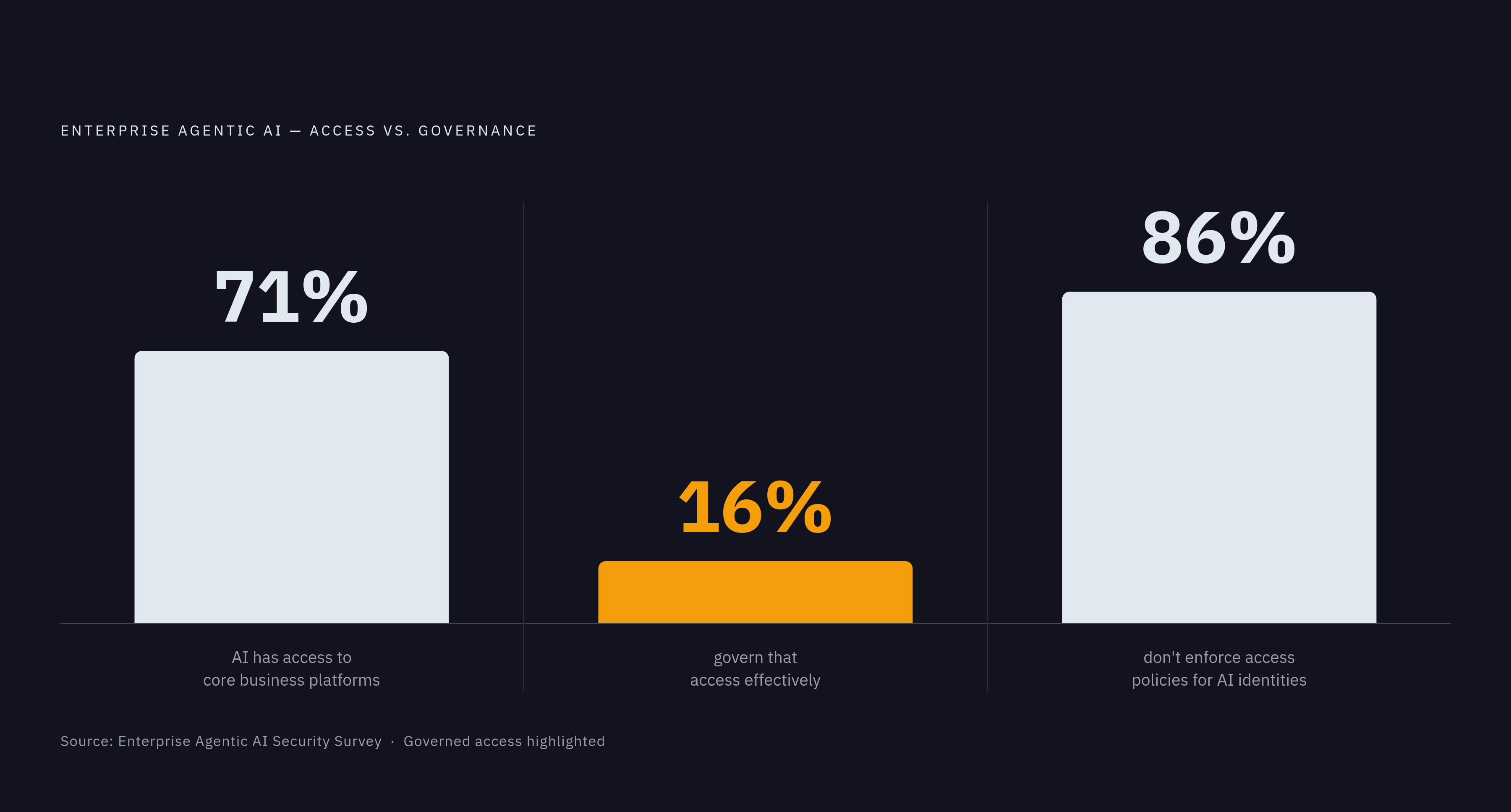
This is where the numbers get uncomfortable. The 2026 CISO AI Risk Report, drawing on 235 large-enterprise security leaders, lays out the scale of the gap. And 71% report that AI systems already have access to core business platforms, ERP, CRM, financial systems, while only 16% say they govern that access effectively McKinsey State of AI 2025 CISO AI Risk Report. Read those three numbers together and the picture is unmistakable: broad access, almost no visibility, and enforcement that barely exists neontri.com.
The problem of managing agent identities is not incidental. It's structural. Only 23% of organizations have a formal, enterprise-wide strategy for agent identity management, and another 37% are running on informal practices that nobody has written down McKinsey State of AI 2025 strata.io. Ownership of the problem is scattered across security, IT, and whatever emerging AI security function got stood up last quarter, with no one clearly accountable for the whole picture McKinsey State of AI 2025 strata.io. Only 29% of organizations reported being prepared to secure their agentic AI deployments before moving forward, and most deployed anyway helpnetsecurity.com.
MCP adoption is outpacing identity and access management infrastructure, and this gap is most visible in Model Context Protocol deployments. MCP solutions and agentic platforms are arriving faster than most identity and access management infrastructure can accommodate, and current authentication patterns create real exposure as a result. Organizations that haven't started thinking seriously about where MCP fits into their identity governance model are already behind, whether or not they've noticed.
Monitoring is close to nonexistent. The EY/AIUC-1 Consortium survey found that only 38% of organizations monitor AI traffic end-to-end across prompts, tool calls, and outputs Gartner CIO and Technology Executive Survey. Only 17% continuously monitor agent-to-agent interactions Gartner CIO and Technology Executive Survey EY/AIUC-1 Consortium survey. That 38% figure means most organizations are operating blind, discovering what their agents actually did only after something forces them to look EY/AIUC-1 Consortium survey.
This isn't theoretical risk. Security researcher Ari Marzouk's "IDEsaster" findings identified more than 30 vulnerabilities across over ten AI coding tools, including remote code execution through IDE settings overwrite attacks and data exfiltration through JSON schema attacks. The pattern continuing into 2026 includes persistent prompt injection and multi-stage attacks carried out with little to no human involvement. The OWASP Top 10 for Agentic Applications, published in 2026, gives readiness teams a taxonomy to map against: goal hijacking, tool misuse, identity and privilege abuse, missing guardrails, sensitive data disclosure, memory poisoning, resource exhaustion, supply chain vulnerabilities, insecure inter-agent communication, and over-reliance on autonomous decisions.
Human-in-the-loop oversight belongs in this dimension as a governance mechanism, not a soft preference. But most organizations lack an architectural approach for integrating those checkpoints, which quietly limits agents to low-risk busywork that never justifies the investment made in them.
A working audit for this dimension asks: does every deployed agent have a registered, governed identity? Are access policies enforced for AI identities with the same rigor applied to human ones? Where do MCP servers sit in the identity governance model, and who actually owns that decision? Are HITL checkpoints built into the architecture, or are they aspirational language in a security review that nobody revisits? An MCP attack surface discovered after deployment is a governance failure, not a security surprise, because the vulnerability existed the moment the server went ungoverned. Real-time monitoring is a safety net. An audit log read after an incident is a postmortem, and postmortems don't prevent anything. 92% lack full visibility into their AI identities CISO AI Risk Report. 86% do not enforce access policies for AI identities McKinsey State of AI 2025 CISO AI Risk Report.
Dimension 3: Governance readiness, accountability structures that most organizations have not built
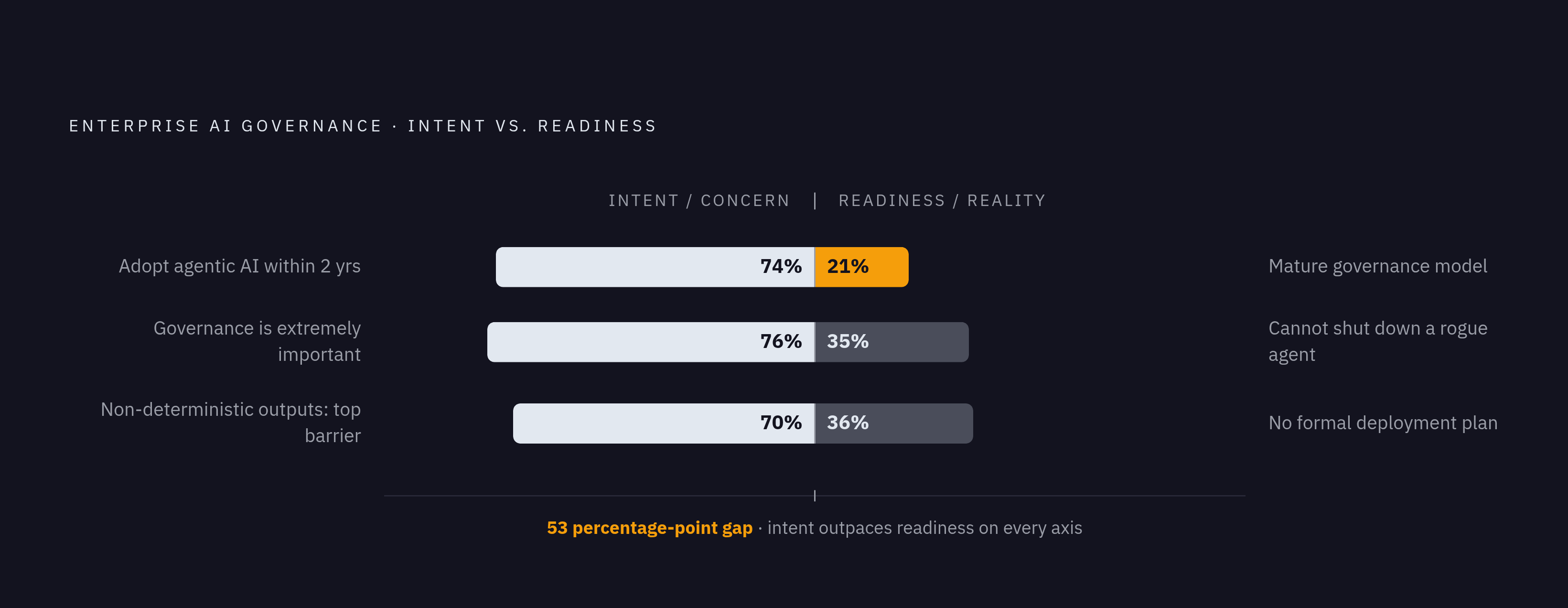
Deloitte research finds that 74% of organizations plan to adopt agentic AI within the next two years, but only 21% currently have a mature governance model for AI agents in place.
Some organizations haven't even reached the starting line. Governance gaps here aren't hypothetical future risks sitting on a slide about "what could go wrong." They're describing damage that, by executives' own admission, has already happened.
The friction is visible in adoption numbers too. A 2026 Writer survey found 79% of organizations facing real challenges adopting AI, a double-digit jump from 2025, and 54% of C-suite executives admitted that adopting AI is tearing their company apart internally svitla.com. Spending and readiness are clearly not the same axis.
Governance now has to answer questions it never had to before. Who is liable when an agent makes a wrong decision? What can an agent do without human approval, and who decided that boundary on purpose rather than by default? How are role-based access control policies for agents defined, maintained, and audited, scoped deliberately rather than just restricted because nobody thought it through? What's the actual incident response playbook when an agent behaves in a way nobody predicted?
Accountability roles to answer these questions mostly don't exist yet. IDC predicts dedicated AI risk and accountability roles will be mandatory for half of all AI-enabled applications by 2027, and most enterprises haven't created them.
Procurement adds its own distortion. Vendors rebranding chatbots and RPA tools as "agentic AI" inflate perceived governance maturity across the market, a pattern sometimes called agent washing.
Shadow agents belong in this section as much as the security one. Teams that respond to risk by blocking MCP servers and outside agent tools tend to push adoption underground rather than eliminating it. The organizations that actually reduce shadow AI are the ones that give employees a governed path to the tools they already want to use, not the ones issuing bans that get quietly ignored. Every agent added without a registry entry is an identity the organization can't account for, and an identity nobody can account for is precisely the one that ends up exploited. 36% of organizations have no formal plan for deploying AI agents at all, and 35% admit they could not shut down a rogue AI agent if one emerged Gartner McKinsey State of AI 2025. 76% of technology leaders say governance is extremely important for agentic AI deployment, but importance and readiness are different scores McKinsey State of AI 2025. 70% of leaders name non-deterministic outputs as the number one production-readiness barrier, a governance problem, not a model problem.
Dimension 4: Workforce and skills readiness, the human layer that assessment frameworks skip
Workera's 2026 AI Skills Enterprise Benchmark Report, drawing on more than 88,000 individual assessments across major enterprises and the US federal government, found that only 13% of employees are accomplished in agentic AI skills before any upskilling begins. That's the lowest score across all 14 capabilities the benchmark measured. Not the lowest agentic score. The lowest score, period.
This has a direct, mechanical consequence for the governance work described earlier. Human-in-the-loop oversight only means anything if the human in the loop actually understands what the agent is doing, what its failure modes look like, and what counts as unexpected behavior that should be flagged. A checkpoint staffed by someone without that judgment is a rubber stamp with a job title attached.
The most common failure in enterprise AI agent deployments is organizational: poor process design, absent ownership, and unclear decision rights stall more deployments than any infrastructure limitation. This points to a specific mistake: organizations treat the deployment as the hard part and the process as an afterthought. Layering an agent onto a broken process just produces a faster broken process. Organizations that succeed in 2026 identify the workflow first, map every decision point in it, and ask what that workflow would look like if it were designed for an agent from scratch. That question, asked honestly, almost always produces a different workflow than the one already in place.
A skills readiness audit needs its own set of questions. Who in the organization can actually evaluate whether an agent's output is trustworthy, as opposed to merely plausible-sounding? Are the people designated for oversight trained to spot prompt injection, goal drift, or tool misuse when it happens in front of them? Is there an upskilling program for agentic AI in place, or is the organization deploying agents straight into a skills vacuum? Are process owners actually involved in redesigning the workflow, or has that work been handed to engineering alone, with the people who run the process day to day left out of the room?
The timing pressure here is real. IDC projects that 65% of organizations expect full deployment by 2027 Gartner. Workforce readiness decisions need to get made now, ahead of the infrastructure, not stitched on afterward once the agents are already live and the gaps are already showing Gartner.
How to run the assessment: a structured readiness audit across all four dimensions before deployment begins
The assessment itself isn't a one-time gate that gets checked off and forgotten.
Sequencing matters more than it might seem. Data readiness sets the floor everything else stands on. Security and identity readiness determines the actual attack surface an organization is carrying. Governance readiness determines who is accountable when something breaks. Workforce readiness determines whether the humans nominally overseeing all of this can actually do the job.
For data and integration, the audit inventories every data source an agent will touch and asks whether it's genuinely authoritative or just trusted within its own silo. It checks whether a governed semantic layer exists and is machine-consumable, not theoretical. And it identifies, in advance, which APIs are known to behave differently in production than they do in testing.
For security and identity, the audit starts with a registry question: does every agent have a registered, governed identity, and is every unregistered agent treated as the accountability gap it actually is? It checks whether access policy enforcement applies the same RBAC rigor to AI identities that it applies to human ones. It maps where MCP servers sit in the identity governance model and confirms that authentication and authorization were explicitly designed, not assumed to work themselves out. It checks the monitoring posture directly against that 38% figure, because most organizations are currently operating blind and need to know if they're one of them EY/AIUC-1 Consortium survey. It confirms whether HITL checkpoints are architecturally real or just written down somewhere.
For governance, the audit forces a name onto every open question: who owns accountability for a wrong agent decision, who signed off on what an agent can do without approval, and whether an incident response playbook for agent behavior actually exists or only sounds like it does in a meeting. For workforce, it checks whether the people assigned to oversight can actually recognize the failure modes they're meant to catch, and whether the workflow an agent is stepping into was redesigned for that agent or just inherited from whatever existed before.
A strong semantic layer doesn't help if nobody enforces access to it. A well-scoped RBAC policy doesn't help if the humans reviewing agent output can't tell a good decision from a bad one. Integration timelines should be estimated against production environments, not pilot environments, using the 3–6 month (buy/configure) and 6–12 month (build) benchmarks as calibration. Deployed agents should be mapped against the OWASP Top 10 for Agen.