Governing MCP Server Access to Eliminate Shadow AI Without Blocking Velocity
A governed access layer lets teams move fast while security teams maintain visibility and control.
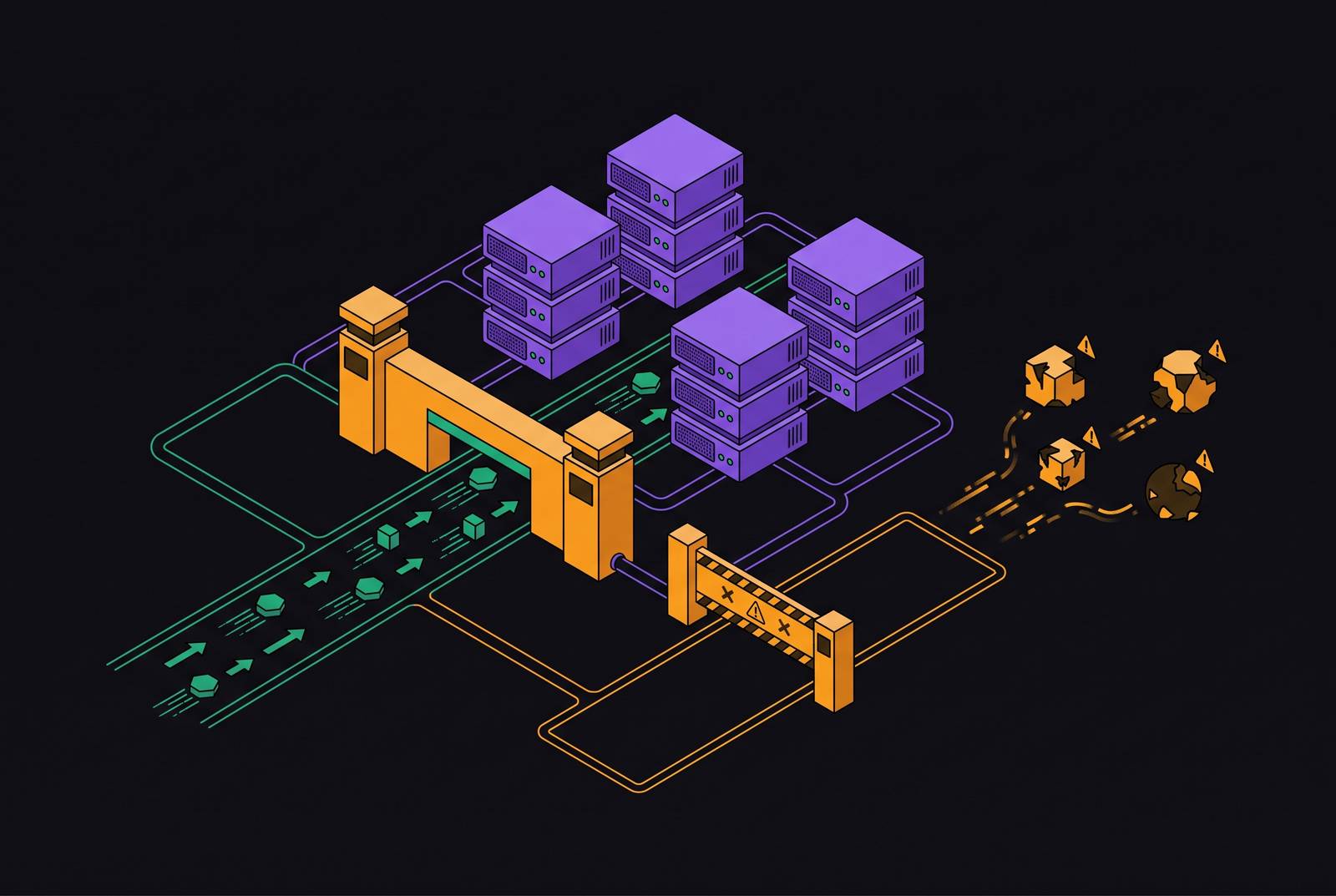
Shadow AI and blocked pilots both trace back to the same mistake: treating MCP access as all-or-nothing. The fix is a governed access layer: it gives teams a fast, sanctioned path to the tools they need, and it gives security teams a full view of every connection an agent makes. That single design choice is what lets a company stop unauthorized tool use without slowing down the people who are trying to get real work done.
The Model Context Protocol stopped being an experiment a while ago. By 2026, the protocol was seeing 97 million monthly SDK downloads, and about 41% of technical leaders reported they had it running in production.
The scale is real, but control hasn't caught up. It's a different kind of risk entirely: it initiates its own connections to outside services, runs code, and often holds onto credentials across sessions. That makes it a privileged identity, something that sits between a normal user account and a service account, with access that can touch production systems directly.
Most companies don't have an answer for the basic questions this raises. For most enterprises right now, the honest answer to all four is: there isn't a standard way to find out.
The binary access model's shadow AI and blocked pilots
Security teams tend to default to one of two postures with MCP: let everyone connect anything, or lock it down company-wide. Both choices, applied at the same time across an organization, produce the same two outcomes everywhere they're tried: engineers build their own unapproved servers underground, while the pilots that went through proper channels stall out before they ever reach production.
Picture a developer trying to connect an AI coding assistant to a staging database, or a data analyst wiring up an agent to pull from an internal API. The new credential sitting in a config file, pointed at a production system, is invisible to anyone outside that developer's laptop.
Left without a governance path, developers tend to repeat the same shortcuts: hardcoded credentials checked into a repo, one set of credentials reused across several MCP servers, a personal access token borrowed from a developer's own account, a database connection string typed directly into a server manifest. None of this is malicious. It's what happens when the fast way and the safe way are the same decision for nobody.
In enterprise deployments, that kind of overprivileged connection is the main reason a single compromised agent can do far more damage than it should.
Meanwhile, on the other side of the same policy, the pilots that followed the rules are going nowhere. An estimated 11% to 14% of enterprise agentic AI pilots actually make it to production. The rest don't die because the model was bad or the use case didn't make sense. Add in the usual friction: mapping MCP tools onto legacy systems and getting IT, security, and the business side to agree on anything. A reasonable pilot can sit in limbo for months.
These two failure modes are the same policy producing opposite-looking symptoms. The binary reflex that creates shadow deployments is the same reflex that kills the pilots security teams could have watched and controlled.
What the MCP attack surface looks like when access is ungoverned
None of this risk is hypothetical. It's been documented, and it traces back to the same two failures the binary access model leaves wide open: credentials with no owner, and permissions with no limit.
Start with credentials. Every MCP server connection needs one, an API key, an OAuth token, a database connection string, a service account secret. They can't answer who owns a given MCP credential, what type of credential should be allowed for a given connection, how rotation gets enforced across dozens of servers nobody centrally tracks, or how anyone would even notice if a credential leaked into a public repo or a Slack channel.
The governance gap here isn't just a matter of people being careless. There's no way to apply one consistent policy across the organization, and the audit trail that does exist is scattered across however many servers are running, with no single place to look.
Platform vendors have started responding to this. On August 6, 2026, GitHub announced that enterprise managed settings now support allowedMcpServers and deniedMcpServers, giving admins a way to control which servers Copilot can reach. Approving the server doesn't tell you what happens once the agent is inside it.
Resolving the Velocity Problem and the Shadow AI Problem Together
The fix is governance that delivers both speed and safety at once. That combination makes the binary choice, allow everything or block everything, unnecessary.
The clearest evidence for this comes from what happens on the supply side. When a company sets up sanctioned AI tools through a governed path and makes that path genuinely easy to use, unauthorized use drops sharply. That's the strongest argument for treating governance as the primary fix for shadow AI: giving people a legitimate way to get what they need does more than any amount of detection or blocking after the fact.
The architecture caught up with this logic in June 2026, when the Enterprise-Managed Authorization extension, now stable, formalized a company's own identity provider as the authority over MCP server access. You get one audit trail instead of a scattered set of logs across dozens of servers, because every access decision lives in one place, the IdP admin console.
The organizations getting real value out of MCP share a pattern that has nothing to do with how many servers they've connected. The binary allow-or-block reflex fails because it leaves no middle ground: you either get total access or no access. A governed MCP access layer breaks that trap by giving teams a sanctioned, fast path to the tools they need while giving security teams the visibility they require. Centralized approval workflows paired with transparent audit trails, the approach platforms like MCP Manager take, directly address why binary blocking and shadow deployment keep showing up together.
The five capabilities a governed MCP access layer must deliver
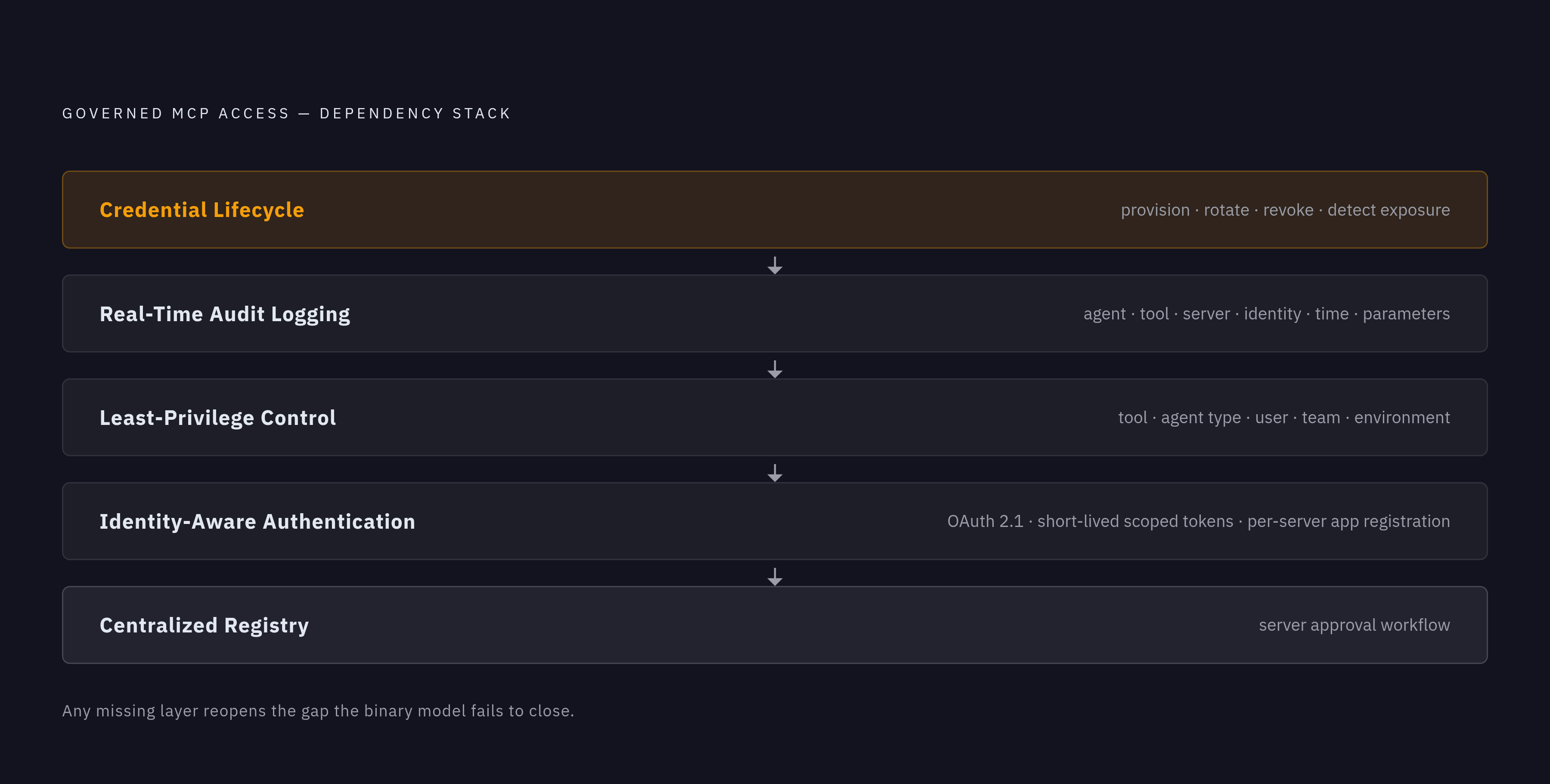
Governed access is a stack of five capabilities that depend on each other, and leaving out any one of them opens up exactly the gap the binary model already fails to close.
The foundation is a centralized registry with a server approval workflow. Every MCP server a company runs, whether it's hosted remotely by a vendor or built and run internally, needs an entry in that registry before any agent connects to it. A server with no registry entry is, from the organization's point of view, an identity nobody can account for. Enterprises are already leaning this direction on their own. Among the most-searched MCP servers, roughly 80% are offered as remote, vendor-hosted servers rather than something installed locally, and that deployment model is actually easier to govern centrally. A registry just turns that existing preference into enforced policy.
The second capability is identity-aware authentication, applied the same way across every connection instead of being left up to whoever set up a given server. If a server connects to SaaS tools or anything crossing network boundaries, that means OAuth 2.1 with short-lived, scoped access tokens and a dedicated OAuth app registration for each server, because sharing one credential across multiple servers means a single compromise exposes everything those servers touch. Certain patterns need to be ruled out explicitly: hardcoded credentials in config files, personal access tokens borrowed from someone's own developer account, long-lived OAuth refresh tokens sitting in plain text, and credentials shared across multiple servers or agents.
The third capability is least-privilege control at the level of individual tools, not just whole servers. Mature governance frameworks push this down to the granularity of tool, agent type, user, team, and environment, because that's the level of control that actually stops a compromised agent from inheriting permissions across every server it happens to touch.
The fourth capability is real-time audit logging that you can actually use, not just a record somebody can pull up after something's already gone wrong. A log reviewed after an incident is a postmortem. Visibility only works as a safety net if it's available while the agent is still acting. That means capturing which agent called which tool, on which server, under which identity, at what time, with what parameters, not just the fact that a session happened. It's the company never finding out until then. These logs also need to export cleanly to a SIEM. The EU AI Act's logging and human-oversight requirements, originally due August 2, 2026 for high-risk use cases, were pushed to December 2, 2027 under the EU Digital Omnibus amendment, giving companies a window to build this properly before the deadline.
The fifth capability is treating credential lifecycle management as an ongoing process rather than something handled once during setup. That means provisioning, rotation, revocation, and exposure detection running continuously. This matters more than it might seem, because the MCP spec itself is changing fast, with the Enterprise-Managed Authorization extension stabilizing in June 2026 and formally folding into the spec in July, and a separate update covering stateless sessions and server-to-client change notifications finalized July 28, 2026. Companies that tried to build their own governance tooling earlier in the year are now shopping for an outside platform instead, simply because the spec moved faster than their own engineering roadmaps could keep up with.
MCP Manager's delivery of these capabilities as a purpose-built governance layer
MCP Manager, acquired by Usercentrics and built by a team with deep experience in AI infrastructure, is designed around this exact five-capability stack rather than being a general-purpose gateway retrofitted for MCP after the fact.
The registry sits at the center of the product. That gives a security team something traditional IAM tools can't: one authoritative inventory of every MCP server in the company, including the ones that would otherwise have been running quietly on someone's laptop.
On top of the registry sits role-based access control, and it's built specifically for AI agents. MCP Manager's controls apply at the level of the individual tool, not just the server, down to the specific combination of tool, agent type, user, team, and environment. That's the granularity the five-capability standard calls for, and it's what keeps a compromised or overprivileged agent from inheriting access it was never supposed to have.
The positioning behind all of this is that fast MCP adoption and safe MCP adoption are the same goal. The friction teams tend to blame on security is usually the absence of a gateway, not the presence of one. Guardrails built this way are what let an organization say yes to a production deployment with confidence.
What other platforms offer for MCP governance
A handful of platforms already address pieces of this five-capability stack, each one built first for a broader purpose and extended toward MCP governance.
GitHub has put real investment into this through Enterprise AI Controls and an Agent Control Plane. Teams running Claude Code, Cursor, or Windsurf alongside Copilot, or departments outside engineering connecting through Claude Desktop or ChatGPT with MCP connectors, fall outside what GitHub's enterprise controls can see.
Microsoft takes a different approach, spreading governance across its existing stack rather than building one dedicated MCP control point: Entra for identity, Azure API Management as an MCP-aware gateway, Copilot Studio and Foundry for the agent tooling itself, Defender for threat hunting. The tradeoff is that the coverage is assembled from pieces built for different original purposes, so a team not already running heavily on Microsoft faces a fair amount of integration work to reach the same five-capability standard.
Identity fabric and secrets management tools, Strata among them, take a third angle by focusing on the non-human identity layer: authenticating and governing AI agents at runtime, enforcing guardrails on what they output, and managing agent identity alongside human and service accounts in one system. That's a strong fit for a company whose main gap is coordinating identity across several identity providers at once. It's a less direct fit for a company whose primary need is a registry and gateway built specifically around MCP servers themselves.
Sequencing MCP governance adoption without halting pilots in flight
Governance doesn't need to be finished before MCP gets used. It needs to run alongside the first pilots already underway, rather than getting bolted on only once a compliance deadline is close or an incident has already happened.
Start by finding out what's actually running before you write any access policy. You can't set rules for a landscape nobody has mapped yet.
From there, govern the connections with the highest blast radius first: production databases, internal APIs, credential stores, code repositories. This order matches the actual risk profile, so it doesn't freeze every experiment in progress while the registry gets built.
Give developers a governed path before taking away the ungoverned one. Provisioning approved MCP servers through an IdP-integrated gateway removes the friction that pushed people toward unofficial setups. MCPManager, a Usercentrics product, is built around that idea of an IT-sanctioned route that audits AI data access centrally rather than leaving teams to route around policy.
Treat how fast the MCP spec is moving as a reason to adopt a platform built for this, not a reason to wait and see. The specification saw material releases in March, June, and July of 2026 alone, and companies that tried building internal governance tooling earlier in the year kept finding the spec had moved past what their engineering teams had built. A platform built specifically for this absorbs those changes as they come, so a company's policy layer doesn't need to be rebuilt every time the spec updates.
The regulatory timeline is already running in parallel. The companies that come out ahead won't be the ones that treated governance as a box to check before an audit. They'll be the ones that built it early enough to keep shipping agentic AI faster than competitors still arguing over whether to allow it.