Agent Memory Scoping and Governance in Multi-Tenant Deployments
Enterprises scaling AI agents must isolate tenant memory before incidents force the issue.
Agent adoption is moving faster than most enterprises can govern it. Gartner projects 40% of enterprise applications will integrate task-specific AI agents by the end of 2026, up from under 5% in 2025. That's a remarkably sharp adoption curve, and McKinsey's 2025 State of AI Global Survey found 23% of organizations already scaling agentic AI, with another 39% still experimenting. Most of that work is happening under time pressure. Infrastructure decisions, especially around memory, are getting made before anyone's fully thought through what happens when tenant A's agent reaches into tenant B's data.
The assumption doing the most damage right now is a simple one: that standard SaaS data separation, the kind built on per-row tenant filtering and scoped API keys, is good enough for AI agents. It isn't, and the reason why has to do with how agents actually work. Agents don't just touch structured database rows. They pull from files, vector databases, long-term memory stores, and a growing list of tool permissions. Vector similarity retrieval, the backbone of most memory systems, is semantic rather than deterministic: a query from tenant B can end up a closer match to tenant A's private data than to anything in tenant B's own context. And because memory persists across sessions, every new interaction widens the window during which that kind of leak can happen.
What agent memory is and why its structure creates unique cross-tenant risk
The context window and actual memory are two different things. The context window is a temporary buffer, gone once the session ends. Memory is different. It lives outside the model, in persistent storage that survives well past any single conversation. The context window is a temporary buffer, gone once the session ends. Memory is different. It lives outside the model, in persistent storage that survives well past any single conversation.
That memory breaks down into four rough types, and each one carries its own flavor of cross-tenant risk.
User-level memory holds facts about a specific person, carried across every session they have with the system. Session-level memory is scoped to one conversation or workflow run, gone (in theory) once that run ends. Agent-level memory is what a particular agent instance has learned or been configured to know. Organizational or shared memory is knowledge available across a tenant's users, or in some setups, across tenants where that sharing has been explicitly allowed.
Each type fails differently. User memory is personally attributable, so a leak there crosses a privacy line, not just a security one. Session memory is short-lived but still dangerous during its window, particularly in high-traffic deployments running lots of concurrent sessions. Agent memory might encode a tenant's specific configuration or preferences, and that information should never appear in another tenant's agent. And shared or org memory is the most dangerous of the four when it's miscategorized: what's meant to be shared within one tenant can get mistaken for something shared across tenants, if the scoping was never made explicit.
Multi-agent systems make this worse. Picture a shared conversation involving more than one agent. A memory entry like "the user needs help with deployment" sounds simple enough, but who actually said that? It could be the user talking. Or it could be a planning agent's intermediate note to itself, never meant to be treated as a user statement. Without clear scoping, that ambiguity becomes a real vulnerability.
The four-scope design pattern: how memory ownership is assigned before isolation can be enforced
Before anyone can enforce isolation, memory needs an owner. The pattern that's emerged for this uses four scopes:
user_id covers memories tied to one specific person, following them across every session. agent_id covers memories that belong to a specific agent instance. run_id or session_id scopes memory to a single conversation or workflow run. An application or organization identifier covers context shared across an entire organization.
These scopes aren't standalone. They compose. A query can ask for one user's memory within one specific run, or pull everything that user has ever generated across every run they've had. The retrieval pipeline handles the merging and ranking automatically, so the complexity stays invisible to whoever's asking the question.
Metadata filtering is a second dimension. Memories can carry structured tags, something like {"context": "healthcare"}, that get queried independently of the semantic content itself. Memories can carry structured tags, something like {"context": "healthcare"}, that get queried independently of the semantic content itself. That matters most when a single memory store handles multiple application contexts that cross tenant lines. Without a metadata filter sitting alongside the scope, semantic similarity alone treats two tenants who happen to be talking about similar things as indistinguishable.
Actor attribution gets trickier in multi-agent setups. Mem0's Group Chat flow, for example, uses separate add() calls scoped by user_id or agent_id. The message's name field only serves as extraction context, it doesn't determine scoping on its own. Provenance comes from the ID passed into add(). Small distinction, but this detail is what lets a system actually answer "who said this" months later.
Three isolation architectures and the trade-offs that determine which one fits a deployment
Three broad architectures handle multi-tenant isolation, and each one trades cost against risk differently.
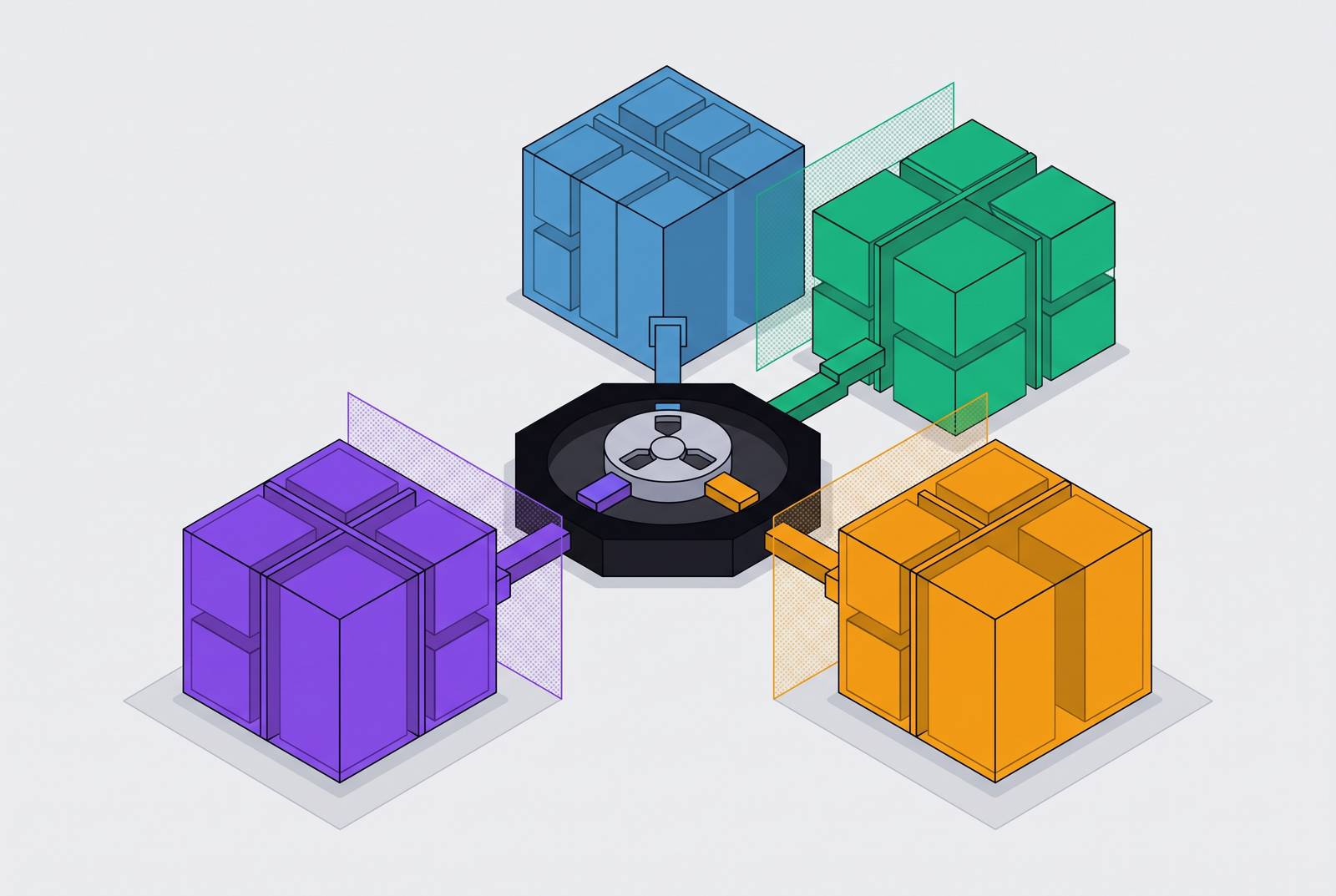
Fully isolated, or siloed, architecture gives every tenant separate infrastructure: dedicated vector databases, separate storage buckets, dedicated compute. It's the strongest boundary available. There's no theoretical path for cross-tenant leakage because there's no shared resource to leak through. Updating a system deployed across dozens or hundreds of isolated tenant environments gets expensive fast, both in dollars and in operational overhead. This model tends to show up where contractual terms, regulatory requirements, or disaster-recovery procedures leave no other option.
Fully shared architecture, sometimes called logical isolation, puts everyone on the same infrastructure and separates tenants in software, usually by filtering every query on a tenant_id. It's cheap and easy to update. But the isolation is only as strong as the discipline behind every single filter, and every code path has to implement that check correctly, every time, forever.
Hybrid architecture splits the difference: shared infrastructure as the default, with selective physical separation carved out for the workloads that need it. Most production systems land here, because it balances cost against risk without forcing an all-or-nothing choice. A regulated tenant can get contractual isolation without siloing the entire fleet.
Namespace isolation, using vector database namespaces or collection partitioning to separate memory by user, team, or organization, is the key mechanism inside both the shared and hybrid models. A separate namespace or index is not the same thing as dedicated infrastructure. Whether it functions like real isolation depends entirely on the implementation that produces it, a point practitioners working on multi-tenant memory have flagged directly. Treating a namespace boundary as equivalent to a physical one is an assumption that gets exposed during an incident review.
The architecture decision should follow the actual requirement: customer-managed infrastructure, regional data residency, workload isolation, credential boundaries, or recovery SLAs. It shouldn't just be whatever the platform happened to default to.
Where enforcement must live: application-layer filtering as an insufficient isolation boundary
The most common pattern in production today appends a WHERE tenant_id = :current_tenant clause to every query, usually through an ORM or a middleware layer. It works, right up until it doesn't.
The structure itself is the problem. Every single code path has to implement that filter correctly and independently. A background job that skips it, a cache lookup that bypasses it, a direct-fetch-by-ID endpoint that never checks tenant ownership at all, any one of these can quietly punch a hole through the boundary. And the failure is silent. Nobody gets an error message when a query returns the wrong tenant's data; the query just succeeds, incorrectly.
97% of organizations that experienced an AI-related security incident lacked proper AI access controls, and that risk is visible in the numbers. That's not a small gap, and it points squarely at enforcement living in the wrong layer.
Enforcement needs to move further down the stack. PostgreSQL Row-Level Security, for example, acts as a backstop at the storage layer itself, so a missing WHERE clause somewhere in application code can't leak data on its own. Systems that reject out-of-bounds queries natively at the query planner level are inherently more reliable than ones that depend on a developer remembering to append the right filter every time. Separate indices, separate keys, authorization checks that run before any vector gets retrieved, and knowledge graph entity nodes partitioned by tenant namespace all push the boundary somewhere a single missed line of application code can't undo it.
Authorization on every read and write: the operational rules that make scoping enforceable
Scoping and authorization solve two different problems. A namespace tells the system which memory to look at. It says nothing about whether the caller making the request is actually allowed to see it. Confusing the two is a common source of exposure.
Real enforcement means checking permission at every operation, not just once at login:
A write or import needs confirmation the caller can add data to that resolved scope. A search or profile lookup needs its permission check run before retrieval happens, not after the results come back. Fetching a document directly by its ID needs the same check, since skipping it here is one of the more common bypass routes: a system might correctly filter search results by tenant while leaving a direct ID lookup wide open. Updates, deletes, and exports need permission checks that cover both the object and the specific operation being performed. Background jobs need to retain the scope they were authorized under when they were originally queued; a retry that loses track of its original scope is a governance failure, not a minor bug. Cache lookups need tenant and permission context baked into the cache key itself, so a cache hit after a tenant switch inside the same browser session doesn't quietly serve up the previous tenant's data.
Personal and shared knowledge need separate authorization too, and their origins need to stay traceable once combined. A support agent pulling up a customer's ticket history alongside the company's shared troubleshooting guide is drawing on two distinct grants of permission, not one blanket authorization that happens to cover both.
And a request framed as "search all customer tickets" is exactly that: a request. It is not, by itself, an authorization. An agent's role or the task it's working on doesn't substitute for an explicit decision about what it's allowed to touch.
Four canonical governance failure modes that scoping alone does not prevent
The paper "Governed Shared Memory for Multi-Agent LLM Systems" lays out a taxonomy that's become the reference point for this problem, and it names four failure modes that scoping, on its own, doesn't fix.
Unauthorized leakage is the most obvious one: memory crossing a tenant or user boundary that isolation was specifically designed to stop. Stale propagation is subtler and arguably more common, where outdated facts keep getting served to agents or users after the real, underlying state has already changed. This gets especially dangerous when a memory store isn't updated synchronously with whatever system holds the source of record, since the agent ends up confidently wrong instead of just uncertain.
Scoping determines who's allowed to see what. It doesn't guarantee the information being seen is current, and it doesn't guarantee an agent won't misattribute a memory's origin in a multi-agent conversation. Those are governance problems that sit on top of the scoping layer, not underneath it.
That's really the throughline across all of this. Assigning scope identifiers correctly is the starting condition, not the finish line. Once ownership is unambiguous, actually enforcing it means validating every read and write against those rules in real time, and doing it consistently across every code path, every background job, every cache hit. That's the kind of enforcement layer purpose-built access control systems are designed around: translating tenant and agent scope definitions into policies that get enforced automatically, such as MCPManager, Usercentrics' AI data-access governance layer, so a well-meaning agent can't retrieve the wrong tenant's context even when semantic similarity makes that wrong context look like the best answer in the room.
Sources
- Multi-Tenant Agent Memory: Scoping, Authorization, and Isolation — supermemory
- State of AI Agent Memory 2026: Benchmarks & Trends
- Production Multi-Tenant State Isolation: How to Prevent Cross-User Memory Leakage in AI Agents
- Always-OnAgents:A Survey of Persistent Memory, State, and Governance in LLMAgents
- scalekit.com
- hackernoon.com
- theneuralbase.com
- medium.com