Agent Identity and Role Binding as the Foundation of MCP Tool Access Control
Organizations must control agent access by binding verified identity to specific tool permissions.
MCP is an interoperability layer, not a security boundary. The access control model it assumes is one the enterprise must supply entirely from outside the protocol. This piece explains how verifiable agent identity and deliberate role binding turn every tool invocation into a decision the organization made on purpose, not a capability the protocol handed over by default.
How enterprises control which AI agents can access which MCP tools across teams
MCP functions the way a single universal connector does: one connector that fits everything. A universal adapter is useful precisely because it removes friction. But a universal adapter that carries no information about who is allowed to plug in is a security liability, not just a convenience. The MCP security control surface analysis states this plainly: "MCP assumes an authorization layer it does not provide. Whatever RBAC governs your agents is something your organization built, bought, or forgot to install."
Early MCP 1.0 had no mandatory authentication requirement and no per-operation permission scoping. Any agent connecting to a server received the full capability set that server exposed. Dynamic tool discovery makes the gap sharper. If a remote MCP server adds a new tool at runtime, say a delete_repository capability, connected agents get access automatically, with no user awareness or approval. Where no access layer exists, the effective policy is whatever the service account behind the tool happens to permit. That is the default condition in a large share of deployments.
The July 28, 2026 MCP specification revision moved to a stateless protocol core. Every request now carries its own protocol version, client info, and client capabilities in _meta. That change is a structural acknowledgment that session-based access was insufficient. It does not add an access control model. It makes it possible to build one that can inspect each request independently.
Why the agent identity problem is structurally different from the user identity problem
An agent token that identifies the user does not identify the agent. In a typical OAuth flow, the access token represents the user but does not carry the agent's identity. Downstream systems and audit logs cannot distinguish which of a user's many concurrent agents made a given call. The CoSAI Agentic Identity and Access Management paper recommends using the act claim from RFC 8693 to carry agent identity as the actor, precisely because the standard token structure omits it.
The point to land first is simple: identifying the user and identifying the agent acting on the user's behalf are different jobs. Controls designed for human intent face a different problem with agents. That is new work.
Two failure modes compound each other when agent identity is absent. The first is the confused-deputy problem. Improper agent identity and authentication leads to impersonation and replay attacks, and the MCP server cannot correctly identify the originating request. An agent with legitimate access to one tool can discover and invoke other tools it should not touch. The agent's autonomy creates a cascade where a single compromised integration exposes an entire toolchain. The agent itself, not just external threat actors, is a surface that identity binding must address.
MCP servers may accumulate credentials, OAuth tokens, API keys, database passwords, without cryptographic protection, secure storage standards, or credential rotation policies. No identity layer is enforcing lifecycle controls. Agents hold rich context about their environment, previous interactions, and available capabilities. If this context flows to the wrong tool or is logged insecurely, sensitive data that would never be exposed through a traditional API becomes available through MCP's own context-sharing mechanisms.
What verifiable agent identity actually requires
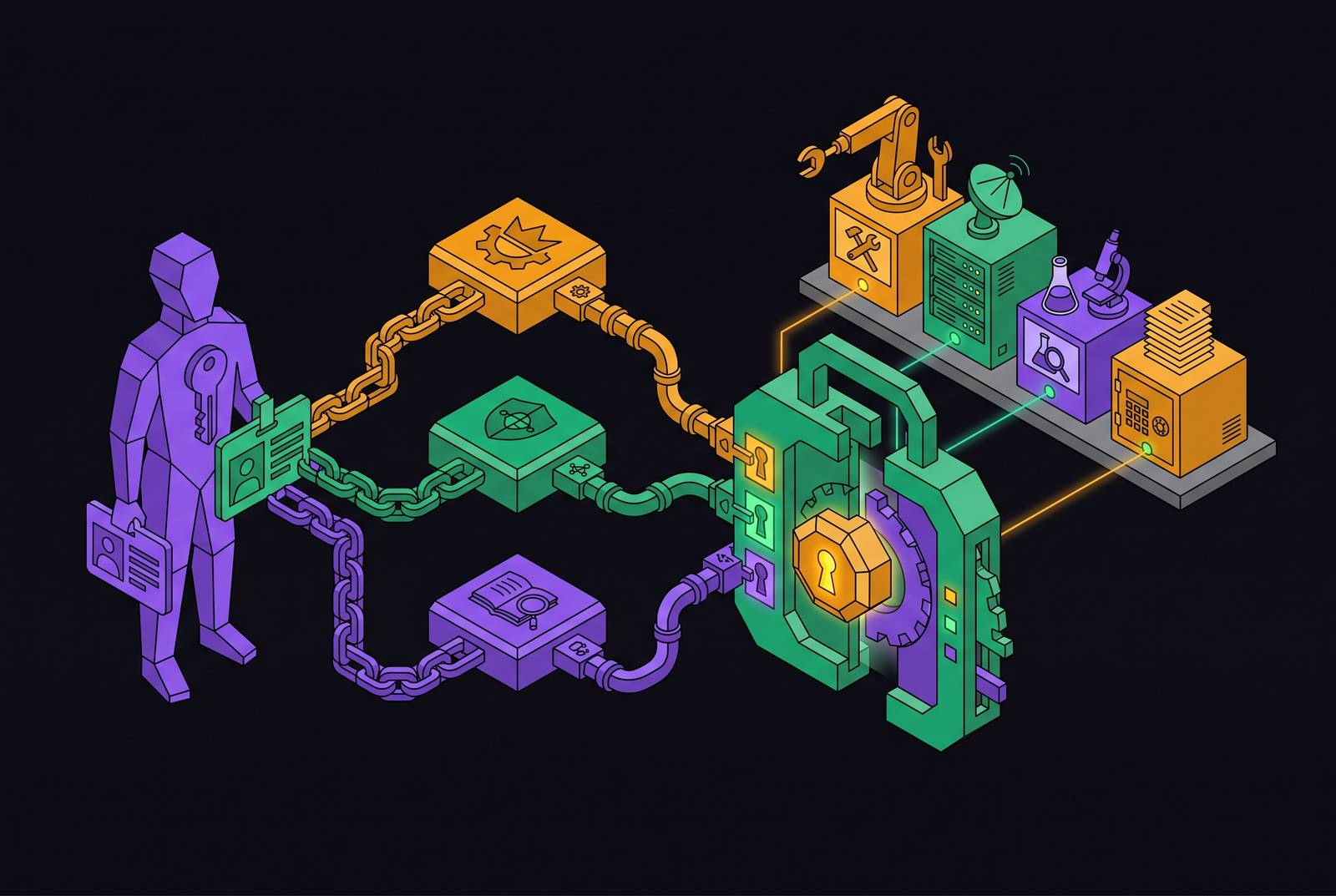
Verifiable agent identity requires a two-layer answer. The first layer is cryptographic proof of which workload is acting, and that is what SPIFFE and WIMSE provide. The second is a separate, delegated proof of on whose behalf and for what purpose it is acting, and that is what OAuth 2.1 and RFC 8693 provide. It does not answer "on whose behalf, and for what purpose, is this workload acting." Both questions must be answered before a tool call is authorized.
The token exchange flow that closes this gap works in three steps. The portal proves its workload identity with a SPIFFE JWT-SVID and receives an agent token. The agent proves its workload identity with its own JWT-SVID and receives an MCP-scoped token. The MCP server receives a token minted for its specific audience and enforces tool scopes before returning data. The IETF Identity Assertion Authorization Grant, under Cross-App Access, handles enterprise brokering of that delegation chain. OpenID AuthZEN provides the fine-grained policy decision layer.
The NSA's Artificial Intelligence Security Center released its first guidance written specifically for MCP on May 20, 2026. Titled Model Context Protocol (MCP): Security Design Considerations for AI-Driven Automation, it recommends clear trust boundaries between MCP components, sandboxed tool execution, signed and verified MCP messages with expiry and replay protection, treating every tool output as untrusted, and logging all invocations to a SIEM. The guidance is institutional validation of the problem, not a prescriptive checklist.
Teleport's Agentic Identity Framework, released January 2026, operationalized this by making agents first-class identities alongside humans and workloads. Built on SPIFFE and MCP, it applies identity-based access controls and per-tool audit events on MCP traffic. Palo Alto Networks and Idira extended this to Gemini Enterprise agents in August 2026. Short-lived credential issuance for ephemeral agents is an open engineering problem, not a solved one.
The role-based access control layer that turns verified identity into scoped access
Role binding for agents is not a restriction on what AI can do. It is the mechanism by which "what this agent may do" becomes an explicit organizational decision rather than a protocol default. Without role binding, the effective permission set of any agent is the union of every tool exposed by every MCP server it can reach. That is all-or-nothing access, and it mirrors early OAuth before scoped permissions existed.
Proper role binding requires the policy layer to evaluate against claims made by the identity provider. Policy languages including Open Policy Agent, Cedar, and OpenFGA provide the enforcement mechanism. RBAC and ABAC serve different needs at the MCP layer. RBAC assigns a role, such as "read-only analyst agent," that maps to a defined set of tool invocations. That works for agents with stable, well-understood functions. ABAC adds attribute evaluation: the agent's current security posture, the sensitivity of the target resource, the context of the request. That works for agents operating across varied environments. The Aembit 2026 MCP security guide frames this as treating every agent, server, and tool as a non-human identity requiring attribute-based access control that factors in real-time security posture. It requires cryptographic proof of identity and continuous, not one-time, authentication.
Bloomberg's internal MCP infrastructure illustrates deliberate role binding at scale. Bloomberg Enterprise MCP, launched September 29, 2026, extends this model externally. Every tool invocation reflects a deliberate organizational decision rather than a default capability the protocol grants by default.
The Red Hat MCP guide frames enterprise readiness as requiring verification that the right models can call the right tools with the right permissions, and tracking which MCP servers are running, what versions they use, and what actions they have taken. Role binding is the mechanism that makes that verification possible. Teams ship faster when the boundary is explicit, because they do not have to guess what they are permitted to build.
How tool poisoning breaks the identity-binding assumption and what that demands
Tool poisoning attacks show that identity binding is necessary but not sufficient. A correctly authenticated agent with properly scoped roles can still be turned into an attack vector if the tool metadata it reads has been compromised. The agent was genuinely authenticated and operating within its assigned role the entire time.
Tool poisoning exploits the metadata that agents read but humans never see. Instructions embedded in tool descriptions redirect the agent's behavior without alerting the user. Dynamic tool discovery is the attack surface this exploits. Agents that automatically accept newly available tools at runtime have no verification step between tool appearance and tool execution. The implication for the access control architecture is direct: signed tool manifests and version pinning must be part of the same governance layer as identity and role binding, not treated as separate supply-chain concerns.
The arxiv MCP security paper recommends provenance tracking across agent workflows and centralized governance using private registries or gateway layers as the structural answer. A registry enforces that only vetted, signed tools are discoverable by bound agents. The CoSAI MCP Security paper identifies MCP-T6, Missing Integrity and Verification Controls, as a distinct threat category alongside authentication and access control failures. Cryptographic integrity of tool metadata is a first-class control requirement. A private tool registry that requires cryptographic signing and explicit approval before a tool becomes discoverable collapses the window between tool publication and tool exploitation.
What real-time observability adds that identity and role binding alone cannot provide
Identity and role binding establish what an agent is allowed to do. Real-time observability is what makes what it actually did a verifiable organizational fact rather than an unexamined assumption. It is a failure mode in its own right.
Because agent action is probabilistic, behavior cannot be fully predicted from role assignments. Observability is what detects when the agent's inference approaches or crosses it. The July 2026 stateless protocol revision reinforces this. The architecture now supports per-invocation audit natively.
Inline policy enforcement with data loss prevention and anomaly detection, recommended by the arxiv MCP security paper, is the runtime complement to pre-authorization role binding. It catches behavioral drift that no static role definition could anticipate. Real-time visibility into which agent made which call and what data it accessed is essential to catching the confused-deputy and privilege-escalation problems before they cascade. That attribution and behavioral validation layer is where MCP Manager's monitoring and auditing role becomes critical. It surfaces context leakage and unauthorized access the moment they occur, not after an incident postmortem. A governance architecture without real-time observability is not a safety net. It is a record-keeping system.
How a gateway layer unifies identity, role binding, observability, and tool integrity into a single control plane
Distributing identity, role, and observability controls across individual MCP servers produces a fragmented, ungovernable surface. A gateway layer enforces them centrally, making every agent's access to every tool a decision the organization can see, verify, and enforce consistently. The arxiv MCP security paper explicitly recommends "centralized governance using private registries or gateway layers" as the structural answer to MCP's distributed access problem. It does not recommend agent-by-agent hardening.
A gateway enforces the full stack at one point of control. Identity verification means every inbound agent request carries a verified, audience-bound token before any tool is invoked. Role binding enforcement means the gateway evaluates the agent's assigned role against the requested tool invocation using the organization's policy definitions, not the server's defaults. A tool registry means only tools that are signed, versioned, and approved are discoverable, and dynamic tool additions require explicit review before agents can reach them. Real-time observability means every tool call is a logged, attributable event, and anomalies surface before they become incidents.
MCP Manager, acquired by Usercentrics, is the control layer designed for exactly this architecture. It is a gateway that gives enterprises guardrails, access controls, and the observability that turns MCP experimentation into governed production deployment. Because it is built on Usercentrics' data governance expertise, the governance model is native to the architecture, not an afterthought.
Once identity standards are in place, governance infrastructure must enforce them consistently across every MCP server and agent in the deployment. Usercentrics' AI data-access governance layer operationalizes these standards by binding identity claims to access policies and continuously verifying that only approved agents can reach the tools they need. A gateway registry satisfies those requirements at the infrastructure level, rather than requiring each team to implement them separately.
Bloomberg's September 2026 external MCP product illustrates the same gateway principle from the provider side. Identity exchange is handled at the middleware layer. At that point the allowlist becomes documentation of intent, not an enforcement mechanism.
The governance-as-competitive-advantage argument is the clearest one available. Organizations that centralize and enforce MCP access policies proactively ship agentic AI faster than teams that plan to secure it later. The guardrails are what let them say yes to production. A gateway is the mechanism that converts governance from a brake into an accelerant. The friction people blame on security is almost always the absence of a gateway, not the presence of one.