NIST AI RMF Govern Function Applied to MCP-Based Agent Deployments
Policy and accountability frameworks must govern MCP server access before deployment, not after.
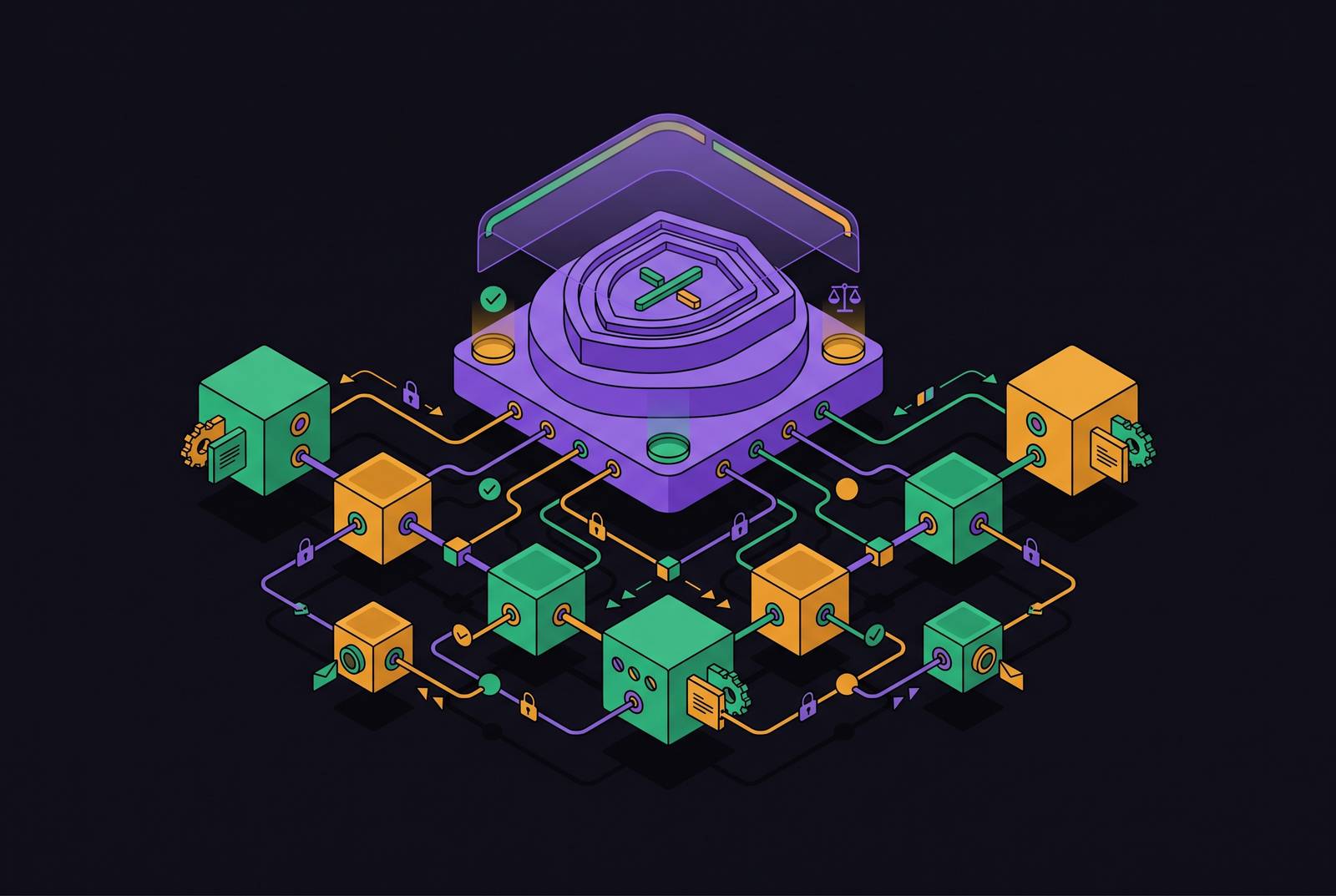
GDPR compliance for AI agents connecting through MCP comes down to one requirement: the organization must be able to name, for every MCP server touching customer or personal data, what data it can reach, who approved that access, and what legal basis governs it. The NIST AI RMF's GOVERN function, specifically GV-1 (policy), GV-2/GV-3 (accountability), and GV-5 (risk tolerance), gives organizations the exact structure to answer that question before a regulator asks it. A tool like MCPManager operationalizes this by cataloging MCP servers and enforcing access scope at the point of connection, turning a policy requirement into something a practitioner can actually audit.
Why the GOVERN function is structurally different from the rest of the AI RMF
GOVERN is the only function in the NIST AI RMF that applies to the whole organization rather than to one AI system at a time. MAP, MEASURE, and MANAGE get applied system by system: a team maps the risks of a specific model, measures a specific deployment, manages a specific incident. GOVERN works differently. It sets the policies, the accountability structures, the risk tolerances, and the oversight cadences that give the other three functions their authority. Without GOVERN, MAP and MEASURE are just technical exercises with no organizational weight behind them.
The NIST AI RMF Core states this directly, and the distinction matters: governance is designed as "a cross-cutting function to inform and be infused throughout the other three functions. Governance isn't a phase that finishes before the real work starts. It runs continuously, alongside every mapping exercise and every measurement cycle, for as long as the AI system is in production.
GOVERN breaks into six categories, each with its own subcategory actions: organizational policies and practices (GV-1), accountability structures and roles (GV-2), workforce diversity and inclusion (GV-3), risk culture and communication (GV-4), engagement with external stakeholders (GV-5), and third-party and supply chain risk (GV-6). Responsibility for these categories spreads across the organizational hierarchy by design. Documentation keeps the whole chain transparent enough to hold people accountable. None of this lives in a single team's job description.
The most dangerous way to implement GOVERN is to complete it on paper and call it done. They sit in a compliance folder while the systems they were meant to govern operate without any connection to them. That gap, between the document and the runtime, is where MCP-based agent deployments expose GOVERN at its weakest.
What MCP-based agent deployments do that earlier AI systems did not
Earlier enterprise integrations ran through static APIs that developers built and controlled. MCP replaces that with dynamic, user-driven connections: an employee can link an AI agent directly to a corporate system, often without any developer or IT ticket involved. That access gets provisioned at the individual employee level, outside the identity and access management systems that GOVERN-level policies were written to cover.
When an employee sets up an MCP connection to a corporate system, the OAuth authorization goes to that person, not to the organization's identity provider. An organization that hasn't implemented it is still exposed to the original problem: access that exists outside its own visibility.
That invisibility compounds with agentic behavior. Agentic AI systems plan multi-step tasks, invoke external tools, and execute consequential actions with minimal human supervision. If a compromised or misdirected agent operates through an ungoverned MCP connection, it executes those actions at machine speed, and no human can catch the mistake before it lands. The "confused-deputy" problem makes this worse: if an attacker gains access through prompt injection or network compromise, the MCP server has no way to verify the true origin of the request. The agent acts as a proxy, and if it holds an active MCP connection with write privileges to a production system, the attacker inherits those same privileges.
GOVERN's baseline assumption is that an organization knows what AI systems it has, who authorized each one, and what each one can touch. A single ungoverned MCP server is enough to invalidate that assumption. Once access can be provisioned by an employee instead of a system of record, the inventory that GOVERN depends on stops being accurate.
The absence of GOVERN structures before MCP deployment is an organizational decision, not a technical accident
An ungoverned MCP attack surface doesn't appear after deployment as a surprise. Agentic AI systems have proliferated faster than governance frameworks have kept pace with them, and the resulting pattern is consistent: teams deploy first and try to govern retroactively. That is the exact inverse of what GOVERN requires.
Every MCP server added without a registry entry becomes an identity the organization cannot account for. An identity the organization cannot account for eventually gets exploited, because no access control, no audit log, and no incident response plan covers an asset that doesn't officially exist. This isn't a hypothetical gap. It happens because provisioning occurs outside the systems built to track it.
Blocking MCP servers outright doesn't solve this. Teams that give employees a governed path to the tools they want reduce shadow AI far more effectively than organizations that try to prohibit it.
Platform-native governance, built into the AI vendor's own stack, might be sufficient on its own, but adding a framework layer on top creates compliance overhead that slows deployment without a proportionate reduction in risk. The counter to that objection is structural. Platform governance solves risk within that one platform. GOVERN-level structures exist precisely to give the organization one point of accountability and one audit trail that spans the full agent ecosystem, and no vendor can provide that on the organization's behalf.
GV-1 applied: what an MCP-specific AI policy must say, and who has to sign it
If an AI policy doesn't explicitly address MCP server registration, agent access scope, and acceptable use of agentic tools, practitioners have nothing to govern their day-to-day decisions. A policy that exists but carries no executive signature loses its authority the moment a team decides shipping fast matters more than following it.
GV-1 requires that policies, processes, procedures, and practices for mapping, measuring, and managing AI risk be in place, transparent, and actually implemented, not drafted and forgotten. So for an MCP deployment, the policy cannot live in an internal wiki page that nobody reviews. It needs to be a named document, signed by executive leadership, with a defined review cadence attached to it. GV-1.1 adds a legal dimension: the organization has to understand, manage, and document which legal and regulatory requirements apply. For MCP specifically, that means identifying which jurisdictions govern the data an agent can reach, beyond the jurisdiction that governs the model itself. A customer record touched by an agent in a regulated jurisdiction carries that jurisdiction's data protection obligations regardless of where the model runs or who built it.
GV-1.2 calls for the seven trustworthy AI characteristics to appear in actual organizational policy language. A workable MCP-specific policy needs four concrete elements: a server registration requirement, so no unregistered MCP server connects to a production system; an agent identity standard, so every agent has a named human owner on record; a clear definition of acceptable use for agentic tools; and a defined process for requesting an exception when a team needs one.
The policy itself should stay short, something like two pages that point to more detailed sub-policies on data handling, model deployment, and acceptable use rather than duplicating that material. It should get reviewed at least once a year, and again whenever the MCP server inventory changes in some material way. A policy nobody re-reads after the first draft stops functioning as governance and starts functioning as an artifact.
GV-2 and GV-3 applied: naming the people who own MCP governance
Without a named owner for the MCP server registry and a defined escalation path from agent runtime up to executive oversight, GOVERN's accountability requirements exist only on paper. The registry goes stale. Nobody has the standing to enforce the policy when an engineering team pushes back and argues the review is slowing them down.
GV-2 covers organizational accountability for AI risk decisions, and GV-3 covers workforce diversity, equity, inclusion, and accessibility. Together, applied to MCP, they require that every AI system has a named owner, that every risk acceptance decision traces back to an actual person, and that incident escalation paths get defined before an incident happens rather than improvised during one. For MCP deployments specifically, the minimum accountability structure needs three roles filled: a registry owner accountable for the completeness and accuracy of the MCP server inventory, a risk acceptance authority who approves a new server's access scope rather than just rubber-stamping its existence, and an escalation path up to a governance committee or executive sponsor.
Smaller organizations can assign registry ownership to the CISO or CTO directly. The structure matters less than the assignment itself: the role has to be given to someone, not assumed to exist because the organization has a security team.
Salesforce's Agent Fabric shows what accountability can look like at the platform level. It introduced "Trusted Agent Identity," which lets agents execute actions using specific user permissions, with mobile approval requests required for high-stakes tasks like money movement or legal review, and controlled registration that only admits agents and tools meeting defined business rules. That's a platform-level implementation of the accountability principle GV-3 asks for at the organizational level, and it's worth understanding as an illustration rather than a substitute: a platform enforcing identity and approval inside its own walls still leaves the organization responsible for accountability across every platform it uses, not just that one.
The practical test for whether GV-2 and GV-3 are actually operating, rather than just documented, is simple to state. For any MCP server currently connected to a production system, can a practitioner name who approved it, what access it was granted, and who gets notified if it starts behaving unexpectedly? If the answer to any part of that is "unknown," the accountability structure has a hole in it.
GV-5 applied: setting and enforcing risk tolerance for agent access to data and systems
You can't set risk tolerance for MCP-based agents with a single enterprise-wide dial. An agent with read access to an internal knowledge base carries a fundamentally different risk profile than one with write access to a production database, or one with transaction authority over financial records. Treating those as the same risk is where most MCP governance programs quietly fail.
GV-5 requires you to define organizational risk tolerance and make AI risk decisions inside that boundary, not improvise them case by case. A workable tiering approach splits agent access into three bands: read-only access to non-sensitive internal data sits at the lowest tolerance threshold and can be approved at the team level; read/write access to sensitive internal systems sits at an elevated threshold and needs approval from the governance committee; and any access to production financial or customer data sits at the highest threshold, requiring executive approval along with a mandatory human in the loop before any consequential action executes.
There's a technical detail that makes this concrete rather than abstract. Many MCP servers use the STDIO transport, which passes parameters directly to the host operating system for process execution without sanitizing the input first, so any process command an agent sends executes directly on the host system. That's a direct argument for why risk tolerance has to include transport-level restrictions, not just restrictions on which data an agent can see.
Role-based access control for AI agents isn't just about limiting what an agent can do. MCPManager, Usercentrics' AI data-access governance layer, restores exactly this kind of visibility: it catalogs MCP servers that would otherwise go ungoverned, assigns ownership to each one, and enforces access controls at the point of connection, which is what turns GV-5's risk tolerance from a sentence in a policy into something enforced in real time.
GV-4 and GV-6 applied: building the workforce and external-stakeholder practices that keep MCP governance from being a single team's burden
If MCP governance lives entirely inside the security team, it does not survive contact with engineering velocity. GV-4 requires that the broader workforce understands its AI risk responsibilities, beyond a security team alone. GV-6 requires you to engage the external MCP ecosystem, including third-party server providers, because most of the supply chain risk in an MCP deployment enters through tools the organization did not build itself.
GV-6 covers third-party and supply chain risk broadly, including risk that comes in through third-party software and data. Applied to MCP, this means governance programs need a software bill of materials for agent systems, one that captures model provenance, the sourcing of training data, and the versions of third-party tools and frameworks in use. The supply chain attack surface for MCP keeps growing with every new community-built server that gets added, and without an SBOM, there's no way to even see that growth, let alone manage it. The Cloud Security Alliance's guidance identifies supply chain integrity as a core MCP security concern, and the mechanisms that make GV-6 operational, rather than aspirational, are concrete: vendor questionnaires, registration requirements for third-party servers, and contractual security obligations written into vendor agreements.
A cross-functional governance committee, with security, legal, engineering, and business representation all at the table, is what keeps MCP governance from siloing inside one team. If organizations build governance into their platforms from the moment an MCP server connects, rather than retrofitting oversight after the fact, they ship agentic AI faster and carry measurably less governance debt than organizations that try to bolt oversight on later. For an organization answering the GDPR question that opened this piece, that's the entire difference between a defensible compliance posture and a registry nobody can produce when a regulator asks for it.
Sources
- AI RMF Core - AIRC - NIST AI Resource Center
- NIST AI Risk Management Framework (AI RMF) Explained: What It Is and How Organizations Use It
- Agentic MCP Security Best Practices Guide
- Usercentrics | Leading in Data Privacy & Compliance
- Securing the Model Context Protocol (MCP): Risks, Controls, and Governance
- Agentic AI Governance: NIST Standards for Autonomous Systems
- Systematization of Knowledge: Security and Safety in the Model Context Protocol Ecosystem
- NIST AI 100-1 Artificial Intelligence Risk Management Framework (AI RMF 1.0)