Regulatory Compliance Automation in MCP Deployments
Agents need runtime governance because MCP shifts compliance decisions from code to behavior.
MCP deployments run without governance because the protocol was never built to provide it. The Model Context Protocol gives AI agents a standard way to find and call tools, but it ships with no authorization framework, no audit trail, and no policy enforcement baked in. That's a design choice with consequences: the protocol hands decision-making to a non-deterministic actor, the agent itself, in a role that used to belong to a developer writing fixed, predictable API calls. Firewalls and perimeter-based role controls were built to judge requests from code that behaves the same way every time. They were never asked to judge an agent that might reach for a different tool on the next run.
This isn't a fringe problem. CData's 2026 State of AI Data Connectivity Report found that most software providers are already exploring or building on MCP as their standard way to connect systems. Adoption is moving faster than the tools meant to govern it. Wikipedia's entry on the protocol states that by mid-2026, more than 10,000 MCP servers had reportedly gone into production, and that pace has outrun governance readiness across the industry.
Known attack surfaces and live CVEs from the governance gap
The gap described above isn't theoretical. It occurs in agent behavior that no static rule is built to catch: an agent might expose a secret while debugging, move personal data around without flagging the compliance risk, reach for a high-privilege tool when a safer one was available, or chain tools together in a way that routes around a security control entirely. A firewall rule doesn't see any of that happening, because none of it looks wrong at the network layer.
The vulnerability record backs this up. Security Boulevard's analysis of MCP hardening found more than thirty MCP CVEs disclosed in January and February 2026 alone, and one of them, CVE-2025-6514 (CVSS 9.6, disclosed July 2025), affected a package with hundreds of thousands of downloads. The supply chain risk in MCP existed before anyone had even built an authorization layer to patch. The typical attack chain starts with a prompt that looks legitimate, triggers a normal-seeming MCP request, and escalates through broad read access into full administrative command execution. Stopping that kind of lateral movement takes a policy layer watching things happen at runtime. A perimeter control, watching the edge of the network, never sees it coming.
On May 20, 2026, the NSA's Artificial Intelligence Security Center released a Cybersecurity Information Sheet dedicated to MCP, titled "Model Context Protocol (MCP): Security Design Considerations for AI-Driven Automation". When a national security body writes a dedicated advisory on a protocol's security design, the risk has stopped being a vendor talking point.
What MCP infrastructure requires from regulatory frameworks
Several regulatory frameworks already apply to MCP deployments directly, and each one makes demands that a one-time review can't satisfy. Its "Map" function requires organizations to document every agent type in use, every connected server and tool, the data stores behind them, and the regulatory obligations tied to each data domain. Meeting that requirement means keeping a real-time inventory of what's actually running instead of a document written up once a quarter.
SOC 2 and GDPR both require that authorization logs for every MCP connection be aggregated somewhere auditable.
The regulatory runway is also getting more defined, and shorter than it looks. The EU's Digital Omnibus on AI received final approval from the Council of the EU on June 29, 2026, pushing high-risk compliance deadlines to December 2, 2027 for Annex III systems and August 2, 2028 for Annex I. NIST's Center for AI Standards and Innovation launched its AI Agent Standards Initiative on February 17, 2026, aiming to build industry-wide standards for secure, interoperable AI agents. That initiative points toward tighter sector guidance ahead.
Banking makes the stakes concrete. Any MCP deployment that connects an agent to payment data, customer records, or regulatory documentation has to preserve a full audit chain, verify user authentication, and track approval sequences end to end. Obot's compliance guide calls this compliance-grade MCP behavior, and notes that not every server on the market delivers it. These are specific requirements that point straight at infrastructure: a registry of what's running, logs that aggregate automatically, and controls that hold up under audit without anyone having to go hunting for the data first.
Why periodic review cannot satisfy those requirements in an MCP environment
Periodic review assumes the system being reviewed holds still between audits. MCP doesn't hold still. In a traditional API setup, a developer picked the integration at build time, and compliance teams could review that decision once, because it rarely changed after deployment. An MCP agent chooses its tool calls at runtime, so the compliance surface shifts with every conversation the agent has.
An audit log read only after the fact is a postmortem rather than a protection. If visibility into what an agent touched isn't continuous, it fails the "detect and respond" standard that both NIST AI RMF and SOC 2 require. Scope creep shows the failure mode clearly: an agent with read-only authorization reaches for a higher-privilege tool simply because that tool happens to be available, and a quarterly RBAC review has no way of catching a call that happened in week two of the quarter.
Arcade CEO Alex Salazar laid out the sharpest version of this problem at the April 2026 MCP Dev Summit, describing what he called the "AND gate requirement": every MCP request has to be checked against both what the agent is authorized to do and what the authenticated user is authorized to do, at the moment the request fires. A periodic review simply cannot enforce a gate that has to open and close on every single call.
Supply chain exposure adds another layer to the problem. Obot's compliance guide includes a section on continuous re-validation that covers version changes in third-party MCP servers, stating that organizations need to track version changes, watch for security advisories, and rerun approval workflows whenever a server updates. A server that passed review in March can carry a brand-new CVE by April, and a quarterly audit cycle won't catch that before the agent has already called it.
The four infrastructure layers that make compliance continuous
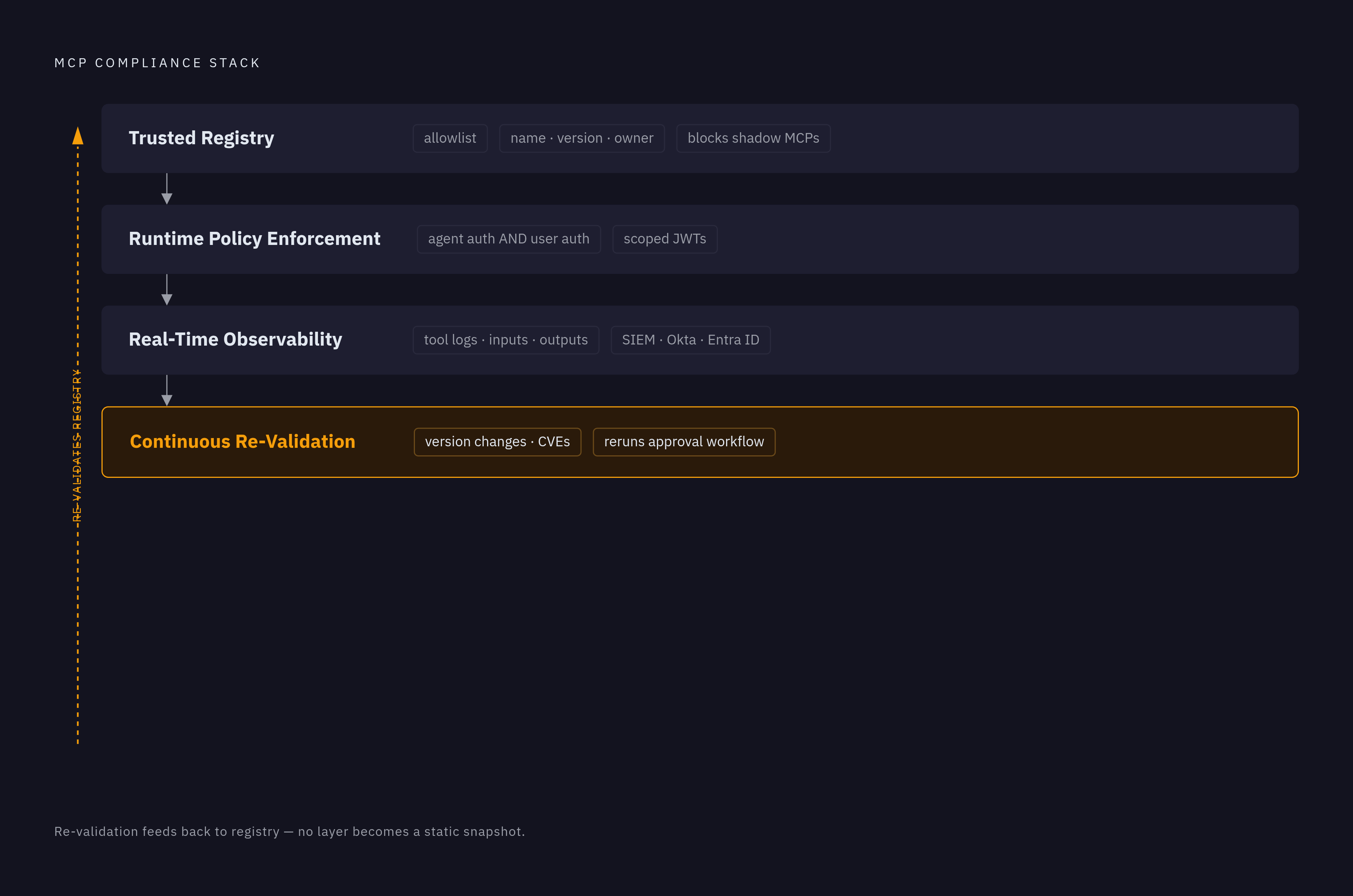
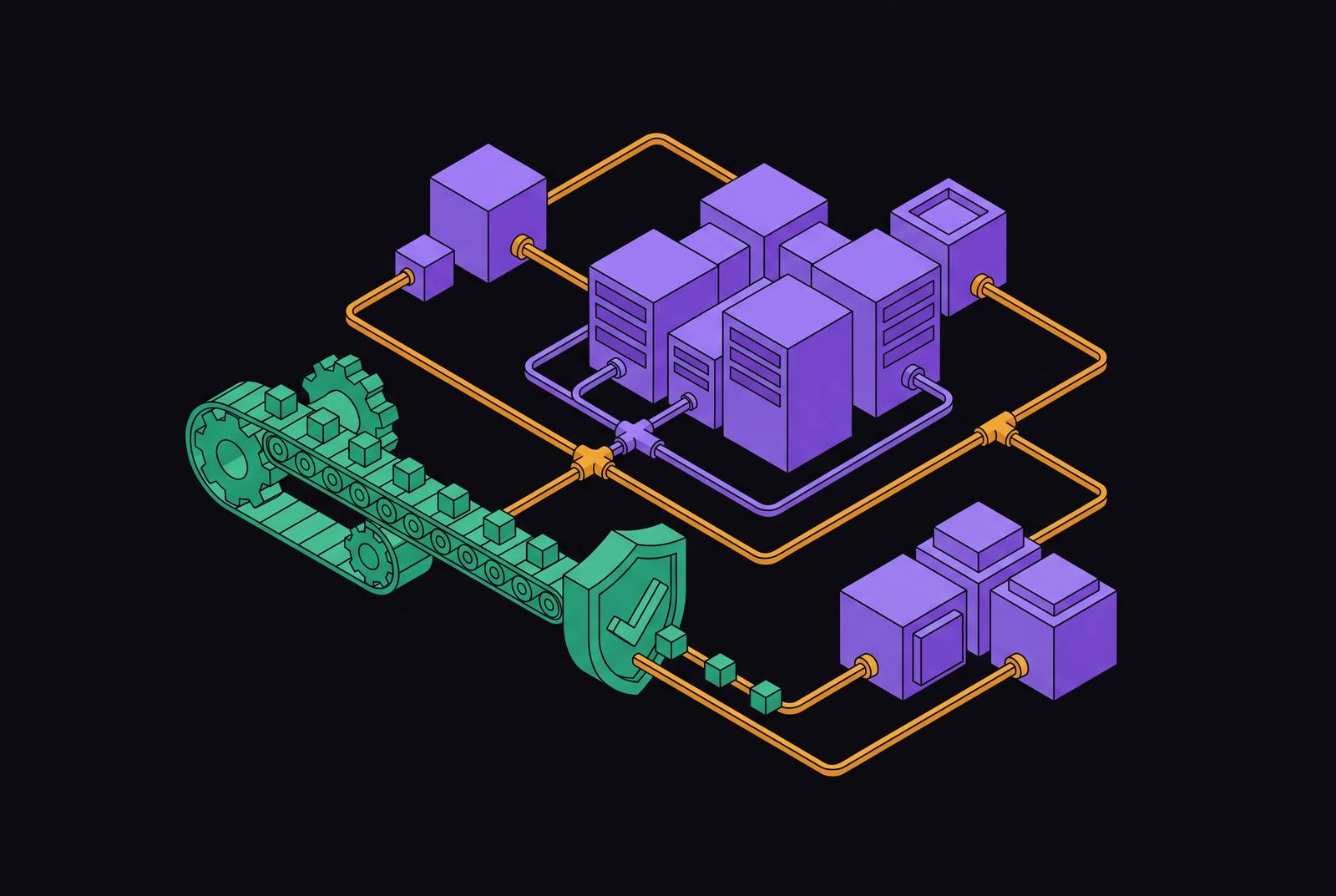
Making compliance continuous in an MCP deployment takes four layers working together: a trusted registry, runtime policy enforcement, real-time observability, and continuous re-validation. None of the four is optional, and none can cover for a gap in one of the others.
The registry comes first, acting as the allowlist for the whole system. It's the authoritative record of every MCP server permitted to run, tracking server name, version, source, and owner, and it rejects anything not on the list at the host level before that server ever gets a chance to connect. Obot's compliance guide notes this is what shuts down "shadow MCPs," the servers pulled straight from public repositories like PyPI or npm with no review at all. Getting into the registry in the first place should require automated security code review, dependency analysis that produces a software bill of materials, malware and secrets scanning, and compliance checks on licensing, data handling, and vendor terms.
Runtime policy enforcement is the second layer, the AND gate itself. Once a server clears the registry, this layer decides which specific tool calls the agent can make and with what arguments, closing the half of the gate that admission controls leave wide open on their own. One concrete mechanism here: swap out static service accounts for short-lived, scoped JWTs issued through identity propagation, where the LLM host requests a token tied to the actual user's identity and the specific request being made. Security Boulevard's hardening blueprint notes this keeps every tool execution time-bound, limited in scope, and logged. Policy-as-code makes this enforceable in practice: rules written into version-controlled configuration files can be reviewed, diffed, and audited the way NIST AI RMF's "Map" function and SOC 2's change-management controls both require.
Real-time observability is the third layer, and it's the one that produces the actual audit trail. Every tool execution needs to be logged with its inputs, outputs, and timestamps, pushed into SIEM systems, and made visible as it happens, not stitched together after an incident. Enterprise-Managed Authorization, which stabilized on June 18, 2026, ties MCP server access to identity providers organizations already use, like Okta and Microsoft Entra ID, aggregating authorization logs on the identity provider's side so auditing stays consistent with SOC 2 and GDPR. That one mechanism solves two problems at once: it handles the admission half of the AND gate, and it fixes the log-aggregation problem in the same move. VS Code 1.123, released June 3, 2026, shipped enterprise-managed MCP authentication in preview, letting admins set the identity provider through a policy-managed setting. Identity-anchored MCP authentication is becoming a baseline expectation for developer tools. The MCP specification revision from July 28, 2026 made the protocol stateless at the protocol layer and moved method and tool names into HTTP headers; gateways can now route and authorize requests directly off those headers. Real-time interception and logging got structurally simpler the moment that change shipped.
Continuous re-validation closes the loop as the fourth layer. This is what keeps the registry accurate after the fact instead of letting it freeze into a snapshot of day one. Each layer depends on the others to function: the registry feeds the runtime enforcer a list of what's trustworthy, the enforcer's decisions generate the data that real-time observability surfaces, and re-validation feeds back into the registry to keep that initial list honest as servers update and new advisories come out. When any one layer is pulled out, the other three lose the thing that made them reliable.
How sector-specific deployments have put these layers into practice
Regulated-sector MCP deployments that have operationalized compliance automation show what this infrastructure looks like when it is working, and what it requires to get there.
IBM OpenPages 9.2 reached general availability in stages: March 23, 2026 for SaaS and IBM Cloud, March 27 for on-premises and cloud-hosted versions, and March 31 for the AWS Marketplace listing. It includes MCP server support that lets AI agents work directly inside GRC workflows covering operational risk, regulatory compliance, and internal audit. That's compliance-grade MCP behavior built into the GRC suite from the start, rather than bolted on after the fact.
Block, the parent company of Square, deployed MCP company-wide through its Goose agent, and built the majority of its MCP servers in-house. Keeping server provenance internal is itself a governance decision. It removes almost all need for third-party vetting by keeping the full server inventory inside the organization's own control.
Salesforce's Headless 360 began routing customer and agent interactions through MCP, and Salesforce reported 4.5 million MCP calls processed since launch, per Wikipedia's entry on the protocol. At that volume, manual audit review is no longer realistic, so automated observability becomes the compliance posture that can keep up.
Financial data providers have moved in the same direction. LSEG and Moody's have both released MCP servers that give agents access to financial analytics and workflows. They're already running in production, in sectors where the regulatory stakes leave no room for a governance gap to sit unaddressed.
Sources
- The Definitive 2026 Guide to Implementing MCP in Enterprise Environments
- MCP Compliance: Model Context Protocol in Regulated Industries
- Model Context Protocol
- Securing Model Context Protocol: The Future-Proof Blueprint for 2026
- The 2026-07-28 Specification
- Model Context Protocol (MCP): Security Design ...
- MCP Dev Summit 2026 Readout: The Protocol Grows Up