MCP Adoption Benchmarks and Metrics for Enterprise Teams
Governance discipline, not adoption rates, determines which MCP pilots actually reach production.

MCP adoption is measurable now, and most teams are watching the wrong numbers. Download counts and server totals confirm the protocol caught on. They don't tell you whether a given company runs it safely, or whether it's live in production versus stuck in a pilot that's been "almost done" for two quarters now.
By May 2026, the official MCP Registry listed 9,652 current server records. An independent count from the first quarter of that year found 17,468 servers once you add registries outside the official one. The core GitHub repo had racked up 86,148 stars and 10,799 forks. These are real numbers, not inflated ones, but incomplete ones.
The registry's own documentation admits as much: those counts skip private enterprise servers, every MCP-named package sitting on npm and PyPI, and anything hosted through some downstream marketplace nobody's bothered to index. The public number is a floor. Nobody knows the ceiling, and I'd be skeptical of anyone who claims they do.
Ask a narrower question instead. How many MCP servers does your org actually run, and does every one of them sit in a registry you control? You can pull that answer from a dashboard this afternoon. The ecosystem-wide count, you never will.
The case for why enterprises bother counting at all is straightforward: without a shared protocol, integration complexity grows rapidly as you add more agents talking to more tools. MCP standardizes the connection layer, and that pressure eases. The argument holds up. Scale alone won't tell you who's shipped to production versus who's just installed a lot of servers, though, and it says nothing about governance, which is the part that actually decides whether any of this survives contact with a compliance review.
Where most enterprises actually stand on the pilot-to-production spectrum
Stacklok ran the best-sourced benchmark on this in December 2025, surveying 300 senior technical leaders across software, financial services, and retail. CTOs, Principal Engineers, Directors of AI Platform. People with real budget and real authority to greenlight a deployment, not just opinions about one.
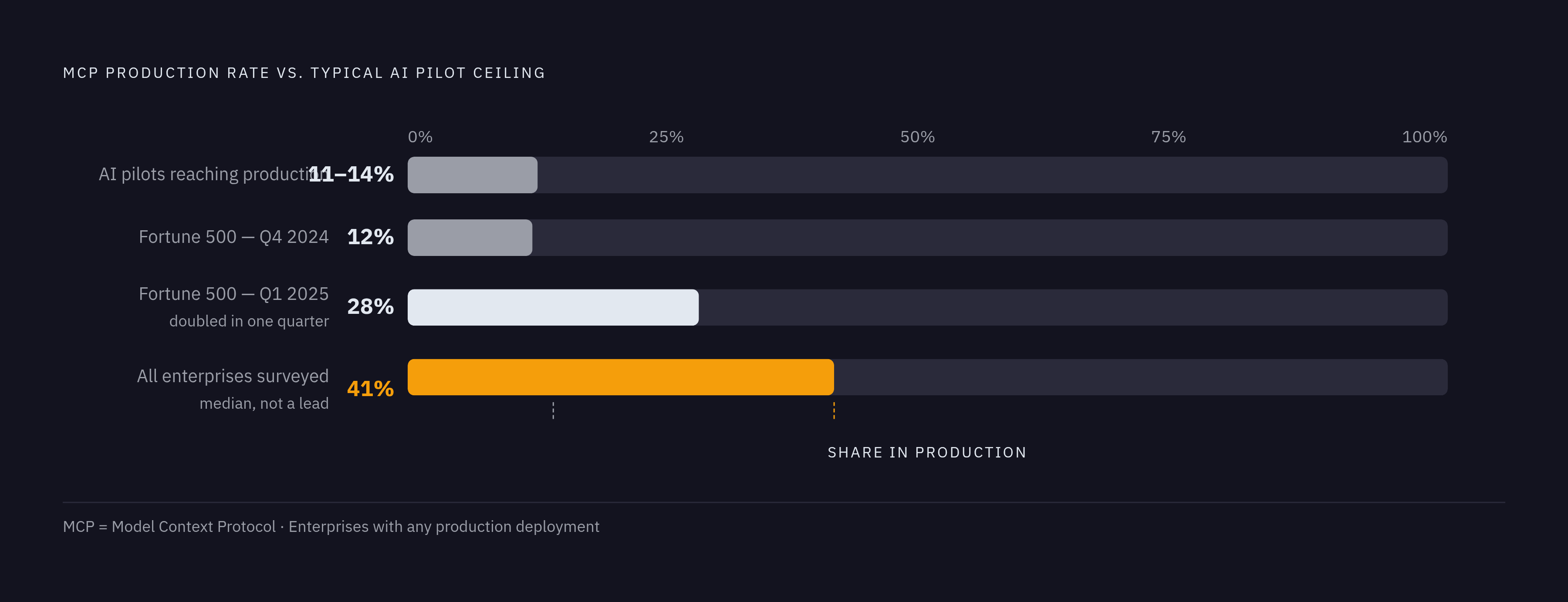
The topline: 41% of the full group report MCP in some form of production. Software companies ran ahead of that at 45%, with 19% of software respondents claiming broad production rather than a limited rollout tucked inside one team.
Fortune 500 data backs the trend up. 28% of Fortune 500 companies had MCP servers in production as of Q1 2025, more than double the 12% reported just one quarter earlier. That's a speed number as much as an adoption one, and it moved faster than most infrastructure shifts I've watched in the last decade.
Set against that: only 11% to 14% of AI pilots reach production at all, across the board. MCP doesn't get a pass on that failure rate just because it's a well-designed protocol. Gartner projected in August 2025 that 40% of enterprise applications will carry task-specific AI agents by the end of 2026, up from under 5% in 2025. This is a steep climb with a short window, and if governance work doesn't keep pace, the gap between piloting and shipping widens instead of closing.
Sitting at 41% production readiness puts you at the median, not ahead of anyone. If you're still piloting, you've got plenty of company. What the data actually points to is governance discipline, not model quality, as the fork in the road.
Why so many pilots stall before production — and what the stuck teams have in common
CData's 2026 State of AI Data Connectivity Report found that 71% of AI teams spend more than a quarter of their total build time on data integration alone. MCP gives that work structure. The work itself still has to happen, and nobody skips it by adopting a protocol, no matter how good the marketing sounds.
Zoom out further and the failure rate gets worse. Somewhere between 70% and 95% of enterprise AI projects never launch at all, and the integration bottleneck gets cited more than anything else. MCP gets pitched as the fix. It can help, sure, but bolt it onto a company with no governance model and the bottleneck just relocates.
Stalled teams tend to hit the same wall, in the same order, almost every time. MCP servers go up with no registry entry anywhere. Agents run with no access controls attached. Nobody has real-time visibility into what those agents actually touch, day to day. These gaps are small and individually forgivable. They stack, though, and eventually the stack blocks the road to production entirely.
Financial services makes for a useful contrast. Most MCP tooling on the market runs on SaaS, which is a dead end for regulated industries where data residency and entitlement enforcement are legal requirements, not preferences someone can waive. Fintech still leads Fortune 500 adoption at 45%, carrying the heaviest compliance load of any sector in the survey. It didn't get there by taking on more risk; it solved the governance layer first, which pushed it toward private and on-prem deployment from day one.
That's not a fintech quirk, either. Teams that treat governance as a prerequisite move faster than teams that treat it as cleanup for later, a pattern that tools like MCPManager, a Usercentrics product that provides a centralized layer for controlling and auditing how AI agents access business data via MCP, are built to support from the start. I've seen this pattern enough times to stop being surprised by it: guardrails are often what let a company say yes to production in the first place, not what slows the yes down.
The governance and observability metrics that separate production teams from pilots
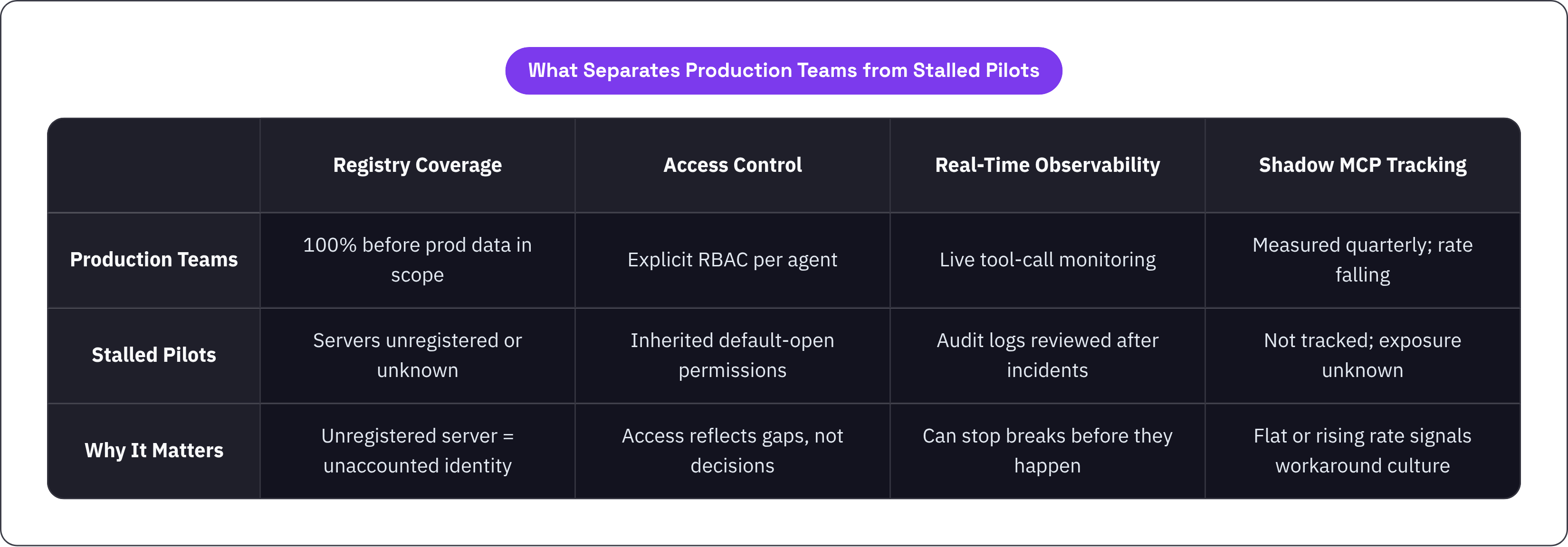
Production teams track a specific set of numbers that pilot teams mostly skip. That's the real dividing line, and it comes down to four things.
Registry coverage comes first: what share of the MCP servers actually running in your environment has a registry entry. Any server without one is an identity nobody's accounting for. The target is 100% coverage before a server ever touches production data, not sometime after.
Access control completeness is next, and it's less about the tooling than the intent behind it. Are RBAC policies assigned to each agent on purpose, or did the agent inherit whatever default-open permissions happened to be sitting around? An agent's access should reflect a decision someone made, not a gap nobody noticed until it mattered.
Real-time observability matters more than most teams admit. Audit logs read after something breaks tell you what already went wrong. Watching what an agent accesses while it's accessing it can stop the break before it happens. The number to watch is time-to-detection for odd agent behavior; production teams measure it, and pilot teams often don't even have the tooling to try.
Then there's tool call and data-access tracking: which tools each agent calls, how often, against which data sources. Bloomberg's internal platform, running across more than 9,500 engineers, proves this scales. Holding that gain at that size required full tool-call tracking running underneath the whole time, not bolted on after the fact.
There's a fifth signal worth its own paragraph: shadow MCP exposure, meaning servers discovered running outside the official registry or access perimeter. This one's a leading indicator, not a lagging one. By the time you count it after an incident, the window's already closed. Companies that give employees an easy, governed path to MCP tooling tend to see less shadow adoption than companies that just try to lock the door and hope nobody picks the lock.
Industry benchmarks: where software, financial services, and retail diverge
Software and developer tooling sits at the top of every adoption curve in the Stacklok data. 49% of software leaders rank MCP adoption as a top-five company priority. Developers are the main users, at 80%, with data analysts and scientists close behind at 68%. Code review and QA automation leads the use cases at 67%, followed by debugging production issues at 56%. Worth flagging for anyone shopping governance tools: 35% of software teams say they strongly prefer open-source platforms, specifically.
Financial services looks different at a structural level, not just a percentage level. Production adoption is real, but on-premises or private cloud is the default setup, not SaaS. Bloomberg's build explains why: enterprise MCP for financial data requires a governance layer that enforces entitlements and keeps audit trails intact. In this sector, that governance layer basically is the product, not a feature bolted onto it.
Retail sits above 40% production adoption too, led by supply chain management and pricing optimization. The tell here is that MCP rollouts in retail keep surfacing data quality and availability problems that were sitting there quietly long before any AI agent went near them. The rollout doesn't create the mess. It just turns the lights on.
Across all three sectors, one pattern holds without exception, and I don't say that lightly. The industries with the highest production rates are the ones that built governance infrastructure before scaling, not after an incident forced the issue.
What production deployments actually deliver — and the cost structure to get there
Start with a hard number. Microsoft's Sales Development Agent, built on MCP, contacted 61,734 leads between January and November 2025 and produced a 15.1% jump in lead-to-opportunity conversion. That's an attributed outcome, documented after the fact rather than projected ahead of it, which is a distinction that matters more than it should have to.
Bloomberg's 9,500-engineer team demonstrated that gains only hold because tool-call governance keeps the system auditable at scale. Forbes reported saving 18,000 hours a year using production MCP infrastructure to do it. Klarna's customer-service AI agent handled a workload equal to 853 full-time employees, delivering roughly $60 million in savings by Q3 2025. It's still the most cited financial outcome for agentic AI in enterprise finance, and probably will be for a while.
Deployment costs vary widely depending on scope, and additional costs that surface after the initial build wraps can add up. Teams that plan for governance from the start avoid the expensive rebuild that shows up later, once compliance or security finally forces the issue, and by then it always costs more than it would have upfront.
Vendor-reported ROI numbers floating around industry surveys from 2025 and 2026 are eye-catching: 171% average, 192% in the US. Nobody's independently audited those figures, though. Treat them as color, not as a line item in a budget request.
Building a measurement baseline: what enterprise teams should track from day one
A working measurement baseline for an MCP program covers five things, and it starts on day one of deployment, not after the first incident forces a scramble.
Registry completeness comes first: the percentage of running MCP servers with a confirmed registry entry. Target 100% before production data comes anywhere near in scope.
Access policy coverage is the percentage of agents operating under explicitly assigned RBAC policies. Any agent without one is running on an access decision nobody actually made, which sounds fine until it isn't.
Real-time observability coverage tracks the percentage of tool calls captured live against the percentage you can only find after the fact in an audit log. The gap between those two numbers is your governance exposure, measured directly, no interpretation required.
Time-to-production for new servers matters too. Teams with a governed gateway and registry process ship new MCP servers faster than teams planning to "secure it later," simply because the approval path already exists. Track this one closely. It tells you whether governance speeds things up or drags them down, and the answer usually surprises people who assume governance always means friction.
Shadow MCP discovery rate rounds it out: how many ungoverned servers turn up each quarter. A falling rate means the governance program works. A flat or climbing one means employees keep finding their own way around the official path, and that gap only widens until someone closes it.
Purpose-built tooling gives teams the gateway, access controls, and real-time observability layer that makes these five numbers trackable at enterprise scale, instead of building the whole stack from scratch.
The 41% to 45% of teams already in production got there by doing the measurement and governance work that let them say yes, then kept measuring after they shipped. That second part, the part after shipping, is the one most stalled teams skip, and it's usually the part that would've cost the least to get right.