Phased MCP Rollout Strategy for Large Enterprises
MCP adoptions stall when governance lags engineering, not the other way around.

MCP rollouts fail for a reason that has nothing to do with the protocol. Underneath the technical roadmap sits a governance sequence, and enterprises that treat rollout as pure engineering hit the same wall between pilot and production, every single time. MCP itself solves something real: before it, connecting M AI applications to N business systems meant close to M times N custom integrations. MCP turns that into M plus N, since agents and systems both talk to a shared protocol instead of wiring themselves to each other directly. The protocol has been characterized as a deceptively simple idea with outsized implications, and the adoption data bears that out.
The adoption curve tells you this isn't a fad passing through. MCP server downloads went from roughly 100,000 in November 2024 to over 8 million by April 2025. SDK downloads hit 97 million a month by March 2026, a 970-fold jump in eighteen months. OpenAI, Google, Microsoft, AWS, and Bloomberg have all backed the standard, and Anthropic handed governance off to the Linux Foundation's Agentic AI Foundation, which took single-vendor risk off the table. By Q1 2025, 28% of Fortune 500 companies had MCP servers in production, more than double the prior quarter's 12%. Fintech leads at 45% adoption. Makes sense, since nobody juggles more disconnected systems than a bank does. There are already over 5,800 MCP servers and 300-plus clients in the wild. So the real question for anyone running a large enterprise isn't whether to adopt MCP. It's how far you can push it before you lose track of what your agents can actually touch.
Why most enterprise AI initiatives stall between pilot and production
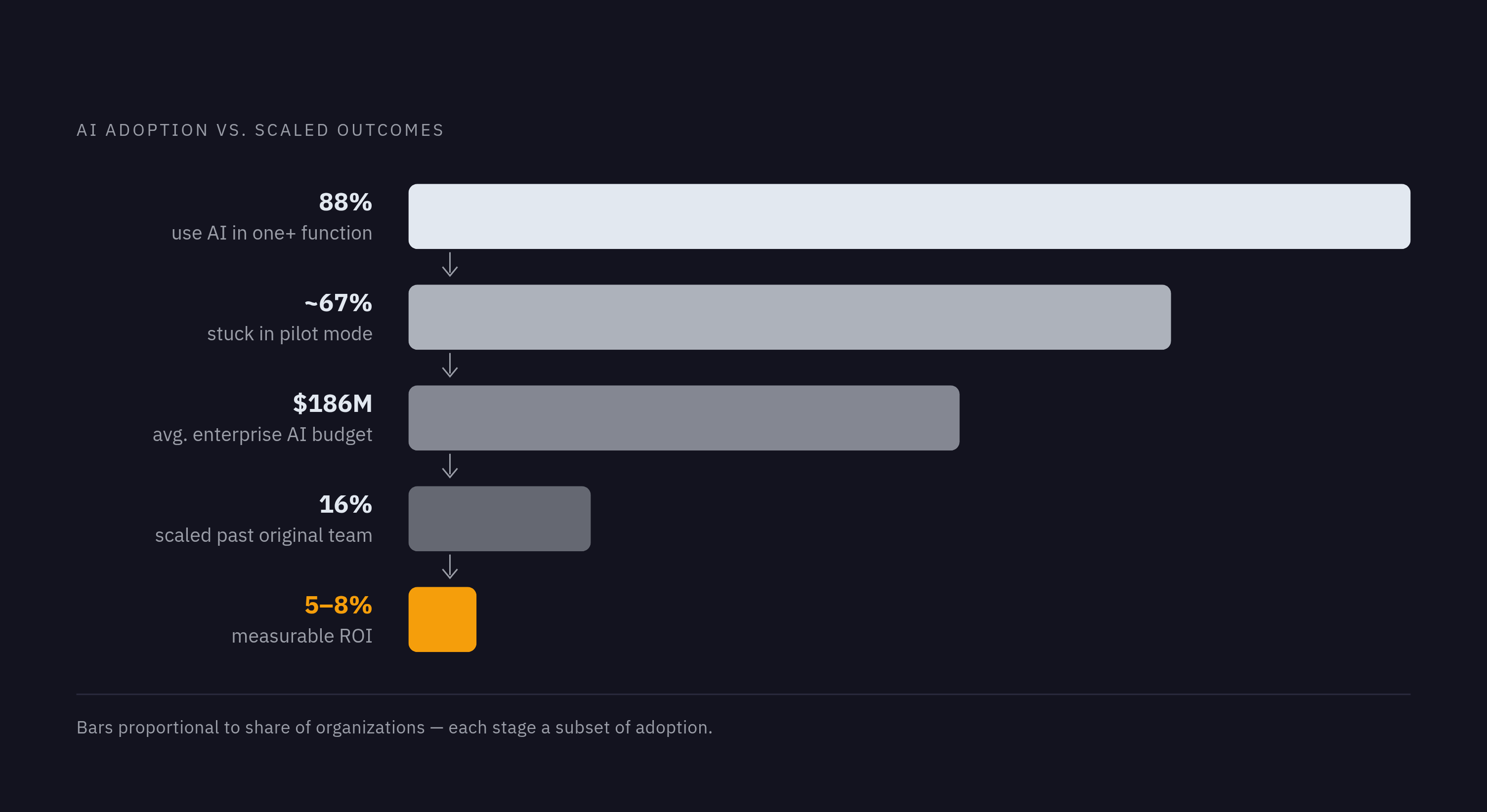
McKinsey's 2025 numbers tell most of the story on their own. 88% of organizations use AI in at least one business function, and nearly two-thirds of them are stuck in pilot mode going nowhere. Average enterprise AI budget runs $186 million, yet only 5 to 8% of enterprises can point to measurable ROI against that spend. IBM's CEO study is blunter: a quarter of AI initiatives delivered what they promised, and only 16% ever scaled past their original team.
That gap isn't technical.
Talk to anyone who's run a real GenAI deployment and you'll hear some version of the same complaint: technology is maybe 10% of the difficulty. Change management eats about 70%, data eats the rest. Only one in five companies, per Deloitte, has anything resembling a mature model for governing autonomous agents, and Gartner expects 40% of enterprise applications to embed task-specific AI agents by the end of 2026, up from under 5% in 2025. That's not a distant horizon. That's next year, arriving whether the governance model is ready or not.
MCP rollouts inherit this exact pattern unless someone actively fights it. Treat phasing like a checklist and you'll reproduce the same collapse everyone else hits, just faster, with wider system access than any prior AI pilot ever carried. Teams that rush through phases without validating each one routinely spend the following quarters untangling who authorized what. The enterprises that actually make it to scale aren't the fastest movers. They're the ones who built the control layer first and let engineering follow behind it.
What a phased MCP rollout looks like before governance is added to it
Strip governance out for a second. The practitioner consensus, documented in different forms by both CData and Knostic, settles into roughly six phases.
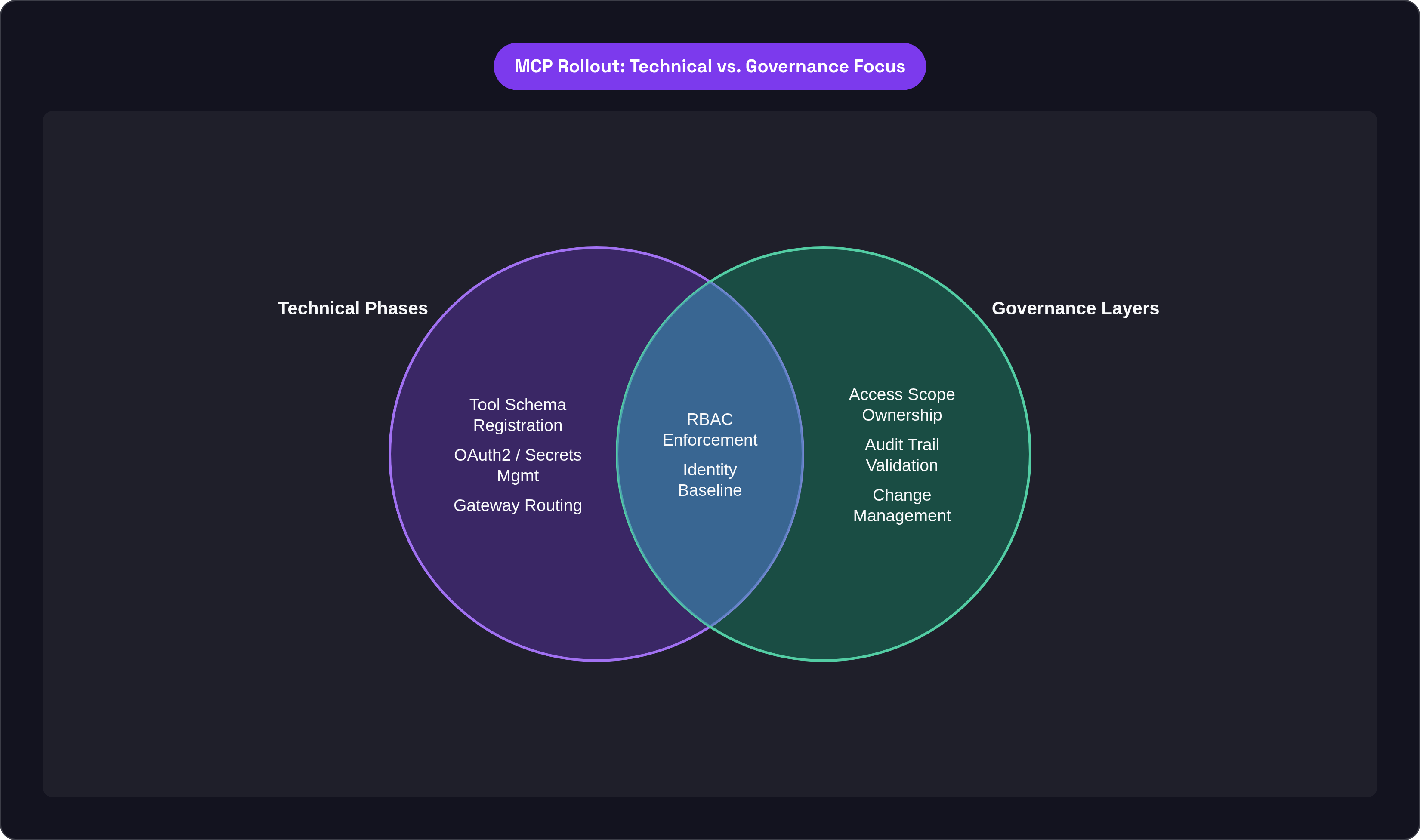
Experimentation comes first, individual developers poking at an MCP server in isolation, nothing connected to anything that matters yet. Then a controlled pilot, where a small, security-literate team gets onboarded formally with limited permissions and some early telemetry running underneath them. Hardening follows: OAuth2 shows up for real, secrets management gets serious, a gateway enters the picture, and tool schemas finally get defined instead of thrown together overnight. Integration comes next, where orchestration frameworks get instrumented and MCP tools get registered into whatever the enterprise runs its agent workflows on. Governance lands fifth on this list, SSO, RBAC tuning, cost attribution, full audit trails, all switched on more or less at once. Scaling closes it out with catalog expansion, automated onboarding, recurring security reviews.
This sequence is real, and it's useful as far as it goes. Each phase builds on the last, and CData's research confirms what practitioners already know from scar tissue: skipping ahead without validating the phase before it is the single most common cause of production failures. A focused pilot on one workflow takes four to eight weeks, governance included. Stretch that across five or ten enterprise systems and you're looking at three to six months, mostly because authentication integration and governance definition eat the calendar, not the engineering itself.
Here's where the model breaks. Governance shows up as Phase 5, which means agents have often been running against production data for months by the time it finally arrives, with thin audit coverage the whole way through. Practitioners consistently flag something worth sitting with: most teams badly underestimate how risk jumps between pilot and full scale. It doesn't climb in a straight line. And the phase model, as usually described, tells you what to deploy at each stage. It never tells you what access to allow at that stage, which is a different question entirely.
The conventional model just doesn't ask it: not what do we deploy next, but what can we prove we can govern before we deploy it.
The governance prerequisites that need to be in place before Phase 1 begins
A 2026 survey of more than 200 data and AI leaders found that 71% of AI teams spend more than a quarter of their total implementation time on data integration alone. That's time that never touches governance, because by the time governance gets a turn, the clock's already run out.
So before Phase 1 starts, a handful of things need to be nailed down.
Start with an architecture inventory: which systems are getting exposed to agents, and what's the blast radius if one misbehaves inside each? Pick the pilot use case with the same care, favoring workflows that are high-impact but low-risk, not because they're simple, but because a governance failure there is recoverable while you're still learning what failure even looks like. Nail down the identity baseline early, deciding which identity provider governs agent connections before a single server goes live, because retrofitting identity later is what wrecks timelines more than anything else does. And get IT, security, legal, and the business owner in a room to agree on access scope before the pilot starts, not after it produces a result somebody wants expanded by Friday.
Data readiness is its own blocker, and it shows up immediately rather than down the road. 76% of organizations say guardrails slow down GenAI progress, and 62% point to data readiness as the culprit. Both of those are governance problems wearing a technology costume.
Shadow IT risk starts on day one, not once you've scaled. Only 8.5% of deployed MCP servers currently implement OAuth 2.1, which the protocol actually requires as a baseline; most servers running in the wild today don't clear the spec's minimum bar. Tools like MCPManager, a Usercentrics product that serves as a centralized governance layer to control, monitor, and audit how AI systems access business data via MCP, exist precisely to close that gap before it becomes a production problem. Knostic documents "MCP Shadow IT," unauthorized internal servers spun up outside IT's knowledge, as an active risk category rather than a hypothetical one. A server registry with a defined onboarding gate needs to exist before you approve the first pilot server, so every server after it has a paper trail to follow.
Every phase from here forward comes down to one thing: expanding what agents can touch. The only honest question each phase has to answer is whether governance coverage grew right alongside it.
What the sandbox and pilot phases actually need to validate about governance
The sandbox phase gets misread constantly. It's not there to answer "does the agent produce something useful." It's there to answer whether you have full visibility into what the agent touched along the way, and whether that visibility holds up under pressure.
Test telemetry coverage directly. Can you reconstruct every tool call, every resource read, every action taken, in real time, not stitched together after something's already gone sideways? Watch boundary behavior just as closely. Did the agent stay inside the access it was given, or did it start probing for scope nobody authorized? An audit log you read after an incident is a postmortem and nothing more. The sandbox is where you confirm the log exists and is accurate before it ever has to matter.
The pilot phase gets four to eight weeks, and that's enough time, but only if governance validation gets deliberate attention instead of happening by accident somewhere in the margins. Test role configurations for real, not just that RBAC is configured, but that an agent running under a restricted role genuinely can't reach resources reserved for a broader one. Check for permission creep too. When an agent asks for something outside its scope, does the system flag it, or does the request fail silently and slip through anyway? Run an incident simulation, a controlled attempt at unauthorized access, and confirm the logging, alerting, and response chain all fire the way they're supposed to.
By the end of the pilot, you want a handful of things in hand before anyone approves Phase 3: a baseline comparing expected access patterns against actual ones for the tested workflow, confirmed RBAC configurations with evidence they enforce what they claim to, and a defined escalation path for when an agent does something outside expected behavior.
The gate between pilot and hardening should be a governance review, not a date circled on a calendar somewhere. The phase advances when those artifacts exist, not when enough weeks have simply gone by.
Hardening and integration as the phases where identity and gateway controls become non-negotiable
Authentication is consistently the top blocker enterprises hit, and there's a structural reason for it. Enterprises expect AI agent connections to route through their existing identity provider with full policy control intact. Per-server consent prompts, common enough in smaller deployments, just don't hold up once you're running dozens of servers across a real organization.
The MCP EMA extension, short for Enterprise-Managed Authorization, reached stable status in July 2026. Anthropic, Microsoft, and Okta have all adopted it. The mechanism is an Identity Assertion JWT Authorization Grant, an ID-JAG, exchanged for a scoped access token. Users sign in once, and any approved server becomes accessible without repeated prompts nagging them along the way.
There's a caveat baked into the spec, and it's the one that matters most for how you phase things. EMA governs whether a user can connect to a server and at what scope, but it doesn't inspect MCP traffic once a token's been issued. Runtime authorization, what an authenticated agent actually does once it's inside a system, stays the organization's job. EMA solves the connection problem. It leaves, quite explicitly, a separate requirement for a runtime control layer, and that layer has to get built during hardening. Not deferred to the governance phase, where it shows up too late to matter.
That's what a gateway is for. Worth being precise here: a gateway isn't just routing traffic. It enforces policy, deciding what tools an agent in a given role can call, and it produces real-time audit records of every action, not a reconstruction pieced together from logs after the fact. Without a gateway, the governance phase later is just paperwork describing access that already happened, ungoverned, months earlier.
Integration is also when tool schema registration has to become a habit rather than an afterthought. Every MCP server added to the environment needs a registry entry before it touches production traffic. An unregistered server is an identity the organization can't account for, and an identity nobody can account for is exactly the one that gets exploited eventually. This is also the last clean point to introduce centralized secrets management, alongside OAuth2, before the environment grows too large for that to be anything but a messy retrofit.
How RBAC and access scope should expand across phases, and why "default permissive" fails
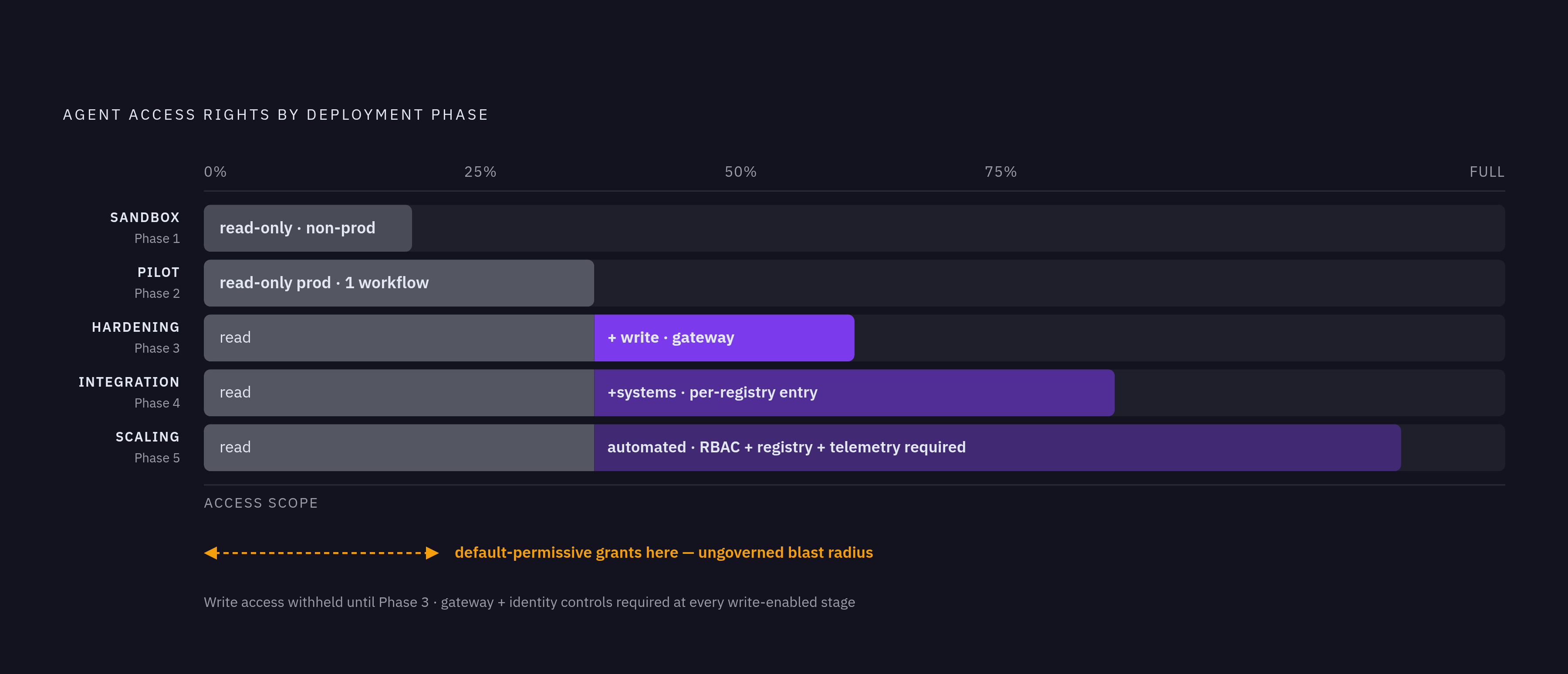
The principle here is easy to say and hard to hold to once a business team is pushing for speed: agents should touch only what the current phase's governance controls can demonstrably cover. Not what's technically possible. Not what's being asked for this week by someone with a deadline.
Mapped across phases, it looks something like this. Sandbox gets read-only access to non-production, non-sensitive data, full stop, because the goal is behavioral visibility, not finishing a workflow. Pilot moves to read-only production data, bounded to a single workflow, with write access held back until RBAC and telemetry have both proven accurate. Hardening introduces write access, but only for the piloted workflow, and only behind gateway enforcement and identity controls already proven a phase earlier. Integration expands to additional systems, but only as each one gets registered, authenticated, and brought under the gateway; adding systems in parallel without adding governance in parallel is exactly how blast radius grows without anyone noticing it happen. Scaling automates onboarding, but the same gate from hardening still applies to every new server: no registry entry, confirmed RBAC, and telemetry coverage means no production access, no exceptions.
"Default permissive" fails at enterprise scale for a specific reason. The conventional approach grants broad access up front and restricts it once problems surface. That's fine in a sandbox. It fails in production, because the incident that reveals the problem is the governance failure; there's no warning shot ahead of it. RBAC for AI agents was never really about limiting what an agent can do. It's about making sure what an agent can do reflects a decision someone actually made on purpose, rather than a default it inherited from a template nobody bothered to reread.
The habit that makes all of this durable: name an access scope owner for every MCP server, a specific person or team that authorized the agent's access to that system and answers for it if that access causes an incident down the line. McKinsey and S&P Global found that 31% of enterprises already have at least one AI agent in production, but median time-to-value sits at 5.1 months. Front-loading governance doesn't slow that number down; it removes the rework cycles that were stretching it out in the first place.
What the governance formalization phase actually covers, and what it still leaves unresolved
Get the earlier phases right and Phase 5 delivers real things. SSO unification ties every agent connection to the enterprise identity provider, so access can get revoked at the user or role level without anyone touching individual server configs one by one. RBAC tuning gets calibrated against real usage patterns from the pilot and integration phases, actual observed behavior rather than role definitions someone sketched on a whiteboard once. Cost attribution gives per-team and per-tool visibility, which matters a lot once you're deciding what to scale and what's quietly burning resources without producing anything worth the spend. Comprehensive audit trails go live formally too, but as an activation of coverage you already validated earlier, not the first time anyone's flipped that switch.
What this phase doesn't do matters just as much, maybe more. Runtime action authorization, what an authenticated agent actually does once inside a system, still isn't covered here. The EMA spec says so directly: identity governance stops at the door. Enforcement past that door depends on the gateway you built during hardening, and no amount of formalization later papers over a gap that should've closed earlier.
New server governance doesn't get resolved here either, not permanently. This phase formalizes control over the environment as it exists right now, today, in its current state. Every server added after this point still has to pass through the same gate as everything before it. Governance was never a box you check once and walk away from feeling satisfied. It's an operating model, one you keep running for as long as the system keeps growing underneath it.