Testing MCP Server Integrations Before Production Deployment
A three-layer testing framework catches MCP failures before they reach production.
The header on that draft was a title pretending to be a sentence, so I'm scrapping it. Here's the real starting point: MCP testing breaks into three layers, and each one catches what the layer below it misses.
MCP servers don't just answer requests. They hold sessions open, negotiate capabilities turn by turn, and run over one of three transports: stdio, SSE, or StreamableHTTP. Each of those breaks in its own particular way. An HTTP 200 tells you the server answered. It says nothing about whether the agent found the right tool, called it with the right arguments, or knew what to do with what came back.
A consistent pattern emerges across MCP failures: most of them live at the boundary, not in the model. A schema description drifts a little. A parameter type quietly changes shape between versions. Transport negotiation holds fine at ten users and falls apart at fifty. None of that shows up in a manual test call, and none of it shows up in a health check either. You only find it by building the habit of looking.
And the habit matters more now than it did a year ago, because the ecosystem's outrunning it. SDK downloads have gone from a trickle at launch to tens of millions a month. Postman's State of the API report found most developers have heard of MCP, but a small fraction use it regularly. So a lot of teams are about to hit MCP server testing for the first time, cold, and most servers shipping right now have no automated tests behind them at all. It follows a familiar trajectory from earlier protocol adoptions. The tooling always lags the adoption curve.
The three-layer testing pyramid that underpins the whole framework
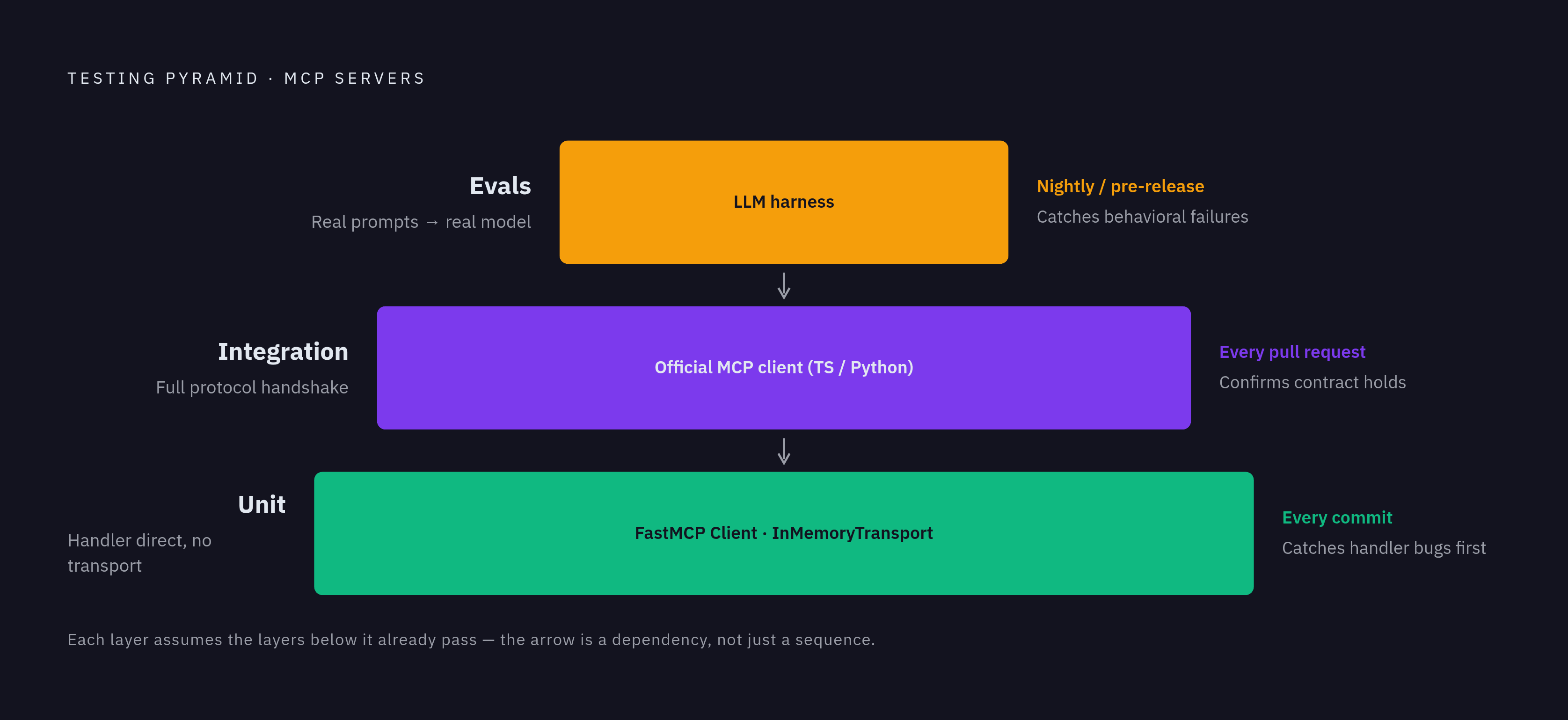
Layer one is unit tests. Call each tool handler directly, skip the transport, check that a given input produces the output shape you expect. It runs in under a second, it's deterministic, and tools like FastMCP's Client or the TypeScript SDK's InMemoryTransport let you do this without spinning up a subprocess or fighting a race condition. This is where you catch handler bugs before any protocol machinery gets involved, and honestly, it's the layer most people skip because it feels too basic to matter. It matters.
Layer two is integration testing. Now you're driving the server through the real protocol: handshake, transport, tool calls, the whole path end to end. Treat the MCP server the way you'd treat any API endpoint, a contract that either holds or breaks. Use the official MCP client in TypeScript or Python. It keeps a persistent connection open and implements the full spec instead of some shortcut version of it that happens to work in your one test case.
Layer three is evals. Send real prompts to real models, check whether the agent picks the right tool and fills in the right arguments. That's a different job than integration testing. Integration tests confirm the system responds; evals confirm it responds correctly. Evals cost money, and the results are noisy, so run them nightly or before a release, not on every commit. They catch what no protocol test ever will: an agent grabbing the wrong tool because the description was ambiguous, or vague, or written by someone who understood the tool better than the model ever could.
I've watched teams skip straight to evals because that's the layer that feels like it's "testing the AI part." Backwards move. Evals sitting on top of a shaky integration layer just give you noisy results you can't trust either way. These three layers are a stack, not three options on a menu. Skip one and everything above it stands on ground nobody actually checked.
Gate 1: confirming the server can be reached, initialized, and discovered
Smoke testing comes first because nothing else matters until the server answers. A server that fails to initialize reliably isn't "mostly working." It's down. Treat the MCP handshake with the same seriousness you'd give any other health check, not as an afterthought bolted on after the real work's done.
Start with MCP Inspector. It confirms the handshake, the transport, and tool discovery before you write a single automated test. Once you're connected, list every tool the server exposes and check each one has a clear name, a real description, a valid input schema. Vague or missing descriptions are the single biggest reason agents call the wrong tool. So the description isn't documentation sitting off to the side, it's part of the test surface. When an agent misreads it, that's a test failure. Not a shrug, not a "well, models are like that."
Smoke testing won't tell you whether the server follows the spec, whether it handles error cases correctly, or whether a real model can actually use it. That's next.
Gate 2: conformance testing against the MCP specification
The spec keeps moving, and I mean that literally: pin your conformance tests to a specific version, because if you don't, you'll drift along with the spec without noticing until something breaks in a way that makes no sense to you.
Conformance goes well past "does the tool run." It covers capability negotiation, JSON-RPC framing, error response shape. Current spec requires input errors to come back as tool errors, not protocol errors, and that distinction matters to any client trying to parse the response correctly. Any server reachable over the internet needs OAuth 2.1, and testing that means checking valid tokens pass, invalid tokens get rejected cleanly, and a token scoped to one resource can't wander into tools outside that scope.
On schema validation: when you write registration tests, check the tool's name, not its description. Descriptions change often, sometimes weekly if you're iterating fast, and pinning tests to them just makes the whole suite brittle for no good reason. If the server returns structured outputs, confirm the returned data actually matches the declared output schema. Don't settle for an untyped blob of text that happens to look right on a screen.
Error hygiene belongs here too. A raw stack trace should never reach a client. That leaks internal structure to anyone downstream, including an agent that might forward it somewhere you never intended it to go. Keep descriptions short enough that they don't eat into the context window, and support idempotency keys on any tool that creates or updates data, so a retry doesn't quietly duplicate work nobody asked for.
MCP Inspector automates a slice of this, but it's a diagnostic tool. It's not a CI gate. Keep explicit unit and integration tests with schema checks running as permanent regression coverage, separate from whatever you're poking at by hand on a Tuesday afternoon.
Gate 3: scenario testing and behavioral regression across releases
Before writing a single scenario test, write down the behaviors you expect. For each one: the prompts that should trigger it, the tool call you expect back, the parameters that call should carry. Cover the edge cases that come from how people actually phrase things. Not just the clean, obvious happy path everyone writes first and stops there.
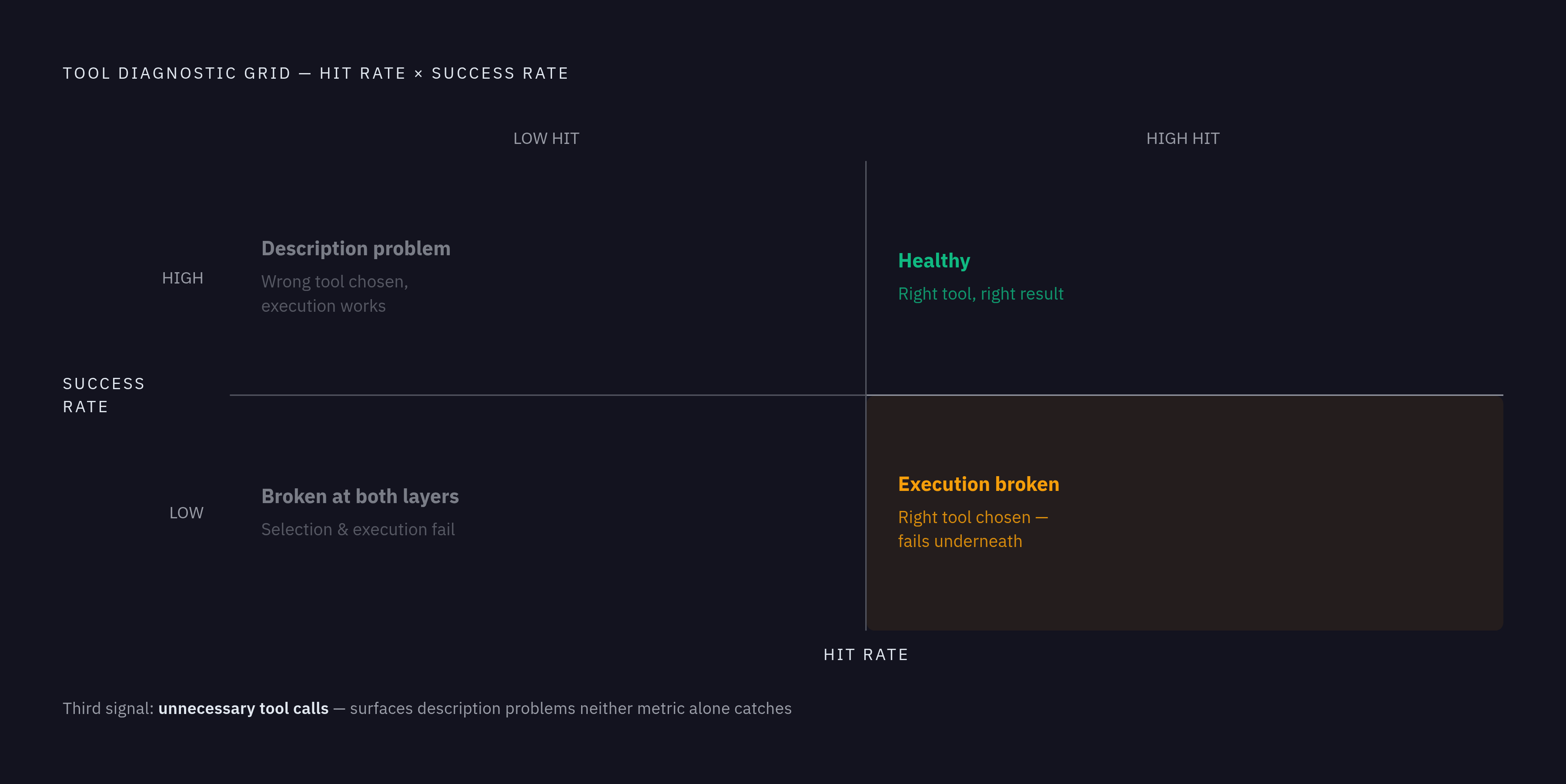
Two numbers together tell you how healthy your scenarios really are. Tool hit rate is how often the agent picks the right tool in the first place; a low hit rate points to a description or schema problem. Tool success rate is how often a called tool returns the correct result once it's been picked. High hit rate paired with low success rate means the description reads fine but something in execution is broken underneath it. Low hit rate with high success rate means the opposite story: execution's fine, the agent just keeps reaching for the wrong tool.
There's a third signal worth watching: unnecessary tool calls. Extra calls cost latency and money, and they make debugging harder because now you're chasing noise instead of a clean signal. A rising rate of unnecessary calls flags description problems that hit rate and success rate alone won't ever catch on their own.
Treat tool descriptions like code. Lint them, version them, A/B test different phrasings, because small changes in parameter naming or formatting shift model behavior more than you'd expect from something that reads like plain documentation. A description change that "doesn't affect functionality" can still break a scenario test. It should break it. Release pipelines need both conformance checks and behavioral regression tests, because a server that still technically works after a schema change might be quietly more expensive, or less accurate, for every single agent calling it from here on out.
Gate 4: load testing for concurrency, throughput, and transport stability
MCP load testing isn't standard API load testing, and treating it that way misses the whole point of doing it. Persistent SSE connections mean load builds up across sessions, not just individual requests, and stateful tools that read files or hit a database hold resources open across multiple turns of a conversation you can't always predict the length of.
Track four things. Concurrency: how many agents keep their connections alive without dropping. Throughput: successful tool calls per second under sustained load. Latency distribution, and I mean p95 and p99, not the average, since averages hide exactly the tail behavior that breaks production. And resource use over time, to catch memory leaks in sessions that run long, which they will, eventually, on somebody's server.
Runtime choice matters more than people assume. Benchmarks show statically compiled runtimes like Java and Go holding steady under load in ways that Python, running the same workload, often doesn't, largely due to GIL constraints. That's a testable, measurable difference, not an architecture call you make on gut feel over coffee.
Transport choice matters just as much, maybe more. stdio's dependence on direct container attachment makes horizontal scaling genuinely fall apart in a Kubernetes setup; I've watched it happen, request after request timing out while SSE and StreamableHTTP handled the same load fine. Load test the transport you're actually going to run in production. Not the one that's easiest to wire up in CI at 4pm on a Friday.
For rough targets: simple tools should answer in under 200 milliseconds, complex operations need to finish inside the agent's timeout window, usually 30 to 60 seconds, and error rate under sustained load should stay well below 5%. k6 is the open-source tool built for exactly this kind of work. A benchmark script can simulate the full session lifecycle and ramp concurrent virtual users up over a sustained stretch, which is the only way you'll find the failure that only shows up after twenty minutes, not twenty seconds.
Gate 5: security testing for the vulnerabilities specific to MCP's attack surface
MCP adoption is outrunning MCP security. Anyone who's looked at a handful of public MCP servers knows this instinctively, and the scans back up the instinct: a large share of public servers carry exploitable flaws, and a small minority run OAuth 2.1 at all, despite the spec requiring it for anything reachable over the internet. Security researchers have been filing CVEs against MCP implementations at a pace that should worry anyone shipping a server without a pentest gate.
Command injection isn't hypothetical here, it's measured. Independent security assessments have found a meaningful chunk of tested MCP implementations vulnerable to it. Pentest for this specifically. A passing functional test tells you nothing about whether the tool can be walked into running arbitrary commands.
Tool poisoning is the attack that's genuinely unique to this protocol, not borrowed from the old API security playbook. A compromised or malicious MCP server can bury instructions inside a tool description, and the agent hands that description straight to its model with nothing filtering it in between. Researchers filed 30 or more CVEs against MCP implementations in just 60 days in early 2026, not theoretical concerns sitting on a whiteboard somewhere. Test for it by checking whether schemas and manifests pulled from remote sources go through integrity checks before anything uses them. A schema registry that's writable without role-based access control, or one where edits reach production without a signed commit behind them: both are preconditions for this exact attack, and both belong in the pentest gate, not a someday-list.
Auth testing comes down to a short checklist: valid tokens pass, invalid tokens get rejected cleanly instead of silently swallowed, and a token scoped to one resource can't reach tools outside it. Auth flaws in this ecosystem don't stay contained, and they should be treated with the same seriousness as any supply chain exposure.
The vulnerability exists the moment a server goes live ungoverned; that's just how exposure works. Gate 5 decides whether you find it before that moment or after somebody else does.
Keeping the test suite honest as servers and schemas evolve
Most organizations running MCP servers today are still pre-production, still building out testing practice, which means there's a window right now to get this right before drift piles up and makes the whole job harder than it needs to be.
Schema drift is the quiet failure mode here, and it's the one I'd worry about most. Tool descriptions, parameter names, output shapes shift a little at a time, and no single change ever looks big enough on its own to justify rewriting the test suite around it. But every description change is still a potential behavioral regression, which is exactly why scenario tests need to tie to a specific version of the description. Tool descriptions belong in source control, versioned the same way the rest of your code is, no exceptions carved out just because they're "just text."
CI gates should match the layer they're guarding, not run on some arbitrary shared schedule. Unit tests and conformance checks run on every commit. Integration and scenario tests run on every pull request. Evals and load tests run nightly or right before release. The pentest gate runs before any production promotion, and again after any real change to schema or auth, because a change that looked small in the diff can open a door nobody meant to leave open.
None of this scales without a server registry. Without one, there's no canonical list of servers to point the gates at, and any server added outside that list skips the queue entirely, quietly, without anyone deciding that should happen. Every server that goes live without a registry entry is an identity the organization has no record of. Which also means, when something goes wrong with it, nobody's testing it and nobody's watching it either.