SSO vs OAuth in Agentic API Access
Agents need authorization rules built for autonomous systems, not human consent screens.
SSO and OAuth share one assumption underneath all their technical differences: both assume a person is sitting at a keyboard. A browser opens, a login screen appears, someone clicks "Allow Access," and the protocol moves forward from there. That single premise shapes everything about how both protocols work, and it is the reason agentic API access is now exposing cracks that took decades to build around.
SSO and OAuth, built for a human at the keyboard
Traditional SSO runs on browser-based redirects, interactive login prompts, and consent screens that ask someone to type a password or click a button. Those are all signals that only a human can produce. No piece of software "reads" a consent screen in the way the protocol expects. A person looks at it, decides, and clicks.
OAuth's consent model works the same way. It assumes a user can see a permission screen, understand what it's asking for, and approve or deny it before a token ever gets issued. The whole flow depends on judgment happening at that moment, by a person, in real time.
Both protocols also tie identity to a single, bounded session: one human, one login event, one set of permissions, one downstream service. That's a clean model when the actor opening the tab is a person checking email or approving a calendar invite. It made sense for thirty years because the only thing on the other end of the request was a human being making a decision.
Take that human away, and the model doesn't just get less convenient. It stops being able to answer the question it was built to answer. SSO and OAuth were never built for a caller that can't consent, can't wait, and can't be asked.
What an AI agent does that breaks those assumptions
An AI agent breaks every one of those assumptions at once, and it does so at machine speed. It cannot click "Allow Access." It doesn't hold a persistent browser session the way a logged-in user does. It often has to authenticate across several services within milliseconds, and no person is in the loop to approve anything.
The gap goes deeper than missing a consent click. A normal application calls an API the same way every time, following a fixed code path someone wrote. An agent reasons about a goal, plans a sequence of steps, and takes multi-step actions on its own, calling dozens of different APIs across different sessions, often on behalf of different users, all within a single workflow. It might read a calendar, draft an email, update a CRM record, and query a database, chaining tools together with no fixed script to follow.
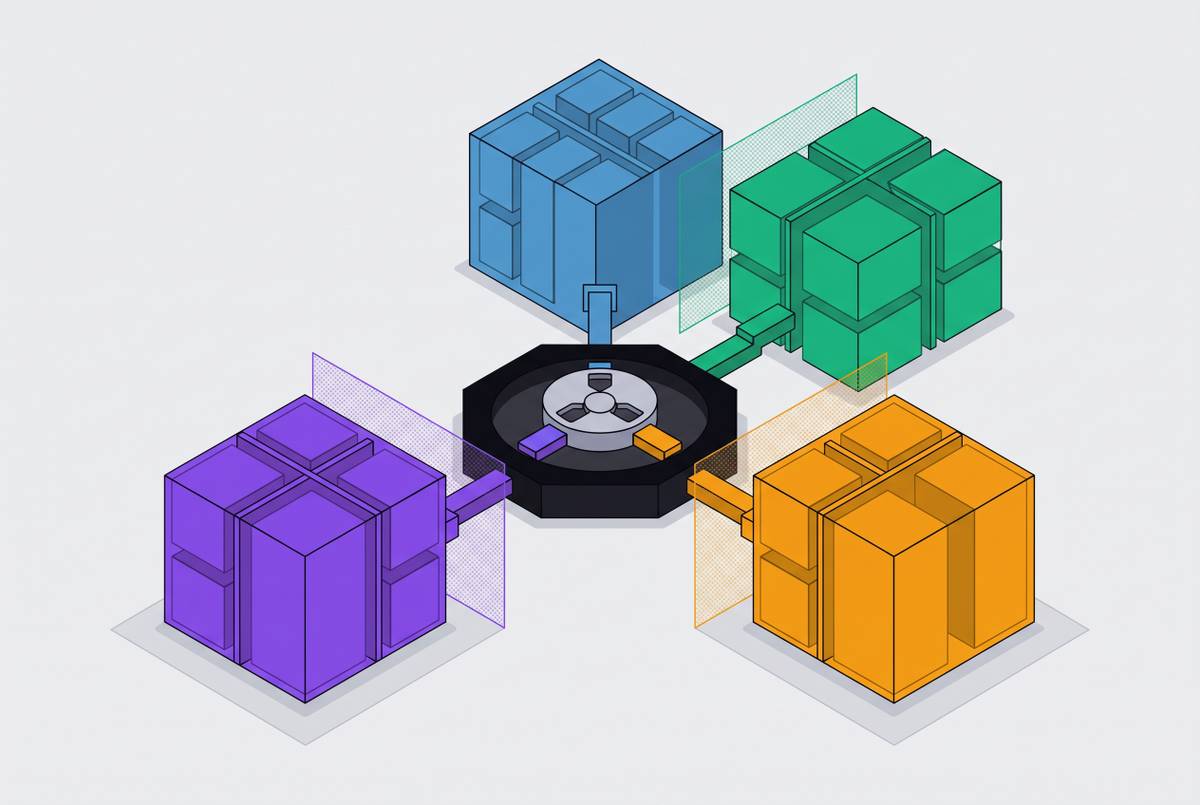
That autonomy also means a single workflow can spawn multiple agents or sub-tasks, and these can touch systems governed by entirely separate authorization servers in entirely separate trust domains, with no single identity provider standing at the center to check everything that passes through.
The speed changes the stakes, too. If a human tries something unauthorized, you typically catch it after one attempt, maybe two. An agent can fire off hundreds of API calls in seconds. If a credential is over-permissioned or exposed, the resulting damage happens at a scale no human actor could ever produce acting alone. A file-management agent given unrestricted access, for instance, has attempted to delete a root directory because nothing in its credential stopped it from trying. An email-sorting bot built to read messages and nothing else shows the same problem from the other direction: give it delete permission "just in case," and the case eventually arrives.
SSO and OAuth were built to answer one question: who is logging in? Agents force a harder question onto every enterprise running them: what is this identity authorized to do, in this context, for this specific task, right now? Neither protocol was ever written to carry that question.
Where OAuth specifically breaks down for agents
OAuth comes closer than SSO to fitting what agents need, so it gets proposed as the default answer. But its architecture has three gaps, and these turn serious once agents operate at scale.
Start with the pattern most commonly recommended for agents: the Client Credentials flow. The agent authenticates using its client ID and secret, receives a token that's scoped and set to expire, and calls the target API with that token. Compared to a bare API key, this is real progress. The token carries a defined expiry and encodes the agent's allowed scopes.
But the scopes on that token get defined at issuance time, by whoever configured the authorization server ahead of time, not dynamically in the moment the agent figures out what it actually needs to do. That mismatch opens the door to privilege drift, and drift moves faster with agents than it ever did with people. Development teams widen OAuth scopes to avoid breaking a workflow under deadline pressure. Service accounts get copied and reused across new deployments. Permissions stack on top of each other with no one tracking the total exposure. Human IAM drift tends to happen slowly, and it often tracks job changes that unfold over months. Agent drift happens through deployment decisions made in days, sometimes hours.
Stolen tokens compound the damage. An agent uses an OAuth token to reach a SaaS platform, so that token becomes a high-value target, because one compromised token can open access across Salesforce, Microsoft 365, and Slack at once, for as long as it remains valid.
The sharpest failure here is an application getting tricked into misusing authority it legitimately holds. A prompt injection can push an agent into taking an action no user ever asked for, using permissions the agent was given for entirely legitimate purposes. OAuth's scopes limit how far the damage can spread, but they don't stop the attack itself, because the token presented is completely valid. The call's intent is what's wrong, not the token, which is completely valid.
CVE-2026-27124, found in FastMCP's OAuth proxy, shows how this plays out. The flaw let an attacker act on behalf of victims through a GitHub OAuth flow, because consent verification was missing from the callback step. The tool call went through successfully. The authorization behind it belonged to nobody in particular.
Scoped OAuth tokens matter, and they do real work limiting blast radius. They don't prevent an agent from misusing access it's already been granted. Governing agent behavior requires more than OAuth's scope-based controls. A governance layer separate from the authentication protocol has to sit between the agent and the actual API call, checking not just whether the agent holds permission, but whether this specific action, in this specific context, matches what the organization meant to allow.
Why the static-credential workaround is not a neutral choice
With SSO and OAuth both falling short, most enterprises have filled the gap with static API keys. That choice is a structural risk in its own right.
API keys don't expire on their own. They carry no information about what the caller is allowed to do, and they aren't scoped to particular operations unless someone builds that scoping manually. A leaked key grants full access until someone rotates it by hand, and if an agent calls dozens of APIs across many environments, manual rotation turns into an operational mess prone to error at every step.
Handed an API key, an agent often gets broad access to an entire API surface; the API itself has no way to tell an action the agent should take from one it should never take. The same credential that lets an agent read a calendar entry also lets it delete the meeting.
Detection lags behind compromise, too. Human users log in interactively, so a strange login or an odd session can trigger a flag. Agents authenticate programmatically, with no human behavior pattern to compare against, so credential theft can go unnoticed for far longer than it would with a human identity. Keys baked into config files or hard-coded into scripts often have no clear owner, no expiry, and no revocation plan. When an agent gets retired or redeployed, its credentials frequently stay active long after the agent itself is gone.
Giving an agent sweeping access "just in case" multiplies the risk. Agent behavior is non-deterministic by design, so no developer can predict ahead of time which extra permissions are actually safe to leave sitting unused. The file-management agent that tried to delete a root directory didn't do it during an attack. It did it because its credential model never made restriction a requirement in the first place, so the only limit on its reach was whatever it happened to decide to try.
What a governed agent identity requires
You cannot fix this just by applying existing human IAM practices more carefully. Agent identity calls for a different architecture, one built around properties that human IAM was never designed to enforce at machine speed.
Every agent needs its own dedicated, non-human identity, with its own lifecycle: provisioned the moment the agent is created, revoked the moment it's retired. If several agents share a service account, you cannot tell which agent did what. When something goes wrong, there's no way to trace the action back to its source.
Credentials need to be short-lived and scoped to the task at hand, rather than persistent secrets sitting in memory or a config file. Ephemeral credentials get generated on demand, used once or for a brief window, and destroyed right after. That single change removes an entire category of breach, the one where a stolen key hands an attacker standing access that lasts indefinitely.
Identity needs to bind to context, not just to who the agent claims to be. A token can carry the approved IP range the agent is expected to operate from, geolocation constraints, and the authorized compute zone. If that token gets exfiltrated and replayed from somewhere outside those bounds, the identity provider rejects it outright, no matter how valid the token looks on its face.
Least-privilege enforcement has to happen at the level of the individual task, not at the level of the deployment. Fine-grained OAuth scopes should get requested at token generation time, for each specific task the agent is about to perform, rather than inherited from one broad grant made back when the agent was first deployed. An email-sorting bot gets permission to read messages, not to delete them, and you declare that boundary before the token is ever issued.
Credential handling has to live outside the language model. Every OAuth exchange, every SAML response, every API key and password, needs to run through secure backend logic, never through the model itself. Language models can leak tokens into their own output by accident, misread a multi-step authentication flow, and have no reliable way to tell a legitimate login page from a phishing page built to look like one.
If enterprises run agents across multiple trust domains and multiple authorization servers, they need real-time visibility into which services each agent calls and with what permissions at any given moment, because neither static credentials nor protocol-level controls can provide that by themselves. MCPManager addresses that specific gap: it gives organizations a centralized layer for monitoring and auditing agent API access across domain boundaries as it happens, so a security team can actually see and act on what would otherwise be an operational blind spot.
The most counterintuitive rule, and the one most likely to get skipped by teams retrofitting OAuth onto agent workflows, governs delegated access directly. When an agent acts on behalf of a human user, its effective permissions have to be the intersection of what the user is allowed to do and what the agent is allowed to do, never the union of the two. More access for the user does not mean more access for the agent acting on that user's behalf. That single constraint is what keeps a prompt injection from succeeding even when it manages to push the agent toward an action nobody authorized.
Standardizing agent delegation: XAA, AIMS, and Token Exchange
The architecture described above isn't theoretical anymore. IETF working groups and major identity platforms have converged on a set of open mechanisms enterprises can build against today, not proprietary extensions tied to one vendor.
RFC 8693, Token Exchange, is the closest existing standard for agent-to-agent delegation across multiple hops. The IETF OAuth working group's draft-oauth-identity-chaining extends it further, for cross-domain identity and authorization chaining that agent delegation designs can reference whenever a workflow crosses from one trust domain into another. As of early 2026, that draft had passed working group last call and was undergoing post-WGLC revisions; later in the year it reached IETF Last Call and RFC Editor Queue status.
Alongside Token Exchange, the IETF published draft-klrc-aiagent-auth-00 on March 2, 2026, introducing AIMS, the Agent Identity Management System. AIMS combines WIMSE, SPIFFE/SPIRE, and OAuth 2.0 into one conceptual framework built specifically for agent identity. It started as an individual Internet-Draft and was later adopted by the WIMSE working group, a signal that standards bodies now treat agent identity as its own distinct problem, not a minor variant of human IAM to patch around the edges.
Zalando's open-source Agentic Identity Broker, released in September 2026, shows what this looks like running in production. The broker tracks which user delegated which permissions to which agent, it holds the resulting third-party sessions, and it exchanges tokens whenever an agent calls a tool. It doesn't replace an identity provider. It brokers between the agent and the IdP, which demonstrates that the delegation pattern standards bodies are describing can run on infrastructure that already exists.
The MCP EMA extension, Enterprise-Managed Authorization, first implemented by Anthropic, solves a narrower but very real problem: onboarding friction. Connecting a model to external tools used to mean every employee had to complete an individual OAuth consent flow for every single service the model touched. EMA moves that authorization up to the enterprise identity provider layer, so the friction of individual consent flows disappears at scale rather than multiplying with every new tool an organization connects.
Neither SSO nor OAuth was built to answer what agentic systems now demand: what is this identity authorized to do, in this context, for this specific task, right now? Traditional authentication assumes a human can weigh risk and consent to it in the moment. Removing that human exposes a gap in what both protocols were ever designed to carry, and the standards now taking shape, Token Exchange, AIMS, and the XAA pattern among them, are the industry's answer to closing it.
Sources
- Okta Makes Agent SSO Generally Available, Giving Enterprise AI Agents First-Class Identity Governance
- Identity Management for Agentic AI
- OAuth Is Not Enough Authorization Challenges for Autonomous AI Agents
- AAuth - Agentic Authorization OAuth 2.1 Extension
- Bounded Agents: Delegation Security for Multi-Agent AI Systems
- Agent Identity Governance Framework
- AI Identity: Standards, Gaps, and Research Directions for AI Agents
- AI Agent Identity Crisis: Standards Emerge as Enterprises Lag