OIDC vs SAML for Enterprise Authentication
Security isn't the real issue—architecture and operational fit are.
Most teams walk into the SAML-versus-OIDC decision asking which protocol is more secure. That's the wrong lead question. A 2026 decision guide from Clerk makes this point directly: both protocols are production-grade, and starting with "which is safer" skips past the three things that actually decide the outcome: cost, vendor lock-in, and platform fit. Those are the categories where the real money and the real risk sit, and a security framing hides all three.
The better question is architectural. Which protocol fits the application you're actually building, the identity systems your customers already run, and the operational budget your team has to maintain it? Neither SAML nor OIDC is insecure by design. Implementation quality and the operational controls wrapped around the protocol are where things go wrong, not the spec itself.
The choice also tends to sit downstream of bigger decisions a team has to make anyway: which identity providers your customers run day to day, what audit evidence your buyers expect to see, how your pricing tiers are structured, and what your admin workflow looks like for provisioning and deprovisioning. Settle those first, and the protocol question often answers itself. Reframed this way, the stakes drop and the answer tends to point toward the same place most mature enterprises land: supporting both, on purpose, rather than picking a side.
Governance decisions in AI systems follow the same logic. The right architecture doesn't come from picking a tool first and retrofitting it to fit; it comes from clarifying what your organization needs to see and control, then matching the tool to that need. MCPManager's centralized governance layer for AI data access is built around that same principle, letting the visibility requirement set the shape of the tool rather than the other way around.
What each protocol does
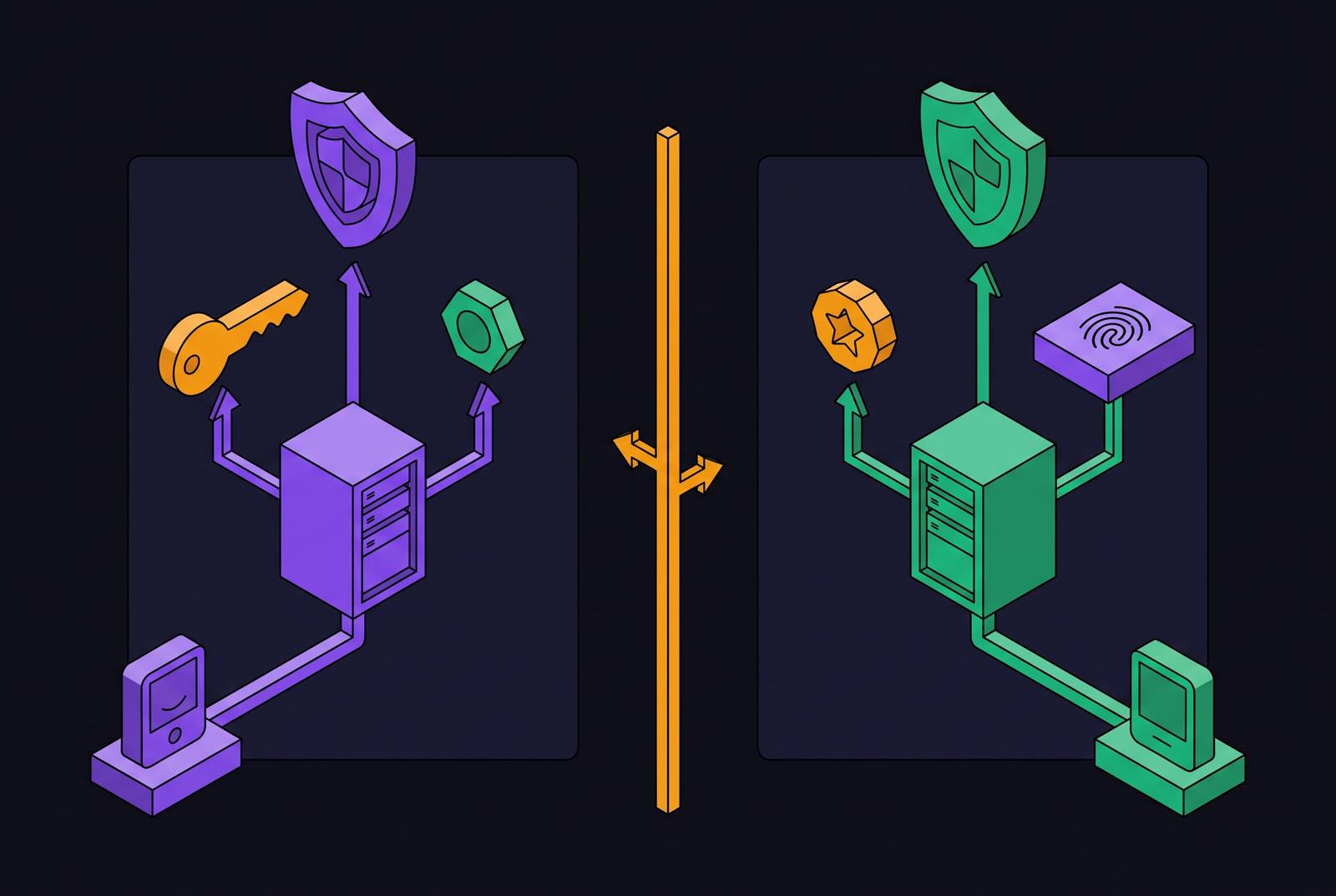
SAML and OIDC exist to solve the same problem: let a person log in once at their organization's identity provider, and let that identity be proven to an application without asking the person to log in again. Where they differ is in how they package that proof and how they move it around.
SAML 2.0 was ratified as an OASIS Standard in March 2005. It carries identity inside a signed XML assertion, and the spec defines three assertion types: authentication, attribute, and authorization-decision. Those assertions travel over one of three browser bindings: HTTP Redirect, HTTP POST, or HTTP Artifact, the last of which uses a back-channel SOAP call rather than passing the full assertion through the browser. It was built for a specific era of web applications: server-rendered, loaded inside a browser sitting behind a corporate firewall.
OIDC, finalized by the OpenID Foundation in February 2014, takes a lighter approach. Every OIDC ID token is a JSON Web Token, and the spec requires five claims at minimum: iss (issuer), sub (subject), aud (audience), exp (expiration), and iat (issued-at). That's a compact, self-describing structure, a sharp contrast to SAML's verbose XML envelope.
The two protocols also move through different flows. SAML logins are either SP-initiated, where the user starts at the application and gets redirected to the identity provider, or IdP-initiated, where the user starts at the identity provider's dashboard and arrives at the application already holding an assertion. That distinction carries real security weight, and you'll find more on that further down.
OIDC's standard flow for modern apps is the Authorization Code Flow with PKCE. The application redirects the user to the identity provider's authorization endpoint along with a code challenge, the identity provider returns an authorization code, and the application exchanges that code for an ID token and an access token, validating the token's signature against a published set of signing keys. Auth0 describes this as simpler to implement largely because it runs on JSON and JWT, formats that are native to how modern platforms already handle data.
A short side-by-side of the two specs:
| | SAML 2.0 | OIDC | |---|---|---| | Final spec date | March 2005 | February 2014 | | Standards body | OASIS | OpenID Foundation | | Transport | XML over HTTP (Redirect, POST, Artifact) | JSON over HTTP | | Token format | Signed XML assertion | JWT (ID token + access token) | | Discovery | Manual metadata exchange | Standard discovery endpoint | | Mobile/native fit | Poor, browser-dependent | Built for it, via PKCE |
Neither protocol handles authorization, the question of what a logged-in user is allowed to do once inside an application. That's the job of OAuth and role-based access control. Neither protocol manages identity once the login event ends, and neither manages sessions when multiple people share a device. Keeping that boundary clear matters, because a lot of confusion in this debate comes from asking a login protocol to do a session-management or authorization job it was never built for.
What the two specs really reflect is two different eras of "the user." SAML assumes a person is at a desk, inside a browser, inside a company network. OIDC assumes a person on a phone, inside a single-page app, or a service calling another service with no human in the loop.
How application surface determines which protocol belongs where
Platform fit is the first and sharpest filter to apply, and it usually settles the question before cost or compliance even enter the conversation. SAML's browser-mediated XML flow handles traditional enterprise web single sign-on well, but it struggles almost everywhere else. OIDC's JSON-native, token-based model works across mobile apps, single-page apps, APIs, and machine-to-machine traffic without much friction.
Machine-to-machine authentication makes the gap concrete. SAML has little practical role here, even though an RFC defines a SAML assertion profile for OAuth 2.0 that can run without a human present. The real workhorse for machine identity is OAuth 2.0's Client Credentials grant, not OIDC. The GitHub Actions OIDC pattern shows this in production: a workflow mints a short-lived token at runtime and exchanges it for cloud credentials through AssumeRoleWithWebIdentity. That pattern has closed off entire categories of credential-leak risk, and AWS, Google Cloud, and Azure all recommend it.
Mobile and single-page apps push in the same direction. OIDC's PKCE flow was built specifically for clients that can't safely store a secret, phones and browsers, and PKCE is now a requirement for every OAuth 2.1 client. SAML's redirect and POST bindings need a browser present for most flows, Auth0 notes, which rules out a clean fit for native mobile.
Token size adds another layer to the gap. SAML's XML envelope is the heaviest payload used in any modern authentication stack. Inside a microservice mesh, each hop has to revalidate that token. On a mobile connection, each round-trip shows up to the user as a visible delay.
A rough map of where each protocol holds up:
| Application type | Better fit | |---|---| | Server-rendered enterprise web app | SAML or OIDC, both work | | Single-page app (SPA) | OIDC | | Mobile/native app | OIDC | | API or machine-to-machine | OAuth 2.0 Client Credentials (not SAML, not OIDC) | | Enterprise workforce SSO | SAML, especially with legacy IdPs |
SAML still fits cleanly in a handful of places: traditional browser-based enterprise SSO, B2B integrations where both companies run structured enterprise environments, legacy HR and ERP systems, and government or regulated-industry portals with long-standing SAML infrastructure already in place, Authgear notes.
A fintech startup moving from a web-only dashboard to a mobile-first product shows this tension clearly. Its enterprise clients already run SAML-based SSO for internal tools, but the new mobile layer needs lightweight, token-based authentication that doesn't depend on a browser being open. SAML's browser dependency makes extending it to mobile painful, Scalekit notes, which is exactly the kind of mismatch platform fit is meant to catch early.
Practitioners have a shorthand: SAML is what you keep, OIDC is what you build. New application surfaces default to OIDC. The SAML estate gets maintained, not expanded.
The same logic applies to identity flows inside AI agent systems. Each protocol assumes a different deployment context, so if you want visibility into what an agent actually touched, you need the right architectural gateway in place before the fact, not an audit log stitched together after. MCPManager's approach to governing AI agent access follows that principle: the control layer has to match the operational surface, meaning real-time visibility across microservices and distributed systems rather than a record reconstructed later.
Why SAML's installed base is a constraint
SAML's grip on enterprise, government, and higher education reflects real certification requirements, genuine advantages in how much identity detail an assertion can carry, and a federation trust model that OIDC has only recently started to match at institutional scale.
Thousands of enterprise applications, procurement contracts, and partner integrations were built on SAML, and they still work today. FedRAMP, FICAM, and the InCommon Federation all standardized on SAML years ago, which locks regulated sectors, government agencies, and research universities into the protocol for the foreseeable future.
SAML also still dominates complex enterprise federation on its own merits. Its assertions carry richer attribute data, it supports hub-and-spoke trust models that suit large organizations with many subsidiaries or partners, and it fits compliance-heavy SSO environments more naturally than a lighter token format. The OIDC Federation specification reached Final status in early 2026, and it now offers a comparable multilateral trust model for large-scale interfederation. SAML still runs most of the existing enterprise deployments that would need to migrate to take advantage of it.
Migration cost here isn't just a matter of engineering hours. You have to re-validate compliance posture, retrain staff, and risk disruption to authentication flows that business-critical processes depend on every day. Large organizations often carry hundreds of SAML integrations, which turns a protocol migration into a multi-year program rather than a sprint any team can finish in a quarter.
A documented failure pattern follows a predictable shape. A modernization mandate comes down declaring SAML legacy technology. Teams start forcing OIDC onto applications that support it poorly, or don't support it. The program stalls, SSO breaks for real users, and application owners who were never consulted end up furious. Ripping out SAML before its replacement is actually ready is a real operational risk, not a hypothetical one.
For B2B SaaS vendors, the constraint is concrete in the customer's own identity provider. If a vendor's enterprise buyers run legacy SAML identity providers, ADFS or on-premises Active Directory among them, the vendor has to support SAML no matter what protocol its own engineering team would prefer to build around. The customer's IdP estate decides the question for them.
Operational cost: where the real money and risk are hidden
Once SAML and OIDC are roughly equal in capability for a given use case, the decision comes down to what each one costs to run: provider pricing models, certificate maintenance, and compliance overhead. Those costs diverge sharply once an organization reaches enterprise scale.
Two pricing models dominate the identity provider market, and they pull apart hard as a company moves upmarket. Per-MAU pricing bills you on monthly active users across the whole customer base. Per-connection pricing bills per enterprise SSO link set up, so it tracks how many enterprise customers you have rather than total seats. As an enterprise customer grows, per-MAU pricing climbs with every new seat they add, but per-connection pricing stays flat per customer. If your growth strategy means landing more large customers rather than more total users, per-connection pricing is the one you can plan around more predictably, a distinction Clerk's second decision guide lays out directly.
Cost also enters through the customer's own identity provider. Microsoft Entra is the common case in enterprise deals, and the features a buyer actually needs to run a real SSO rollout usually sit a tier or two above the entry-level price. That cost lands on the customer, but it shapes what the vendor has to support and explain during procurement.
Then there's what's known as the SSO tax. Plenty of vendors gate single sign-on behind their most expensive enterprise tier. SAML gets gated more often than OIDC because requesting SAML signals a buyer with an enterprise identity provider and a procurement budget behind it. OIDC-based social login, by contrast, often sits on cheaper tiers aimed at smaller customers. The gating follows the buyer's profile rather than the protocol's underlying cost to run. The ssotax.org "Friends of SSO" list catalogs vendors who include SSO in all paid plans without an unreasonable surcharge, which is useful evidence that the premium many companies charge is a pricing choice, not a cost-recovery necessity.
Certificate rotation is SAML's quieter operational liability. Rotating a signing certificate often requires coordinated updates across the identity provider and every relying party connected to it, and a mistake in that coordination can break trust or cause downtime. That coordination burden is why teams tend to put off rotation, and the delay just extends the window of exposure. Certificate rotation incidents have accounted for the majority of SSO outages at some organizations, a pattern that tracks with how much manual coordination the process demands. OIDC avoids most of this by exposing its signing keys through a JWKS, which supports more dynamic validation and removes the need for a tightly choreographed swap across every connected party.
The developer experience gap between the two protocols compounds the longer a system runs. OIDC's discovery endpoint, its standard HTTP flows, and its JSON-native token format mean a skilled developer can usually get an integration working in a matter of hours. A SAML integration typically takes days, and general developer consensus rates SAML's implementation difficulty meaningfully higher than OIDC's across nearly every comparison.
A full cost model has to count both sides of the ledger: the premium a company pays its own identity vendors for each protocol it supports, and the premium its customers pay their own identity provider vendors to make that connection work. Leaving either side out makes the total cost of ownership understate what the decision actually costs.