FedRAMP Authorization Requirements for AI Agent Infrastructure
Vendors must document AI agent capabilities, identities.
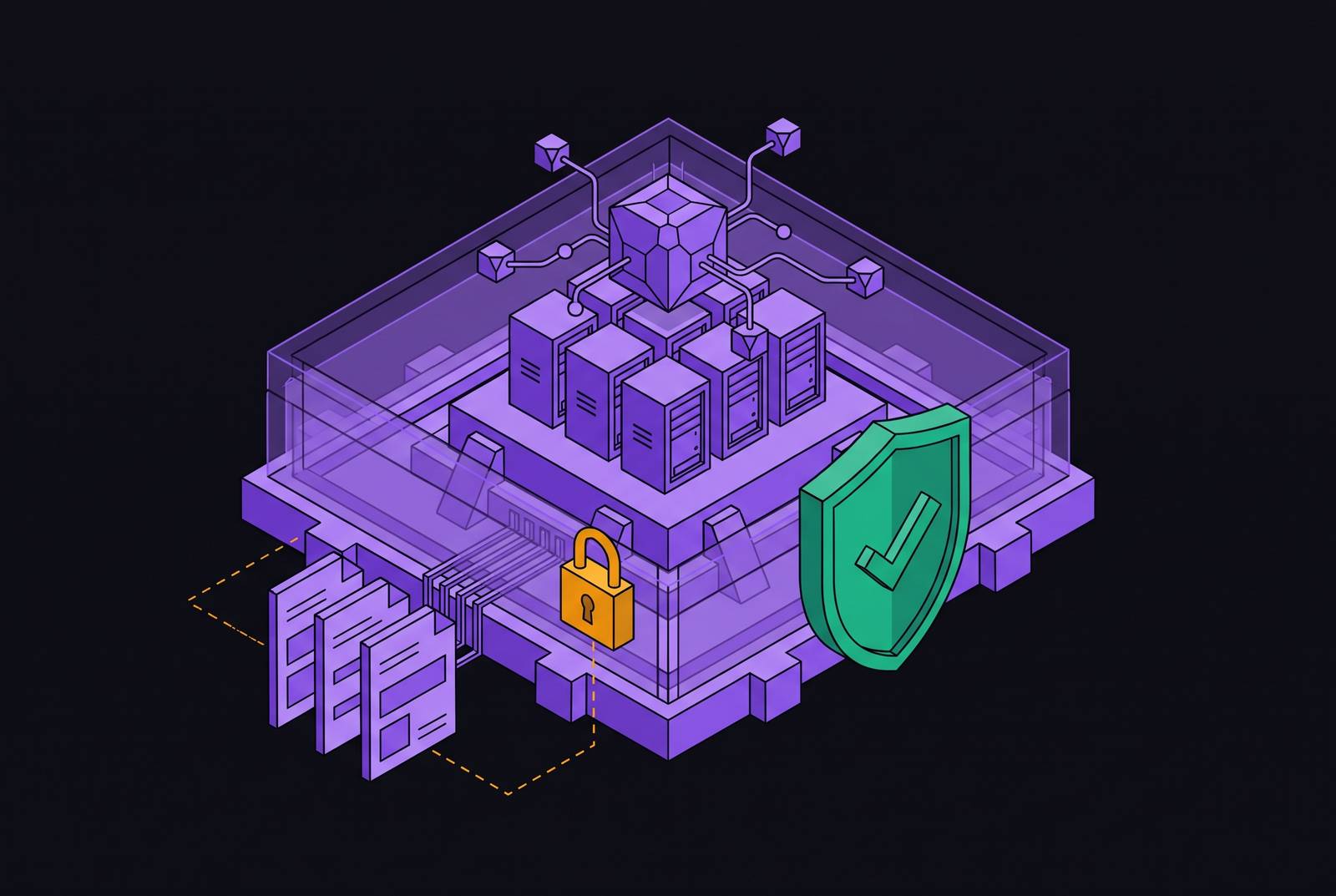
FedRAMP authorization requirements for AI agent infrastructure cover more than the cloud that hosts the model. They must cover what the agent can do, whose identity it uses, and every service it can reach. CR26 changes how vendors prove that coverage. Governance must be part of the agent’s architecture before a successful pilot.
Why FedRAMP authorization is harder to scope for AI agents than for conventional cloud services
The legacy FedRAMP framework leaves vendors without a published scope example for an agent that acts or delegates. Through September 2026, FedRAMP PMO guidance reached only as far as conversational engines. In its examples, public chatbots and coding assistants that work on public code are outside the boundary, while private-code assistants and internal data search are inside. None addresses autonomous actions with side effects. The missing distinction is between reading information and changing another system.
For agents, scope therefore depends on which systems they can write to and which tools they can invoke without human approval at each step. Delegation adds another unresolved question about who is acting. NIST control overlays for single- and multi-agent systems are still unfinished, so vendors must map what agents do against controls written for services that humans operate. Assessment may reveal a wrong boundary only after the budget and delivery schedule are committed.
How CR26 changed the vocabulary, the structure, and the timeline every vendor must now track
CR26 replaced “FedRAMP Authorized” with “FedRAMP Certified,” using “FedRAMP Certification” as the noun form. FedRAMP issues a Certification, while a federal agency issues an ATO for its own system under the NIST Risk Management Framework. They are different instruments from different bodies. Conflating them in a proposal signals that the vendor has not caught up with the rules.
CR26 was released June 24, 2026, with early opt-in from July 4, 2026, and becomes mandatory for every stakeholder on January 1, 2027. Rev5 remains available until June 11, 2027. CR26’s staggered deadlines extending into 2027–2028 superseded RFC-0024’s proposed September 30, 2026 deadline for machine-readable packages. FedRAMP Ready became a legacy designation on July 28, 2026, with no new Ready submissions accepted afterward.
The package itself changes as much as the terminology. CR26 replaces narrative templates with machine-readable JSON schemas, built for automated updates as systems change. Two certification paths now exist. The Program path requires no agency sponsor and is open to qualifying vendors, while the Agency path retains sponsorship. The Agency path is currently the only available route for Class D under Rev5, with a 20x Class D Program path planned for 2027.
What the new Certification Classes require from AI platforms specifically
CR26 names its baselines by Certification Class, replacing FIPS 199 impact-level names. Class A is a new, time-limited pilot tier replacing the former Ready designation, with no FIPS 199 predecessor. Class B covers what used to be the Low and Li-SaaS baselines, Class C covers what used to be Moderate, and Class D covers what used to be High. Agencies still categorize their own systems as low, moderate, or high under FIPS 199. Those categories have not disappeared from agency risk decisions.
The transition labels have an expiration date, however. After December 31, 2026, impact-level labels in parentheses disappear entirely, so vendors must change how they label their offerings in later proposals. More importantly, a class defines an evidence commitment. Higher classes demand more assurance information on a tighter cadence, raising initial and recurring costs. For AI platforms, that evidence reaches into hosting infrastructure, models, training data, and pipelines.
AI services that handle sensitive data usually fall in Class C or Class D. An agent that handles Controlled Unclassified Information needs more than Class B. Choosing a class therefore determines both the customers a vendor can serve and the evidence operation it must sustain.
What FedRAMP 20x changed about the authorization timeline, and where that fast lane now stands
The dedicated AI prioritization track is closed. GSA announced FedRAMP 20x on March 24, 2025, shifting the demand from descriptions of control implementation toward telemetry proving enforcement now. The first Moderate pilot authorizations followed on March 6, 2026. Phase 3, wide-scale adoption, is active, while Phase 4 for Class D is planned for the first half of fiscal 2027.
The continuous-evidence model is now the baseline expectation. Under 20x, vendors no longer have to go through the significant change request process to get government sign-off before they update commercial products. That change is consequential for AI models and pipelines that change frequently, but it does not remove the need for traceable evidence. FedRAMP said it had added 124 cloud services to the Marketplace ahead of its FY25 target and pointed to that as evidence that services were moving through faster. Speed comes from a different way of proving controls while keeping agent behavior subject to examination.
Every component an agent architecture must place inside the authorization boundary
Under FedRAMP’s Minimum Assessment Scope rules, providers must document how information flows and what the security categories are for every resource in an offering. That includes external services and metadata about federal customer data. The model and inference endpoint must sit inside the vendor’s authorized environment or a listed FedRAMP Marketplace service. A default commercial API key breaks that boundary when prompts with federal data in them leave it.
Every callable tool also needs an authorized destination and a runtime authorization check. Consider a vendor that has FedRAMP High authorization for document analysis and adds a call to an external scheduling API. The new call sits outside the original boundary. Vector stores and retrieval systems need just as much attention because their indexes may hold copies of federal records. Their architecture must reflect the system’s FIPS 199 categorization.
The orchestration layer belongs in scope as well. MCP tool registries, memory backends, reasoning configurations, and credential chains determine how agents act and what they can reach. Changes to these components can alter behavior without triggering traditional change management. An existing agency ATO covers the boundary as documented when granted. Adding autonomous tool use, persistent memory, or multi-step reasoning requires new boundary documentation and control evidence.
The three NIST SP 800-53 control families that carry the heaviest burden for autonomous agents
Access Control exposes the first gap in conventional SaaS documentation. Under AC-6, Least Privilege, the agent must have an explicit permission set instead of relying on an assumption that human user roles cover autonomous processes. Delegation makes this harder. A sub-agent using its parent’s token lacks a separately attributable identity, so scope attenuation exchanges each inbound token for a narrower one with explicit actor and subject claims. Agents can fit NIST’s non-person entity category, but the glossary does not explicitly classify them that way, and the PMO has issued no agent-specific identity guidance.
Audit and Accountability requires more than ordinary API logs. AU-12 governs audit record generation, while AU-9 governs protection of audit information. Sponsors want evidence that reconstructs why an individual action occurred, including reasoning-chain logs and decision provenance traceable to an authorization event. Infrastructure logs alone do not establish that chain. The assessment concerns the agent’s decisions as well as its execution environment.
Configuration Management brings in CM-8, System Component Inventory. Tool registry entries and memory backend configurations must be tracked because changes to them can change how an agent acts. Two further families expand the work. System and Information Integrity adds prompt-injection detection and adversarial input monitoring for responses from external tools, and Security Assessment adds capability-level assessment and testing of adversarial behavior. Standard hosting documentation does not cover those agent-specific surfaces.
Why MCP transport authorization is a distinct control surface that cannot be inherited from the infrastructure layer
Under the MCP Authorization Specification, published November 25, 2025, authorization at the transport layer needs its own assessment. An authorized infrastructure host may cover compute. It does not cover which MCP servers an agent can call, the credentials it presents, or the constraints on those calls. Those controls remain customer-responsible. They cannot be inherited from the infrastructure below.
Federal deployment engineers must document MCP endpoints, the authorization rules enforced at each, and credential lifecycles as discrete System Security Plan line items. Each callable server is also a configuration item under CM-8. An undocumented endpoint leaves an identity and access path the assessment cannot account for. Where the agentic layer spans an authorized host and external tools, it needs its own explicit boundary definition.
A centralized MCP gateway addresses this control surface directly. It can enforce access policy, log each tool call with the agent’s identity and the context of its action, and register server endpoints as configuration items to be tracked. That makes the protocol’s authorization rules assessable. The gateway’s role is to produce evidence of governed tool access.
How the compliance obligation differs across federal buyer types — civilian agencies, DoD contractors, and CUI handlers
For civilian agencies, a vendor’s Certification and the agency’s ATO answer different questions. The class shows the vendor’s certification baseline, but the agency still has to authorize its own system. Contract terms add another constraint. Agencies and contractors that handle Controlled Unclassified Information need at least what used to be Moderate authorization, now Class C, for cloud and AI systems in federal environments. Uploading CUI into a tool without that coverage can directly violate the contract.
When a DoD program office mandates IL5 for CUI workloads, a Class C platform cannot meet that requirement merely by showing its FedRAMP status. Model capability cannot close that gap. State and local procurement introduces a separate distinction because GovRAMP, formerly StateRAMP, has assessment requirements that diverge from FedRAMP’s.
What authorized agentic AI deployments look like in practice today
IBM watsonx achieved FedRAMP Moderate authorization on April 1, 2026, on AWS GovCloud (US). Its coverage includes watsonx.ai for building and tuning applications, watsonx.data for an open lakehouse architecture, and watsonx.governance for transparency and risk management. The service provides a path to generative AI and agentic workflows within an authorized environment. The scope extends beyond a model endpoint.
Amazon Bedrock AgentCore launched in AWS GovCloud (US-West) in May 2026, deployable in a FedRAMP High and IL4/IL5 authorized environment. It handles serverless agent execution, session isolation, memory, code interpretation, and browser automation. Those functions cover several components that would otherwise each need their own boundary treatment. The deployment environment is part of the compliance story.
Cyera achieved FedRAMP High, Class D, certified status. That class is described as the highest unclassified security certification under CR26 and leaves out systems that process classified information. These cases illustrate different service-level paths. In each, an authorized service operator owns the boundary documentation. Agencies choosing a deployment path must therefore consider both who supplies the model and who accounts for the service and its actions.
Why most government AI pilots stall at the compliance gate and what the authorization planning gap actually costs
Government agentic AI pilots routinely stall because the production compliance architecture was never part of the pilot. The recurring gaps include an unfunded production budget, an unplanned FedRAMP or ATO requirement, privacy policies that do not cover data use at scale, and the late discovery that decisions leave no structured audit trail. Each gap separates a successful demonstration from a system an agency can approve.
For AI platforms pursuing Moderate or High through agency sponsorship, the path from signed sponsorship to certification takes months to over a year. AI-specific control issues can extend it further. If a vendor learns during assessment that it has scoped the boundary wrongly, it has already committed spending to a delivery date it cannot meet. The missing work is architectural, even when it first appears as a compliance finding.
That cost determines how engineering and compliance work must be sequenced. Teams that make authorization planning a precondition of pilot design can produce evidence as the system develops, avoiding reconstruction afterward. Visibility, identity, and access control designed at the start distinguish a pilot that can reach production from one that stalls at the approval gate.