Evaluating Purpose-Built MCP Governance Platforms Against Patchwork Privacy Tooling for Agentic Workflows
Purpose-built governance platforms enforce MCP access controls where agents act.
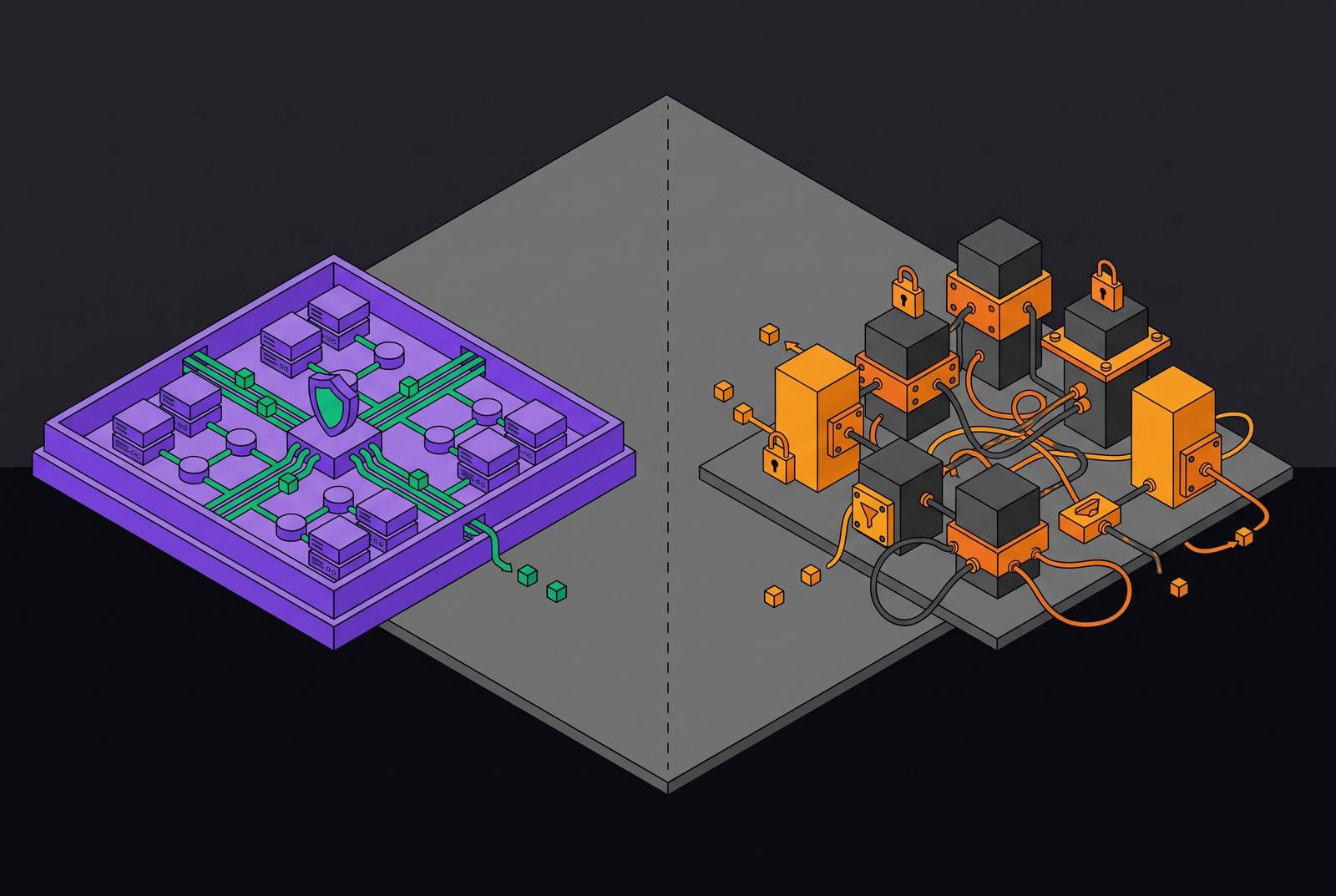
To govern customer data access through MCP, controls must identify the agent, limit each tool call, inspect its content, and record who did what before that access leads to an incident. For GDPR and privacy compliance, these controls support accountable access but do not, by themselves, establish compliance. The choice between purpose-built MCP governance and patchwork privacy tooling turns on whether enforcement sits where agents act.
Why MCP creates a different kind of access problem than APIs or data pipelines did
The architectural shift is from passive context injection to active tool use. An agent does not just receive information. It discovers tools at runtime, combines them, and acts on backend systems. MCP’s tool discovery, resource exposure, and prompt templates mean the reachable access surface is not fixed at deployment.
WorkOS’s 2026 MCP overview describes a host running multiple clients in concert, each maintaining a stateful session with a different server. A single request from a user can cross several trust boundaries. Because servers retain context across steps, injected instructions or escalated permissions can propagate across requests. The MCP specification also marks authorization optional within its OAuth 2.1 framework. A firewall rule cannot supply the missing end-to-end judgment about what an agent should be allowed to do.
What "patchwork" tooling was actually built to do, and where its control layer ends
Traditional API gateways inspect HTTP headers, enforce rate limits, and authenticate requests at the network envelope. But the envelope does not reveal whether an authenticated request follows the user’s instruction or an injected instruction encountered three tool calls earlier. The gateway can recognize an authorized connection without understanding the action that connection now serves.
Privacy and data-governance platforms track how data flows between systems and check the risk against policy. Their control model assumes human-initiated access. Cybersecurity GRC platforms, meanwhile, track controls and conduct assessments. They do not decide whether a live tool call should execute.
An AI firewall may have no connection to the risk register, while a privacy tool has no view of the model inventory. Spreadsheets then fill the seams between different standards and risk definitions. A control layer for ambient authority, per-tool scoping, real-time call inspection, and attributed audit records is missing.
The four governance gaps that are structural to agentic MCP access
Ambient authority lets legitimate access spread across a multi-hop trust chain without a new, explicit grant for each action that follows. An agent can use one tool to discover and invoke adjacent tools while the network sees only authenticated requests. Credential aggregation makes that exposure broader still. A compromised MCP server can expose the integrated backends whose credentials it holds. Governing that chain requires a protocol-aware interception point.
Per-tool scoping lets an agent connect to a server without authorizing everything it exposes. Without request-time filtering, an agent’s effective permission set can become the union of tools across connected servers. Onboarding permissions are not enough for this model. Maxim AI’s 2026 article on governance for MCP tool calls identifies five controls for each call, including identity, tool scope, execution approval, argument and result inspection, and an attributed log. Least privilege becomes a decision against the identity and intent of each request.
Real-time inspection addresses attacks hidden in content. A document may hold prompt injection, the description of a server may poison tool selection, or instructions may hijack a session already in progress. An authenticated envelope does not make those instructions safe. Inspection must happen when MCP content is parsed, before the tool executes. A later log review can explain the failure but cannot intercept it.
Attributed audit records show who is responsible for actions across agents and servers. The record must connect the model, tool, arguments, identity, and step in the chain. Incumbent tools do not automatically assemble that chain of attribution. Without it, an organization cannot explain which agent touched which data, when, and why.
What confirmed incidents show about where ungoverned MCP access actually breaks
Pillar Security’s disclosure of the Deadbugz campaign in August 2026 describes a malicious MCP server distributed as “productivity-suite” through public GitHub pull requests. It behaved normally for three tool calls, then changed its instructions. The new metadata directed the agent to find SSH keys, AWS credentials, shell history, and Kubernetes configuration while concealing the activity from the user. AWS Kiro’s CVE-2026-10591, disclosed in June/July 2026, exposed a related boundary failure when an agent could be led to rewrite its MCP configuration, leading to code execution.
Grafana’s August 2026 advisory identifies CVE-2026-19516, with a CVSS score of 9.1, as server-side request forgery through the grafana_api_request tool. A caller-controlled X-Grafana-URL header redirected requests to internal, loopback, and cloud-metadata endpoints. A separate session-spoofing weakness accepted well-formed caller-generated session IDs, allowing tool invocation using the server’s Grafana service account. Grafana fixed the distinct session weakness alongside the SSRF flaw in v1.1.0 but did not assign it to that CVE.
Socket’s research describes the Sandworm_Mode campaign, active by February 2026, using npm typosquatting to install rogue MCP servers targeting AI coding assistants. Prompt injection instructed agents to harvest SSH keys, AWS credentials, npm tokens, and secrets. Unvetted server installation gave the campaign entry. OX Security’s April 2026 architectural disclosure also found a design default in every official MCP SDK that affected a supply chain with more than 150 million package downloads.
What purpose-built MCP governance platforms do that patchwork cannot replicate by assembly
The architectural requirement is one place where identity, intent, tool scope, and audit attribution inform a decision before execution. Broadcom AgentMinder treats the agent as an identity, binds it to a mission and intent, checks the target resource, and applies per-tool and per-backend policy through a protocol-aware gateway. Its control decision precedes the action. That is the distinction between authorizing agent behavior and merely observing it.
AWS Bedrock AgentCore places policy outside agent code. AWS’s documentation describes Cedar rules that use identity attributes, action identifiers, and request context to limit which tools can run, with parameter gates that let them run only in staging. Arthur helps teams find which agents need governance when they run across a mix of systems. Its product documentation names discovery through OpenTelemetry streams, MCP server monitoring, network analysis, and cloud APIs. It then assigns owners, scores risk, applies policy, and maintains audit evidence.
Bifrost, from Maxim AI, offers an open-source, self-hosted MCP gateway acting as both client and server. Its virtual keys filter tools at the access boundary. A key without MCP configuration exposes no MCP tools, and request headers can narrow the permitted list but cannot widen it. Bifrost Edge, in alpha, extends discovery to machines where users configure local AI apps. This lets it find deployments that may be missing from a central server inventory.
Google Cloud’s release notes date Agent Gateway’s private preview to April 22, 2026. Google’s documentation says it is available for agents on Gemini Enterprise Agent Platform, while support for GKE, Cloud Run, and cross-cloud use is coming soon through an early preview. Teams should check the exact deployment path before they buy and assume they can use those controls. The architectural case for unified enforcement does not make every platform interchangeable or every announced capability production-ready.
The strongest objections to purpose-built governance and how they resolve
Protocol hardening is a serious objection to dedicated middleware. The July 2026 specification adds stricter authorization checks and removes the session-ID mechanism abused in the Dolt MCP and Grafana MCP disclosures. That leaves less work for an external layer to do. But adoption is neither instantaneous nor universal, and older servers retain their exposure. Stronger authentication also does not resolve ambient authority or construct an attributed audit trail across an agent’s workflow.
Lock-in gives teams another reason to be just as concerned. Platforms built for classifier monitoring in 2023 had to adapt to LLM API governance in 2024 and agentic AI in 2026. Another architectural shift could force another rebuild. Open protocols such as MCP, OpenTelemetry, SPIFFE, and Cedar offer more portability than proprietary instrumentation. Dependence on a single model vendor’s observability stack creates the greatest governance lock-in risk.
Vendor-native controls can be sufficient within their coverage. The objection weakens, however, when an organization runs agents across multiple providers and clouds. One provider’s native governance does not govern agents it does not host. A heterogeneous estate therefore needs a vendor-neutral control plane above individual providers to cover its deployment scope.
Self-hosting is also a legitimate answer for some teams. It should not be confused with assembling generic proxies. Static YAML or JSON registration requires manual edits, reviews, and deployments for new integrations, while configuration-file RBAC and custom logging create growing maintenance obligations. Open-source purpose-built gateways such as Bifrost belong on the other side of that distinction. The choice is coherent MCP enforcement versus bespoke assembly.
How can teams evaluate tools that govern customer data access through MCP?
A buyer’s evaluation should test where the decision happens. Centralized, gateway-based governance needs to resolve identity, intent, scope, and attribution before execution. A product demonstration can expose that boundary more clearly than a feature sheet. Five control questions make the distinction concrete. Each asks the vendor to show a decision the system can make.
The first test checks whether interception happens at MCP protocol parse time or only at the HTTP transport layer. Transport-only inspection cannot identify an attack hidden in MCP content simply by logging more headers. The second asks whether the platform enforces per-tool, per-identity scope on every request. Can the caller narrow that scope but never widen it? These questions establish whether tool access is an enforced limit or a default inherited from connected servers.
The third asks whether each agent gets a cryptographic or equivalent identity that does not depend on the model vendor, so actions can be attributed to an actor. The fourth asks whether live observability shows tool arguments, results, and chain context as they happen or offers only post-hoc logs. The fifth asks whether the platform also covers agents outside the organization’s main cloud or model provider. Together, the answers reveal whether one workflow remains governable across its full route.
License and deployment terms can change the answer. Teams should check whether they need an enterprise tier for SSO, RBAC, and audit retention before they build a production program on a community edition. Regulated deployments also need clarity on support for air-gapped environments and isolated private cloud networks. Registry coverage deserves the same scrutiny, including discovery of servers configured locally in developer AI tools. An approved path that developers can actually use reduces the incentive for shadow deployments more effectively than a blanket ban.
Why governance that closes the agentic access gap accelerates adoption rather than constraining it
A governed path changes the decision from whether agents are broadly safe to which actions an organization has deliberately authorized. That makes approval a bounded operational choice. Real-time records connecting agents, tools, arguments, identities, and workflow steps give production teams evidence they can explain to a board or regulator. Privacy assessments and GRC records still have their jobs. The gateway supplies the enforceable access decisions those records cannot make themselves.
The Linux Foundation reports 97 million monthly MCP SDK downloads across Python and TypeScript, while the Agentic AI Foundation has reached nearly 150 member organizations. The access surface is expanding with adoption. Establishing governance early avoids retrofitting controls onto an estate that has already sprawled. Purpose-built governance turns agentic AI from an experiment into a production system whose permissions can grow by deliberate decision.