Sanctioned MCP Server Onboarding Workflows That Turn Developers Into Governance Allies
A structured registry and review process makes approved MCP access easier than shadow workarounds.
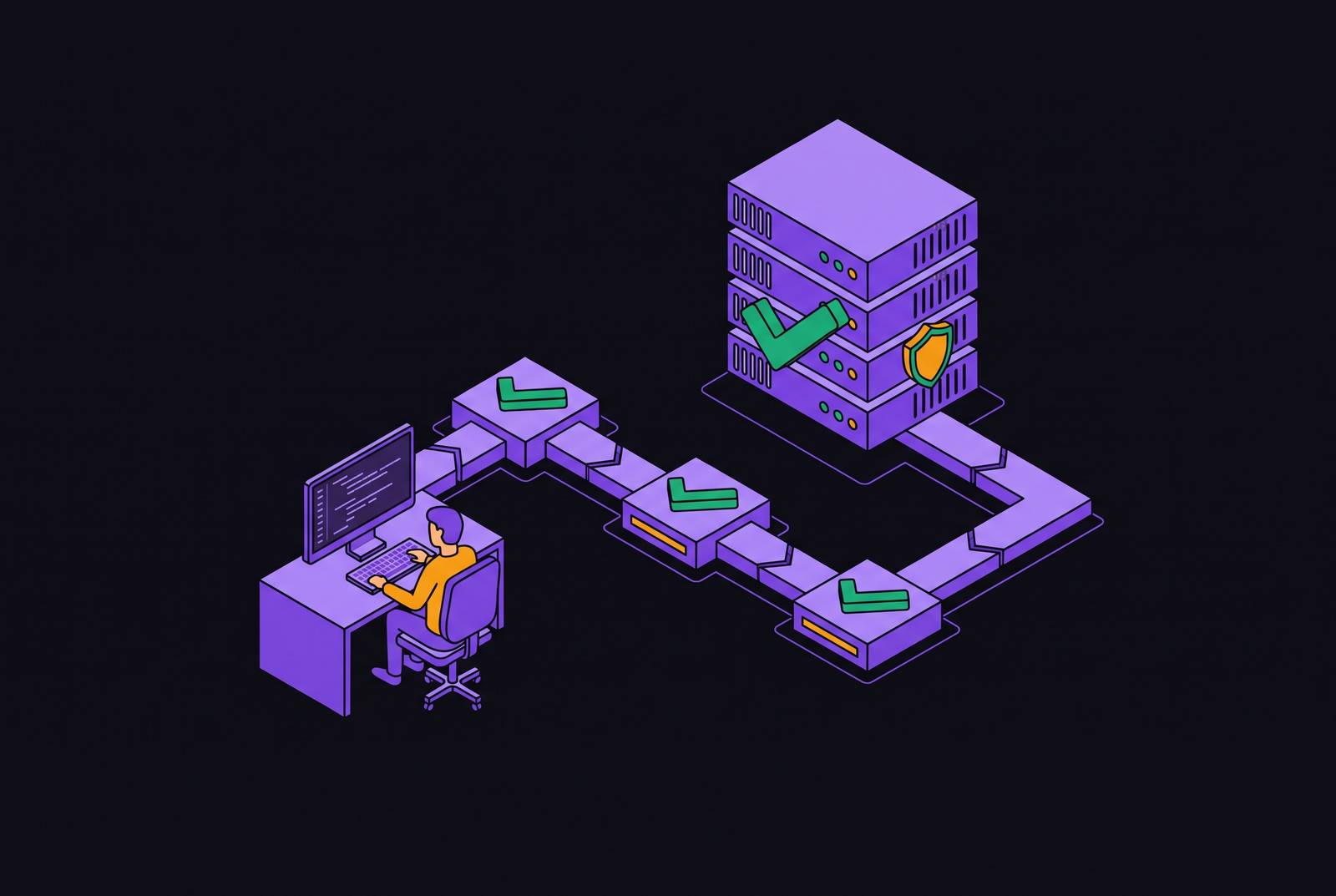
Sanctioned MCP server onboarding prevents shadow AI by making approved access easier than a workaround. The practical pattern is a private registry, a clear request-and-review process, gateway enforcement, and a role-aware employee catalog. Together, these turn developers into governance allies by giving them a usable path to the tools they need for work that a ban leaves unresolved.
Why most MCP pilots never reach the teams that need them
MCP has reached massive enterprise adoption by download count, yet only an estimated 11–14% of enterprise agentic pilots reach production. That gap is a business frustration before it is a security problem. Teams can prove that an agent works, then stall because identity management, auditability, and access controls are missing. The protocol is not the main obstacle here. The organization has no agreed way to approve a connection and make it fit for production.
Without a registry, an approval workflow, or an audit layer, developers face a choice between waiting and pasting a server directly into an IDE. The latter creates shadow MCP, with no reliable inventory of what is connected. Because MCP servers can aggregate credentials for multiple enterprise systems, a compromised server can also cascade across the systems it touches. Governance gaps therefore grow with adoption, rather than staying confined to individual experiments. The EU AI Act becoming enforceable for high-risk systems adds urgency, but the immediate problem is simpler. Teams need a governed path into production to turn useful pilots into work tools they can support.
Why friction in the onboarding path is the mechanism, not a side effect
Bans on all MCP servers make clear what the policy allows and block MCP connections where the bans are enforced. That is a real benefit. But a ban does not provide an approved way to accomplish the blocked task. Governed MCP access alone also leaves open what to do about employees who use personal chatbot accounts. The narrower, practical goal is to remove the incentive to bypass controls when employees need MCP capabilities for work.
A request with no named owner or feedback on timing makes a direct connection more attractive. A separate portal, another ticketing system, and manual credential sharing make that choice recur with each server. Shared tokens add a further cost because actions appear under the same identity, undermining attribution during incident response. One compromised system can then expose the token used across the organization.
Block made the approved route easier to take. It added Goose to its internal software center for auto-installation and auto-updates, bundled over 100 internal MCP servers by default, and implemented OAuth with identity provider integration. Employees went through an SSO flow they knew, with no need to manage credentials themselves. These changes enabled governed adoption across 12,000 employees in 15 job functions.
The registry as the boundary between sanctioned and unsanctioned
A private registry gives approval a precise meaning. It records which servers exist, who owns them, which teams may use them, and which tools each role may access. Anything outside that boundary is unsanctioned. This turns the discovery of shadow MCP into something the organization can act on, because there is an authoritative record against which to compare a connection.
That record must come before the controls that depend on it. A gateway needs to know which connections and tools are allowed, while role-based provisioning needs an approved relationship between servers, tools, and teams. Audit records also need that context to distinguish permitted activity from a policy breach. Without it, each layer is working from a different answer to the same question. Who approved this access, and for what purpose?
The registry is therefore more than a browsing page. Its entries list the servers people have found and set out the decisions that downstream systems must enforce. Without gateway enforcement, however, those decisions stay on paper and have no force as runtime limits. The two layers need each other to work. The registry supplies authority, and the gateway applies it when a user or agent calls a tool.
Designing the request-and-review workflow developers will actually use
To turn that boundary into a usable process, start with the job the developer needs to do. The request should describe the capability, name the proposed MCP servers and specific tools, and go to a named platform owner. That owner returns a yes or a no with a reason. Keep the loop visible from submission through decision. Clear ownership and feedback on response time prevent the request from becoming an indefinite wait that rewards bypassing it.
The review then examines the connection behind the request. Verify the publisher identity, resolve the exact artifact version, inspect the package and source, and enumerate the tools at runtime. Classify the permissions those tools require before isolating secrets, sandboxing execution, and constraining network access. These checks serve different purposes and should not collapse into a single approval checkbox. A known publisher does not, by itself, establish that the requested permissions fit the job.
Promote reviewed servers into a private registry or enforced allowlist rather than allowing unrestricted installation from a public catalog. Make reapproval part of the same workflow whenever tools, dependencies, endpoints, or artifacts change. The Postmark rug-pull attack demonstrates why that condition belongs in onboarding. The package behaved legitimately at installation, but a later version silently sent a hidden copy of every agent-sent email to an attacker-controlled domain. Approval must cover only the artifact that was reviewed, with each future version needing its own review.
What gateway enforcement makes possible that the registry alone cannot
A gateway enforces runtime limits on an approved capability so the developer does not have to do it manually. Per-agent tool allowlists permit only the tools named in the approved request. This is where approval becomes an operating rule. A developer can use the sanctioned connection without rebuilding access controls inside each MCP server.
Identity binding makes those limits attributable to a user or agent. The MCP authorization specification defines an OAuth 2.1 framework but makes authorization optional, so a gateway that enforces it closes a gap the protocol leaves open. Managing tokens in one place gives users or agents their own identities in place of shared credentials. Connecting an individual server may still require credentials such as a Client ID and Client Secret.
The same enforcement point can apply PII detection, prompt injection blocking, and data-handling policies centrally. Real-time audit logging records who called what, when, and with what result, while immediate revocation cuts access when credentials are compromised or an employee leaves.
How do employees find approved MCP servers without asking around?
An employee-facing catalog brings approved capabilities to people beyond the team that built them. Someone looking for the HubSpot MCP server engineering created should not need to locate its author or file a discovery ticket. “Ask around” leaves a sanctioned tool harder to find than a workaround, wasting the review and enforcement work already done.
Organize the catalog by function and filter it to each employee’s access. Descriptions should say what each server does and which tools it exposes, so employees can tell whether it fits their task before they connect. Onboarding to an approved server should take minutes, with centrally handled authentication and a familiar SSO prompt. Reusable workflows belong in the catalog too. An employee who builds a useful automation from approved tools should be able to package and share it, rather than leave it stranded in a personal configuration file.
Bloomberg’s Enterprise MCP for its Data Licence Plus service applies the same principle to third-party data integrations. Bloomberg hosts and manages the access layer, validates entitlements before returning data, and leaves clients in control of the connected agents and applications. The lesson extends beyond internal tooling. Discovery and entitlement checks need to work together if approved access is to feel like a usable service.
Why RBAC for MCP servers is a scoping decision, not a restriction
Role-based access control lets an organization approve a powerful server without exposing all its capabilities to everyone. A server-level yes or no is often too blunt. A team may need to read from a system without needing to change it, and that distinction should survive all the way to the tools an agent can call. Tool-level scoping lets a team keep that limit even when a server can both read and write.
Tying RBAC to an existing identity provider such as Entra, Okta, or Google maps access onto the organization’s groups. Marketing does not need Kubernetes management tools, and a role-aware gateway can enforce that boundary without requiring each developer to think about it. A finance-group portal can expose only read-only tools from an internal repository. The approved surface is then the explicitly granted tool set. That narrower grant limits the blast radius.
The GitHub MCP prompt injection succeeded because a personal access token allowed too much access, while the Asana cross-tenant exposure involved a flaw in the logic for tenant-isolation. These cases show why access scope and isolation deserve attention before exotic attack scenarios. RBAC gives governance teams a way to say yes to a capability because its reach has been deliberately bounded.
Approval is not a one-time gate — the continuous review loop
Once an installation is approved, it needs to be monitored to check whether it can still be trusted. The update risk demonstrated by Postmark calls for version pinning and a fresh review before an artifact changes. Tool lists, dependencies, and endpoints need the same treatment because they can change a server’s effective behavior. Updates that come automatically from a public registry skip that checkpoint. Pinning keeps the reviewed artifact in place while the next version is assessed.
Sandworm_Mode in February 2026 used npm typosquatting to impersonate packages including Claude Code and OpenClaw. Its payload injected rogue MCP servers into AI coding assistants including Claude Code, Cursor, and Windsurf, then used prompt injection to exfiltrate SSH keys, AWS credentials, and npm tokens. The attack entered through installation. A review process that checks only for changes to servers already approved misses that way in.
Registry presence also has a limited meaning. The official registry provides namespace verification, standardized metadata, and version records, but does not certify code security, honest tool descriptions, or unchanged behavior after an update. Gateway monitoring should flag anomalous tool calls for teams as they happen, rather than leave teams with a record first read after an incident.
How to sequence the rollout so governance scales with adoption, not after it
Start with the registry before opening the catalog. Define what sanctioned means, assign server owners, and establish the request-and-review process while the inventory is still small. Put the gateway in place before broad rollout so it enforces controls on newly approved servers from the start. Then populate the catalog with the most useful capabilities. Employees need an immediate reason to choose it over a direct connection.
For new internal servers, use templates that include default-deny write controls, audit logging, CI/CD pipelines, and secrets management. There are different ways to assemble the layers. Cloudflare combines its Cloudflare One and Cloudflare Developer platforms to govern employee MCP use, while MCP Manager offers a private registry that feeds gateway enforcement and role-based provisioning, making approved servers both discoverable and controllable.
Download counts and server counts show intent, while the governance measure is the fraction of active servers that are registry-enrolled, gateway-enforced, and under continuous review. EU AI Act obligations set the minimum requirements for this work. The competitive advantage is the ability to approve production use with confidence before unmanaged connections accumulate. Organizations that treat governance as infrastructure rather than overhead can move fast without moving blind.