Distributed Session Management for Multi-Agent OAuth Flows
Agents need two identities, per-call limits, and coherent revocation.
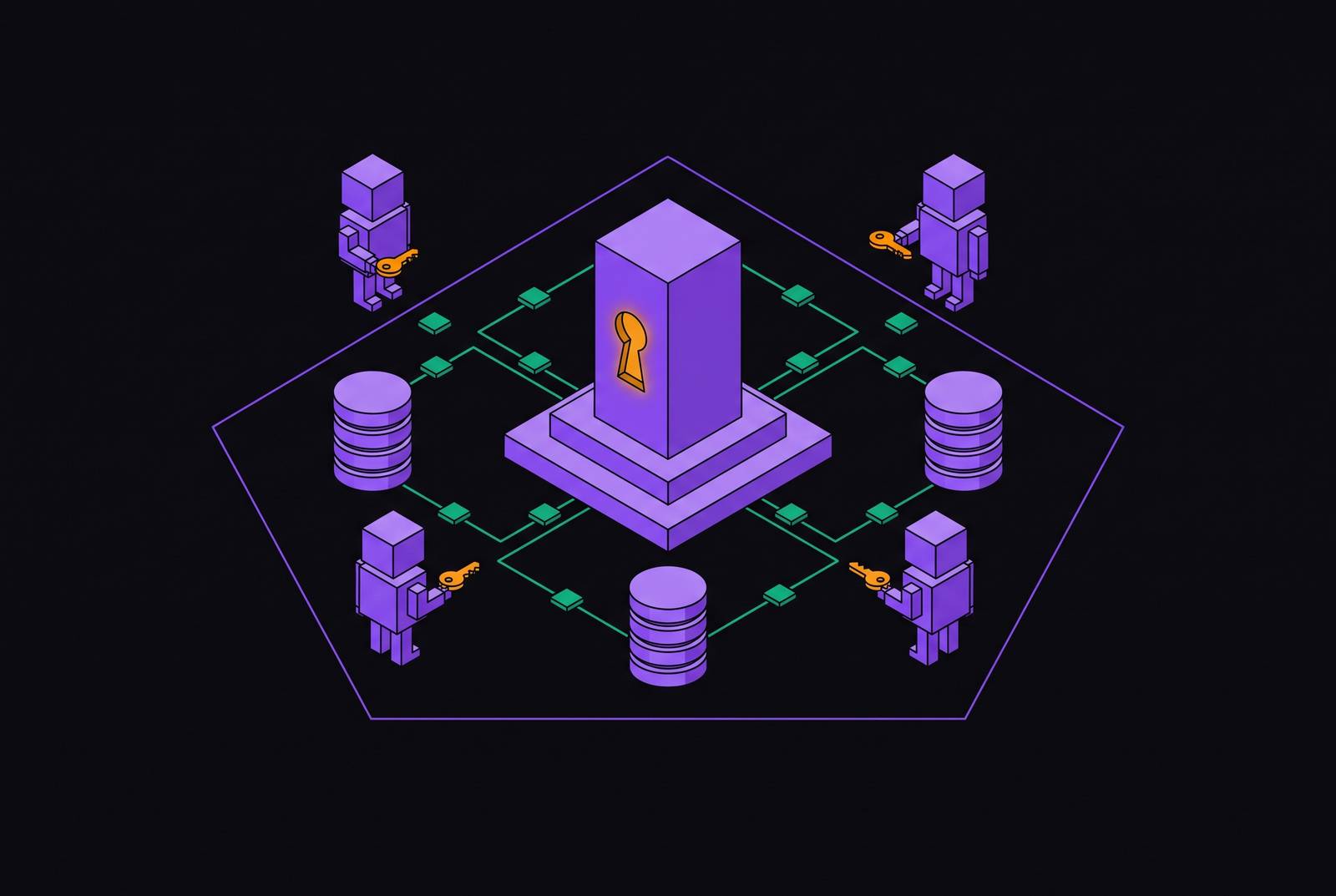
In multi-agent OAuth flows, a user’s permission to start a task is separate from the authority agents keep using afterward. Distributed session management closes that gap. It coordinates credentials, preserves delegated identity, limits each tool call, and stops authority coherently across running agents. These controls form an architecture for keeping autonomous work inside the bounds a person and an organization actually authorized.
Why OAuth's original design assumptions collapse under multi-agent workloads
The familiar OAuth flow starts with a person opening a browser, authenticating, and consenting to access. The application gets a short-lived access token as part of that interaction with the person. A task can continue for hours, days, or weeks after the user closes the browser, while access tokens expire and refresh tokens rotate. The initiating session no longer explains the authority still in use.
That separation creates several failures at once. Delegation can last without a person watching over it, and the user’s broad permissions can become the default authority for a narrow task. Orchestrators then spawn subagents that call tools and external APIs. Each hop makes attribution harder to establish. Without explicit limits, the system may leave undefined whether a subagent can acquire permissions its parent never had.
Parakhin’s Okta research shows how recursive delegation, high-frequency decisions, and parallel execution challenge what identity systems built for humans assume about timing. A revocation delay tolerable between human clicks becomes exposure during rapid automated calls. Identity also needs more than a user name. For an agent, provenance includes its codebase, model, and verified deployment artifact, which token claims alone cannot establish. The mismatch is architectural.
The two-identity model and why the intersection rule is non-negotiable
An agent’s effective authority must be the strict intersection of its own baseline permissions and the requesting user’s permissions, never their union. Both identities must permit the action. Giving an agent a broad identity of its own lets a user with restricted access get around their own limits. Giving it the user’s full access instead lets a prompt injection reach systems that have nothing to do with the task.
The two-identity model keeps those sources of authority separate. The project-level key identifies the agent application as a workload registered as an OAuth client. The user-level identity identifies the person on whose behalf it acts, authenticated through OpenID Connect and represented as the delegated subject. Neither identity is enough on its own. The runtime evaluates both within a bounded, short-lived delegated execution context containing the user, agent, scopes, audience, tenant, task ID, and expiry.
That context must be evaluated at every tool call. OpenID Connect establishes who the human is, while OAuth 2.1 governs the authorized tool access on that person’s behalf. Mixing up authentication and authorization encourages the use of tokens beyond what they were meant for. This is the confused deputy failure in practical terms, where an application is tricked into misusing authority. If the user cannot delete a database record, the agent acting for that user must fail too, regardless of its own broader capabilities.
Token lifecycle coordination across concurrent agent instances
Identity rules do not prevent concurrent refresh collisions. With single-use refresh token rotation, each refresh that succeeds gives out a replacement and makes the prior token invalid. Multiple agent instances sharing that credential can race to use it.
The engineering choice is where to absorb that coordination cost. Distributed locking gives one instance a lease on the refresh operation, at the cost of latency and contention. Credential sharding separates credentials by agent or task but expands the management surface and complicates complete revocation. Per-agent credential isolation gives each instance its own set derived from the user’s authorization, improving attribution while increasing storage and rotation overhead. In all cases, stored tokens need encryption and tenant isolation and must be kept out of logs.
The flow must also fit the action. Authorization Code supports interactive consent, while Client Credentials supports machine-to-machine calls without a human in the loop. Token Exchange under RFC 8693 lets an agent reduce scope by presenting the subject token, the agent’s actor token, the scope it wants, and the token type it requests. Valid tokens alone are not sufficient. The 2026 IETF OAuth WG discussion warns of delegation-chain splicing, where subject and actor tokens that are each valid but come from unrelated contexts produce a signed but false chain unless both are bound to the same authorization request.
Tenant isolation makes the consequences concrete. In the hypothetical fintech Slack triage scenario, a shared GitHub OAuth token without a tenant boundary sends agent actions to the wrong tenant’s repository. Channel-owned OAuth simplifies setup to one configuration entry per channel. It does not remove the isolation requirement. Credential ownership and destination configuration still have to agree about which tenant the action belongs to.
Delegated identity separation across agent hierarchies and trust domains
Each trust domain needs its own authorization server, and verification across domains needs federation that is already in place. Where tokens are opaque, intermediaries also need introspection to inspect the delegation path represented by the act claim hierarchy.
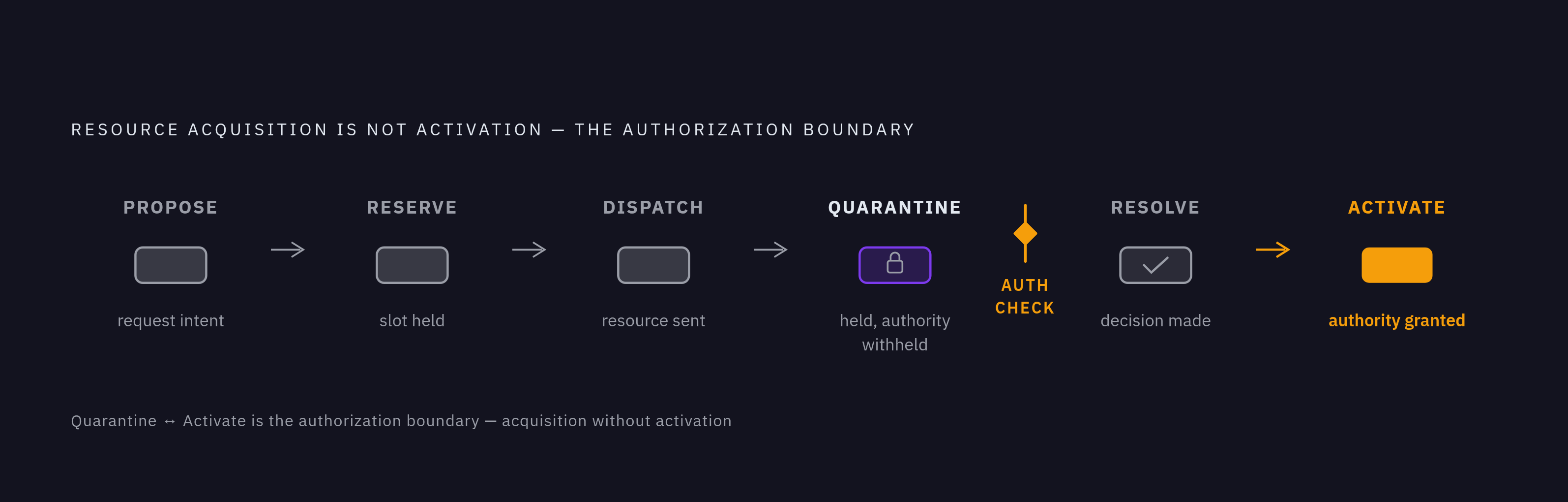
Zhu and Wang’s Runtime Authorization for Resources Acquired by AI Agents addresses another gap within delegation. Permission to acquire a resource does not automatically authorize using the authority it returns. A valid payment, provisioning call, and tool manifest can all coexist with an unauthorized resulting capability. Acquisition is not activation. Their design makes that distinction an explicit runtime boundary.
The lifecycle proceeds through propose, reserve, dispatch, quarantine, resolve, and activate. Quarantine records the resource that comes back without making its authority usable, and resolution uses authenticated provider evidence to find out what capabilities it has. Activation then needs a new authorization decision checked against the current acquisition graph. A downward-closed envelope keeps the resource’s capabilities within the bounds of the original authorization, and non-amplification is proved under the model’s assumptions. This applies to credentials, services, compute instances, and newly acquired agent principals.
These controls do not solve cross-domain federation. MCP’s use of OAuth 2.1, token exchange, and audience binding through RFC 8707 Resource Indicators still depends on agreements between authorization servers. Build attestation remains a separate requirement too. A complete delegation chain explains permission, but not whether the acting code, model, and deployment artifact have the required provenance.
Revocation coherence and why TTL-based expiry is structurally insufficient for agents
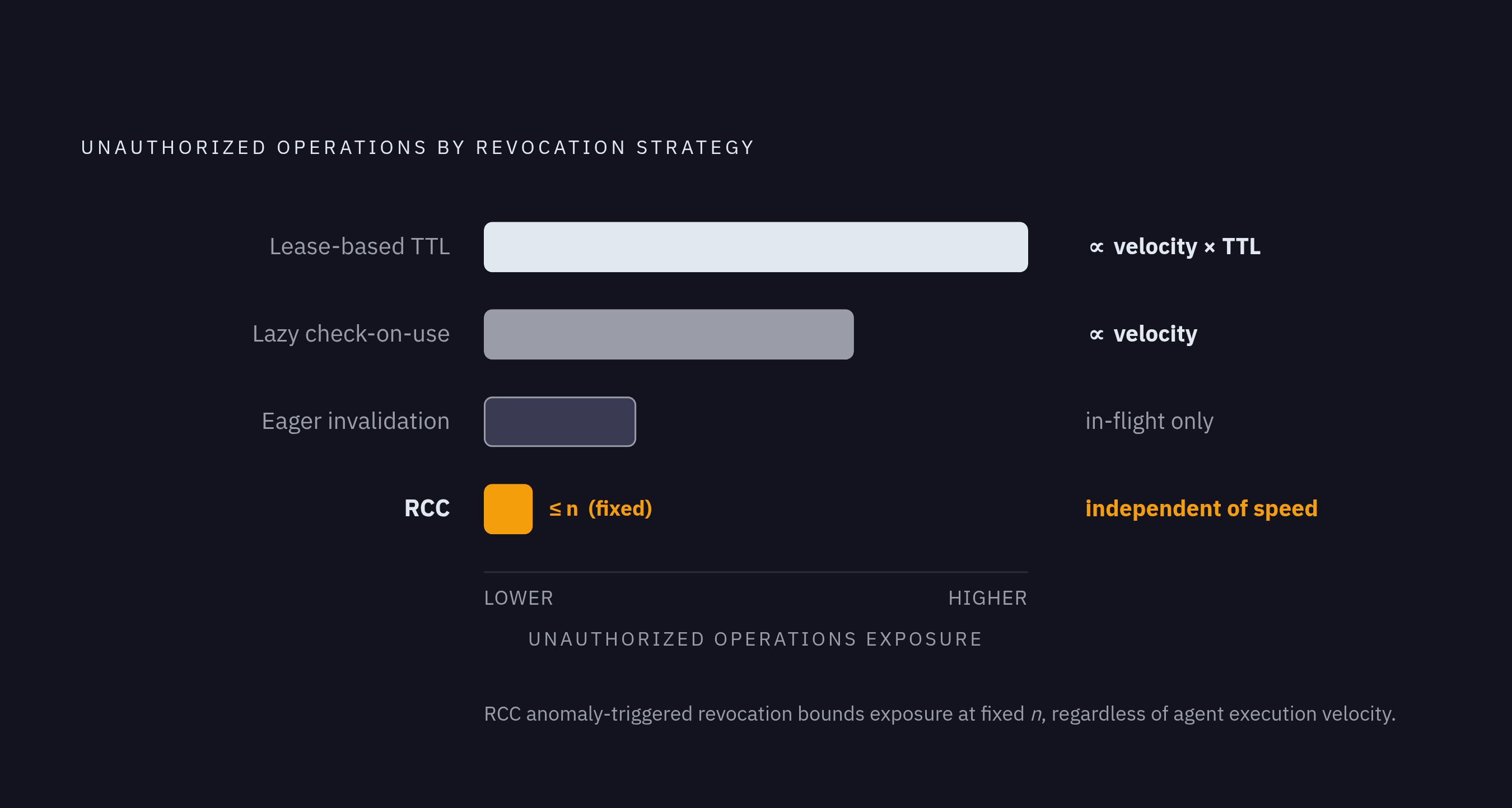
Even correctly delegated authority becomes unsafe when revocation leaves agents acting on stale permission. Parakhin’s The Bureaucracy of Speed formalizes this as velocity vulnerability, expressed as Vv = v · TTL. Unauthorized operations grow with both execution speed and the revocation window. A sixty-second window therefore has a different security consequence for a high-velocity agent than for a human operator.
The paper treats this as coherence. Its Capability Coherence System maps authorization transitions to cache-coherence transitions using MESI semantics. The useful intuition is straightforward. Distributed agents need rules for when their local view of permission may still be used, just as distributed caches need rules for when stored state remains valid.
Parakhin’s simulations compare eager invalidation, lease-based TTL, lazy check-on-use, and Release Consistency-directed Coherence, or RCC. Eager invalidation still leaves exposure from requests already dispatched, while lease-based TTL has the highest count of unauthorized operations among the strategies tested. Checking on use reduces exposure but still scales with velocity. RCC changes the bound itself. At a fixed execution-count bound n, the model bounds unauthorized operations at n independently of agent velocity, with anomaly-triggered revocation producing the greatest reduction.
In that architecture, an Authority Service enforces execution-count boundaries at synchronization points. Parakhin cites the Replit production-database deletion incident as a concrete example of the failure class. Token hygiene is a lower bar. The MCP Security Maturity Model’s Level 2 requirements include access-token lifetimes of no more than one hour, rotation on each refresh, and no session-token storage in plaintext files or environment variables. Those practices do not establish coherent revocation.
Scoped access enforcement and what "least privilege" actually requires at the tool-call level
Revocation sets when authority must stop, while scope enforcement sets what authority there should be in the first place. Teams often use broad tokens when the infrastructure needed for narrow, purpose-built credentials has yet to be built. The shortcut then becomes the production design. A compromised or mistaken agent can act beyond its task even while presenting a valid token.
Least privilege therefore needs to be enforced at each call. The user_id must pass through every intermediary, and the requested scope must be checked against the delegated execution context. Audience binding confines a token to its intended resource. The holder cannot simply narrow an issued OAuth token itself, so scope reduction requires an exchange for a narrower token before downstream use. Just-in-time issuance further reduces exposure by removing standing credentials from agents.
Tenant context needs equally explicit treatment. Downstream resource parameters must come from configuration. In the fintech scenario, message-payload parameter injection and stale in-memory mappings illustrate how wrong-tenant access can resemble a configuration bug. The distinction can disappear in production. Trigger, execution, authorization, tenant, and attribution identities all need explicit representation so that one is not silently substituted for another.
Aembit’s April 2026 GA launch introduced Blended Identity, an MCP Authorization Server, and an MCP Identity Gateway. Its just-in-time credential issuance, policy-based kill switch, and structured audit logs integrated with security monitoring systems were pre-existing platform capabilities. The distinction is useful. Identity components establish context, while issuance, enforcement, and audit controls determine how that context governs actual access, including access to personal and proprietary data exposed through MCP tools.
Revocation, incident response, and the attack vectors that distributed session management must close
Confused deputy attacks exploit authority that exceeds the user-agent intersection, while token passthrough sends upstream credentials directly into downstream systems. Tool poisoning targets the agent through malicious server responses. That last threat also needs supply-chain governance and server verification, because valid authorization does not make returned content trustworthy.
The August 2026 Grafana MCP incident shows the risk at the connector boundary. The server accepted any well-formed caller-generated session ID, allowing callers to list and run tools using its Grafana service account. The fix shipped in mcp-grafana 1.1.0. In the brief’s SSRF threat category, this incident illustrates how connector access can expose internal infrastructure under a server’s authority.
The September 2026 MCP Python SDK OAuth flaw exposed a different boundary. A malicious server could obtain a client’s OAuth client secret through the OAuth implementation. The SDK received a fix. This was credential theft at the implementation layer, showing why sound architecture does not excuse protocol defects. Plaintext HTTP endpoints add another route to interception of OAuth tokens, API keys, and session metadata.
An audit log inspected afterward cannot stop the action it records, whereas anomaly detection and synchronization-boundary enforcement can constrain the execution window. Registration governance belongs before that window opens. Rogue servers gain trust by entering the tool set, while community-hosted servers can disappear or introduce untested updates. A verified registry makes server identity and supply-chain accountability part of session management from the start.
What production-ready distributed session management requires as an enterprise governance layer
Centralized governance gives these controls a shared decision point rather than leaving each agent implementation to interpret policy. User identity, workload identity, and delegated context must lead to the same access decision across credential issuance, tool execution, revocation, and audit. Otherwise, what one component restricts can become permission that another component inherits. The control layer needs both enforcement and evidence.
At every tool call, an MCP gateway such as MCP Manager is one option for centralizing the intersection rule through role-based access policies governing what agents can reach through MCP servers, making “what AI can do” an explicit organizational decision. Its verified server registry and real-time observability connect that enforcement to accountable server identities and visible access.
A governed route also gives engineers an alternative to shadow adoption. Blocking servers without providing such a route pushes use outside the controls intended to protect it. Singapore’s IMDA Model AI Governance Framework for Agentic AI, published January 2026, recognizes multi-agent risks including cascading errors and miscoordination. Governance is catching up with the execution model.
The operational obligation is already clear. GDPR’s accountability principle, CCPA/CPRA’s data access requirements, and emerging agentic governance frameworks converge on the need to demonstrate what agents accessed, under whose authority, and on whose behalf. Authentication logs alone cannot answer those questions. Real-time visibility into what agents touch is a basic operational right, and the authorization architecture must make it possible.