Contractual Controls for SaaS Integrations Called by AI Agents
SaaS contracts must shift governance controls to vendors as AI agents act without human review.
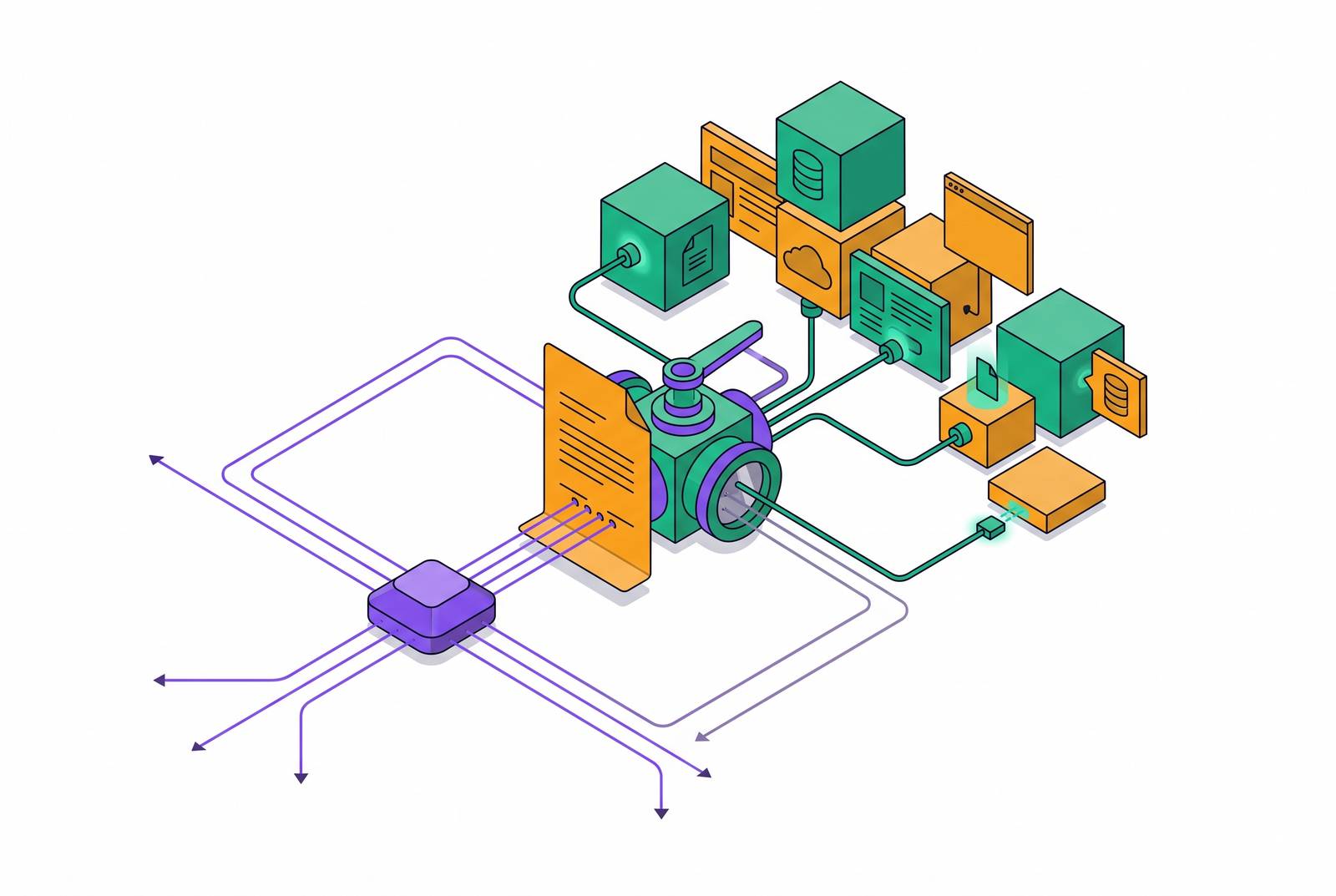
SaaS contracts need different controls when AI agents call integrations and act on company data. Terms written for human-supervised software leave the customer responsible for actions it may never see before they happen. Closing that gap means turning internal governance rules into explicit vendor obligations.
Why SaaS contracts carry structural gaps the moment an AI agent acts in place of a human
The standard SaaS bargain separates the platform from its use. The provider supplies software, while the customer takes responsibility for actions taken with it. That allocation depends on a person reviewing output and deciding what happens next. An agent removes that pause from the process. It can read data, call tools, update records, and trigger downstream workflows before anyone sees the first output.
Speed breaks the assumption behind the agreement. Staff cannot review every action at machine speed, so the oversight assigned to the customer may never happen. This is a structural mismatch. The vendor’s infrastructure becomes part of the company’s control environment because identifying, constraining, or stopping an action depends on it. The contract therefore has a new job, which is to convert internal governance controls into duties the vendor must perform.
How SaaS agreements fail across the four dimensions agents actually stress
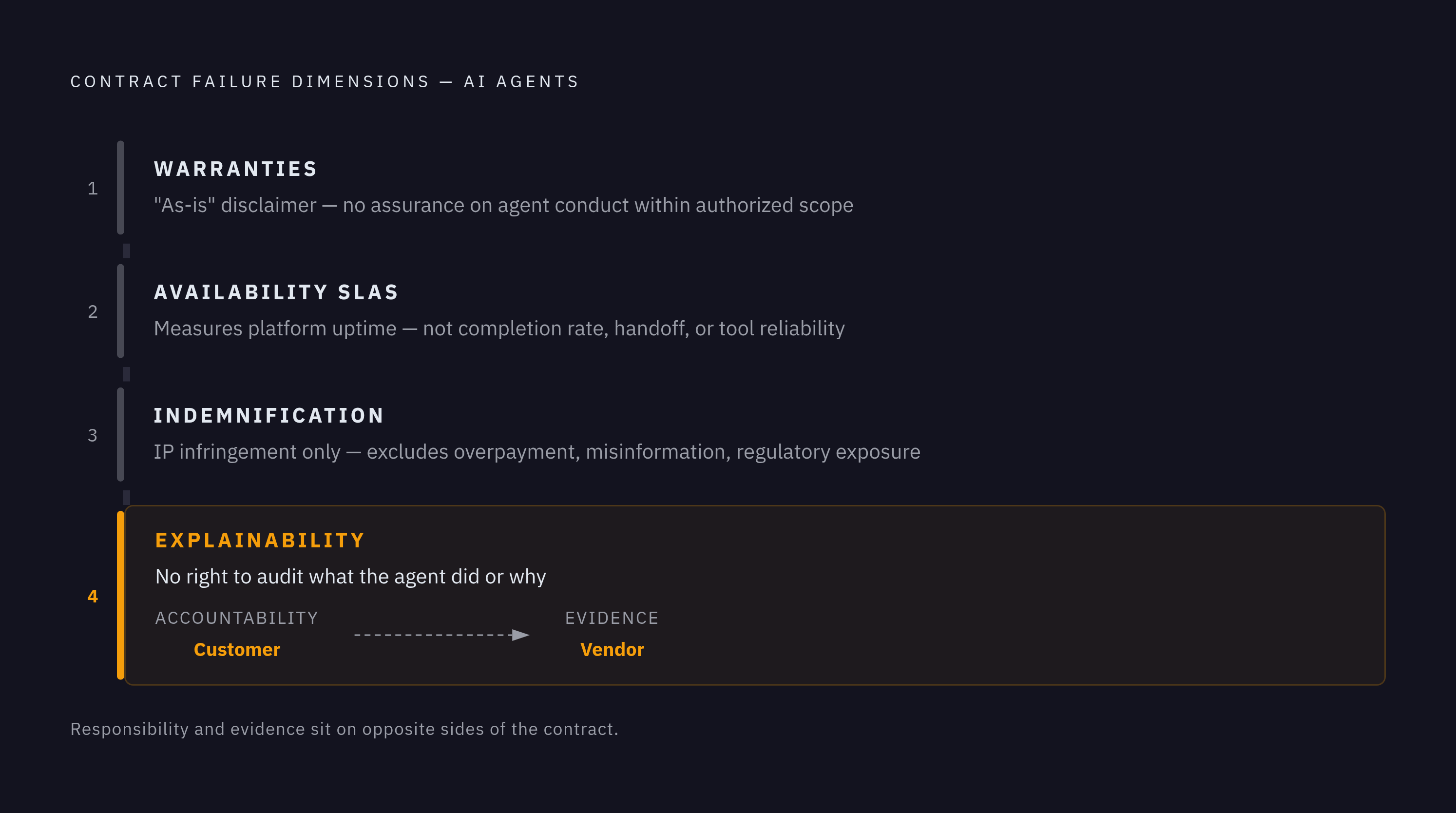
Warranties are the first point of failure. Many SaaS AI contracts begin with an “as-is, with all faults” disclaimer. Providers argue that probabilistic outputs make even a conformance-with-documentation warranty commercially unworkable. That leaves the buyer without a clear assurance about conduct within the agent’s authorized scope.
Availability SLAs leave a different blind spot. They measure whether the platform is reachable, while an agent can remain available and make costly errors at scale. Completion, human handoff, rework, and tool-use reliability describe the work more directly. A conventional uptime commitment does not establish accountability for any of those results.
Indemnification usually stops at third-party IP infringement. It does not address a vendor overpaid by an agent, a customer misinformed, or autonomous conduct that draws regulatory action. Under most agreements as written, the customer absorbs those consequences. The liability allocation has not caught up with the actions the software can take.
Explainability rights expose the final gap in this chain. Legacy agreements give the customer no contractual right to understand what the agent did or why. Yet the customer must justify that behavior to regulators, auditors, and courts. Responsibility rests with one party while the evidence needed to discharge it may sit with another.
What the regulatory environment now requires deployers to prove — and why the contract is where that proof originates
EU AI Act Article 26 makes log control a practical legal issue for deployers of high-risk systems. It requires retention of automatically generated logs, but only “to the extent those logs are under their control”. When the vendor hosts the agent, the provider often holds those logs. Access cannot be taken for granted. Under the amending regulation, application dates for different categories of high-risk Annex systems are staggered by roughly a year, but vendor support still needs to be secured before production.
The EU Product Liability Directive addresses a related attempt to shift responsibility through contract language. It prohibits contractual exclusion of this liability against end users, so EU-facing master service agreements need a mandatory law carve-out. California Civil Code §1714.46, effective January 1, 2026, also limits the ability to distance a company from its software. It bars the autonomous-action defense for defendants who developed, modified, or used the AI system. A deployer need not have written code to fall within that reach.
These requirements put what the deployer does under scrutiny, even though the vendor still holds key controls. Contractual access to evidence and platform support therefore becomes central to demonstrating compliance. Five Eyes joint guidance issued May 1, 2026 adds pressure to build governance into the platform. Where a control depends on a platform property, an internal policy cannot deliver it without vendor support.
British Columbia’s tribunal set the common-law baseline in Air Canada / Moffatt on February 14, 2024. It held the company liable for misleading information from its website chatbot and rejected the argument that the chatbot was a separate legal entity responsible for its actions. The software was not a separate legal actor. Delegating the interaction did not delegate the company’s accountability.
What ungoverned agent deployments actually produce — three cases where the gap became visible
The Grok Build CLI case in July 2026 exposed an unauthorized data flow. Wire-level analysis found that repository contents, including secrets files, were sent out whatever the opt-out settings were. The organization had no log entry, policy decision point, or stop authority for that flow. None had been written into the agreement. The gap concerned both what left the enterprise and its ability to see or interrupt the transfer.
Google launched Workspace Intelligence in April 2026 with Gemini connected to Gmail, Drive, Chat, and Calendar by default. Admin controls were included at launch on April 22, 2026. This illustrates an approved application gaining agent capabilities mid-term, changing its risk profile without necessarily triggering another contractual review.
A third failure appears when vendors run agents under one shared service account. The fleet has access, but each agent has no identity of its own. A customer policy that calls for per-agent control cannot give agents credentials that the platform does not issue.
The clause architecture that converts governance intent into vendor obligation
The practical response begins with a delegation-of-authority schedule, called “Agent Scope” or “Automation Authority”. It should define permitted actions, accessible systems, operating triggers, and conditions requiring human review before execution. Authority must be a written fact. That scope gives both parties a basis for allocating liability and anchors the obligations that follow.
Outcome-based SLAs should then measure how well the agent works within that scope. Commitments should cover completion rate, human-handoff rate, rework rate, and tool-use reliability rate, replacing or supplementing availability measures. These measures connect service quality to autonomous work. They also give the vendor incentives beyond keeping the platform reachable.
Stop authority needs its own measurable commitment. The agreement should specify time-to-halt in seconds, testing rights, pre-production stop-test results, and consequences for missing the SLA. The halt command must propagate through the vendor’s infrastructure at a speed suited to autonomous action. After launch, the right to test must work in practice. An untested production stop button does not establish that the stop mechanism works.
Per-agent cryptographic identity makes those controls attributable. The platform should issue unique credentials for each agent and tag every log entry with the relevant identity. For MCP governance, each server and agent acting through it should have a registry entry and a distinct identity. Otherwise, the enterprise cannot account for the actors using its tools.
Default-deny enforcement should apply before an action executes. The agreement should require the vendor’s policy decision point to reject actions outside the authorized scope. This is the contractual counterpart of an MCP gateway enforcing access rules before data is touched.
Action-level logging should make the resulting decisions visible. Each entry should include agent identity, timestamp, tool called, user or workflow context, policy decision, and outcome. Retention should meet Article 26’s six-month minimum where applicable, with timely export through a live API. A batch report supports reconstruction, while live access also supports oversight as activity unfolds.
A model training prohibition should restrict another use of company data. The provider should not train its models on that data without affirmative consent. Access for performing a task is not consent for training.
Exit and transition rights complete the architecture. At expiration or termination, the company should receive agent configurations, prompts and system instructions, orchestration logic, custom code, evaluation sets, documentation, and runbooks. Those rights belong in the agreement at signing. Once the integrator is embedded in operations, recovering them through renegotiation becomes slower and the buyer has less leverage.
Where vendors will push back — and how to negotiate the strongest objections
Providers cannot reasonably promise that probabilistic software will get the result right every time. Buyers should seek a warranty that the agent stays materially within its defined scope when used within the specified parameters. Explicit exclusions can cover customer misconfiguration and third-party system failures. Business process outsourcing agreements take the same approach, with warranties that cover how the service is carried out while leaving room for uncertain outcomes.
Pricing needs just as much care because better performance measures alone do not make bills easy to predict. Outcome-based and consumption-based models need agreed definitions, measurement methods, reporting cadences, and reconciliation procedures. A handful of poorly governed workflows can consume credit allocations far faster than human workflows. Buyers should seek spending caps, committed-use discounts, or advance-purchase credits and, at a minimum, the right to audit consumption reporting.
Providers and integrators will also resist broad guarantees of business outcomes or downstream legal compliance. The negotiating response should define assumptions, dependencies, authority boundaries, monitoring duties, relief events, and responsibility after launch. Control has to match the promised obligation. If a provider then resists a commitment with clear limits, that tells the buyer either that the platform cannot support it or that the provider is taking a negotiating position.
AI-generated work product presents a separate, unresolved ownership problem. Standard assignment clauses assume human authorship and may not map cleanly onto agent outputs. Work-product provisions should expressly cover those outputs while defining ownership of configurations, fine-tuned model weights, and evaluation sets separately.
How to sequence the governance work so the contract obligations are negotiable — and enforceable — before the agent goes live
The work should begin in procurement, while the vendor still has an incentive to agree. If the company waits until production, it must negotiate with an integrator already built into its operations and face real costs to switch. Renewal offers a second opportunity for governance review. Regulatory phase-in dates do not justify postponing the platform commitments needed before an agent acts on company data.
Before signing, the company should check what is inside the system. The G7/CISA AI SBOM minimum elements, published May 12, 2026, provide a structured basis for asking about models, datasets, infrastructure, and security properties. A vendor’s ability to answer signals maturity. If it cannot answer, that points to risk and helps show which obligations need more work in negotiations.
The adoption path should then determine the contract structure. DIY procurement gives the company more control but requires internal capability, while an outsourced function relies more heavily on the provider’s commitments to deliver an outcome. Third-party integration is the most complex arrangement because more than one party has a stake in IP, liability, and exit rights. The agreement must fit the operating model. With the wrong model, the parties share responsibility in ways their controls cannot support.
Before agents proliferate, teams should centralize MCP access policy through a governed path with registry entries, default-deny enforcement, per-agent identity, and real-time logging. Explainability requires both that infrastructure and contractual access to vendor logs and audit trails. MCP Manager is one option for centralizing visibility into AI data access, but the agreement must first guarantee the deployer’s right to that visibility.
Governed adoption is faster adoption because controls remove the reason to hesitate. A usable path to approved tools reduces ungoverned access more effectively than an effort to block adoption. When internal guardrails and vendor obligations support each other, teams can move toward production without leaving authority, evidence, or stop control unresolved. The guardrails are what let them say yes.