Identity-Aware Data Mapping for AI-Accessible Datastores
AI agents need distinct identities to enforce data access limits that match their purpose.
Identity-aware data mapping defines what each AI agent may reach by deliberate policy. It links sensitive data to identities that can be held to account, then applies those limits when they access the data. A data inventory cannot govern an agent unless its findings shape what that agent can call, read, and change.
Why AI agents break the access control assumptions that enterprise data governance was built on
Traditional enterprise governance separated two questions. Identity controls decided who could reach a system, while data security tracked what lived inside it. That split worked while humans made discrete requests that could be reviewed. AI agents break the assumption behind it because one request can lead to a chain of tool calls, generated outputs, and writes to live systems. When no human checks the steps as they happen, a review after the event is too late to control the action.
Agents work faster than people, and their behavior can change at runtime, so static policies and yes-or-no rules built for predictable users cannot cover every path they take. Early agentic deployments often go wrong in ways that are hard to spot, with unintended data exposure, policy drift, and actions that go beyond the intended task more common than dramatic attacks. Access broader than its purpose is enough for an agent to cross a boundary.
Service accounts make that mismatch worse. Oracle's Deep Data Security documentation says excessive agency can come from highly privileged service accounts that agents and applications use to serve a wide range of users. Their broad reach amplifies prompt injection and inadvertent errors, increasing the risk of large-scale data exfiltration and unauthorized transactions. The agent inherits permission to do things that its own task never required. Most organizations compound this problem by relying on shared API keys or other credential sharing rather than treating agents as independent identities.
Application-layer controls cannot reliably close that gap on their own. Agents construct SQL dynamically, making it impractical to review or test every query for safety before execution. RAG workflows that use semantic search over vector embeddings present similar difficulties. Permission to enter a system therefore says too little about what an agent should be allowed to retrieve or change inside it. The missing link is between the agent's specific purpose and the data its credentials make reachable.
What identity-aware data mapping is and how it differs from conventional data security posture management
Identity-aware data mapping continuously discovers and classifies sensitive data, then binds each asset to the human, machine, and AI agent identities that have a path to it. The resulting catalogue of sensitive records shows which identities can reach those records, the entitlements behind that access, and the risk attached to it. That link lets an organization tell which access it chose and which access an agent inherited. Classification supplies the meaning of the data, while correlation connects that meaning to an accountable identity.
In practice, automated scanning finds sensitive assets across cloud and on-premises datastores and classifies them by type, sensitivity, and regulatory exposure. Cyera continuously discovers, classifies, and monitors sensitive data, while labels and exposure context flow via API into Delinea. Each identity is then automatically correlated with the data it can access, creating a risk picture that changes with the environment.
Conventional Data Security Posture Management, or DSPM, finds sensitive objects and shows who can reach them, but knowing this does not automatically control what an agent does next. A correctly classified dataset can still leak through an agent allowed to call downstream tools with broader access than the source intended. Classification and access visibility alone leave policy too far upstream from the moment data moves.
AI Security Posture Management, or AI-SPM, fills another part of the picture by inventorying models and agents and showing what they can reach. Where AI-SPM identifies an agent's path to a database, DSPM identifies the sensitive records inside it. Identity-aware mapping joins those views to keep data linked to entitlements as they change. Making every subsequent action safe requires the map to reach the layer where agents call tools.
How the MCP layer became the dominant but ungoverned wiring between agents and datastores
Model Context Protocol has become the main wiring layer that connects AI agents to enterprise datastores. Its authorization gap now sits at the heart of governance and carries more weight than a small protocol detail. MCP shipped without a defined role-based access control model, required authentication, or a specified way to bind a session to a verifiable enterprise identity. A working connection could therefore exist without a clear answer to who was using it or what that identity should be allowed to do.
Security researchers catalogued nearly 7,000 internet-exposed MCP servers by early 2026, with roughly half operating without any authentication controls. The July 28, 2026 MCP specification addressed the gap through a stateless protocol core, authorization hardening, and closer alignment with OAuth and OpenID Connect. It finalized on that date after being a release candidate since May 21, 2026. Those changes improve the protocol foundation, but they do not retroactively govern servers already deployed without them. An MCP server missing from the registry remains an access path the organization cannot account for.
A gateway supplies the control point that the connection alone lacks. Before a tool call reaches a datastore, it verifies the agent's identity against a registry and applies the entitlements bound during data mapping. It also produces a real-time audit record of what the agent touched. This turns the map from background knowledge into a decision at the point of access. A request must carry an accountable identity.
A ban on MCP servers still leaves that need unmet. It pushes adoption underground, where the same connections become harder to govern. A governed path gives teams access to the tools they want within defined limits and reduces shadow AI more effectively than a blanket ban. However, the gateway can only apply those limits reliably if the identity behind each request is distinct and verifiable.
Why treating every AI agent as a first-class identity is the prerequisite for any mapping to hold
A data map needs something stable to bind to. Shared credentials cannot show which agent is accountable, and a broad service account cannot define what each agent should be allowed to do. When several agents use the same identity, one pool of privileges hides what each agent is meant to do. Registering every agent as a first-class identity preserves that distinction. It makes access a decision about a particular agent rather than a side effect of the credentials available to it.
Microsoft Entra Agent ID gives each agent a registered identity and a human sponsor who is responsible for it throughout its lifecycle. That ownership matters after the project that created the agent ends, when an orphaned agent's entitlements could otherwise drift. The registry establishes who is responsible, while the data map establishes what the identity can reach. Neither is sufficient alone. A named agent without a defined scope remains overexposed, while a carefully scoped entitlement attached to an unverifiable identity cannot reliably constrain access.
External governance frameworks reinforce the same principle. Singapore IMDA's Model AI Governance Framework for Agentic AI states that as autonomy grows, “identity management has to be extended to agents as well to track individual agent behaviour and establish who holds accountability for each agent.” The EU AI Act's rules for high-risk AI systems take effect in December 2027 for standalone Annex III systems or August 2028 for Annex I product-embedded systems. They effectively demand proper orchestration and accountability for systems making or supporting consequential decisions affecting individuals' rights, safety, or access to services.
Operational concerns remain central alongside regulatory requirements. Role-based access control for agents makes what an agent can do an intentional organizational choice tied to its registered identity. But assigning a role does not settle every question about the records or fields it may receive. The registry and the map must therefore carry identity into more granular controls. Those controls have to act when the query runs.
How attribute-based and row- and column-level controls enforce the map at query time, where RBAC alone cannot reach
Static role-based access control can decide whether an agent reaches a database, but it cannot by itself filter the answer to every query the agent constructs. That distinction matters when the query is generated at runtime. A permitted connection is not permission to receive every record behind it. Attribute-based access control, or ABAC, uses the agent's identity and attributes to decide what it can access after it connects. The boundary then follows the request into the data layer.
Row-level security returns only the records the agent is authorized to see, evaluated at query time. Column-level masking narrows the result further by redacting sensitive fields even within permitted queries. A fraud detection agent with database access can see transaction amounts without seeing payment card numbers because the governance layer filters the return at query time. This preserves useful access without exposing every field. It also holds regardless of how the SQL was constructed.
Oracle Deep Data Security in Oracle AI Database 26ai implements this pattern through transparent and secure identity propagation. End-user and agent identities, roles, and attributes can be relayed to the database at runtime. The database uses that context to enforce policies controlling what agents can do under which conditions, and it generates audit records capturing agent activity. The data layer enforces the rules, so enforcement does not rely on application code alone.
The gateway governs what the agent can call, while database-layer controls govern what the database returns. Even when an agent is correctly authenticated, it can be denied records or fields that its entitlement does not cover. With these controls working together, less depends on any one of them working perfectly. They also establish where the data map must ultimately lead, from a classified asset and registered identity to a constrained result.
What a complete implementation looks like across discovery, classification, registry, enforcement, and real-time observability
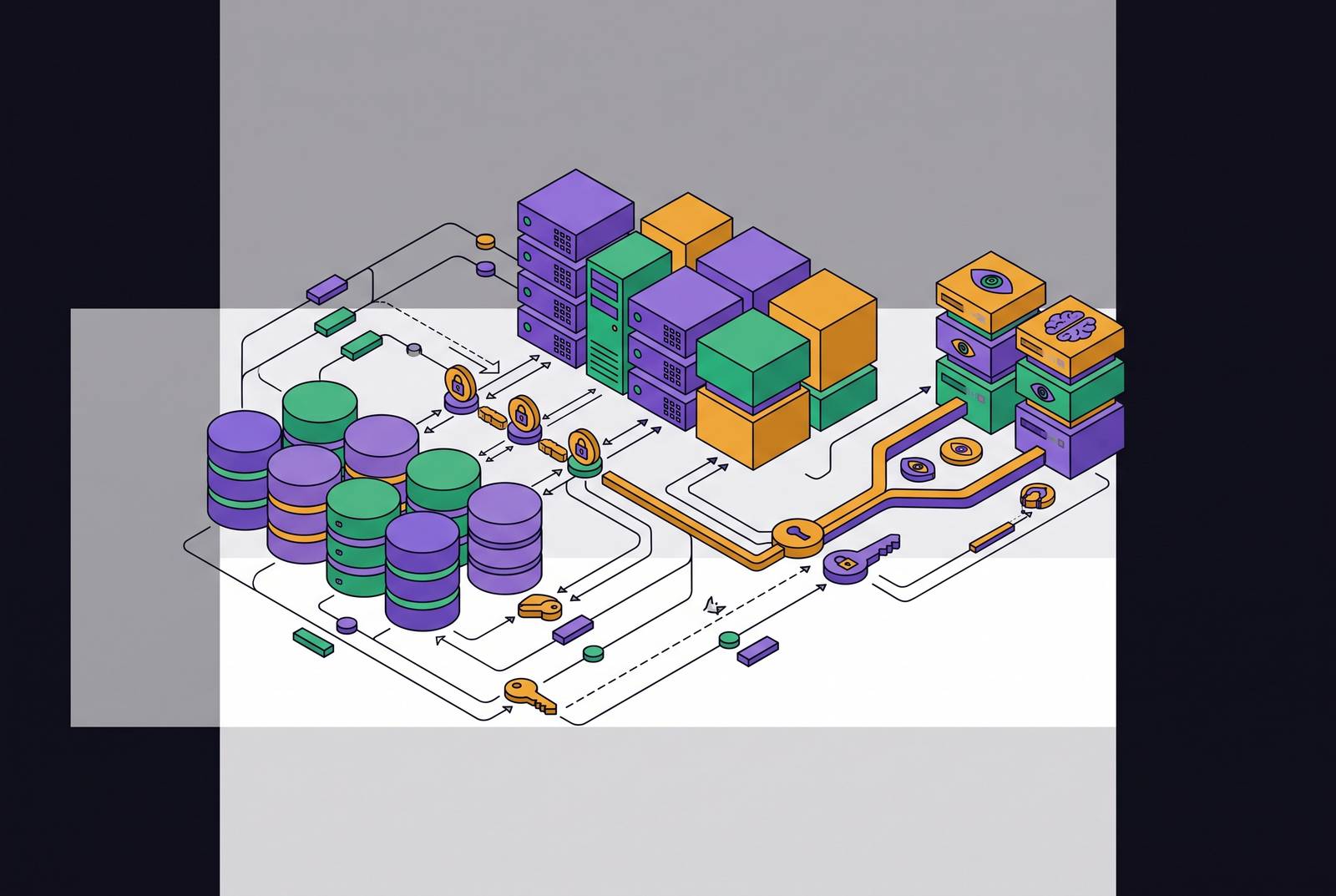
A complete implementation needs these capabilities to work together in one architecture, beyond buying each one on its own. Continuous discovery keeps track of sensitive data across cloud and on-premises datastores as it changes. Classification must refresh as data moves and new datastores appear, because stale labels weaken every decision built on them. The identity registry then binds those findings to agents with human sponsors and defined access scopes. Changes in data exposure must remain connected to the identities affected by them.
That connection also gives risk scoring a useful basis. An entitlement count says how much access an identity has, but sensitivity shows what that access could expose. When classification labels and exposure context feed into the identity layer, security teams can first close the gaps that could cause the most harm. Without that context, a queue of privileged accounts does little to help teams decide which problem matters most. The map makes that distinction possible before a tool call is permitted.
At the MCP or API layer, every agent tool call passes through a gateway that verifies its registered identity and permits or blocks access under the mapped policy. MCP Manager, Usercentrics' centralized governance layer for AI data access, can fill this role with registry and access controls that link agent identities to the datastores and operations they are allowed to use. Identity propagation then carries the agent's context through to the database. Row-level security and column-level masking use the same entitlement to control which records and fields come back.
Real-time observability completes the architecture by recording what each agent accessed, when, and under which policy condition. Those records give regulators and internal governance teams evidence that the rules set by the entitlements are being enforced. An audit log examined only after an incident explains the failure but cannot serve as the safety net during access. Organizations that build this control layer before they deploy agents at scale can ship agentic AI faster than teams that plan to secure it later. Governance is the accelerant because it gives every new tool call a boundary the organization chose on purpose.
Sources
- The AI Agent Governance Gap: What CISOs Need Now
- Identiverse 2026 Recap: Identity Security For Agentic AI Dominates
- Agentic MCP Security Best Practices Guide
- Model Context Protocol (MCP) Security
- From Tool Connection to Execution Control: Benchmarking Security Invariants in MCP-Style Agent Runtimes
- Governance Gaps in Agent Interoperability Protocols: What MCP, A2A, and ACP Cannot Express
- Agentic Identity and Access Management
- Who Governs the Machine? A Machine Identity Governance Taxonomy (MIGT) for AI Systems Operating Across Enterprise and Geopolitical Boundaries